When Dreams Pause

Golden dreams shatter in slow motion allowing for new ones to form. Twenty years have passed since Yitzchok and Rivka married, and the longed-for child has not yet arrived. They don’t despair and increase their prayers. Thousands of years later, brave women share with us their tumultuous experience of waiting, pain, faith, and prayers. “May He who answered Yitzchak and Rivkah, answer us too!”
Natural Expectation
You get married and wait for what comes next, but it’s delayed in coming. Tell us about it.
Menucha A.: Throughout my childhood years, everything went easily. I was a Chassidishe girl, successful socially and academically. We were well off. Shidduchim also went relatively easily. I married a Chassidishe bachur and knew clearly that my home would be blessed with children, G-d willing. Time passes, a year and another year. And I begin to realize that… uh oh. Something is stuck here.
Miriam Bitton: My shidduchim period was longer than usual. When I married, thank G-d, the expectation of pregnancy and birth was natural. Time passes, and it doesn’t happen. We realized that something is happening in our lives and we needed to understand what’s going on. We started looking for an answer to the question.
Leah K.: When I married, three sweet children were born one after another. About a year after my third daughter’s birth, my younger brother passed away after a long and difficult illness. He was my closest brother. We had a very deep connection. I felt I had lost part of myself, and the longing for comfort was immense. I had a strong desire to have a child who would be named after him, and I thought that as a natural continuation of previous births, another pregnancy and fourth birth would come. But it didn’t happen.
The Struggle
Menucha talks about that feeling of yearning: I suddenly feel there’s something I want. Not just want, want very much – and I can’t reach it. This was new to me, I always achieved everything I wanted. For me, it manifested in pregnancies that ended prematurely. Excitement from a pregnancy that arrived, expectation and fall. Another greater expectation and fall. The third time, the pregnancy progressed further than before, and then shattered again. I felt I had reached a breaking point. I asked Hashem: ‘What? What do you want from me?’ I cried a lot. I felt pain. Disappointment. Frustration.
My husband, in contrast, was more relaxed, He would say, ‘When Hashem wants, He will give us.’ On one hand, it frustrated me that he wasn’t as tense as I was, and on the other hand, it helped me that there was someone calm in this story who could strengthen me. I was always a Chassidishe girl. And I started asking myself ‘What am I doing with everything I learned about faith and trust in Hashem?’
Miriam: On the advice of mashpiim, after a year from the wedding, we went on shlichus to New Zealand. This shlichus is seasonal – after a period of activity, we travel to Eretz Yisrael and then return to shlichus again. Every time we left for Eretz Yisrael, I told my husband we weren’t returning to the shlichus without a pregnancy. I somehow felt that Hashem ‘owed’ me this.
It wasn’t just passive expectation. We rushed around trying to do something. Initially, we distanced ourselves from the frightening word ‘treatments’ and tried to act through alternative methods like acupuncture and homeopathy. But later, when we saw it wasn’t helping us, we began to realize that if we want to reach the goal, we need to go all the way, and we started conventional treatments. I discovered that this world is full of ‘ego.’ The attitude of most doctors, at least those I encountered, was arrogant and humiliating, as if they were the owners of the children that would or wouldn’t be. I also saw that among the doctors themselves there was great competitiveness. The process is already difficult and unpleasant; to go through it with a disparaging attitude on their part? I felt it was beyond my capacity. I told my husband I wasn’t willing anymore and let’s do a ‘reset.’
Leah K.: Time passed, the family began to recover from mourning. We were blessed, boruch Hashem, with good news from some of my brothers and sisters. Amazingly, after my brother’s passing, each of my brothers and sisters had a son, and they all named them after my brother Meir z”l. I was so happy to see the bent backs straightening with each new baby added to the family, another continuation of the life that was cut short. But I still wanted my own Ner Meir. I know, and several women said to me ‘Why is she fighting so hard? She should be happy that she has children at home. There are those who don’t have any at all.’ But that didn’t comfort me. Of course I was grateful to Hashem for my wonderful children but the desire for comfort was stronger than me.
I decided to dedicate myself to the ‘Shifra and Puah’ organization. I felt this would bring me the bracha. Although I usually find it difficult to wake up early, I would rise early, prepare a good breakfast, add some small treats for the new mother, and bless her with love in a note I tucked into the package. Once, when the volunteer came to collect the breakfast, she saw me looking downcast when I usually greeted her with cheerfully. She asked me what happened. Instead of answering, I burst into tears. “Hashem sends blessings to so many women,” I cried, “and what about me? For so many years I’ve been waiting for Him to give me another baby.” I trembled from the intensity of emotions that burst from me.
This dear woman put the tray back on the counter, hugged me warmly, and innocently promised me: “God willing, you will have more children.” Of course, we tried to check what could be done. I underwent tests, including very expensive ones, consulted with a famous doctor who told me: “Ma’am, I don’t know what to tell you. You gave birth to three children in succession, without problems. I have no idea what the problem is here.”
The Prayer
Our three heroines tell about their connection to Hashem, each in her own words: “At first we thought prayer was like an ATM. If we pray well we’ll receive our heart’s desire, and if we miss something we probably won’t receive it. We felt that G-d owed us. That the Rebbe owed us. After an internal battle, we reached the simple recognition that so many talk about, and that’s so hard to internalize: “G-d manages the world. He and only He will decide if I will have a child or not. It could be that He doesn’t want it, and that’s really, really the best for me. G-d is a loving father who watches over me and sees me. I depend on Him like… like a small infant who falls asleep embraced in his mother’s arms. Like the one I dream about.”
Menucha becomes determined as she describes: I decided I wanted to get help for myself and also with others. I read the book Joy as a Challenge a lot. I went to someone who would help me deal with my feelings. She helped me pick myself up. I remember something she told me: “For a regular mother, whose children were born right away, her self-work happens while raising the children. For you, the children will come to a prepared mother, a mother who has worked on her character traits. They will only benefit.” This statement strengthened me greatly. I wrote to the Rebbe; I also wrote to myself what I was feeling and it helped me unburden.
Before Miriam continues her story, a baby’s cry is heard. She pauses the conversation for a moment and calls into the house: “Menachem Mendel, come. Come sweetie to Ima”…
We decided to get out of the whirlpool of chasing after doctors while checking who’s better and who’s more expert. We understood that since Hashem decides and He just wants us to make a vessel – we’ll do our effort calmly. When you start to let go and truly trust in Hashem, you begin to see His good hand advancing things.
Two days later, I entered a clinic I don’t even belong to in order to get a certain form. The clerk there said she was willing to help us with whatever we needed, gave her personal phone number and asked us to talk to her. She also transferred me to her branch so we could stay in touch. She was a good messenger from heaven to show us we were on the right path. Within a month we finished tests that usually, due to bureaucracy, take a year to do. We returned to our mission. One day a religious doctor entered the Chabad house. “I’m a gynecologist,’ he told us. ‘When you return to Israel, I’ll refer you to an excellent doctor I know.”
When we met him, we saw a less well-known doctor, gentle, patient, and sensitive to all the halachic issues that his predecessors had dismissed. This was a miracle from the Rebbe, because if we hadn’t let go and returned to our shlichus, the chance of meeting this doctor would have been zero.
We sat in the clinic with the doctor for an hour, which was not the norm. The secretaries started calling him to check what was happening. But he stayed with us. He gave us approvals for things we shouldn’t have received.
All the bureaucracy was handled by the clerk from the clinic. From the moment we submitted the requests, within three days we had the treatment approvals. This was two days before our flight back.
When my brother got married, we came back to Israel for the wedding and started the treatment. We wrote to the Rebbe and received an answer dated the 12th of Menachem Av, and the content of the answer was: “Regarding his request for offspring, go to Professor Zondek and tell him everything that’s been done until now and he will help. And of course make a vessel in spirituality: strengthen your Torah study schedule and ask forgiveness from everyone you’ve met etc. Waiting for good news.’”
Interesting who this Professor Zondek is, we thought. After checking, we discovered he’s the doctor who established the entire gynecological system at ‘Hadassah Ein Kerem.’ In precise hashgacha pratis, the doctor treating us is from ‘Hadassah Ein Kerem.’ We did the treatment and it didn’t succeed… Again we returned to our shlichus. After the travelers’ season ended, we wanted to try again. Again we submitted all the forms anew. Another treatment. Waiting two weeks for results. After two weeks we receive an answer. Positive. The date: 12th of Menachem Av.
Leah provides us with practical tips that she used: I understood that what Hashem wants from me is joy. Anticipation with a feeling that it’s about to happen. If initially the urge of my soul was to cry and beg, now I understood that I needed to dance and make music. Joy breaks through barriers. I became a very joyful woman, so much so that friends around me started asking what happened to me. At the Shabbos meal we began saying ‘l’chaim’ and blessing ourselves that we would have a baby. We treated the baby as a reality that would certainly exist. I could walk through the living room and hear my eldest saying to his sister: “When the baby is born, Abba will probably take time off work.” Despite there being no signs that it would happen.
I used imagination a lot. Every night I simply imagined our baby’s bris, down to the smallest details. I even bought special lipstick to wear at the bris… we really lived it. I asked my husband to buy us baby formula. Just to have it. When he stood in line at the checkout with a full cart and the Materna box prominently displayed on top, a nice neighbor appeared behind him and called out: “Reb Moshe, how wonderful! Did you have a baby?” Somehow my husband escaped from him and left the store.
For years I’ve made sure to go to a dance class once a week. Almost never miss a meeting. Once I felt great weakness. I noticed all my classmates moving lightly while I was shlepping along. I made a doctor’s appointment. Maybe I needed vitamins. The doctor sent me for a test. And the result: Yes. I am carrying new life within me.
The Greatest Gift
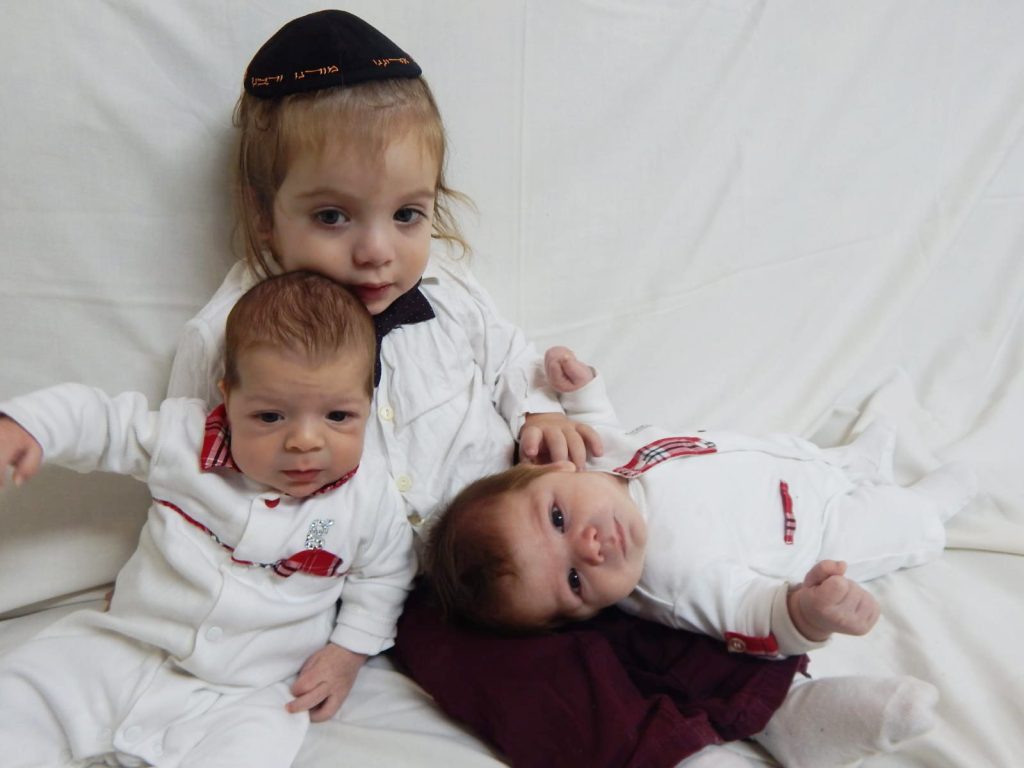
Menucha, Miriam, and Leah had sweet, healthy babies after countless moments of blood, sweat, and tears. They are emotional when they talk about the miracle. They observe and see the blessings in the process. Yes, it was difficult, nerve-wracking, frustrating, no doubt. But what is all the difficulty compared to the greatest gift?!
They, and certainly anyone who has gone through hardship, have important insights to share with us.
There are many women and girls who read what you wrote and feel exactly the same way. Stuck. It seems that everyone around them has lives flowing naturally and freely, and only they are trudging through a trial. What can you say to them? How do you cope?
Menucha suggests: The most important thing is to remember that Hashem runs the world. You need to relax, release the pressure. These are big words. Find who and what will help you break them down into small change. To feel them and not just understand; a book that speaks to you, a good friend, a therapist, it’s nothing to be ashamed about.
We need to unload our feelings and process them. Otherwise, they surge and surge and might overwhelm us with their intensity.
Along with releasing the pressure, you can try… to enjoy this period! If I were to experience the waiting period again, maybe I could choose to enjoy the time when I’m completely free. To do things I love, invest in our marriage, develop areas that interest me. As my therapist told me, my children will benefit from this period later.
Miriam offers: The waiting period is a nerve-wracking time because you don’t know when it will end. Women feel insecure. Fears. Don’t know what will happen. Stuck in the same place and nothing is happening.
After the first treatment, when I received a negative response, I cried a lot. Endless crying. My father kept repeating: “Miriam, have bitachon in Hashem.” I told him: “Abba, enough.” Later, I understood that Hashem could solve the problem in an instant. Trusting in Him does not depend on proof of whether it succeeds or fails. It’s bitachon above all else. When they asked me, “Do you have children?” I answered, “I will have children!” How will you remember this? Write this message in front of your eyes on notes and reminders.
Repeat the sentence: “G-d has given me a role, and I do what I can with it.”
Learn ‘Sha’ar HaBitachon’ – it’s also a recommendation from the Rebbe.
Again. There are moments of crisis. But with this work, we will gradually learn to accept the waiting with love.
As great as the anticipation is, is the size of the gift. If my child had come right after the wedding, very easily, I don’t know if I would feel like I do today, how much he is my gift.
Try to see what you have, the miracles, and rejoice in the miracles that are already happening to you.
Pay attention to anticipating, but not a nerve-wracking anticipation. Anticipation out of joy!
Leah too, with bitachon in Hashem, emphasized joy. Express it physically, buy a drum and dance at home. Train the facial muscles to smile, engage in things that bring you joy.
And most importantly, remember to ask for the true and complete Geula with simcha v’tuv leivav...
Beis Moshiach #1437 • pp. 46-50
© 2026 Beis Moshiach Magazine. All rights reserved.
This article originally appeared in Beis Moshiach #1437. You are welcome to share it with friends and family by email or in print, provided that you do not change, add to or omit any part of it, you credit the author and Beis Moshiach, and you include a link to archive.bmoshiach.org (written out in full in printed copies).
To republish this article in a newspaper, magazine, book or website, please request permission in advance at [email protected].