Hope, Reality, or a Way of Life?
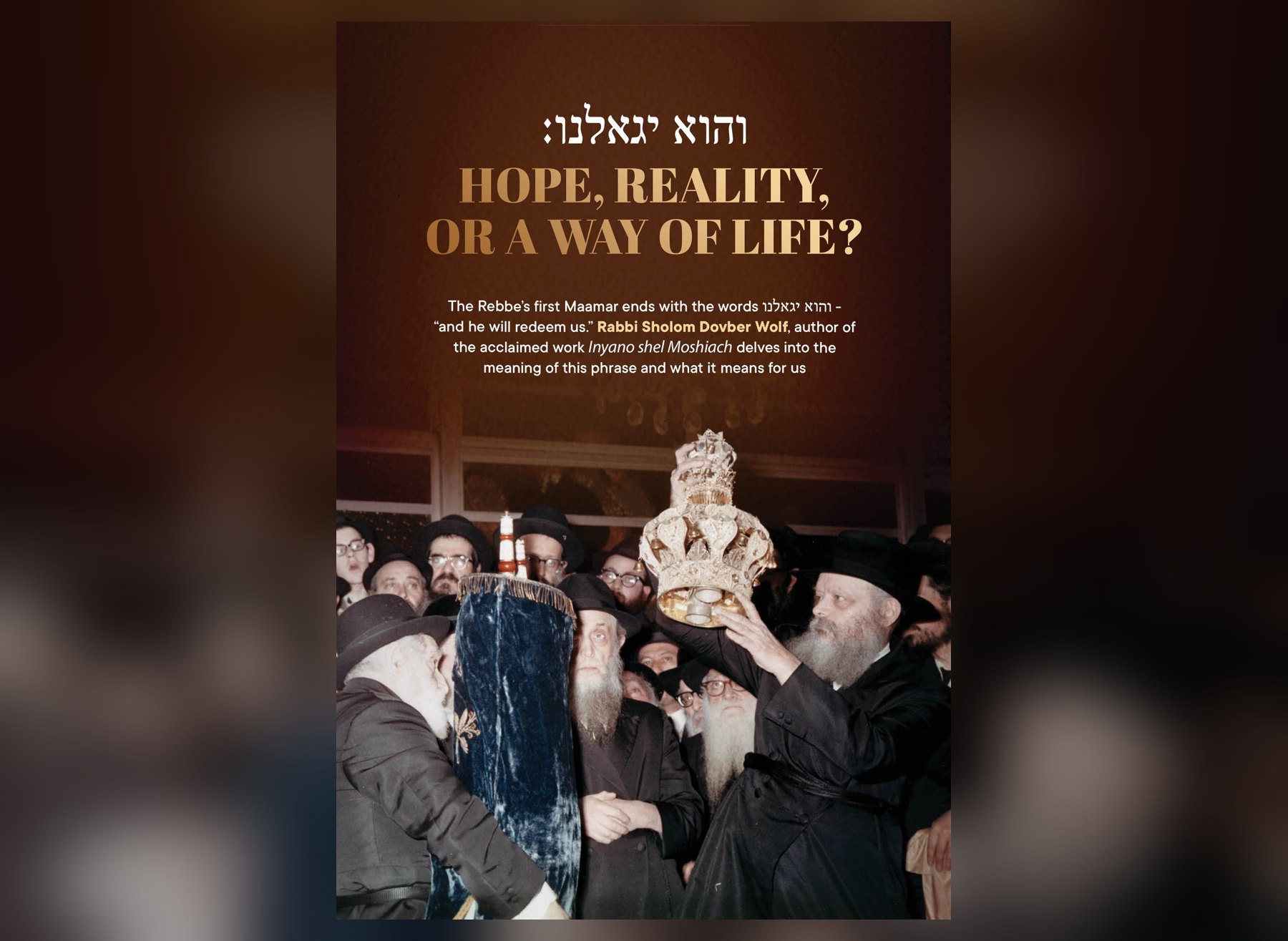
The Rebbe’s first Maamar ends with the words והוא יגאלנו – “and he will redeem us.” Rabbi Sholom Dovber Wolf, author of the acclaimed work Inyano shel Moshiach delves into the meaning of this phrase and what it means for us
In the inaugural maamar of the nesius, “Basi L’Gani 5711,” the Rebbe explains the foundations of the mission of the seventh generation. The goal – to bring down the ikar Shechina, and how? By spreading Yiddishkeit and Elokus everywhere, through Ahavas Yisrael, in a way of shtus d’kedusha (holy folly).
At the end of the maamar, the Rebbe concludes with a wish: “And Kevod Kedushas the Rebbe, my father-in-law, who bore our illnesses and carried our pains, and he was wounded by our transgressions, crushed from our sins; just as he saw our troubles, may he soon in our days and in our time redeem his flock from spiritual exile and physical exile together, and place us in the ray of light. But all this is still only giluyim (revelations), and even more – that he will connect and unite us with the essence of the Ein Sof, blessed be He.”
[It should be noted that when delivering the maamar, he explained more, “that the Rebbe who is from the seed of the House of Dovid, who bore our illnesses.” However, in the edited version, these words were omitted].
And he continues further in connection with this, until the actual conclusion, “and we shall merit to see the Rebbe here below in a body and below ten hand-breadths, and he will redeem us.” The simple understanding of these words is that he will be Moshiach Tzidkeinu who redeems Israel in the true and complete Geula.
When examining these words, we can see that this idea is found within his earlier statements, “Kevod Kedushas the Rebbe, my father-in-law, who bore our illnesses and carried our pains, and he was wounded from our transgressions, crushed from our sins.” These phrases are part of Yeshaya’s prophecy in the section of “Behold my servant shall prosper, he shall be exalted and lifted up,” which is interpreted by Chazal and Chassidus to be referring to Melech HaMoshiach. Similarly regarding this pasuk, “he bore our illnesses,” which is interpreted by Chazal to be referring to Moshiach’s sufferings.
The same applies to the continuation, “will redeem his flock from spiritual exile and physical exile together… will connect and unite us with the atzmus Ein Sof, boruch Hu,” since Geula from exile in its simple meaning is the role of Melech HaMoshiach.
All the more so in light of the addition during the maamar’s delivery, that the Rebbe is from the seed of the House of Dovid, which is simply understood to emphasize the connection to Melech HaMoshiach, who as Rambam states is a king from the House of Dovid who restores the kingdom of Dovid to its former glory.
The Meaning of “And He Will Redeem Us” in the Avoda of the Seventh Generation
These words were said briefly and without explanation in the maamar, and even in subsequent sichos it is rare to find direct reference to this topic, until a much later period, as will be noted below. Superficially, one might pass over this matter without placing emphasis on it. Because on the surface, these words in the maamar come only as a wish, and the maamar itself, the goal it sets and the path it outlines as mentioned above, can stand even without this conclusion.
But upon contemplation of the fact that these words are the conclusion of the foundational inaugural maamar, and although as mentioned above he does not emphasize this topic in sichos at all – when specifically here, in this fundamental maamar, he chose to emphasize this – it is understood that there is a significant matter here that deserves attention. That is, it is something that relates to our avoda in implementing the content discussed in the maamar.
In general, one can understand that this idea is an inseparable part of the maamar’s essence. Meaning, the maamar speaks about an idea and path, the goal to bring down the Shechina, and the path of spreading Elokus everywhere. And these things could remain as an abstract idea. But when he concludes and says “and he will redeem us,” it is understood that there is someone present who reflects this idea in his personality, and this path is his personal mission and responsibility. And when understanding this, this take on a clearer, more tangible and practical meaning.
This is similar to what is explained in the sicha of Simchas Torah 5746, which begins with how every Jew is Hashem’s shliach to make Him a dwelling in the lower worlds and thereby bring Moshiach Tzidkeinu. And continues “in order to make easier and bring out in a more revealed way the shlichus of every Jew as Hashem’s shliach – Hashem gave the Jewish people a Nasi in every generation, until our generation – the Nasi of our generation, Kevod Kedushas the Rebbe, my father-in-law… that the Nasi HaDor gives strength to all people of the generation to fulfill their shlichus to publicize Elokus in the world.”
Following this, he explains further and says that the “meshaleiach” is the Moshiach aspect of the generation, and every “shliach” has a spark from the soul of Moshiach, which is the general ‘yechida’ level in everyone’s neshama as mentioned above, and therefore every shliach has the power to carry out the shlichus of Moshiach and bring the Geula b’poel mamosh.
One who thinks about it will see that this entire sicha doesn’t give much practical guidance about what and how the shliach should do (which is explained in many other sichos), rather this sicha focuses on the essence of the shlichus, explaining the idea that should be in the shliach’s consciousness, with which he lives and by which he acts. An idea that gives inner drive to act, and gives strength not to be affected by any interference.
The general idea is that the shliach should know that the meshaleiach is the general Moshiach whose role is to bring Geula in actual practice, and the shliach himself is an individual Moshiach spark acting through the power of the general Moshiach. And even before detailed explanations, one can simply understand in general the power and strength this idea gives to the shliach.
Indeed, theoretically, the shliach could suffice with knowing he is a Moshiach spark of the general Moshiach soul, even without being conscious of its revealed expression [by way of the Nasi HaDor] in our generation. But as mentioned above, the point is “in order to make easier and bring out in a more revealed way,” which is when we are conscious of and connected to the expression of the neshama of Moshiach in a flesh and blood person here with us, as is obvious.
* * *
Despite the above, in most of the many sichos speaking about shlichus etc. the Rebbe does not explicitly emphasize this matter. The exceptions are special occasions like here in the inaugural maamar of Basi L’Gani, and similarly the Simchas Torah sicha of 5746, which in general for our Rebbeim, and also in our generation, Simchas Torah is a time of revelation when such matters, and the like, were discussed.
It would seem fitting to properly define the relationship of this matter to the general shlichus work of spreading Yiddishkeit and hafatzas ha’maayonos, as the relationship of a foundation to a building. On one hand it is the foundation upon which the entire building stands, and the beginning of the building is specifically from it, but it is buried in the ground, and not visible afterwards. And what is visible to the eye is the large building standing upon it.
Similarly regarding our subject, that this concept that the meshaleiach is the Moshiach etc., is like a foundation upon which the entire building stands, and therefore at the beginning of the entire project, in the foundational maamar, this matter stands revealed. But later when dealing with the details of the work in progress, it’s not necessary for it to be emphasized. And perhaps on the contrary, specifically because it is an inner matter that pertains to the innermost aspect of the soul etc., it remains ‘behind the scenes,’ in the realm of the innermost aspect of the soul.
And more specifically: The belief in the coming of Moshiach in general is a foundation of our faith, one upon which the entire building stands and without it there is no building, as explained that belief in the coming of Moshiach is belief in the eternality of Torah, that the day will come and it will be fully realized in practice in the world. And without this faith, the Jewish people could not have endured the difficulty of galus. But the particular identification of the Moshiach of the generation, which is “in order to make easier etc.” is not a necessary foundation for the entire building. Meaning, one can envision a reality of a Jew engaged in Torah and mitzvos without this. And one can also envision a reality of a Jew engaged in the shlichus of spreading Judaism etc. without this.
Along the lines of what he says at the end of the aforementioned Simchas Torah sicha, “whether one understands the matter in its completeness or not – the main thing needs to be practical action… to spread Yiddishkeit and Torah and mitzvos… including, obviously, belief in the coming of Moshiach.” The obvious intention is also (and perhaps mainly) referring to this concept (that the meshaleiach is Moshiach) explained previously in the sicha, that even if there is someone for whom this doesn’t sit well, it shouldn’t affect practical action, which is possible even without this understanding.
“There Already is the Revelation of Moshiach”
All the above is when speaking about the avoda of the seventh generation in general to bring Geula, avoda whose substance is spreading Torah and Judaism in general, and spreading the wellsprings of Chassidus in particular, “including obviously belief in the coming of Moshiach,” i. e. the general belief as it existed throughout all the generations.
However, over the years the Rebbe placed more and more emphasis on this, the belief and anticipation of Moshiach’s coming. And from 5751 onward, the Rebbe said clearly that the time of Geula has already arrived, and moreover, we are already in the time of Yemos HaMoshiach, including also that there is the revelation of Moshiach. Therefore the avoda now needs to be ‘to live with the time of Yemos HaMoshiach,’ and more so to be ‘mekabel pnei Moshiach Tzidkeinu in actual practice.’
And we see in practice, that in those sichos the topic of the Moshiach of the generation became more revealed and explicit, including also clear indication of his identity, and with time it became more and more revealed and clear.
Namely: The general matter that “the time of your Geula has arrived,” which he connects to the words of the known Medrash, “the year that Melech HaMoshiach is revealed, the king of Persia provokes the Arab king etc.” (which he interprets regarding the Gulf War etc.), and its continuation, “in the time that Melech HaMoshiach comes he stands on the roof of the Beis HaMikdash and announces to Israel saying, ‘humble ones, the time of your Geula has arrived.’”
This he explains to mean that the Medrash is referring to the time before the actual Geula, when Moshiach and the Jewish people are still in galus, and “the Beis HaMikdash” in the Medrash hints to the main ‘Mikdash Me’at’ [mini-sanctuary] in galus, and from there Moshiach announces to the Jewish people that the time of Geula has arrived, “as they announced and announce especially recently.” These words point to the obvious understanding that now is the time that Moshiach Tzidkeinu himself is with us and announcing to us about the Geula.
And later in the year (mainly from the sicha of Parshas Balak 5751) he begins to speak about how not only has the time of Geula arrived, as something that needs to happen in the future, but moreover, we are already now in the time of Yemos HaMoshiach, and therefore now we need to ‘live with the time of Yemos HaMoshiach,’ meaning conduct fitting for the state of Geula, as explained in several sichos from that period. And in this context he emphasizes that “we are already standing in the time that Melech HaMoshiach comes… that he has already come,” and already now one can point with a finger (meaning, clear identification) that “hinei zeh Melech HaMoshiach ba.”
The most basic understanding of that is that the existence of Moshiach among us is the inner meaning of saying that “we are in the time of Yemos HaMoshiach,” which is why the Rebbe demands from us avoda fitting for this time.
Similarly in the sicha of Parshas Matos-Massei 5751, where he speaks about Ahavas Yisrael that needs to be like a taste of Geula, and explains that now “we are already at the Yarden of Jericho, the level of Moshiach who judges by scent,” and since Moshiach is the general ‘yechida’ level that unites all Jewish souls in one simple unity, now everyone needs to have such a feeling of that simple unity.
Here again, it would seem that the simple meaning of the statement that we are already at the level of Moshiach is that Moshiach Tzidkeinu is with us here, and we have here the actual man who relates to all Israel with simple unity (as we see in practice the Rebbe’s conduct in his relationship to every Jew), and therefore we can also conduct ourselves this way.
“Menachem is His Name”
Now in the above sichos he speaks about how we need to “live with the time of Yemos HaMoshiach.” In general terms, “Yemos HaMoshiach” is a time period and state in the world, which demands Geula-like conduct in general, such as in the inyan of Ahavas Yisrael etc.
And then comes the sicha of Shabbos Parshas Chayei Sarah 5752 in which he speaks explicitly and directly that in every generation there is a Moshiach, and in our generation it is the Nasi of our generation, “the only Moshiach in our generation” and he has already received his shlichus, and therefore now there needs to be the matter of kabbolas pnei Moshiach, by explaining to all Jews the inyan of Moshiach as it is in Torah, and thereby they become ready to be mekabel Moshiach.
If in previous sichos up to this point, the topic of the Moshiach of the generation was mentioned ‘in passing,’ without emphasis and without explicit indication of which Moshiach is being referred to, and one needs to deduce one thing from another, then in this sicha, these matters were stated explicitly and clearly.
It seems obvious that this shift, emphasizing the matter in explicit fashion, relates to the content of the subject matter itself. Because when focusing on the inyan of Melech HaMoshiach as an individual (and not as an era), and the shlichus to prepare the Jews to greet him, it is necessary to emphasize that this individual is here, and who he is. Otherwise, these matters are far from having any practical meaning. It is difficult to imagine a scenario where a shliach, engaged with vitality and zeal in preparing Jews to greet the Moshiach who is coming, connects them to the Moshiach as an individual, etc., without the shliach himself knowing clearly the identity of the Moshiach who is here, to whom ultimately all the Jews must be connected.
* * *
Subsequent to this and in greater detail, is the sicha of Shabbos Parshas Mishpatim 5752, where he speaks about the prophecy of “and they shall beat their swords into plowshares,” that now we can already see “the beginning of the fulfillment of this prophecy,” as explained there.
He emphasizes that this “beating of swords into plowshares” is a direct accomplishment of Moshiach, about whom it is said at the beginning of that prophecy “and he will judge among the nations.” Therefore, when we see “the beginning of the fulfillment of this prophecy,” we understand that there is “the beginning of the action of Moshiach upon the nations.” The main elaboration in the sicha is to show the connection of this inyan to the Nasi of the generation, the Moshiach of the generation, who is the one acting upon the nations to bring them to this state, until the very end of the sicha, where he explains (contrary to his usual approach until then) about the three generations of our Rebbeim, including ‘Moshiach, Menachem is his name.’
It seems quite obvious that this matter also pertains to our avoda and the guidance for us, as to how we should look at the events of the world, see the inyanei Geula in the world, and the actions of Moshiach in the world, with awareness and connection to the reality of the Moshiach of the generation (even if the words were not said in the manner of a “directive” but rather as a narrative of events).
Beis Moshiach #1445 • pp. 10-13, 33
© 2026 Beis Moshiach Magazine. All rights reserved.
This article originally appeared in Beis Moshiach #1445. You are welcome to share it with friends and family by email or in print, provided that you do not change, add to or omit any part of it, you credit the author and Beis Moshiach, and you include a link to archive.bmoshiach.org (written out in full in printed copies).
To republish this article in a newspaper, magazine, book or website, please request permission in advance at [email protected].