The 12-Second Question That Lit Up the Briefing Room
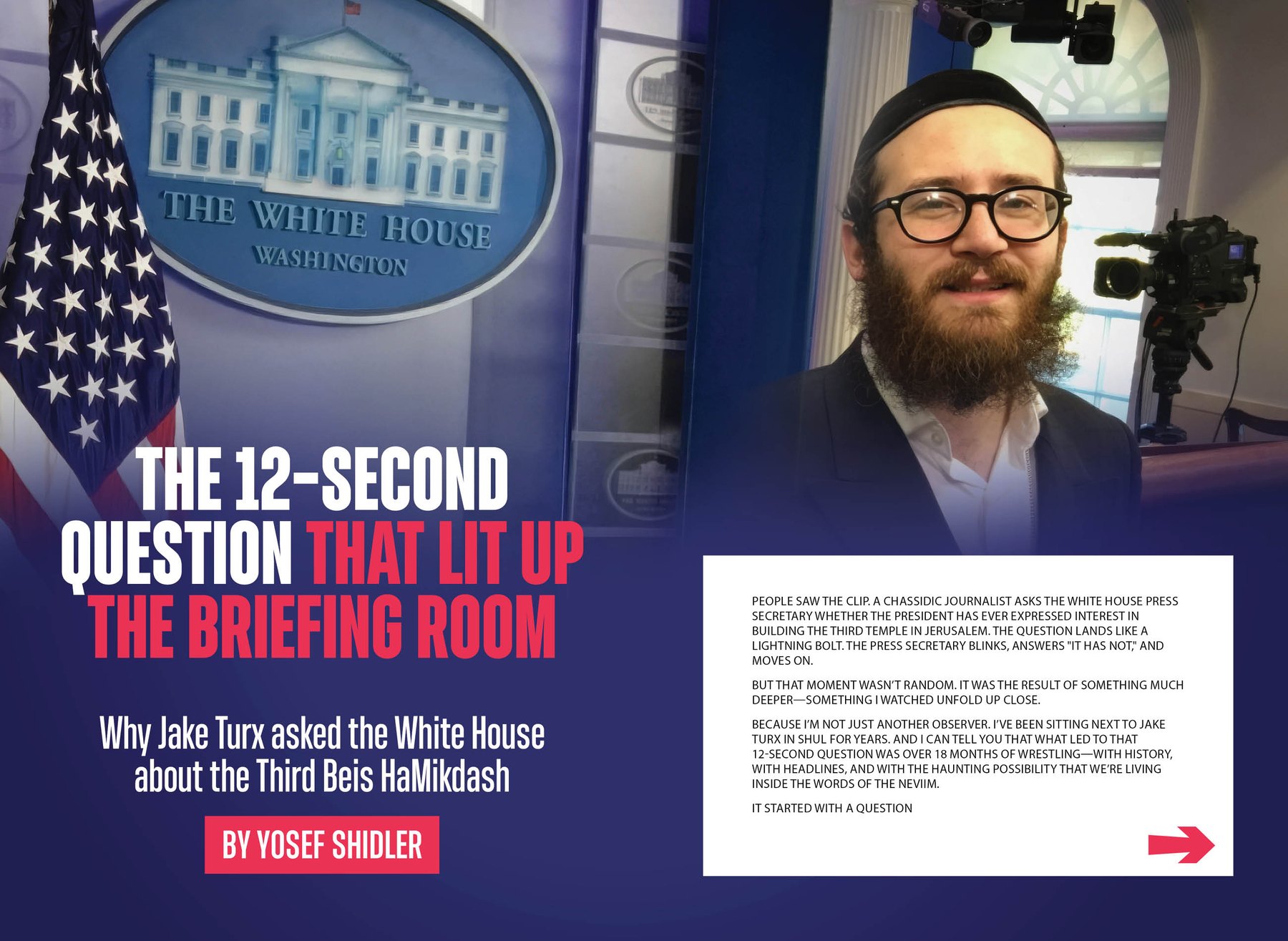
People saw the clip. A Chassidic journalist asks the White House press secretary whether the President has ever expressed interest in building the Third Temple in Jerusalem. The question lands like a lightning bolt. The press secretary blinks, answers “It has not,” and moves on. But that moment wasn’t random. It was the result of something much deeper – something I watched unfold up close. Because I’m not just another observer. I’ve been sitting next to Jake Turx in shul for years. And I can tell you that what led to that 12-second question was over 18 months of wrestling – with history, with headlines, and with the haunting possibility that we’re living inside the words of the Neviim.
Millions of people saw the clip. A Chassidic journalist, in beard and peyos, asks the White House Press Secretary whether the President has ever expressed interest in building the Third Temple in Jerusalem. The question lands like a lightning bolt. The Press Secretary blinks, answers “It has not,” and moves on.
But that moment wasn’t random. It was the result of something much deeper – something I watched unfold up close over 18 months of wrestling with history, headlines, and the haunting possibility that we’re living inside the words of the Neviim.
Because I’m not just another observer. I’ve been sitting next to the man himself, Avraham Yaakov Tarkieltaub, aka Jake Turx, in shul for years. And what led to that 12-second question was a journey I witnessed firsthand.
After “October 7th,” Everything Changed
After October 7th, something shifted. The pain, the chaos, the global reaction – Jake besides for being a White House reporter wasn’t just reading the news. He was reading Navi. Quietly, consistently, and with growing intensity.
“Is all of this already in the Neviim? Are we living inside prophecy, and we just don’t realize it?”
That’s what he kept asking. And I watched him start digging – not into politics, but into ancient texts. Not just the big, sweeping nevuos of Yeshaya or Yechezkel, but the short, cryptic ones. The footnotes of the Tanach. Especially Sefer Ovadia.
He wasn’t trying to predict dates. He was trying to interpret patterns. He started looking at the collapse of Western institutions – media, government, academia – and wondering whether this was more than a political moment or, in fact, a prophetic one.
And then came a spark.
A Forgotten Sefer Resurfaces
One Shabbos after davening, our Rav – R’ Duvid Nuchem Spira of the Dinov Beis Medrash of Toms River, NJ, a direct father-to-son descendant of the holy Bnei Yissaschar – overheard Jake speaking passionately about Ovadia and Edom.
The Rav paused and told him about a sefer almost entirely unknown, barely ever published – called Klei HaRoim (“Instrument of the Seers”), written by the Bnei Yissaschar himself. It contains commentary on Sefer Ovadia with prophetic insights few in the world have ever seen.
The Bnei Yissaschar didn’t write commentary on all of Tanach. In this small book, he chose just one Navi – Ovadia. That alone was telling. The Klei HaRoim is his singular, laser-focused vision of the end of days.
The Rav happened to have a copy. He brought it to shul the next week and handed it to Jake.
Jake devoured it.
He started sending me passages about Edom’s spiritual decline, about its eventual collapse, about how the final Geula might begin with the implosion of what we once considered the most stable forces in the world.
It wasn’t fantasy. It was eerily grounded – like the sefer had been waiting patiently for this moment.
Slowly, our Shabbos post-davening conversations became a chavrusa. I’d bring what I knew from the Rebbe’s teachings on Moshiach and Geula – he’d bring what he found in Sefer Ovadia and Klei HaRoim. A few Jews surrounded by leftover cholent, discussing world events and their connection to the final Geula.
Then Came His Mother’s Question
Jake later wrote:
“I had the honor of hosting my mother last Shabbos (Berishis 5786). In middle of the meal Trump’s name came up, and I mentioned that lately he’s been talking about ‘entering heaven.’
“She asked me what other kinds of things he’s been saying. ‘Has he ever mentioned the Beis HaMikdash?’ she asked.
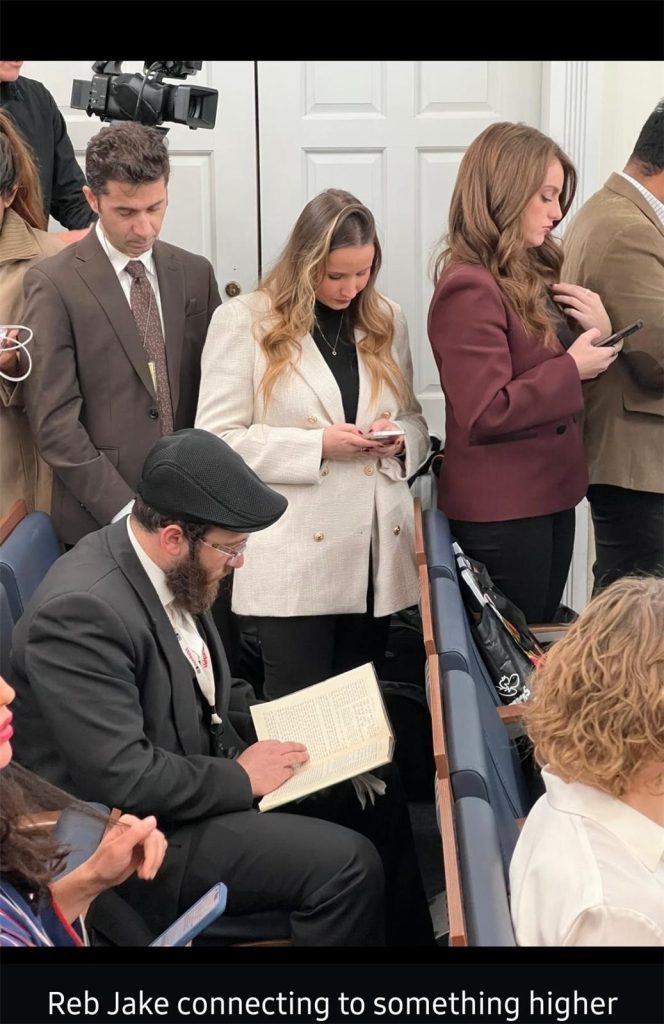
“I said, ‘Not that I recall.’ Then I asked, ‘Would you like me to ask?’ And she said, ‘Absolutely! Please ask!’
“This was the first briefing since that exchange. The fact that it took place on the first day of Cheshvan – the month Chazal tell us (Yalkut Shimoni on Melachim I:8) the Third Beis HaMikdash will be rebuilt – felt especially meaningful.”
He didn’t ask it because it was cute or timely. He asked it because it had been burning in him for months – a way of saying: the world isn’t random. We’re in a story.
“Has the President ever expressed any interest in building the Third Temple in Jerusalem?”
It was a genuine question. But also a signal.
Who Was Ovadia—and Why Did He Receive This Prophecy?
Ovadia was an unlikely Navi. He wasn’t born Jewish; our sages say he converted from Edom, Israel’s historic adversary. Even while serving as King Achav’s palace steward, he “feared G-d greatly.” When Queen Izevel set out to kill the prophets, Ovadia hid one hundred of them in caves and kept them alive with bread and water, going into debt to sustain them. In that merit, he was granted his own nevuah.
What’s extraordinary is that Ovadia’s prophecy doesn’t speak broadly about nations in general – it focuses entirely on Edom, and on what will happen to Edom at the end of days.
This is striking because at the time of Ovadia’s nevuah, Edom was just a small nation neighboring the Land of Israel – long before it evolved into the Roman Empire, then into the Christian empires of Europe, and ultimately into the foundation of today’s Western world: the culture, politics, and power structures of Europe and America.
Edom never vanished. It simply changed forms, carrying its spiritual identity forward through every generation of Western civilization.
In the Klei HaRoim, the Bnei Yissaschar explains that no other prophet could have received this vision. It had to be Ovadia – someone born in Edom yet who became part of Klal Yisrael, the only prophet who carried both realities at once. Other prophets could not withstand this particular nevuah; the spiritual intensity of seeing Edom’s ultimate downfall would overwhelm them, sending their souls into a trance-like state.
But Ovadia was different. As someone who had emerged from Edom and transformed himself through holiness, he alone could contain the vision without being shattered by it.
Ovadia’s prophecy is only 21 verses long, but each word is packed with significance – about downfall, retribution, and redemption. About the collapse of Edom, the restoration of Yerushalayim, and the long arc of Jewish history returning to its root.
Learning to See Geula in Real Time
What Turx was doing wasn’t just a personal journey; it was a living example of something the Rebbe had been guiding us toward for years. As Lubavitchers, we’ve always heard the Rebbe speak about the times of Moshiach not as a distant dream, but as something we can begin to see unfolding before our eyes.
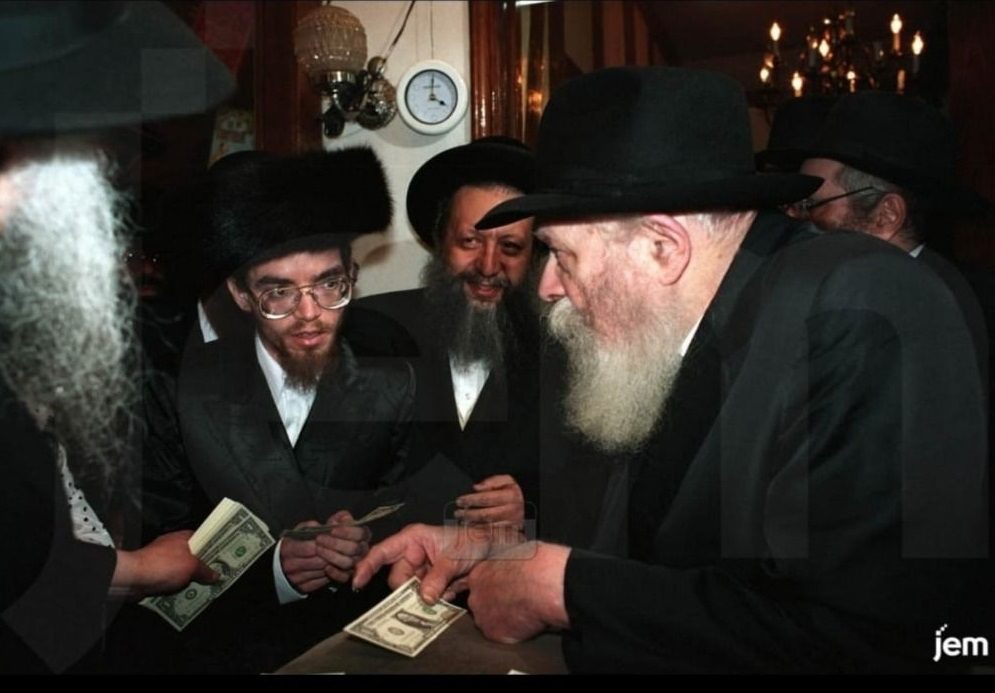
As Lubavitcher Chassidim, the Rebbe trained us to see the world through Geula lenses. These prophecies do speak to our moment. Our task isn’t to shrug and say “someday”; it’s to actively look for how they connect now – responsibly, through the traditional mefarshim – while avoiding absolute claims about this or that headline.
Yes, the Rambam cautions against certainty in the order and details of the end-time events, and we accept that humility. But humility is not passivity. It means we map patterns, not names. We learn Navi with the classic commentaries and ask: How does this fit our timeframe? When a sefer like Kli HaRoim offers a clear reading, and that reading aligns strikingly with current realities, that should move us – not to prediction contests, but to a deeper grasp of where we stand in history.
More than three decades after Gimmel Tammuz, the Rebbe’s directive to live Geula now remains our compass.
We don’t need 100% “on-the-dot” identification of every verse with every event to know the general arc is unfolding. So, we study the sources, notice the convergences, and let them clarify our moment – and then translate that clarity into action: more Torah, more mitzvos, more chessed, and a Geula-mindset that reads today’s world as Hashem steering creation to its goal.
The Rebbe’s instruction: learn about Moshiach, open the sefarim, look at what’s written, and open your eyes to see that we’re living the Geula process. The events of the world – political upheavals, cultural shifts, even the rise and fall of nations – are part of a story predicted for thousands of years.
Turx’s exploration was a real-time practice of what the Rebbe encouraged: to see the Geula in the here and now, to realize that the pieces of the puzzle are all around us, waiting to be understood.
‘The World Has Lost Its Mind’: Ovadia’s Vision Meets Today’s Headlines
Ovadia speaks of Edom rising to dominance and ultimately facing collapse. But this isn’t broad-stroke geopolitics – Ovadia paints specific and hauntingly familiar images:
On hostages and betrayal: “And you should not have stood by the gap to cut off their fugitives, neither should you have delivered their survivors on the day of distress” (1:14).
After October 7th, when over 200 Jews were taken hostage by Hamas, this verse jumped off the page.
On The Loss of Wisdom: When you read Ovadia today, it’s impossible not to feel like he’s describing our generation. His twenty-one verses aren’t abstract poetry; they’re a mirror of the modern world – especially the years following the COVID era.
Ovadia speaks about a time when the leaders of Edom, the most powerful nations of the world, would lose their clarity and sense. The Bnei Yissaschar explains that this isn’t a metaphor – it’s literal. “I will cause the wisdom to be removed from Edom,” the Navi says. In other words, there will come a point when those who rule the world will make decisions that defy reason itself.
And haven’t we seen exactly that?
From Washington to Europe, we’ve watched leaders unravel. Policies that once seemed stable have turned irrational. From “woke” ideologies to collapsing moral standards, it feels as though the wisdom of leadership itself has evaporated. Even in America – the modern face of Edom – we’ve seen moments that perfectly reflect Ovadia’s words.
Presidents and prime ministers alike appear confused, detached, or erratic. As one commentator joked, “the world has lost its mind.” But through Ovadia’s lens, it’s not madness – it’s prophecy.
On trusted allies turning: Western nations publicly claim friendship with Israel yet fund her enemies. Follow the money trail – billions flowing to Iran and Hamas under Western leadership, particularly during the Obama and Biden eras. The governments that pledged “support” for Israel also bankrolled those who shed Jewish blood on October 7th.
The Bnei Yissaschar writes that in the final reckoning, Edom will protest: “But we were the Jews’ friends! We defended them!”
And the answer from Heaven will be: “Yes – but what did you do behind closed doors?”
Within Ovadia’s 21 verses lie references to the reclaiming of Eretz Yisrael, the role of Western powers attempting to restrain that reclamation, the expulsion of Jews from Yemen (“Land of the South”) and neighboring lands – all part of the gathering of exiles before redemption.
To unpack it all would take volumes, but the takeaway is clear: Ovadia’s vision isn’t ancient history. It’s the spiritual map of our century.
The Rebbe’s Sicha: ‘The Spiritual French Revolution’
In Parshas Vayishlach 5752 (1991), the Rebbe offered one of his most striking interpretations of Sefer Ovadia, focusing on the verses:
“And the exiled host of the children of Israel who are among the Canaanites as far as Tzorfas (France)… and saviors shall ascend Mount Zion to judge the mountain of Esav, and the sovereignty shall be Hashem’s.” (Ovadia 1:20–21)
The Rebbe explained that these pesukim describe a process already underway in our time.
Tzorfas = France = Refinement (Tziruf): The word Tzorfas (צרפת) shares a root with tziruf (צירוף) – ”refinement” or “purification.” The Rebbe said this is Divine hint: France’s spiritual purpose is connected with refining the world.
Where earlier generations saw France as the center of opposition to holiness – home of the “Enlightenment” and the 1789 Secular Revolution – the Rebbe pointed out this was being transformed before our eyes.
Torah study, mitzvos, and Chassidus are flourishing there. “In the very place that symbolized rebellion against G-d, there now burns the light of Torah and mitzvos – a true ‘spiritual revolution.’”
From Material Power to Spiritual Purpose: The Rebbe contrasted two types of revolutions. The 18th-century French Revolution sought to liberate man from G-d; the new revolution liberates man for G-d. It represents Edom’s inner transformation – the shift from ego to humility, from self-sovereignty to Divine sovereignty.
This is the fulfillment of Ovadia’s vision: Edom is not annihilated; it is refined and elevated. Its cultural and intellectual energy is redirected toward holiness.
And then came the Rebbe’s most astonishing line:
“We have already polished the buttons. The work of refinement has been completed. What remains is to open our eyes and see that the Geula is here.”
The Teshuva of Edom
To understand why Edom must face both downfall and transformation, we have to go back to its origin.
Edom – descended from Eisav – was the nation that destroyed the Beis HaMikdash. From that point forward, prophecy foretold that Edom would remain a central player until the very end. The same civilization that tore down the Temple, Chazal teach, will ultimately be involved in building it again.
That’s not poetic justice – it’s a Divine blueprint.
The Rebbe explained that the transformation of Edom is not annihilation, but refinement. Edom must be elevated, its energy redirected from ego to holiness, its culture of dominance turned toward acknowledgment of Hashem. This is the birur Edom—the purification of the Western world before Geula.
And in our generation, we’re watching it happen.
Take President Donald Trump. In many ways, he embodies the paradox of Edom itself: brash, powerful, deeply material – and yet, unexpectedly reverent. After surviving the assassination attempt in Butler, Pennsylvania, he said, “It was G-d Almighty who saved me.” When authorizing strikes against Iran, he used the same language – crediting Hashem directly.
It’s a phenomenon that feels ripped from prophecy: the chutzpa of Edom turned toward faith instead of defiance. As the Rebbe described, Edom’s teshuva means the very nations that once resisted G-d’s sovereignty will begin to proclaim it.
The Question Heard Around the World
When Jake stood up in the White House briefing room and asked if the President had ever expressed interest in building the Beis HaMikdash, he wasn’t being provocative. He was holding up a mirror to Edom.
This wasn’t a private exchange. It was broadcast live on every major network – Fox News, CNN, ABC, CBS. When a White House correspondent asks a question in that room, it echoes around the world.
In that instant, a Chassidic Jew was publicly speaking the words “Holy Temple” on live national television – injecting a timeless, prophetic question into the heart of modern media.
In a world where “the wisdom of Edom” has been removed, where leaders stumble and societies rewrite morality, Jake’s question was a signal to awaken a collective consciousness: that Edom must now take responsibility for its role in the unfolding Geula.
Because just as Ovadia was chosen for his role – born in Edom but transformed into a prophet of Israel – Jake, in a sense, stands in that same symbolic space. He sits front row in the heart of Western power, speaking its language, understanding its culture, yet carrying within him the fire of Torah. He lives inside Edom, yet belongs to Klal Yisrael.
It’s uncanny. Ovadia sat in a place of power close enough to see Malchus, yet faithful enough to speak Hashem’s truth from within it. Now, centuries later, another Jew who walks the halls of the Malchus of Edom – not in Rome, but in Washington – has become the one to reawaken Ovadia’s words.
History is coming full circle.
Ovadia’s words are not ancient history. They are alive, breathing, unfolding before our eyes. Every line speaks directly to the spiritual landscape of our time.
And once you see that Ovadia’s vision is in motion, you begin to realize that all the Neviim are in motion. Daniel, Yechezkel, Zechariah – no longer dormant ideas for a future time, but moving pieces in a single unfolding picture.
The train has started. The Geula train is in motion. Whether we feel it or not, we are already on board.
In the words of the Rebbe: “The refinement is complete. All that remains is to open our eyes and see that the Geula is here.”
Beis Moshiach #1482 • pp. 12-19
© 2026 Beis Moshiach Magazine. All rights reserved.
This article originally appeared in Beis Moshiach #1482. You are welcome to share it with friends and family by email or in print, provided that you do not change, add to or omit any part of it, you credit the author and Beis Moshiach, and you include a link to archive.bmoshiach.org (written out in full in printed copies).
To republish this article in a newspaper, magazine, book or website, please request permission in advance at [email protected].