Who Taught Reb Zushe How To Learn?
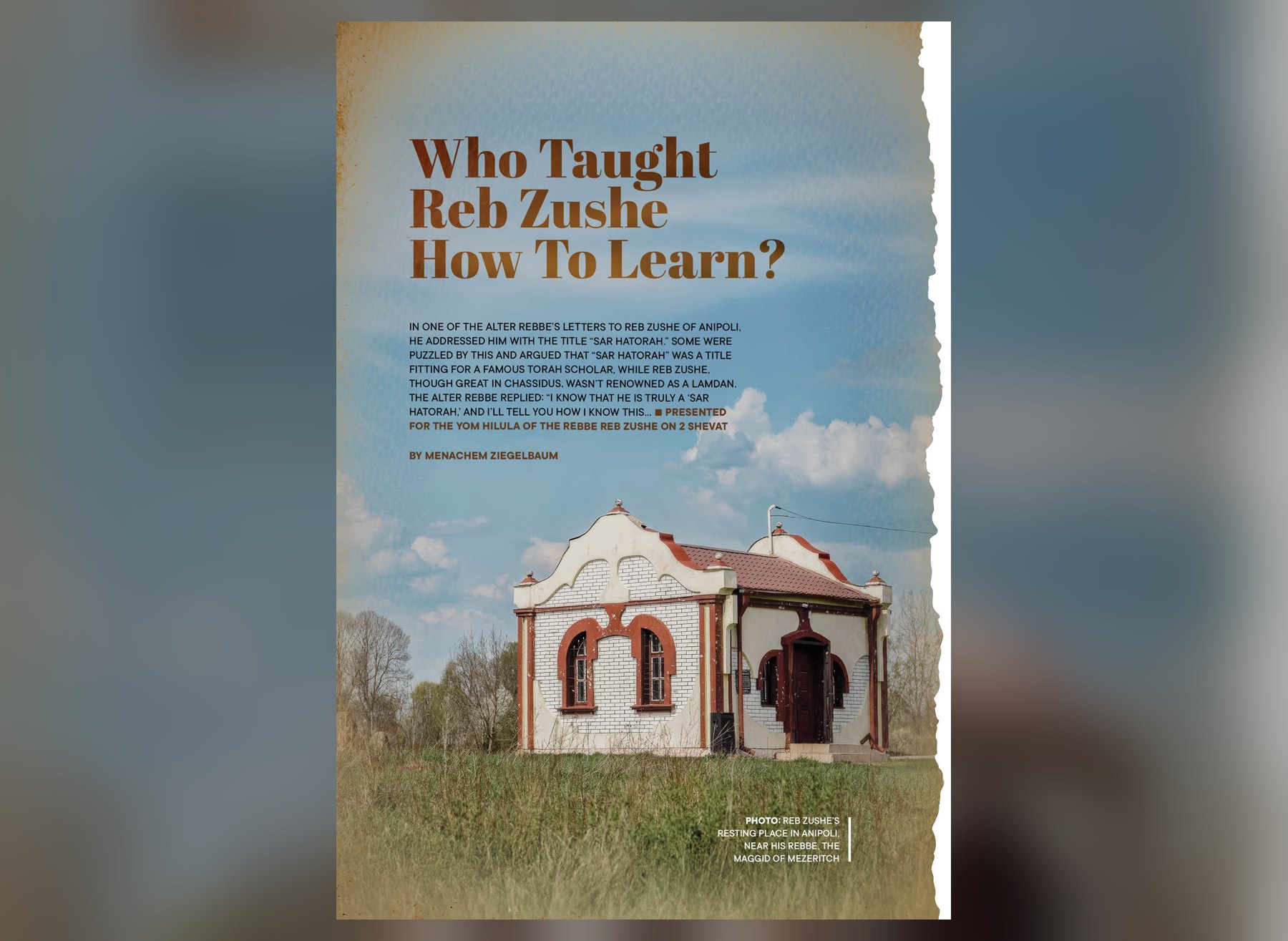
In one of the Alter Rebbe’s letters to Reb Zushe of Anipoli, he addressed him with the title “Sar HaTorah.” Some were puzzled by this and argued that “Sar HaTorah” was a title fitting for a famous Torah scholar, while Reb Zushe, though great in Chassidus, wasn’t renowned as a lamdan. The Alter Rebbe replied: “I know that he is truly a Sar HaTorah, and I’ll tell you how I know this…” Presented for the yom hilula of the Rebbe Reb Zushe on 2 Shevat
I
Rabbi Zushe of Anipoli was a remarkable and exemplary figure in the court of his teacher and master, the Maggid of Mezeritch. Even among the distinguished group of disciples surrounding the Maggid, Reb Zushe stood out as a unique symbol of sincerity, humility, and kindness.
This is how he was described: “He did not uproot mountains with his sharp analytical skills, nor thread elephants through the eye of a needle. He didn’t write sefarim, nor did he compose responsa or legal rulings but he was a perfect tzaddik, pious and humble, who loved his people with boundless love.”
Rabbi Meshulam Zushe Lipman, better known as “Reb Zushe of Anipoli,” was born in 1730; his father was Rabbi Eliezer Lipa Lipman. His parents, known for their acts of chessed and tzedaka, had seven sons and one daughter. Two of the sons were deeply devoted to Torah study and their names and light spread far and wide. To this day, the two are known as “The Holy Brothers.” They learned together, and after mastering Torah, Talmud and poskim, they delved into Kabbalah, particularly the teachings of the Arizal.
The two brothers took upon themselves eight years of exile, engaged in self-mortification and fasting, living a life of hardship. They wandered through Polish towns to share in the pain of the Shechina and to inspire the Jews they met to do teshuva. During this exile, they suffered hunger, curses, and abuse from villagers and common people who didn’t recognize the righteous men before them. About this, Reb Zushe would say that such suffering was like sweet sugar, as it cleanses a person’s sins.
News of the Chassidic movement reached them during their exile, and Reb Zushe was drawn with strong bonds of love to the great Maggid of Mezeritch, and he was the one who ‘dragged’ his brother Reb Elimelech along with him.
Once he discovered the path of Chassidus, Reb Zushe stopped his fasting and self-mortification, and instead focused on reciting Tehillim frequently. His tefilla and saying of Tehillim was like that of a child pleading with his father. He would address Hashem with closeness and supplication.
II
Although Reb Zushe wasn’t considered one of the greatest scholars among disciples of the Maggid of Mezeritch, his holy companions knew his strength in Torah was great. Whenever he would study and struggle to understand a concept, he would cry and say “Master of the Universe, Zushe doesn’t understand the meaning of this,” and would fall asleep crying. Often, the author of that law or Eliyahu HaNavi would appear to him in his dream and reveal the interpretation, after which he would wake up.
In one of the Alter Rebbe’s letters to Reb Zushe, he addressed him with the title “Sar HaTorah.” Some were puzzled by this and argued that “Sar HaTorah” was a title fitting for a famous Torah scholar, while Reb Zushe, though great in Chassidus, wasn’t renowned as a Torah scholar. The Alter Rebbe replied: “Know that he is truly a ‘Sar HaTorah,’ and I’ll tell you how I know this.
“In the past, I studied with Reb Zushe by our Rebbe, the Maggid of Mezeritch. One day after Shacharis, one of the fellowship showed us a passage from the holy Zohar that he couldn’t understand. Indeed, it was a difficult passage, and none of us could explain it. We began to discuss it, one saying this and another saying that, until there was a great commotion in the Beis Medrash.
“At that time, Reb Zushe was preparing to daven, walking back and forth in the Beis Medrash, deep in his thoughts and in great dveikus. The tumult disturbed his dveikus, and he turned to ask what was happening. We answered: ‘There’s a difficult passage in the holy Zohar, and we’re trying to understand it.’
“Reb Zushe said: ‘Show it to me too,’ and we showed it to him. After looking at the sefer, he said: ‘Please be quiet for a moment, so you don’t disturb me.’ He sat down, rested his head on his hand for a short time, and when he emerged from his thoughts, he explained the meaning clearly and sweetly until we all understood the true interpretation.
“We asked him: ‘Where did you get this explanation from?’ And Reb Zushe replied: ‘Since you disturbed me and I couldn’t daven, I asked Rabi Shimon bar Yochai, the author of the Zohar, and he explained his words to me so that you would stop making noise and I could daven…’
“That being the case,” concluded the Alter Rebbe, “you can see for yourselves that he is truly a ‘Sar HaTorah’!”
III
The young Rabbi Shneur Zalman stood before his teacher and master, the Maggid, with awe and love, waiting silently for his words. The Maggid’s crystal-clear eyes gazed ahead, but it was evident that he was deep in thought and in other worlds.
“There is a kitrug (accusation) in the upper worlds,” whispered the Maggid to his student. “The accusation is about the lack of agreement among different poskim regarding the form and shape of STaM letters (Sefer Torah, tefillin, and mezuza letters),” added the Maggid, revealing matters hidden from the world, from what transpired in the heavenly court. “I ask you, my student ‘the Rav,’ to study carefully the words of the poskim and mekubalim to find a proper and correct way in the form of the letters that will be accepted both according to the various halachic authorities and the kabbalistic approaches and there will be peace in the heavens and upon us and all of Israel.”
The Alter Rebbe nodded silently. The Rebbe’s request was like a command, and he left the presence of the tzaddik in holy awe.
The Alter Rebbe took upon himself this sacred task, and from that point immersed himself in works of halacha and poskim, diving into the depths of halacha and determining the secret of the proper way of forming the letters. It was many long days, perhaps even weeks, until the Rebbe established a new template for STaM letters in a way that would reconcile the various opinions.
Later, he stood again before his teacher and master and presented what he had discovered in his research. The Maggid reviewed the form of letters that his student presented, listened to the various explanations that his student Rabbi Shneur Zalman presented, and was pleased.
The Maggid lifted his gaze toward his beloved student. Light shone within them, a light of joy – as there is no joy like the resolution of doubts. “Know, my Zalmanyu, that at this moment they announced in the heavenly court that this is how the letters should be formed, thus and not otherwise,” said the Maggid with evident satisfaction.
The next day, the Alter Rebbe had to leave Mezeritch and return to his home in Vitebsk. Leaving the place his soul pined for was very difficult for him. He received a farewell blessing from his teacher the Maggid and set out on his way.
The journey home was long, especially in those days when travel was by horse-drawn wagon or even on foot. The Alter Rebbe made his way to Vitebsk via Anipoli, the hometown of his good friend Reb Zushe. It was late at night when the Rebbe entered Anipoli. The entire town was shrouded in heavy darkness. All the townspeople had long been in deep sleep.
Rabbi Shneur Zalman looked here and there, hoping to find a glimmer of light in one of the houses – a sign that the home’s residents, or some of them, had not yet gone to bed despite the late hour. Suddenly his eyes rested on a bright point of light in the darkness. Light! Someone was still awake. The Alter Rebbe directed his steps toward the house, and as he approached it, he recognized it as the house of Reb Dovid, the sofer of Anipoli, the house from which tefillin and mezuzos emerged for all Anipoli’s residents. The Rebbe was truly delighted and entered the house quietly, so as not to wake the household.
Before his eyes appeared a wonderful sight – Reb Dovid the scribe, a distinguished Chassid, bent head and body over his work desk, carefully drawing letters on parchment, busy writing a Sefer Torah. Slowly the letters took shape, and the sofer filled the ink in the forms he had drawn with expert and experienced hand. In the room flickered a large candle that illuminated its surroundings with bright light. The Alter Rebbe stood quietly behind the sofer’s back, so as not to disturb him and distract from the holy work, watching in amazement.
How surprised the Rebbe was to see that the sofer was drawing the beautiful letters exactly according to the method he had outlined and ruled just yesterday while at Mezeritch. If at first he hesitated whether this was indeed the case, as more letters were added and more lines were added to the parchment, it became clear to him that the sofer was indeed writing exactly as he himself had ruled yesterday after long days of toil and effort in the depths of Torah. “Reb Dovid the sofer wasn’t in Mezeritch at all yesterday, so how does he know this?!” the Rebbe wondered.
When Reb Dovid finished his work, he straightened his bent back and raised his eyes and to his great surprise saw Rabbi Shneur Zalman standing near him. Since the two knew each other from their time in Mezeritch, the sofer was overjoyed at his unexpected guest and welcomed him with a heartfelt “Shalom Aleichem.”
Rabbi Shneur Zalman couldn’t contain himself and asked him where he learned this method of writing the letters. The Alter Rebbe didn’t explain the reason for his amazement, but seeing the expression of wonder on the sofer’s face, he understood that his question was indeed warranted.
The sofer shrugged his shoulders and said: “Indeed it is a great mystery to me as well,” he said and continued to explain. “A special event occurred with me just this morning. Early in the morning there was a knock on the door, and Reb Zushe stood at the entrance. How surprised I was to see the tzaddik’s figure at my door at such an early morning hour. However, Reb Zushe allowed no room for questions, and simply said to me: ‘Reb Dovid, from now on the STaM letters need to be written in a new way, since today they announced in the heavenly court that the form of the letters should be written in a new way that will suit both the opinions of the poskim and the opinions of the kabbalists – and here Reb Zushe took a piece of parchment and began to draw for me the form of the letters one by one, and I just wrote exactly according to what Reb Zushe taught me this morning.”
The sofer finished his story and the Alter Rebbe stood before him, amazed at the greatness and holiness of his friend, Reb Zushe. In the morning, he went to Reb Zushe’s house to pay his respects.
IV
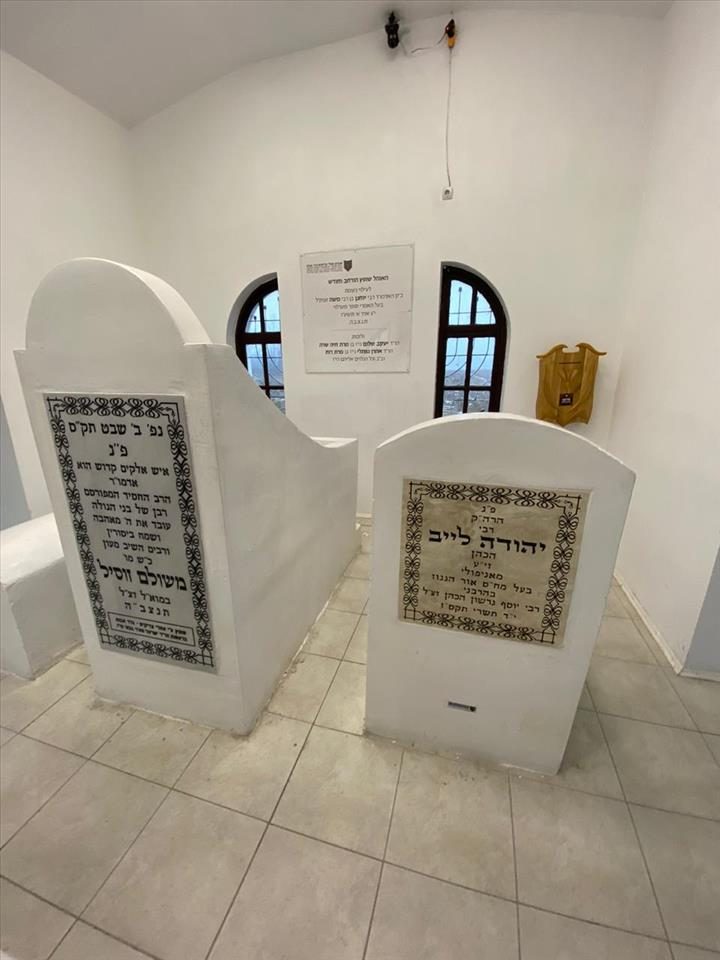
On Beis Shevat 5560 (1800), after a prolonged illness, Reb Zushe’s neshama departed in the town of Anipoli. This talmid merited what none of his fellow talmidim of the Maggid of Mezeritch did (except Rabbi Yehuda Leib HaKohen), that his kever was dug next to his teacher the Maggid of Mezeritch’s kever in Anipoli.
On his matzeiva was written: “Here lies the holy one… servant of G-d with love and rejoicing in suffering, who turned many from sin.” Later, the matzeiva was rewritten and on it written only: “The Rebbe Reb Zusha.” In the newly refurbished Ohel, the original wording was reinstated.
His Torah teachings were later collected from the notes of his talmidim and printed in the book Menoras HaZahav.
Beis Moshiach #1445 • pp. 28-32
© 2026 Beis Moshiach Magazine. All rights reserved.
This article originally appeared in Beis Moshiach #1445. You are welcome to share it with friends and family by email or in print, provided that you do not change, add to or omit any part of it, you credit the author and Beis Moshiach, and you include a link to archive.bmoshiach.org (written out in full in printed copies).
To republish this article in a newspaper, magazine, book or website, please request permission in advance at [email protected].