The Day Likkutei Sichos Crossed the Iron Curtain
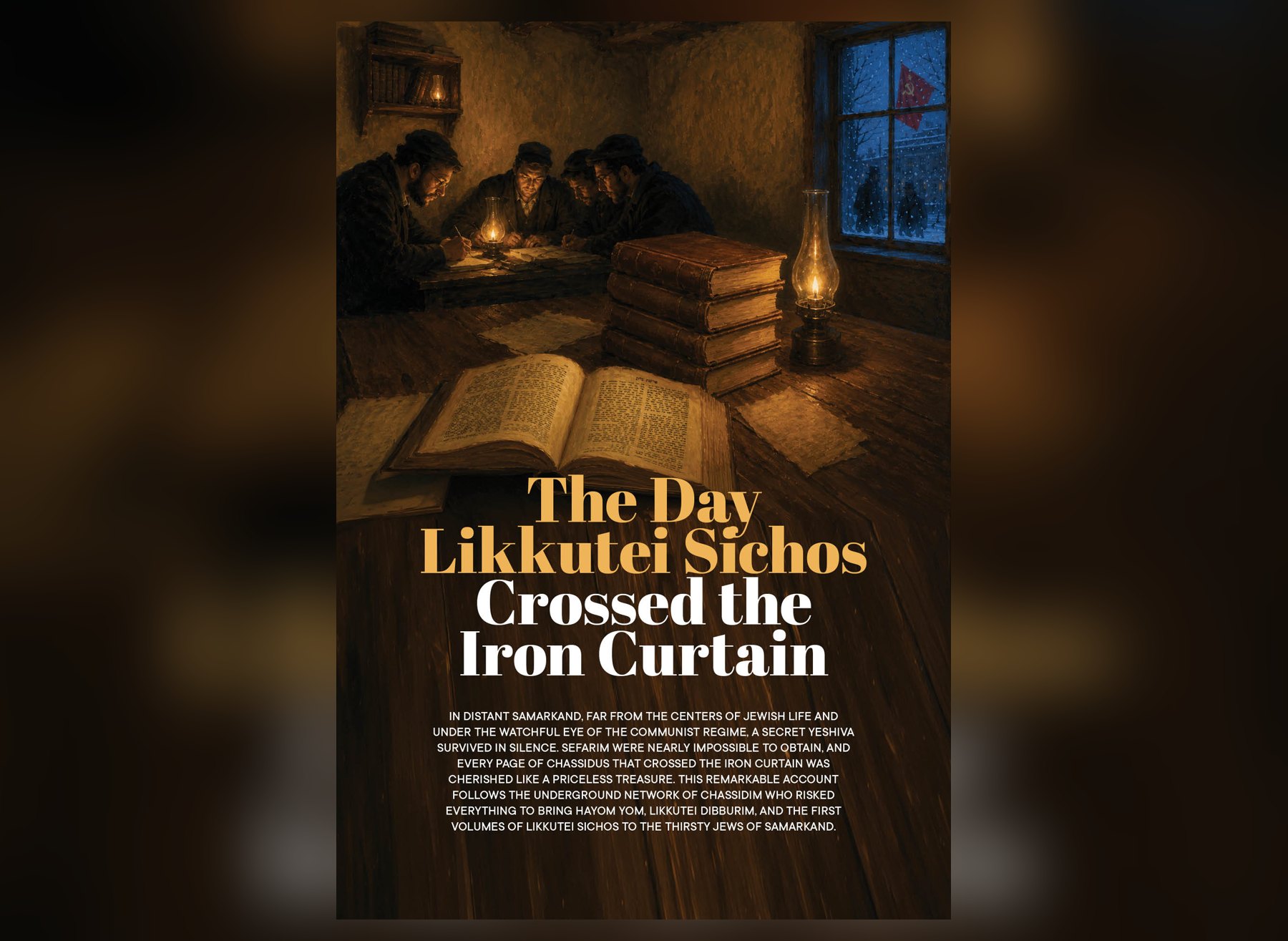
In distant Samarkand, far from the centers of Jewish life and under the watchful eye of the Communist regime, a secret yeshiva survived in silence. Sefarim were nearly impossible to obtain, and every page of Chassidus that crossed the Iron Curtain was cherished like a priceless treasure. This remarkable account follows the underground network of Chassidim who risked everything to bring HaYom Yom, Likkutei Dibburim, and the first volumes of Likkutei Sichos to the thirsty Jews of Samarkand.
I
Far from the centers of Jewish life in Communist Russia—Moscow, Leningrad, and Riga—a secret “Tomchei Tmimim” yeshiva was established. Almost no one knew about the yeshiva whose secret was kept under heavy guard. Only a few knew it had been established in distant Samarkand, and that was all.
Those few to whom rumors of the yeshiva somehow reached considered it a great privilege to help and support it. And yet, none of them asked anything about the yeshiva, in order to protect its secrecy.
A yeshiva needs money, a budget and also sifrei kodesh for study. In Russia at that time, holy books were hard to come by. There were no new printings; the old ones had been plundered by the Communists or stashed away in dusty archives in shuls that had been shut and padlocked.
The longing for sifrei Chassidus was great. The young Lubavitchers had been cut off for many years from all Chabad literature. They hadn’t seen current sichos and maamarim, and didn’t know what the Rebbe was speaking about in that period. The need to obtain holy books was a necessity.
Only rarely did they manage to receive anything Chabad-related from abroad. One way of solving the problem came in the form of businessmen who arrived in Russia from abroad on business, or scientists who came as part of scientific delegations. These would bring with them tashmishei kedusha, sefarim with sichos and maamarim, Tanyas and siddurim.
The Chassidim’s chief desire was to obtain sifrei Chassidus. Today, when bookshelves are packed with sifrei Chassidus, it’s hard to grasp the preciousness of every sefer that managed to breach the Iron Curtain and reach the Chassidim.
There was no one happier than the Chassid, R’ Hillel Zaltzman when, one day, the small but high-quality HaYom Yom came into his hands. The book arrived via tourist-businessmen who had come to Moscow. R’ Hillel took the sefer with him to distant Samarkand, and the joy of the Chassidim in the city knew no bounds. They read every single line of the calendar with passion, including the histories of our Rebbeim, our leaders, presented at the beginning of the book. Even the conditions for membership in the “Machne Israel” organization, detailed at the back of the book, were avidly read.
The young Chassidim in Samarkand were not satisfied with this alone. They took care to photograph every page of the book, developed the photos, and sent copies to Anash living in nearby Tashkent as well. Brothers in hardship and in joy alike.
II
One of the special Chassidim who worked hard to assist the yeshiva in Samarkand was R’ Yisroel Pevzner z’l.
During the war, when tens of thousands of refugees arrived in Tashkent and Samarkand, he too arrived in Samarkand and remained living in the city. His persona was a model image of a “living” Chassid. He was known as a man of great energy, the owner of a successful business, and some even said he was wealthy and generous. Outwardly he appeared as a dignified businessman, always wearing a hat and tie, but those who knew him closely knew that inwardly he was filled with Chassidishe chayus devoted to communal activity.
Because of his far-reaching business dealings, the authorities took notice of him and pursued him. As a result, he was forced to flee Samarkand; no one knew where. For a time, he moved his residence from city to city. After many wanderings, he settled in the city of Riga. R’ Yisroel had a finely developed Chassidic “sense of smell,” and somehow he learned of the existing yeshiva in Samarkand, even though no one had ever told him about it, for understandable reasons.
* * *
The meeting between the bachur, Hillel Zaltzman from Samarkand and the seasoned Chassidic businessman was a warm and heartfelt meeting between two Chassidim.
R’ Yisroel looked around as if checking the area. “Listen, I want to tell you something,” he confided a secret in the ears of his young friend, many years his junior. “Not long ago, a guest visited us—not just any guest, but a very important and distinguished guest.”
Zaltzman’s eyes widened with curiosity, but he knew he mustn’t ask. He had to wait patiently; if they told him, they would tell him, and if not, it was a sealed secret.
R’ Yisroel did not torment his young friend’s soul any further. “The Rebbe’s secretary was here in Riga,” he whispered. The eyes of the young ‘tamim’ opened wide, as though a guest had arrived from the moon…
R’ Yisroel continued, telling how the Rebbe’s secretary, Rabbi Nissan Mindel, had magnificent tefillin made from a single piece of leather, something unheard of anywhere in the entire Soviet Union! R’ Yisroel had approached him and asked to exchange tefillin with him, and the secretary agreed… The exchange was made, and the precious tefillin remained with R’ Yisroel. Since then, Chassidim would come and ask to put them on with a trembling of holiness and recite the Shema while wearing them.
“The secretary also passed along a request from the Rebbe,” R’ Yisroel added.
Hillel Zaltzman’s ears perked up. A direct request from the Rebbe! A shiver of excitement seized his entire body.
“The Rebbe asked that photographs be sent to him of all the bachurim of Anash in Russia,” R’ Yisroel whispered in strictest confidence. “I suggest you also have your photo taken, so as to send your picture to the Rebbe.”
This was already too much for the young man. The Rebbe will see my picture?! Me?! He trembled at the thought. It was beyond his capacity. Shame and fear gripped him. Had it not been for R’ Yisroel’s encouragement, who insisted and even practically dragged him to the photographer’s studio, he would never have had his picture taken. And had he not needed to keep his eyes open for the photo, Hillel would have had it taken with his eyes shut tight, for in those very moments he was recalling, in his mind, perek 12 of Tanya, “so that the Rebbe should see, at the very least, a face bearing a Chassidishe form and image”…
III
R’ Yisroel Pevzner, who felt great affection for the young Chassidic generation in the Russian valley of tears, wanted with all his heart to merit giving them pleasure in whatever way he could.
“Know that the Rebbe’s secretary, Rabbi Mindel, left with me a great treasure, two volumes of Likkutei Dibburim from the Rebbe Rayatz”…
R’ Yisroel would not agree to give the actual books to the young man, who so cherished them, because not all of Anash in Riga had yet had the chance to go through the books. “I suggest you photograph the pages of the books, and afterward develop the photos once you get to Samarkand,” he proposed.
The proposal was accepted joyfully, and young Hillel hurried to buy ten rolls of film. The bedroom in R’ Yisroel’s house was specially prepared for the secret task. Before they entered the room, R’ Yisroel asked his wife not to come in. She asked no questions. She understood, and stayed silent. Better not to know.
“Know something else,” he revealed further, “tourists who had recently arrived from the United States brought with them the first four volumes of the Likkutei Sichos series, from the teachings of the Rebbe shlita.”
Hillel Zaltzman could no longer contain himself.
“Where are they?” he cried out. To him, the news was like winning the biggest lottery prize.
“The sefarim reached Rabbi Avrohom Lubanov, known as ‘the Leffler Rav,’ the Chabad Rav in Leningrad, and he is holding onto them,” R’ Yisroel revealed the closely guarded secret. “My advice to you is to travel to Leningrad and request them from the Rav. He’ll probably be wary of you; if so, tell him that Yisroel Pevzner sent you,” he advised.
Hillel Zaltzman did not delay. When he finished photographing the pages of Likkutei Dibburim, a great and arduous task that took many long hours, he set out for Leningrad. With great strides he reached the central shul on Nevsky Prospekt 8, where most of the Chabad Chassidim had davened before World War II, in the small shul in the left-hand courtyard, on the second floor.
In a small apartment beneath the shul, Hillel found Rabbi Lubanov, who also lived there.
The Rabbi looked at the young man’s face with a closed, guarded expression. He didn’t trust him and didn’t believe he could share his great secret with him, so great was the fear in those days. Only after Hillel explained that he had come on behalf of R’ Yisroel Pevzner, and that they were old friends, and only after the Rav recognized him as one of the community of Chassidim, did his eyes light up, and he welcomed him with a warm, Chassidishe “Shalom Aleichem.” The Rav generously agreed to give him the set of Likkutei Sichos that he had kept safe.
It’s impossible to describe the great joy that enveloped the community of Chassidim and Tmimim in Samarkand when this precious treasure arrived in the city. Generously, two volumes were sent on to the young men in nearby Tashkent, while those in Samarkand began studying the two volumes in their possession. After two weeks the volumes switched hands. Within two weeks they managed to go through two volumes from cover to cover. “Day and night we studied and drank thirstily from the holy sichos,” related Rabbi Hillel Zaltzman.
Meanwhile, Zaltzman took pains to develop the film rolls containing the photographs of the Likkutei Dibburim. This was no simple matter, since merely possessing these photographs carried real risk, to the point that even the yeshiva bachurim themselves were not given the photographs to hold. Zaltzman, together with several of his friends, would sit at night and copy out the sichos of the Rebbe Rayatz, by hand, into notebooks. They would hold competitions among themselves over who could write faster and more beautifully. The handwritten copies were then passed on to the ‘tmimim’ in the yeshiva so they could study from them.
Such was the studying of the yeshiva students in those days, from handwritten manuscripts; straight, dense lines, exquisitely rounded handwritten letters. In this way they studied the profound “Hemshechim” of the Rebbe Rashab, and the maamarim of his son, the Rebbe Rayatz. Studying from the handwritten copies was done with eagerness and love, with Chassidic warmth (years later they would relate that when they reached the lands of plenty and began studying from printed sefarim, the feeling was that this was somehow a coarser way of learning…).
(Adapted from the book “Samarkand”)
Beis Moshiach #1512 • pp. 34-37
© 2026 Beis Moshiach Magazine. All rights reserved.
This article originally appeared in Beis Moshiach #1512. You are welcome to share it with friends and family by email or in print, provided that you do not change, add to or omit any part of it, you credit the author and Beis Moshiach, and you include a link to archive.bmoshiach.org (written out in full in printed copies).
To republish this article in a newspaper, magazine, book or website, please request permission in advance at [email protected].