Is Free Choice Always Free?
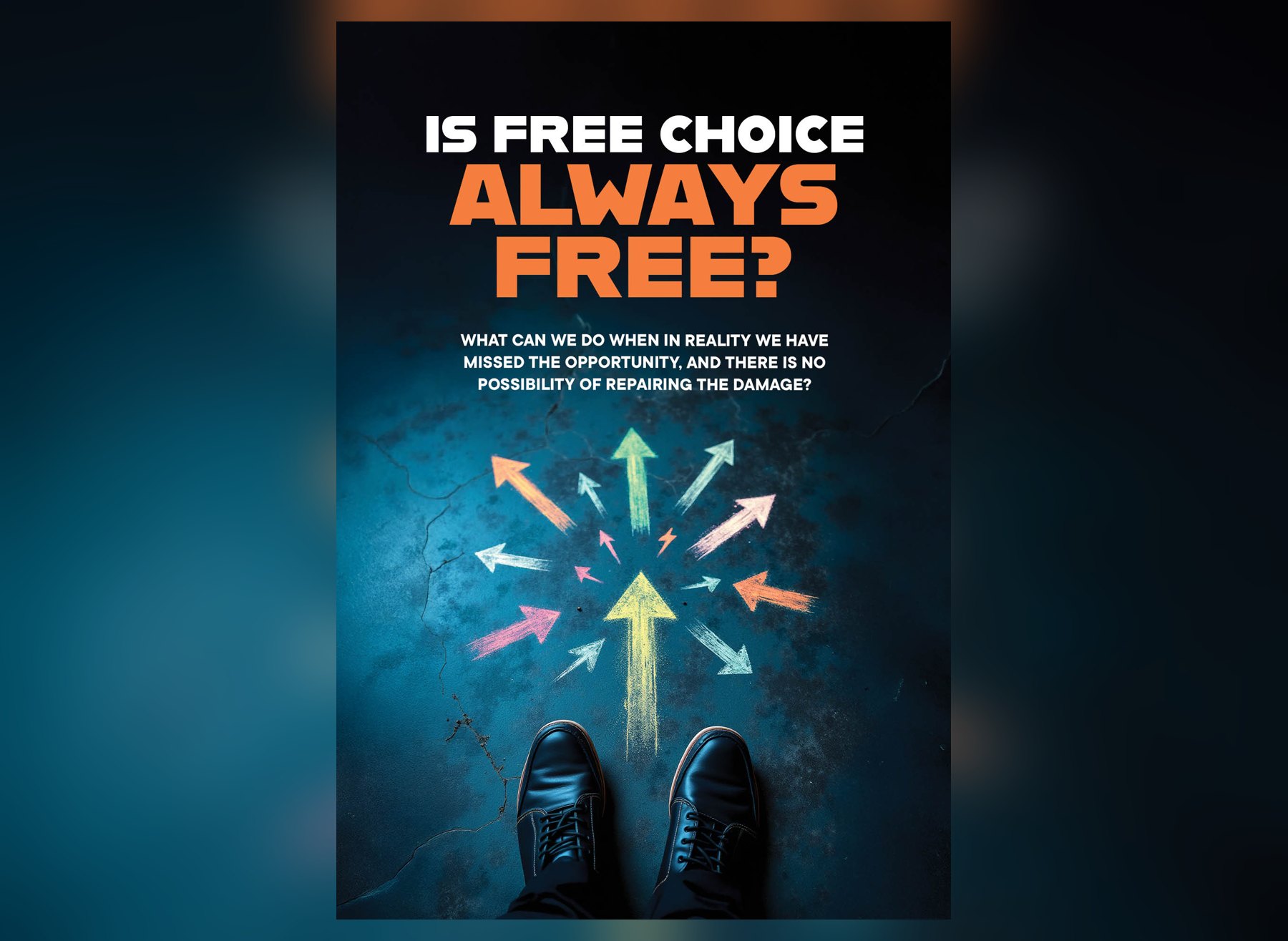
What can we do when in reality we have missed the opportunity, and there is no possibility of repairing the damage?
“I came to you because my husband asked me to get some advice regarding our daughter. However, the truth is that I no longer believe that anything can be done.”
This was Chaya, a forty-five year old mother of seven, telling her story:
“She’s twenty-one, and apparently we’ve already missed out on having a connection with her. It’s not that we haven’t tried, I just think that what we haven’t managed to do until today isn’t suddenly going to change. I don’t believe that it’s possible to do anything.”
I asked Chaya if she could describe to me what’s bothering them regarding their daughter.
She said that their daughter was unwilling to listen to them telling her what to do. “It’s impossible to tell her to help in the house because from her viewpoint, she already has her own life to live. At the Shabbos table, she gets up in the middle of the seuda and goes to deal with her own personal affairs. In the middle of the week, she is averse to updating us when she will be returning home, even though we have explained to her that we’re just worried, etc.”
As our conversation continued, the thing that stood out the most was Chaya’s feeling that the prevailing situation was a lost cause and there was no longer anything that could be done. “We don’t want to annoy her”, We don’t want to create any friction with her”, “We prefer to remain silent and hold back”, “She’ll be getting married soon in any case and most of these things will no longer be relevant”, “We’ll be quiet, swallow our pride, and move on.”
Sometimes, it seems to us that free choice isn’t really free. The difficulties exist so significantly in our reality, to the point that it creates a feeling that there’s no possibility of overcoming them, we won’t be able to deal with them, nor can we change anything for the better. The feeling is that we are bound by the limitations of this reality.
Did Pharaoh Choose?
We’re finishing Sefer Shemos this week, so let’s use this opportunity to go back to the beginning when Pharaoh received a warning before the plague of locusts. This begs the question: What was the reason for sending Moshe Rabbeinu to warn Pharaoh at a time when it was clear to everyone that Hashem had hardened his heart and he no longer had free choice? Furthermore, what was the justification in punishing him if he is unable to choose?
The Rebbe explains that while Hashem had hardened Pharaoh’s heart, nevertheless, he still possessed the ability to choose to overcome the hardening of his heart and repent. Thus, since he could have pushed himself and not acted against the Jewish people – there is room to say that he had to be warned, even punished for his evil choice.
Pharaoh And Us – What Is The Connection?
In Iggeres HaTeshuva, the Alter Rebbe explains that even in certain situations regarding which it is said that “a person is not given the opportunity to do teshuva”, if we apply pressure, get stronger, overcome our inclination, and repent – our teshuva is accepted. The meaning of “not given the opportunity” is that no one assists him. However, not only doesn’t anyone help him, but they also even place difficulties in his path to doing teshuva, such that he eventually reaches a point of stress.
Yet, there is no situation in which the path to repentance is totally blocked before us. We’ll have to make a much greater effort, prove the sincerity of our desire in the face of numerous obstacles and challenges that Heaven has placed before us, although we always have the choice of overcoming them and doing teshuva.
The kelipa associated with Pharaoh was kashyus ha’oref (stubbornness, stiff-neckedness) – ha’oref having the same letters as Pharaoh. This is the place where we make it impossible for any opening for change.
If Pharaoh, a gentile totally cut off from holiness, had the strength to repent even though Hashem had hardened his heart, this applies all the more when we’re talking a Jew with a Divine soul.
The Alter Rebbe writes in Tanya that even when a person sins and distances himself spiritually, he is still together with Hashem. The Aibishter is always in touch with us, He doesn’t withdraw from our existence, not even in situations of “stress.” Granted, it feels difficult and sometimes impossible, but we need to remember that our inner purpose is not to distance ourselves. These difficulties, these warnings, this “stress” come to remind us that it’s always possible to reconnect. Nothing is lost for good.
Irreversible?
People sometimes have a perception that there are some things are not allowed to be changed. A person says to himself:
“I can’t change. That’s just how things are in our family – cold people who don’t show any feeling or smile with a full heart.” This will also appear in our perception of the world. “People don’t change, there’s nothing to expect from them, it’s impossible to rely upon them.” Similarly, it will have an influence on one’s perception of the future: “We can never correct things, there’s nothing new under the sun. What was is what will be. There’s no hope, it would simply be preferable to continue our lives this way, without any expectations or aspirations. It would be a pity to get disappointed and break down again.”
I suggested to Chaya that before we talk about the problems she’s having with her daughter, we should first consider what she’s been feeling. Are we really dealing with a lost cause? Is it already impossible to make any changes in the relationship between parents and their twenty-one-year-old daughter?
Chaya hesitated for a moment. It’s not so simple to place question marks on something that seems to her so conclusive and definitive. It’s easier to deal with what we know, pressing on to keep from feeling the pain.
However, in the final analysis, Chaya said that perhaps this is an opportunity for her. Specifically now, when the children have grown up a little, she has time available to contemplate life. Maybe there’s some good advice here for her to be followed by a renewed sense of spiritual connection.
Summary:
Strength – Situations of stress and difficulty are a kind of warning to us that this is a good time to make a change.
Connection – It’s possible to re-establish relationships even if in reality, there are serious difficulties and challenges.
Choice – Free choice is always free even when it seems to us that the situation leaves no chance for success.
The clinical examples presented in this column have been completely changed in their details and content.
Beis Moshiach #1453 • pp. 40-43
© 2026 Beis Moshiach Magazine. All rights reserved.
This article originally appeared in Beis Moshiach #1453. You are welcome to share it with friends and family by email or in print, provided that you do not change, add to or omit any part of it, you credit the author and Beis Moshiach, and you include a link to archive.bmoshiach.org (written out in full in printed copies).
To republish this article in a newspaper, magazine, book or website, please request permission in advance at [email protected].