From Captivity to Freedom:
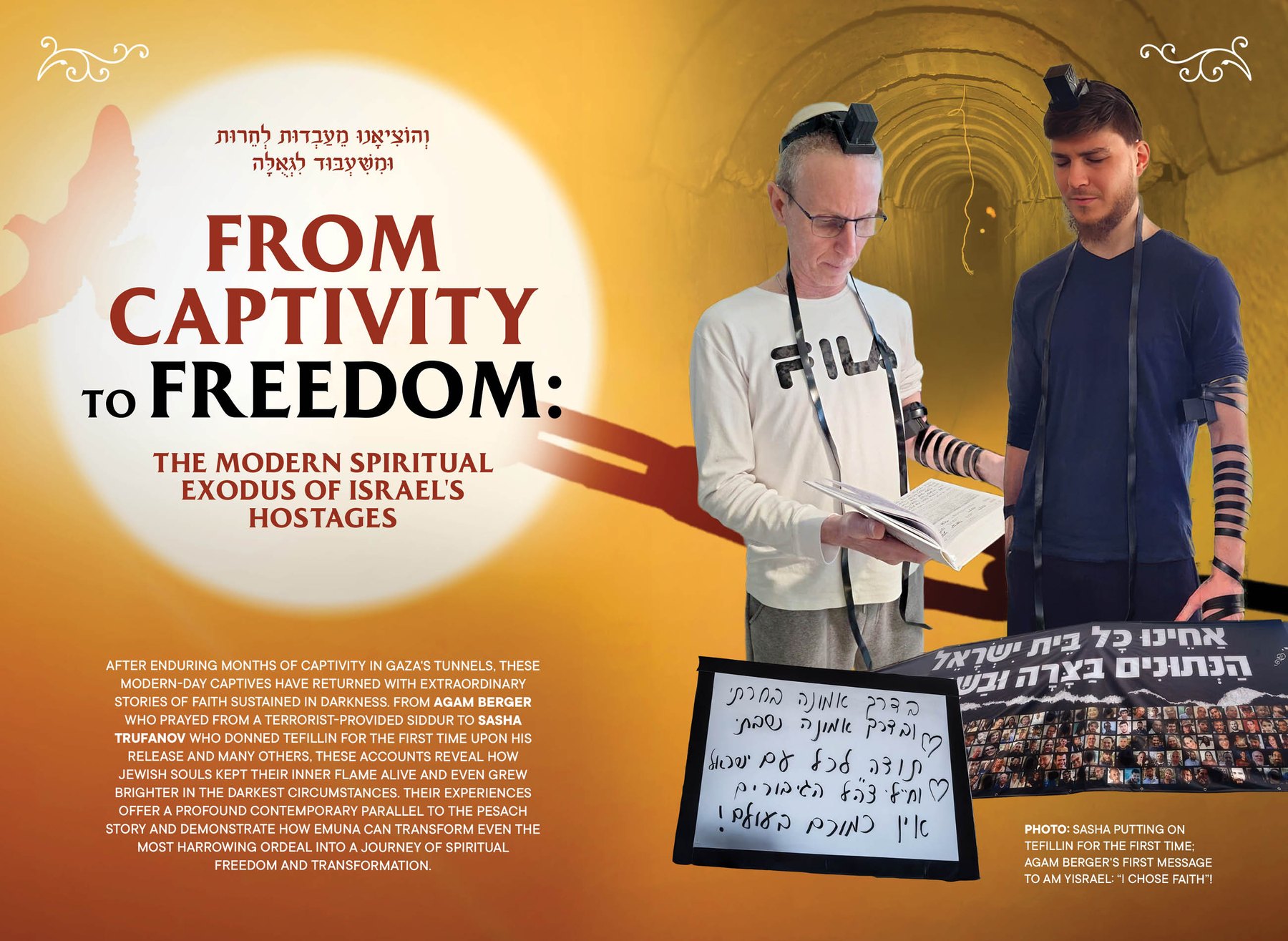
After enduring months of captivity in Gaza’s tunnels, these modern-day captives have returned with extraordinary stories of faith sustained in darkness. From Agam Berger who prayed from a terrorist-provided siddur to Sasha Trufanov who donned tefillin for the first time upon his release and many others, these accounts reveal how Jewish souls kept their inner flame alive and even grew brighter in the darkest circumstances. Their experiences offer a profound contemporary parallel to the Pesach story and demonstrate how emuna can transform even the most harrowing ordeal into a journey of spiritual freedom and transformation.
In recent times, this story repeated itself weekly: three hostages return from the dark tunnels in Gaza to their homes. Received by military representatives, they are flown by helicopter to a hospital where they are welcomed with indescribable emotion by their parents, wives, sons, daughters, and family members after such a long forced separation.
Although these scenes have been repeated week after week, one cannot get used to them. Each time, eyes tear with emotion, hearts are moved, and joy knows no bounds. Not only are the family members emotional, but with them, the eyes and hearts of all Am Yisrael who watch as we experience a kind of “uva’u l’Tziyon b’rina” or if you prefer, “with great mercies I will gather you.”
Indeed, after such a long period of hester panim, about five hundred days spent in death tunnels and hidden lairs of murderers, the hostages are able to experience open divine radiance and siyata d’shmaya that accompanies them as they exit the valley of tears in their return to their country and family.
Jewish Pride Even in Hamas Captivity
Simchas Torah 5784, 6:30 AM. Hamas terrorists suddenly attacked many settlements in the Gaza Envelope area and carried out massacres in Nachal Oz, Cholit, Nir Oz, Netiv HaAsara, Nirim, Beeri, Kfar Aza, Sderot, and Ofakim. They also carried out a mass massacre at a party near Re’im where 364 people were murdered. May Hashem avenge their blood.
The murderers did not stop there, and from all these places, they kidnapped civilians, sometimes entire families, including men, women, the elderly, children, and infants, taking them captive to the Gaza Strip. The enemy showed no mercy.
251 civilians and soldiers, Jews and non-Jews, were kidnapped during the surprise attack on that terrible morning. A record number, unprecedented in Eretz Yisrael. Most of the hostages were civilians, only a few were IDF soldiers kidnapped from bases near the border.
During the winter of 5784, the Israeli government and the murderers reached a ceasefire agreement and the release of 80 women and children who were kidnapped in the terror attack. In addition, over time, IDF soldiers managed to rescue 8 more hostages alive and 40 bodies.
These days, the second hostage release deal is being completed, during which another 31 hostages were released alive, and 4 deceased hostages (at the time of writing). Therefore, 59 hostages remain in Hamas hands, of whom 35 have already been confirmed dead.
The turmoil experienced by the hostages, as well as their families, is indescribable. Constant anxiety. During the day they wished for night, and at night they wished for day. On weekdays, Shabbos, and Yomim Tovim, the heart seems to disconnect from the body and stays with the kidnapped family members whose whereabouts and fate no one knows. Indescribable mental suffering.
In these times, the Jewish spark ignites and becomes a flame of fire. Yes, even among families who did not observe mitzvos, not even tradition. The soul is drawn to much higher places, to connection and embrace from a lofty divine place – the main thing is to hold on until “the children return to their borders.”
Throughout the past year and a half, one could see family members take upon themselves various mitzvos for the merit of their kidnapped loved ones, visit rabbanim, strengthening in emuna that spread like wildfire.
A bit more than a month ago, the safe return of military lookout Agam Berger was widely reported as when she was in the helicopter that took her for initial medical examinations, she wrote on a board “In the path of emuna I chose, and in the path of emuna I returned.” The four hundred and eighty-two days in captivity turned the 19-year-old girl into a symbol of Jewish strength filled with emuna and connection to the Creator of the world.
In the days that followed, she continued to tell how she bravely kept Shabbos and mitzvos inside Hamas tunnels, and how her parents – alongside her strengthening in Yiddishkeit – turned their longing for her and anxiety into a spiritual journey of strengthening the people of Israel.
After her release, Agam Berger shared new details about her time in captivity. She said that the terrorists moved her from place to place “about once a month.”
She knew about her release only two days before it happened. She also explained that she and another hostage, Liri Albag, kept track of the days and dates by themselves as best they could, since they did not always have a calendar. Berger said she had a conflict with one of the terrorists because she refused to read the Quran they brought her.
Her stories are astonishing. She asked Hashem to send her a Siddur, and He “who hears the prayer of every mouth” sent her a Siddur as she requested…
It turned out that IDF soldiers who were in one of the places and left, left behind Siddurim that reached the mayor of Gaza, who in turn gave them to the terrorists who gave her one of them… She noted that she “dreamed” about receiving a Siddur and then they brought it to her. “The terrorists showed us the Siddur and asked us ‘what is this’ and gave it to us,” Berger said, “we used it throughout captivity.”
Surprisingly, when she was released from captivity, the terrorists refused to give it to her… It seems that this Siddur has another mission inside Gaza…
Berger also told about Pesach 5784 that she spent in captivity: “There were no matzos, but it was clear to me that I would try to keep what I could. I asked them [the terrorists] for corn flour and dates, whatever was possible, because it was a period when there were no vegetables and other things.” She added that she also ate rice, and even used separate utensils and disposable cutlery. “Liri Albag and I drew a Haggadah from memory. We tried to have a holiday atmosphere.”
Regarding Yom Kippur, Berger said she asked the terrorists to tell her when the fast was… “We told them ‘We have holidays now, try to check for us,’ and somehow they managed to find out. I hope it was the exact date, like I don’t really know now if it was the actual date or not, but that’s what they said…”
And Rabbi Levi Yitzchok of Berditchev would be deeply moved and delighted by this simple faith that was revealed in all its beauty and glory precisely in the most difficult times.
Jewish Awakening Among Hostage Families
The demonstrated Jewish awakening began shortly after the massacre and kidnappings. The Rebbe’s shluchim in Eretz Yisrael made contact with hostage families and promoted various emuna initiatives with them through joint meetings.
One of the initiatives of the shluchim in every place where there were hostages was to check the mezuzos in their homes, following what the Rebbe said after Operation Entebbe in 1976, to check the mezuzos in the homes of the survivors. The shluchim were warmly received.
“There were several hostages whose mezuzos we replaced in their homes, and they were able to leave Hamas captivity,” said shliach, Rabbi Menachem Volika. “Just one week after we checked the mezuzos in the homes of three hostages from the settlement of Maale Tzviya near Karmiel, we were happy to hear that these hostages were released from Hamas captivity. The first hostages released during the first ceasefire were from Kibbutz Nir Oz – the first place we worked with the mezuzos. We saw how fixing and replacing the mezuzos affect the world.”
The connection of the Rebbe’s shluchim with the hostage families continues to this day – a personal connection that has accompanied them throughout the past year and a quarter.
It is no wonder, then, that after the heroic rescue of hostage Noa Argamani, she came to offer a tefillas hodaah at the Ohel, taking the opportunity to also daven for the rest of the hostages who have not yet been rescued.
Argamani thanked for her miraculous release from captivity and mentioned that her father Yaakov had visited the Ohel during the time that he davened and hoped for her release, bringing with him a picture of his daughter and asking for her safe return home. The moving documentation of him with his daughter’s picture was published in thousands of media outlets around the world.
In a moving farbrengen held at the Chabad House in Neot Afeka even before her miraculous release, Yaakov Argamani gave a short speech, full of inspiring emuna: “We had the privilege of asking for the Rebbe’s blessing, and we also visited several Chabad Houses around the world.
“This is a difficult time for us and many ask me ‘how do you manage to handle all of this?’ and I tell them: ‘I am a member of one of the most unique peoples in the world. There is no substitute for this world without this people… We are the children of G-d, and that gives us strength. Emuna in G-d, tefillos in shul, these are the things that strengthen us. I believe” – Mr. Argamani concluded – “that the yeshua, G-d willing, will come soon. It’s just a matter of time and everything will return to normal. My daughter will return, and we will be a family again.”
A few days later, his daughter was miraculously rescued by IDF soldiers along with three other hostages.
This is how the hostage families were strengthened by the Rebbe’s shluchim, and also through other means. The spark of emuna became a flame that burned intensely. In the face of the violent protests that flooded the streets of Tel Aviv “for the release of the hostages,” many families preferred to direct their energies toward prayers, good deeds, and strengthening emuna for the sake of the hostages.
“‘Kesher Yehudi’ and hostage families in a Jewish unity initiative,” this was the headline for a special evening organized by the Kesher Yehudi organization – “An evening of chizuk, tefilla, and sharing the burden.” Shelly Shem Tov, mother of Omer; Meirav Berger, mother of Agam; and Anat Angerst, mother of Matan, spoke at the event. The mothers shared their heartbreak, longing, and the reserves of emuna that keep them going.
This was one event out of hundreds that took place for religious women during the past year and a half.
Jewish arousal spread rapidly and touched countless hearts. In Kislev, hundreds of communities held special tefillos and initiatives for the return of the hostages, “with strength and victory,” as part of a dedicated Shabbos. The hostage families, who initiated the special Shabbos, called on the public to join them and mark the Shabbos with the sign, “It is my brothers that I seek.”
As part of the initiative, the hostage families asked to light an additional candle when lighting the Shabbos candles, and to join the cry for their return. The families also called on people to go out to the city streets during the recitation of “Lecha Dodi” and invite neighbors and passersby to pray together in unity for the hostages.
For the Jews There Was Light and Joy
Those recently returned from captivity also intensified the light of emuna everywhere. No, these are not talmidei chachamim, Chassidim, and G-d-fearing people who grew up with Torah. These are simple Jews whose emuna is their stock in trade. But the jarring images shook many hearts.
“Everyone is searching and not finding the moving reunion video showing Abera Mengistu’s mother running to him, hugging him after ten years of longing – but this mother observes Shabbos,” was written in one place about Mrs. Agernesh, the mother of Abera Mengistu who returned from captivity last Shabbos after ten years.
Every time the hostages return, Am Yisrael are moved to see the heart-wrenching videos showing parents waiting for their son, hugging him with excitement and crying on each other’s shoulders. But in Mengistu’s case, the mother was absent.
“Ten years she hasn’t seen her son. Ten years of tears, of prayers, of dreams that shatter every night anew. And yet she waits until Shabbos is over. What emuna! What strength!
“In a world that rushes to see everything, share everything, the mother stops, because her emuna is greater than her longing. Because for her, Shabbos is holier than any mother’s tears. This is a mother who will go down in the glorious annals of Jewish history; not only as Abera’s mother, but as a symbol of faith that was not broken, strength that did not bend even after ten years.”
Along with Abera, Eliya Cohen also returned from captivity, after more than five hundred days in Gaza tunnels.
A few hours after the end of Shabbos, his grandfather, Aharon Rabi, performed a highly publicized Havdala ceremony in the hospital, joined by the other hostages released that day, Omer Shem Tov, and Omer Neutra.
The happy grandfather surrounded by the three released captives was seen savoring each word – as if it had been written for the occasion: “Behold, G-d is my salvation, I will trust and not be afraid… Happy is the man who trusts in You, L-rd, save us, the King will answer us on the day we call… For the Jews there was light and joy, gladness and honor.” Each word perfectly framed, spoken with overwhelming emotion of joy. And the eyes? The eyes of the hostages and all their family members surrounding them with love – sparkle with happiness.
In an interview the excited grandfather gave, he shared the moving moments of reunion with his grandson, the hardships he endured during captivity, and his strengthened emuna.
“Since the release I’ve been emotional, we got Eliya back after almost a year and a half, 505 days. We prayed all the time – morning, noon, and evening, we visited rabbanim, and boruch Hashem, the tefillos were answered,” he says.
Aharon Rabi, who performed the Havdala for his grandson and the other hostages, described the emotions that poured forth in those moments: “When I performed the Havdala, something broke inside me. For 505 days he wasn’t the same Eliya, and I – I wasn’t the same Aharon. Every word I said, I said from the heart, with full kavana. It was important for me to make him happy, and he was happy, boruch Hashem.”
When asked what his grandson told him about the difficult period in Gaza, Aharon Rabi answered painfully: “Eliya said that they were bound in chains, that they had nothing to eat, that they were always in darkness – no sun, no light. Sometimes they received slightly better treatment, sometimes less, it constantly changed.”
Rabi told about his grandson’s medical condition after he returned: “He lost more than 20 kilos [44 pounds], but he is lucid, recognizes everyone, smiles, laughs. He just walks with a slight limp because of the leg injury, but b’ezras Hashem, he will recover very quickly.”
He added that one of the moments that moved him the most was when his grandson said a bracha on food: “They gave him cake, and he said a bracha. It’s a moment that can’t be explained in words. After almost a year and a half – to hear his voice saying a bracha, it’s simply a miracle.
“We are a religious family, but I’m sure my grandson became even stronger there. I believe he will keep Shabbos, attend shiurim, and pray three times a day. Either way, the coming Shabbos will be exceptionally special. We are planning a big seudas hodaah in Yerushalayim; there will be a Kiddush, everyone is invited!”
If Only On Yom Kippur I Could Feel Like This…
Recent cases make us forget earlier ones.
Just a week ago, the hostage Sasha Trufanov was released, also with obvious miracles. The first to welcome him and help him put on tefillin was the shliach and Chief Rabbi of Russia, Rabbi Berel Lazar.
Already at the outbreak of the war, Rabbi Lazar approached Russian President Vladimir Putin, who got deeply involved and consistently worked for the release of family members with Russian passports, and later influenced the current release of Sasha.
“There is strong Russian involvement in the entire hostage issue, but I won’t go into too many details because I don’t think the time has come yet to tell everything,” Rabbi Lazar said this week. “What I can say is that there were several conversations with the Russian president on this subject, and he is completely involved with everything that’s happening. Both when Yelena, Sasha’s mother, was herself released from captivity in Gaza, and now with the story of her son Sasha, Putin himself is personally involved. He not only asked to deal with it directly, he follows up on it.”
During Rabbi Lazar’s visit to Sasha upon his release, for the first time in his life Sasha had the privilege of fulfilling the mitzva of putting on tefillin, and received a special gift from the Jewish community – a pair of mehudar tefillin and a Chitas for protection. Everyone’s eyes teared up, led by his mother who made a kiddush Hashem with her emuna and bitachon throughout the difficult period she went through, alongside major steps she took in strengthening her observance of Torah and mitzvos together with all her family members. Now her son Sasha joined with this moving hanachas tefillin.
“After Sasha put on tefillin, he was very excited by the tefilla, and thanked G-d for the hatzala,” Rabbi Lazar said. “I told him that it’s a special moment when he puts on tefillin and prays to Hashem.”
Yelena Trufinov was held captive for 54 days along with her mother. She even witnessed how the terrorists took her husband with them. She thought he was also kidnapped, but only after she was released did she find out that he had been murdered on that same day.
Regarding the rescue of Sasha’s mother, Rabbi Lazar excitedly added: “Thanks to the pressure exerted by Putin, two women, Leah (Yelena) and her mother, who were together in captivity, were released. When they came out, I met two women for whom Torah and mitzvos were not part of their lives but as soon as they were freed, they understood that they needed to strengthen themselves after everything they had been through.
“Already in the first meeting, she came to the Kosel and took upon herself to start keeping Shabbos and kosher, and daven every day.
“Leah reads Sefer Tehillim every Shabbos. It took her 4–5 hours to finish the entire Tehillim. She also changed her life. Throughout the time she was in captivity, she prayed and worried for her son, saying, ‘What I am most worried about is that he will come out, b’ezras Hashem, with strong emuna. What will he do when he sees that I have become a religious woman? Maybe this will even bring our family closer together…’
“When they announced the release of her son,” Rabbi Lazar continued, “she called and asked, ‘What should I do? He’s being released on Shabbos, and I took upon myself to keep Shabbos… Is it permitted for me to go meet my son when he is coming out of Gaza on Shabbos?’ She added, ‘If you tell me no, I won’t go to meet him…’ This is a woman who, just a year and a half ago, didn’t even know what Shabbos was… I ruled that it was permissible for her to be there and meet him, but she requested and announced that no photos should be taken or published from the meeting, so that, ch’v, Shabbos wouldn’t be desecrated because of her…
“The next morning, I was privileged to meet Sasha Trufanov. I was told in advance: don’t try to pressure him, don’t try to talk to him about Yiddishkeit. Despite this, of course, I brought tefillin, a Siddur, and sifrei kodesh, and suddenly a Jewish soul with immense spirit was revealed. After he put on tefillin, he recited the Shema. After he said ‘Shema Yisrael,’ I told him, ‘Now you can open your eyes and thank Hashem for the miracles, and pray for the people of Israel, and for the other hostages.’
“The scene I witnessed – I hope to merit it at Neila, at the end of Yom Kippur. This young man began to pray from the heart. This was someone who had no connection to Yiddishkeit, and suddenly I saw how the spark of his soul was burning in him, no less. He thanked me for the tefillin and said that he wanted to learn. I saw ‘Naaseh v’Nishma’ (we will do and we will hear) literally. First, he fulfilled the mitzva of tefillin, and only then asked: Why seven times? Why the tefillin on the head this way and on the arm that way? He had no idea what was inside the tefillin. On the other hand, I saw in him emuna peshuta, just like they once spoke of simple Jews. I have seen a lot in my life, but I never witnessed anything like this in my life…”
Yelena Trufanov herself, recounted with amazement in an interview she gave to ‘Kol Barama’ radio, that her son returned from captivity with emuna in Hashem: “It was a miracle above nature – he came back a believer. He felt that people were praying for him, he said that he had obvious miracles there, that Hashem watched over him, and he came back a believing person.”
The picture of Sasha putting on tefillin immediately after his release moved all Am Yisrael, and his mother Leah confirmed that he greatly strengthened in his faith following the difficult experiences he went through.
“He told about situations that I cannot reveal but these are obvious miracles. G-d protected him even in situations where seemingly there was no hope left, but he was saved and returned home. He planned his life this way and that, but G-d chose differently. He sat there and understood that everything depends only on G-d, he returned with the knowledge that everything is from Him. I hope he will continue to get stronger,” she said.
She also shared the deep connection she felt to the figure of Rochel Imeinu: “I was at Kever Rochel on her hilula, and prayed that I would see my son – one day after that I received a video of my son… I connected so much to Rochel Imeinu who had a son, Yosef, and he too was in captivity. When Sasha returned, he told me that Hamas told him to choose another name so they wouldn’t identify him, and miraculously he chose the name Yusef…
“There is no doubt that Hashem protected him,” his mother emphasizes. “I said the bracha of ‘Shehecheyanu,’ and we will go to shul and say the HaGomel blessing with Sasha.”
* * *
Are these signs of faith a natural consequence given the difficult circumstances? Do they have any substance? And what is their impact on Israeli public life, which is currently grappling with conflicts between emuna and ‘progressive’ ideology that seeks to uproot faith from the public sphere?
It turns out that when we hear the opposing side, we can understand the immense importance of emuna that is pulsating strongly and being proclaimed everywhere.
In an article published this Tuesday by the media critic of Haaretz, Yasmin Levy, the writer angrily criticizes the media for giving a platform and publicity to “religious gestures,” as she calls them, of released hostages and their families. She expresses her displeasure at the extensive coverage of hostages who kept mitzvos while in Hamas captivity, as well as families who found comfort in prayer, viewing this as a “dangerous religious agenda” driven by media outlets that, in her words, “cater to representatives of G-d.”
“Recently, it seems that G-d is not only in the small details but is hovering everywhere, if we believe the numerous items published about hostage families who strengthened their faith, prayed, and now thank ‘first of all the Creator’ for the return of their loved ones,” she begins her article.
Levy claims she does not judge the hostages and their families who turned to faith out of distress, but she is shocked by how the media gives prominence to these matters. For example, she describes the extensive coverage of the mother of Omer Shem Tov, who spoke about her tefillos, or the mother of Eliya Cohen, who said that her son did Kiddush in captivity.
It turns out that these expressions of emuna from the hostages’ parents and the hostages themselves fall on fertile ground – a ground of faith that is growing stronger among hundreds of thousands of Jews. Since the outbreak of the war, a spirit of emuna has been increasingly taking root across the nation, indicating more than anything that Israel is a Jewish state, not a “liberal and progressive state.” Torah and mitzvos are the backbone of the national ethos of the people living in Tziyon.
It is not surprising that hostages like Eliya Cohen or Ohad Ben Ami say that “faith strengthened and saved” them, or that families like Roni Gonen’s find comfort in the Siddur. The media is not “encouraging religious coercion” when it reports on this – it is simply doing its job: reflecting reality as it is.
When Eliya Cohen’s grandfather leads the Havdala at the medical center, or when Agam Berger’s mother asks not to take photos on Shabbos, the media is not “debasing itself” – it is broadcasting life itself. Families calling for mass prayers or hostages speaking of miracles are not trying to “numb” the protest; they are holding on to what has kept this people alive for generations. This is the reality of a people for whom faith is part of the national DNA.
This approach has accompanied the families of the hostages throughout the past year and a half, during which the families participated in emotional prayer rallies, hafrashas challa events, and other faith-based events of making good hachlatos, alongside other ceremonies.
“Omer’s Release This Shabbos Is Not Coincidental”
One of the women who most exemplified the way of emuna throughout the period of great pain was Meirav Berger, the mother of kidnapped Agam Berger.
Meirav Berger reached out several times to the public in Israel, asking that they observe the Shabbos on which her daughter was supposed to be released, in her honor. When her daughter finally fell into her arms, the first words the mother spoke to the public were “Shema Yisrael Hashem Elokeinu Hashem Echad – Agam is coming home…”
Also, Mrs. Shelly Shem Tov, the mother of the hostage Omer Shem Tov, who was released on Shabbos, shared the spiritual path she had taken since her son was kidnapped to the Gaza Strip.
In a post she put up last erev Shabbos, Shelly Shem Tov wrote that exactly one year ago, on erev Shabbos Parashas Mishpatim, she was invited to attend a Shabbos organized by the ‘Kesher Yehudi’ organization for the families of the hostages. The Shabbos, which took place with charedi families who hosted them, was a life-changing experience for her. “The Shabbos was so powerful – the connection between the hostage families and the charedi families, the tefillos, the singing, and the kedusha that was felt every moment,” she wrote excitedly.
This deep experience led Shem Tov to adopt shemiras Shabbos, a commitment she continued throughout the year. “Since then, I have kept Shabbos,” she wrote, adding that this decision was accompanied by a deep feeling of connection to faith and the Creator.
She further wrote: “And on this Shabbos, I will be privileged to embrace my Omer exactly one year later. It’s amazing how everything is so precise.”
For her, Omer’s release on this Shabbos was not coincidental – it serves as testimony to the power of faith and the feeling that “there are no coincidences in the world – everything is from Him and all are messengers to the Creator.”
“Throughout the Entire Captivity, I Felt That Someone Above Was Watching Over Me”
Thus, the waves of faith that have flooded Agam Berger and her family, as well as Noa Argamani and her family, and the mother of Abera Mengistu, and Mrs. Shelly Shem Tov, Eliya Cohen and his family, and many others.
Here are a few more examples of emuna bursting forth:
For example, the words of Keith Siegel, who was released from Hamas captivity after 484 days. Keith, 64, from Kfar Aza, an occupational therapist and nature enthusiast, was kidnapped on Simchas Torah morning from his home, along with his wife Aviva, who was released after 51 days.
In a conversation this week with the chessed powerhouse, Shai Graucher, he spoke about how he became closer to religion during his captivity. “I started saying brachos before meals,” he says, adding about the tefillos he said during his captivity: “The first thing I wanted to do when I came back was Kiddush and to say ‘Hamotzi…’”
This spiritual strengthening was not his alone. Ohad Ben Ami, a kibbutznik at heart, who returned from captivity, also spoke while adorned with tefillin:
“Throughout this captivity, I really felt that there is Someone above watching over me, and I had to be strong,” he said.
In a video released that same week, Ben Ami sent a message of faith to the people of Israel: “Our people are a strong people. Even though we seemingly come from different camps and different exiles, inside we are a strong people, and what unites us is emuna. Personally, I feel that faith in G-d held and saved me, and thanks to G-d, I am here, back after captivity. I probably needed to be metaken (spiritually rectify), probably had to go through this. This captivity only makes me stronger.”
Ohad Ben Ami was kidnapped by the terrorists along with his wife Raz from their home in Kibbutz Beeri. His wife was released in the first deal, but he was only released after 491 days of captivity.
“My message to the people of Israel,” he declared, “is that our faith is what unites us, and it also gives us strength in moments when we are most humiliated and most broken. It holds a person strong, helps them overcome all difficulties, and return stronger. We are here to win.”
It seems there is no better way to end this article than with the words of Mrs. Meirav Berger herself, when she welcomed her daughter after her release. She said her words at a press conference before the public and the world, how fitting, with Jewish pride:
“On this emotional day, I want to mainly say one word – toda. Thank you to the Creator of the world. Thank you to Am Yisrael and the Jewish communities in the Diaspora, who stood by us with inspiring unity and mutual responsibility, who rejoiced with us, fought with us, prayed with us, taught us what love of others is, wrapped it in endless love, and turned every stone with self-sacrifice to bring our Agam home.”
Shai Graucher, who initiated a year-long project of good deeds for the hostages, recounts:
“I heard from the hostages who returned, that while they were in captivity, they heard about the good deeds that Am Yisrael were doing, and this strengthened them a lot. The knowledge that the nation cares, that they unite and act for their benefit, gave them the strength to stand on their feet.”
* * *
In the period following the Six-Day War, the Rebbe referred to the spiritual awakening of those days and connected it to the coming Geula.
In a maamar the Rebbe said on Rosh Hashana 5728 about the pasuk, “And on that day a great shofar will be blown,” the Rebbe explained that the reason why those who were ‘lost’ and ‘scattered’ are awakening in teshuva is because the process of ‘a great shofar will be blown’ has already begun.
Beis Moshiach #1455 • pp. 12-23
© 2026 Beis Moshiach Magazine. All rights reserved.
This article originally appeared in Beis Moshiach #1455. You are welcome to share it with friends and family by email or in print, provided that you do not change, add to or omit any part of it, you credit the author and Beis Moshiach, and you include a link to archive.bmoshiach.org (written out in full in printed copies).
To republish this article in a newspaper, magazine, book or website, please request permission in advance at [email protected].