A Soldier at 770’s Amud
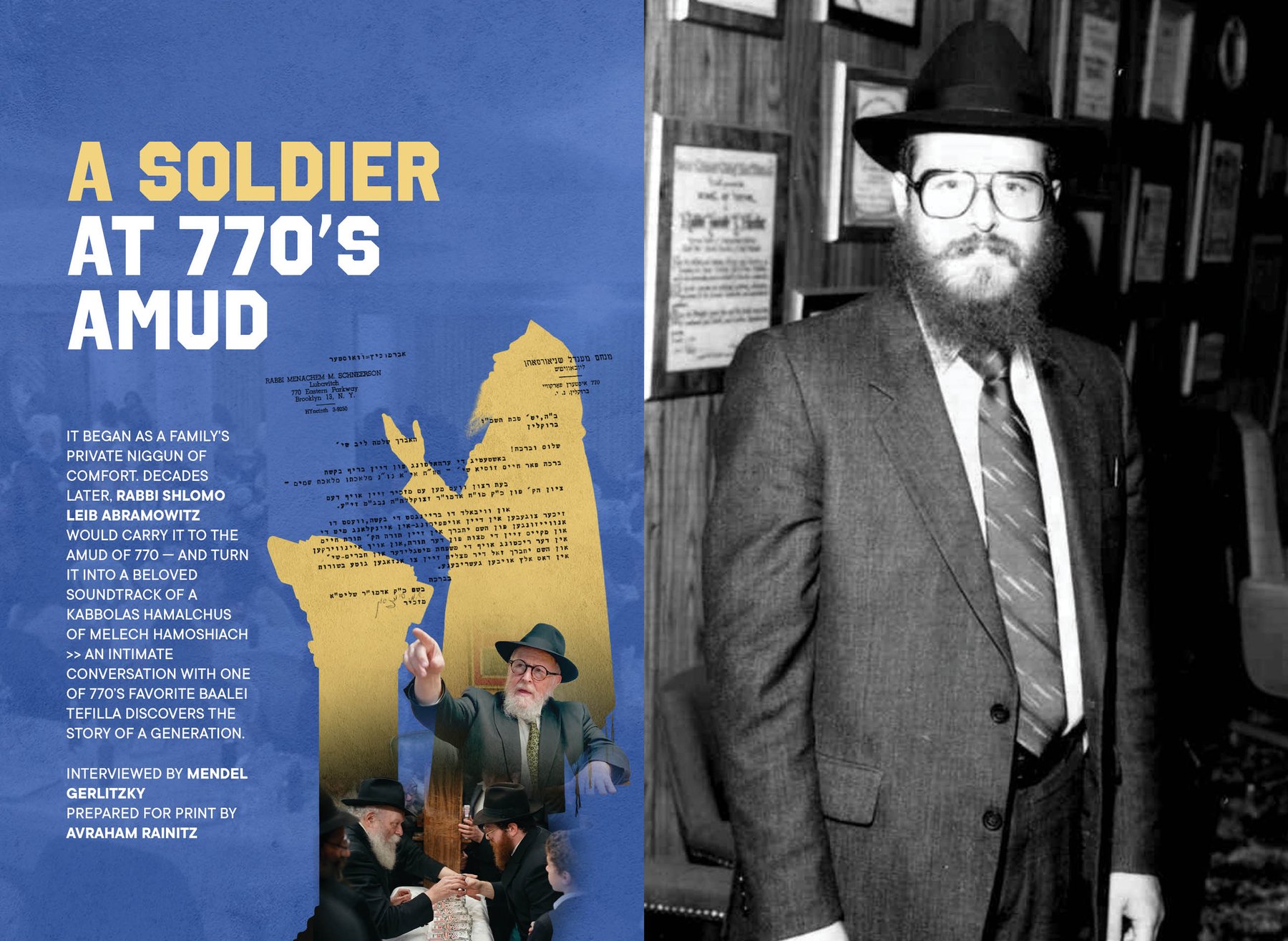
It began as a family’s private niggun of comfort. Decades later, Rabbi Shlomo Leib Abramowitz would carry it to the amud of 770 – and turn it into a beloved soundtrack of a Kabbolas Hamalchus of Melech Hamoshiach. An intimate conversation with one of 770’s favorite baalei tefilla discovers the story of a generation.
The first Friday night after Chof-Zayin Adar I, 5752 (1992).
The Rebbe MH’M was upstairs in his room following the stroke he had at the Ohel, and thousands of Chassidim below were grasping at every shred of hope. The first Shabbos was about to begin and 770 was enveloped in a “kalamutneh” atmosphere, a dark heaviness, and no one understood how it would be possible to daven “Lecha Dodi” without the Rebbe on the platform, as everyone had been accustomed to all those years.
As it became time for Kabbolas Shabbos, Reb Shlomo Leib Abramowitz, the chazzan whose powerful voice had already become an inseparable part of 770’s soundtrack, was asked to approach as shliach tzibbur.
Reb Shlomo Leib stepped up to the amud, and his voice reverberated through the tense space. He began the tefilla and upon reaching “Lecha Dodi,” the crowd, already familiar with the “dreidlach” (musical flourishes) of this baal tefilla, knew that when he reached the words “lo seivoshi v’lo sikalmi,” the tune was about to change.
And then, out of the tense silence and piercing pain, Reb Shlomo Leib chose to sing that tune, the Hecht family’s niggun. The melody played, swept along, climbed upward. He reached the end of the piyut: “Boi v’shalom ateres baalah, gam b’rina uv’tzahala… boi kalla, boi kalla”—and what happened in that moment, no one could have planned.
Like a breached dam, like a volcano of emuna and anticipation erupting all at once, the crowd simply began singing on its own (“fun zich alein”). “Everyone sang the niggun,” Reb Shlomo Leib recalls, “but this time they sang it with the words: ‘Yechi Adoneinu Moreinu v’Rabbeinu Melech HaMoshiach L’olam Va’ed!’”
It was no longer just a niggun. It was an inner cry of Chassidim unwilling to give up. For half an hour, maybe forty-five minutes, an eternity in terms of tefilla, the entire crowd sang continuously, without pause, from that inner feeling: “Melech HaMoshiach L’olam Va’ed.”
In those moments, amid the emotional storm of the Shabbos following Chof-Zayin Adar, the anthem was created that has since accompanied Chabad Chassidim as part of the text of “Lecha Dodi.” The niggun that until recently had been a “family anthem” became, in an instant, the soundtrack of the Geula.
Musical Roots of the “Nusach Ha’Ari”
Who is this Chassid who managed, and still manages, to stir 770 at such a sensitive moment? How did one man become the soundtrack for thousands of Chassidim?
Reb Shlomo Leib Abramowitz doesn’t claim the title “chazzan.” He simply defines himself as a “baal tefilla,” but one who creates a special atmosphere in the shul. The powerful, resonant voice, together with his presence at the amud, was something of a “chiddush” in 770 in those years.
To understand the power of the connection between the niggun, the tefilla, and the crowd, one needs to know the man who stood there behind the shtender.
His story begins on Rosh Chodesh Kislev, 5713 (1952), in the city of Worcester, Massachusetts, where he was born and raised in a family defined as “ordinary Litvish.” But beneath the surface flowed currents of Chassidus, currents of tefilla and niggun. His father, Reb Eliyahu Shmuel Abramowitz, came from the city of Dvinsk in Latvia, a city bustling with Jewish life, home to spiritual giants such as the Gaon known as the “Rogatchover” and the author of “Ohr Sameach.” His father even had the privilege of knowing them personally.
It turns out, quite a few Chassidim lived in Dvinsk. “There were many ‘Nusach HaAriniks’ there,” explains Reb Shlomo Leib. “Not necessarily Lubavitcher Chassidim, but there were Chabad Chassidim there too.” And indeed, although his father did not grow a beard, he made a point of davening in “Nusach Ari,” the nusach he had absorbed in his hometown.
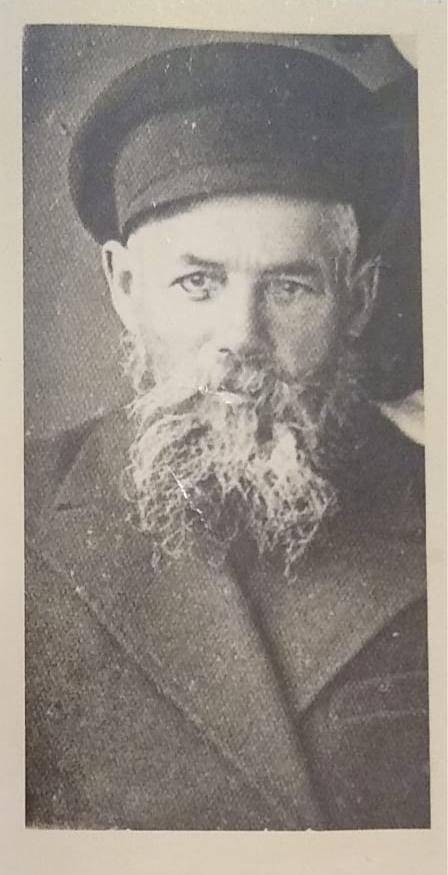
His father was a gifted baal tefilla. He served as a baal korei, taught bar mitzva boys, and also worked as a shochet for his livelihood. Young Shlomo Leib’s first exposure to the world of tefilla and nusach came from the time spent walking alongside his father.
His father was active in the Ashkenazi shul near their home, where he served as a kind of shamash and baal korei. In addition, every Shabbos the family would walk to Worcester’s old-age home, where the father would read from the Torah for the residents there. “On the Yomim Noraim,” Reb Shlomo Leib recalls with longing, “my father stood at the amud, and my brothers Levi Yitzchok and Tzvi Dovid and I would stand beside him, ‘helping’ him like a choir of young chazzanim. Years later, my brother Levi Yitzchok also became one of the well-known baalei tefilla of 770.”
But the musical talent and the powerful voice didn’t come only from his father. His mother’s family, too, was deeply rooted in the world of music and chazzanus. His maternal grandfather was the chazzan Nosson Stolnitz, born in the city of Vilna, who later emigrated to Canada.
R’ Nosson was not merely a chazzan-baal tefilla, but primarily a musical authority and author of books. He is one of the founders of the Cantors Association of the United States and Canada. “He knew all the great chazzanim of the ‘Golden Age’ of the previous century,” recounts Reb Shlomo Leib. “The Kousevitzky brothers grew up with him on the same street in Vilna and knew him well.” The grandfather, who carried himself with dignified bearing, wearing a Homburg hat and conducting himself meticulously in mitzva observance, was a familiar figure at the annual chazzanim’s conventions for which he even wrote his books.
Out of this melting pot, combining classical chazzanus, roots from Vilna, and “Nusach Ari” from Dvinsk, there began to take shape the baal tefilla who would one day stand at the amud in 770.
First Chassidic Seeds
In those days, the central Jewish school in the city was “Achei Tmimim,” established at the initiative of the Rebbe Rayatz with the goal of rescuing Jewish children in America from public education. At the head of the institution stood the unforgettable shliach, Rabbi Yehuda Tzvi (Hershel) Fogelman. “In the early days,” Abramowitz describes, “Rabbi Fogelman and his wife would knock on doors and ask families: ‘Do you have children at home? Why don’t you send them to our yeshiva?’ When the parents said public school was free, the Fogelmans reassured them: ‘Don’t worry about the money, we’ll help you.’”
Attending “Achei Tmimim” was Reb Shlomo Leib’s first glimpse into the world of Chabad. The institution operated with the goal of serving the city’s entire population—Holocaust survivors, ordinary American families, and Shabbos-observant Jews from all circles. So that the school would be acceptable to everyone, the school administration was careful not to push the Lubavitch agenda too aggressively. “They didn’t even teach us the Ma Nishtana according to the Lubavitch order, but according to the common custom,” he recalls. “They probably worried that if they started teaching Chabad customs, the parents wouldn’t understand it.”
And yet, the Chabad scent wafted through the air: pictures of the Rebbe and the Rebbe Rayatz hung in the principal’s office, and he still remembers young boys singing at the top of their lungs “Pada B’shalom Nafshi” on Yud-Tes Kislev. The first seeds of hiskashrus, even if hidden from view, were planted deep in the ground in those days.
A Child’s “L’chaim” Cup
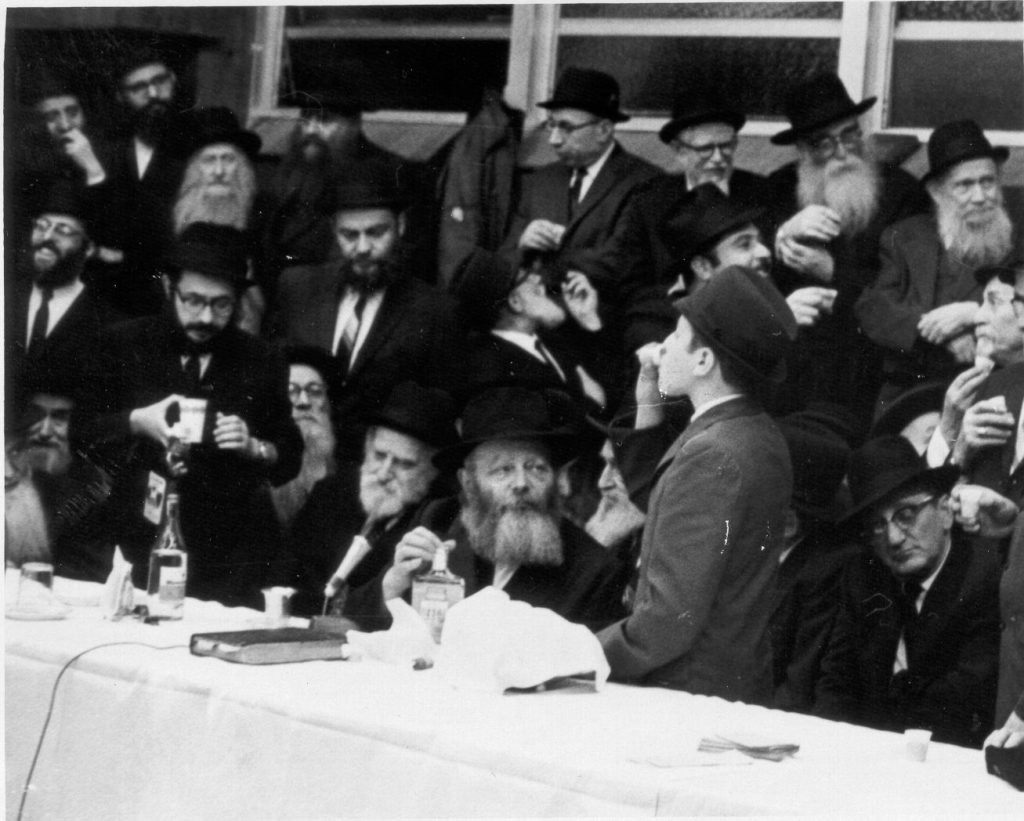
In the year 5724 (1964), the “Achei Tmimim” school in Worcester organized a special Shabbaton in New York for several grades. For young Shlomo Leib, it was a journey into the unknown. “I didn’t really know what I was heading into. They told me, ‘We’re going to New York,’ so I went,” he recalls with a smile.
The highlight of that Shabbaton was entering 770 for the Rebbe’s Shabbos Mevorchim farbrengen. It was the first time in his life that he merited seeing the Rebbe face to face. The commotion in the shul, the pushing of the Chassidim, and the Rebbe’s hadras panim made a deep impression on him.
The boy, not yet versed in the intricacies of Chabad farbrengens, looked around and tried to fit in. “I see everyone raising little cups and saying ‘L’chaim,’ and the guys around me say, ‘Say l’chaim to the Rebbe!’ So between the sichos, I just poured myself a cup, raised it, and drank.”
The electrifying atmosphere did its work, and young Shlomo Leib felt right at home. “A short while later I took another cup… I probably said ‘L’chaim’ to the Rebbe three or four times at that one farbrengen…” he laughs.
That farbrengen heralded what was to come in the life of the future baal tefilla.
Kaddish Yasom in Front of the Rebbe
The routine course of childhood in Worcester was cut short all at once by a painful family tragedy. In Sivan 5725 (1965), Reb Shlomo Leib’s father passed away, leaving behind seven children, not one of them yet married. Reb Shlomo Leib found himself an orphan just six months before his bar mitzva celebration.
Family friends, who rallied to help the young children, decided to send some of them to camp to lift their spirits. Young Shlomo Leib was sent to Camp Gan Yisrael in Swan Lake in the Catskill Mountains, where his deep acquaintance with the inner world of Lubavitch began.
The boy from Worcester landed in a new and vibrant reality. “I was simply amazed at the ‘chayus,’ at the ‘varemkeit’ there,” he recalls with excitement. “The singing, the davening… true, we also sang at Birkas Hamazon back in Worcester, and there were Rosh Chodesh gatherings with niggunim and so on, but here, wow! This was something completely new for me.” He was captivated.
From a boy who had planned to go for only one three-week session, he found himself begging to stay for the second session, and then the third as well.
The end of that summer was etched in his memory forever, and constituted his second encounter with the Rebbe. The tradition in those days was that the campers would end the summer with a trip to 770 for Mincha with the Rebbe. The shul was packed to capacity with children and counselors.
Shlomo Leib, still in his year of mourning for his father, stood in a far corner of the shul to say Kaddish. When it was time for the final Kaddish, Kaddish D’Rabbanan, the Rebbe, who stood at the front, turned around and began looking for who was saying the Kaddish. “And suddenly, just like the ‘splitting of the sea,’ a path opened up within the dense crowd,” describes Reb Shlomo Leib. “The children moved aside so the Rebbe could see me standing there at the edge.”
The Rebbe looked at the boy through the path that had opened, and his gaze penetrated deeply. That warm look was another significant reinforcement in the building of the young boy’s hiskashrus.
Tears That Left Their Mark
The experiences at Camp Gan Yisrael were not all simcha, tefilla, and a lively color war. For young Reb Shlomo Leib, the camp was a living, powerful school of hiskashrus. One of the most formative moments etched in his soul occurred, of all times, under cover of darkness, far from the children’s commotion.
Yud-Beis Tammuz, the Chag HaGeula, was approaching. A group of counselors organized excitedly for a trip to New York to participate in the Rebbe’s farbrengen. Levi Yitzchok (ben Reb Lipa) Shapiro a’h, who was then a young bachur of 16 or 17, though already bearded and with a mature appearance, served as a “substitute counselor.” His friends made clear to him that he had to stay behind at camp: “You can’t go. What do you think you’re here for?” And so the counselors traveled to the Rebbe, and he remained behind.
“I went out from the evening activities, and it had already started to get dark outside,” Reb Shlomo Leib recounts. “I walked past the edge of the camp grounds, and suddenly I heard sounds of bitter weeping. I started to get closer, and I looked inside through the screen window of one of the bungalows.”
The sight before his eyes left him stunned. “Levi Yitzchok sat there on the edge of the bed, cradling his face in his hands, crying from the depths of his heart. I left quietly, but that sight made an enormous impression on me.” There, through the screen window of a darkened bungalow in the Catskill Mountains, the boy from Worcester came to understand the meaning of yearning and longing for the Rebbe.
As if rubbing salt in the wound, the next day the counselors returned from 770, excited, and recounted: “Wow! You missed out! The Rebbe taught a new niggun.” At that farbrengen the Rebbe had explained the niggun “Nyet Nyet Nikavo.”
Levi Yitzchok Shapiro passed away in the prime of his life. Many years later, at the Shabbos aufruf of one of his children, Reb Shlomo Leib approached the son and said, “I want to tell you a story about your father,” and shared with him about those pure tears of a Chassid ‘s love for the Rebbe that he had witnessed that night…
The Choice of ‘Tomchei Tmimim’
Even before his father’s passing, while he was a seventh-grade student, his father had already begun searching for a yeshiva for him. His older brother had been sent to the Litvishe Telshe yeshiva in Cleveland, following the influence of one of his father’s friends, a prominent Worcester balabus who claimed that in Lubavitch “they don’t learn.” The older brother pushed for his younger brother Shlomo Leib to follow him.
At the same time, his father examined another option. R’ Shlomo Leib traveled together with his grandfather, the renowned chazzan Nosson Stolnitz, to an admissions interview at the ‘Ner Israel’ yeshiva in Toronto. During the interview, upon hearing that the boy came from ‘Achei Tmimim,’ the interviewer let out a sarcastic, biting remark: “Ah, so you’re going to Lubavitch in Worcester? Did they teach you about all the Lubavitch holidays?…”
But hashgacha steered things differently, and the turning point came after his father’s passing, during the summer at Gan Yisrael.
One day, one of the counselors, Chaim Capland (later a shliach in Columbus, Ohio), approached him. “Where are you going when you graduate yeshiva in Worcester?” he asked.
“I’m going to ‘Ner Israel’ in Toronto,” Shlomo Leib replied.
“What?! You can’t go there! That’s a Misnagdishe yeshiva!” Kaplan exclaimed.
“So where should I go?” the confused boy asked.
Kaplan wasn’t at a loss. He pulled out a beautiful, glossy brochure from his pocket and declared: “Go here, to Montreal!”
A few days later, on visiting day, Rabbi Chaim Zusha Fishman came to visit. He was one of the most outstanding educators in Worcester, known for his powerful skills of persuasion in both Yiddish and English, and for a rare ability to touch the hearts of young and old alike. He had been Shlomo Leib’s teacher in fifth grade and a close friend of his father. After the father’s passing, he became something of an adoptive father to R’ Shlomo Leib.
“Come, I want you to talk to my counselor,” Shlomo Leib asked of R’ Fishman. Capland turned to R’ Fishman forcefully: “How can it be that you’re sending him to a ‘Misnagdishe’ yeshiva? Send him to Montreal!”
R’ Fishman, who had already heard good things about the Chabad yeshiva in Montreal, listened, nodded, and said: “There’s something to what you’re saying, you’re right.” The following winter, the two of them packed their bags and traveled together across the Canadian border for an admissions interview at the ‘Tomchei Tmimim’ yeshiva in Montreal.
The Dedication of a Menahel Gashmi
Acceptance to ‘Tomchei Tmimim’ in Montreal came with one significant obstacle: money. The Abramowitz family numbered seven orphans and their financial situation was dire. When R’ Fishman sat across from the yeshiva’s administration, and in particular facing the menahel gashmi, the Chassid Reb Aryeh Leib Kramer, he was candid and said: “Listen, the family has no money for tuition; I’ll try to pay what I can from time to time.” Rabbi Kramer didn’t hesitate and said: “Don’t worry, we’ll take him in.”
He indeed kept his word, and accepted the brothers for almost nothing.
Those were difficult days for the yeshiva itself as well. Rabbi Kramer dealt with heavy pressure from banks and creditors. One day, at the height of the financial pressure, the menahel gashmi instructed his bookkeeping staff to call everyone and try to collect funds. The clerk accordingly summoned the young tamim Shlomo Leib to the office and confronted him: “You know, we haven’t received your tuition payment, and this can’t continue like this. How are you going to pay to be here?”
The frightened Shlomo Leib rushed to call his patron, R’ Fishman, and told him that the clerk was trying to ‘shake him down.’ Fishman turned immediately to Rabbi Kramer: “How can it be that you’re calling an orphan to ask him for money?”
Rabbi Kramer, who never intended for his staff to pressure the boy, went the very next day to that person and rebuked him sharply: “Don’t you ever, ever do such a thing again! What you did was completely wrong!” And so it was. Tuition was never demanded of him again. Shlomo Leib Abramowitz continued studying at the yeshiva for eight years, until his wedding.
R’ Shlomo Leib’s gratitude was etched deeply into his soul. He says that “to this day—the best years of my life were the years of learning in Montreal.” Many years later, when Rabbi Kramer went through a difficult period at the institution, R’ Shlomo Leib did not forget the kindness shown to him in his youth. He sent him a moving letter of appreciation at his home, thanking him for accepting him and his brothers without payment, along with a respectable personal donation. Rabbi Kramer was moved to tears by the letter, which arrived at the exact moment of breaking point. “I wanted to give him chizuk,” R’ Shlomo Leib concludes.
Later, in 5748, when the Rebbe called for the organizing of Hakhel gatherings, R’ Shlomo Leib decided to organize a special gathering for graduates of the Montreal yeshiva. He reached out to the yungeleit who had studied during his time at the yeshiva and who lived in the vicinity, and about 50–60 participants came to the first gathering. The special responses led him to organize another alumni gathering, and this time he publicized the event in the Chabad and general Canadian Jewish press, reaching out to all the tmimim who had studied at the yeshiva since its founding in 1942, and rented the large hall at Oholei Torah.
He wrote to the Rebbe about this, and asked for a bracha for success in the manner of “l’chatchila ariber.” That same Friday night, he led the davening for Kabbolas Shabbos, and after the davening, as the Rebbe passed by him, the Rebbe stopped, looked at him directly, and made an encouraging gesture toward him with his holy hand. And indeed, the gathering was a great success, with about 400 alumni participating—so much so that other mosdos called him to find out exactly how he had managed to organize the gathering…
The Rebbe Inquired: What Does the Sicha Say?
In preparation for his bar mitzva, Shlomo Leib studied with the Chassid, R’ Yisroel Gordon, who lived in Worcester at the time, and who prepared him for the bar mitzva. Among other things, R’ Yisroel studied with him a sicha of the Rebbe on Parshas Toldos, and used it to prepare his bar mitzva drasha.
[As an aside, R’ Shlomo Leib wishes to note: during that period he traveled to a Jewish music performance as the “young chazzan from Worcester,” and R’ Yisroel Gordon prepared for him a list of songs with an introduction for each one. Among them was the niggun sung to the tune of “Mikolos Mayim Rabim”—with the Yiddish words expressing a longing to run through the streets crying out loudly about the holiness of Shabbos. R’ Yisroel Gordon wrote in the introduction that this niggun is attributed to Rabbi Levi Yitzchok of Berditchev. That is how it came to him, by tradition from earlier generations. (Ed. – It is generally attributed to Reb Aharon HaGadol of Karlin.)]
His growing closeness to Chabad aroused in him a strong desire to travel to the Rebbe for a yechidus in preparation for his bar mitzva. He therefore turned to R’ Chaim Fishman, who treated him just like one of his own sons, and asked him to come with him to the yechidus. R’ Fishman agreed to the request and arranged the yechidus for them. It was the first time in R’ Shlomo Leib’s life that he had yechidus with the Rebbe, and those moments remain etched in his memory even today, more than sixty years later.
“The Rebbe asked me: What have you prepared for the bar mitzva? Will you say something? When I answered in the affirmative, the Rebbe continued to inquire: What will you say? I answered that I would say a sicha. The Rebbe asked: What does the sicha say? And I said that the sicha explains why Yitzchok our father was greater than the other Avos.
“It seemed the Rebbe enjoyed this very much, and when he went on to ask: And will you do anything else?—R’ Fishman answered: He’s going to lead the davening, read from the Torah, everything… Kabbolas Shabbos, Shacharis, Musaf… and finished enthusiastically: ‘He’s a chazzan, after all!’ The Rebbe smiled, and continued to bless me for the bar mitzva, while also noting the birthday observances I should keep.”
A short time after the bar mitzva, Shlomo Leib once again approached R’ Fishman and asked to go with him to the Yud-Tes Kislev farbrengen with the Rebbe. R’ Fishman agreed, and from then on it became a fixed practice that for nearly every major farbrengen, the two of them traveled together to 770. “That’s how it turned out that R’ Fishman drew me close, and at the same time he himself grew closer and closer to the Rebbe”…
At that Yud-Tes Kislev farbrengen 5726, after the maamar, Shlomo Leib approached the Rebbe to say ‘l’chaim,’ as was customary in those years for bar mitzva boys to receive ‘l’chaim’ from the Rebbe. After he handed the Rebbe the bottle of liquor, the Rebbe opened the bottle, poured a bit into the cup for him, and said: Distribute some of this drink here at the farbrengen, and also distribute it in Worcester when you return there. Afterward, the Rebbe looked toward R’ Fishman and motioned for him to say ‘l’chaim’ as well.
The Rebbe’s Advice That Prevented Family Arguments
When Shlomo Leib began growing closer to Chabad Chassidim and adopting various customs and hiddurim, this didn’t sit well with his older sister. She argued with him, “You don’t need to be stricter than the way our father practiced”… So when she heard about an OU Shabbaton for modern Orthodox young men and women, she decided to sign him up, hoping it would halt his Chassidic progress.
“Of course I didn’t want to go to this Shabbaton,” recalls R’ Shlomo Leib, “but since in certain respects my older sister was the one running the household after our father’s passing, I couldn’t fight her directly. I didn’t know what to do. I wrote to the Rebbe about it, without thinking about exactly how the Rebbe would respond, since if he sent a letter, my sister checks the mailbox, and if the secretariat called, maybe she’d answer…
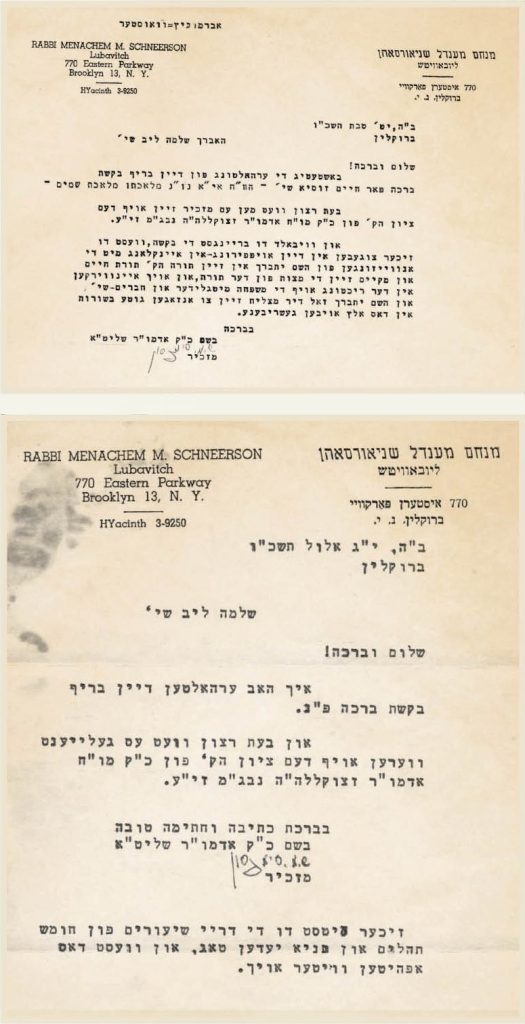
“But the Rebbe found a way to respond… A few weeks later, I traveled to 770 for the Purim farbrengen with the Rebbe. As I opened the door of 770, the secretary Rabbi Binyamin Klein was standing there. He recognized me and said: ‘Abramowitz, the Rebbe instructed Rabbi Chodakov to give you the answer as soon as you arrive.’ I went into Rabbi Chodakov’s small office, and he told me in Yiddish: ‘Regarding what you wrote to the Rebbe about the Shabbaton, the Rebbe said to tell your sister that since you are in the year of mourning for your father, halacha does not permit you to attend such an event.’ The Rebbe ended the response with the bracha, ‘I will mention it at the tziyun.’
“This was an amazing piece of advice from the Rebbe! The Rebbe gave me a clear halachic solution that didn’t hurt anyone and didn’t create a fight in the family. When Shabbos approached and she told me to pack a suitcase, I told her, ‘I can’t go, we’re in the year of mourning.’ She wondered, ‘So why do you go to the Rebbe’s farbrengens?’ I answered her, ‘That’s different, a farbrengen is a spiritual matter, not a party.’ I breathed a sigh of relief when she accepted that and didn’t say another word.”
A few weeks later, approaching Acharon shel Pesach, Shlomo Leib wanted to travel to Beis Chayeinu to participate in the Seudas Moshiach with the Rebbe. This time no one could travel with him, and he went alone to 770. During the farbrengen, the Rebbe instructed R’ Zalman Duchman to begin the “Seder of the Four Cups.” R’ Shlomo Leib notes that many don’t remember, but in those years it was customary for R’ Zalman Duchman to announce that the Seder of the Four Cups was beginning, and after a while announce “that concludes the first cup,” and so on until the completion of the four cups.
During the farbrengen, between sichos, the Rebbe turned to many of those present with a questioning look, asking whether they had drunk the four cups. R’ Shlomo Leib remembers there were several dozen, and over the years he had occasion to speak with some of them, discovering that behind each one was a special story. He himself was one of those Chassidim.
“I stood there facing the Rebbe, and as a young man who didn’t know anyone, I struggled to obtain four cups. I got one cup, a second cup, but beyond that I couldn’t manage… and then the Rebbe turned toward me with a questioning look, gesturing with four fingers—asking, had I already had four cups?
“The first time the Rebbe turned toward me, I didn’t think for a moment that the Rebbe was addressing me, and I was certain the Rebbe meant one of the older Chassidim standing next to me. So I didn’t respond. But the second or third time, the Chassidim standing near me understood that the Rebbe meant me, and they told me: the Rebbe is asking you! I looked directly at the Rebbe, and when he signaled with his fingers asking if I had already drunk the four cups, I signaled that I hadn’t yet… The Rebbe gestured with his hands as if to ask: why? I answered the Rebbe, with hand signals of course because of the distance, that I hadn’t managed to get wine… At that moment, when the Chassidim around grasped the Rebbe’s wish, bottles of wine immediately flowed toward me from every direction… I drank the remaining cups, and then the Rebbe looked at me with a broad smile. For my part, I thought I received this special kiruv as encouragement for the story with the Shabbaton, which, boruch Hashem, had gone successfully.”
The Rebbe’s Concern for the Family’s Home
After his father’s passing, community activists gathered and raised a tidy sum to provide material support for the family. But after about two years, this sum ran out, and the askanim didn’t know what to do. Someone suggested selling the house, with the family moving to a smaller apartment.
R’ Fishman, who was one of the leading askanim, wrote to the Rebbe about this, and was answered that they should not sell the house, but should instead approach the community members again and raise an additional sum. He of course complied with the Rebbe’s instruction, but didn’t bother to update the Rebbe that this had indeed been done.
Young Shlomo Leib wasn’t involved in these financial matters. So when he entered for a yechidus ahead of his birthday, and the Rebbe suddenly asked him, “What’s happening with the house?” he was in shock that with all his spiritual and worldly occupations, the Rebbe remembers the family from Worcester, and is concerned that he wasn’t updated that the idea of selling the house had been taken off the table…
Of course, Shlomo Leib hurried immediately after the yechidus to call R’ Fishman and ask him to update the Rebbe. From this he learned a lesson for life: when something hurts us, we rush to write to the Rebbe. But even when things work out, the Rebbe expects us to write and update him!
A Baal Tefilla By the Rebbe
In the year 5734, R’ Shlomo Leib married the daughter of the Chassid R’ Yaakov Yehuda Hecht, and as a result moved to live in Crown Heights. It didn’t take long before the distinctive voice he had developed in Worcester and Montreal found its way to center stage of Chabad Chassidus.
The first time he approached the amud at 770 is etched clearly in his memory. “It was on Shabbos Mevorchim of the month of Kislev, 5736,” he pulls out the exact date without hesitation. His brother-in-law, Rabbi Yossi Hecht from South Africa, was getting married, and that Shabbos was his aufruf.
About twenty minutes before Kabbolas Shabbos, the old-time gabbai of 770, the Chassid R’ Yankel Lipsker, stood near the Torah reading platform urgently searching for a chazzan. He approached the Chassid R’ Bentzion Raskin—another brother-in-law of the chassan, and suggested he daven in honor of the family occasion. R’ Bentzion, who spotted R’ Shlomo Leib out of the corner of his eye passing right by, immediately turned to the gabbai and said, “Send my brother-in-law; he’s a chazzan!”
R’ Shlomo Leib was completely stunned by the sudden suggestion. “Are you crazy? I’m not going up to the amud!” he replied in a moment of shock. Although he already had many hours of experience davening as chazzan in other shuls, being the chazzan in 770, directly in front of the Rebbe, was an idea that thoroughly frightened him. But R’ Bentzion encouraged him warmly: “Go, don’t worry, you’ll be a hundred percent fine. Don’t be afraid, go up to the amud.”
The encouragement helped, and young R’ Shlomo Leib Abramowitz stepped up to stand at the front of the large shul. Overcome with excitement and tension, he could barely manage to steady his breathing, but he got through the entire tefilla and did very well. The next morning, in the middle of the Torah reading, when the satisfied gabbai approached him again and asked him to lead Musaf as well, R’ Shlomo Leib politely declined.
To be continued
Beis Moshiach #1522 • pp. 12-23
© 2026 Beis Moshiach Magazine. All rights reserved.
This article originally appeared in Beis Moshiach #1522. You are welcome to share it with friends and family by email or in print, provided that you do not change, add to or omit any part of it, you credit the author and Beis Moshiach, and you include a link to archive.bmoshiach.org (written out in full in printed copies).
To republish this article in a newspaper, magazine, book or website, please request permission in advance at [email protected].