Light, Shadows & Menorahs
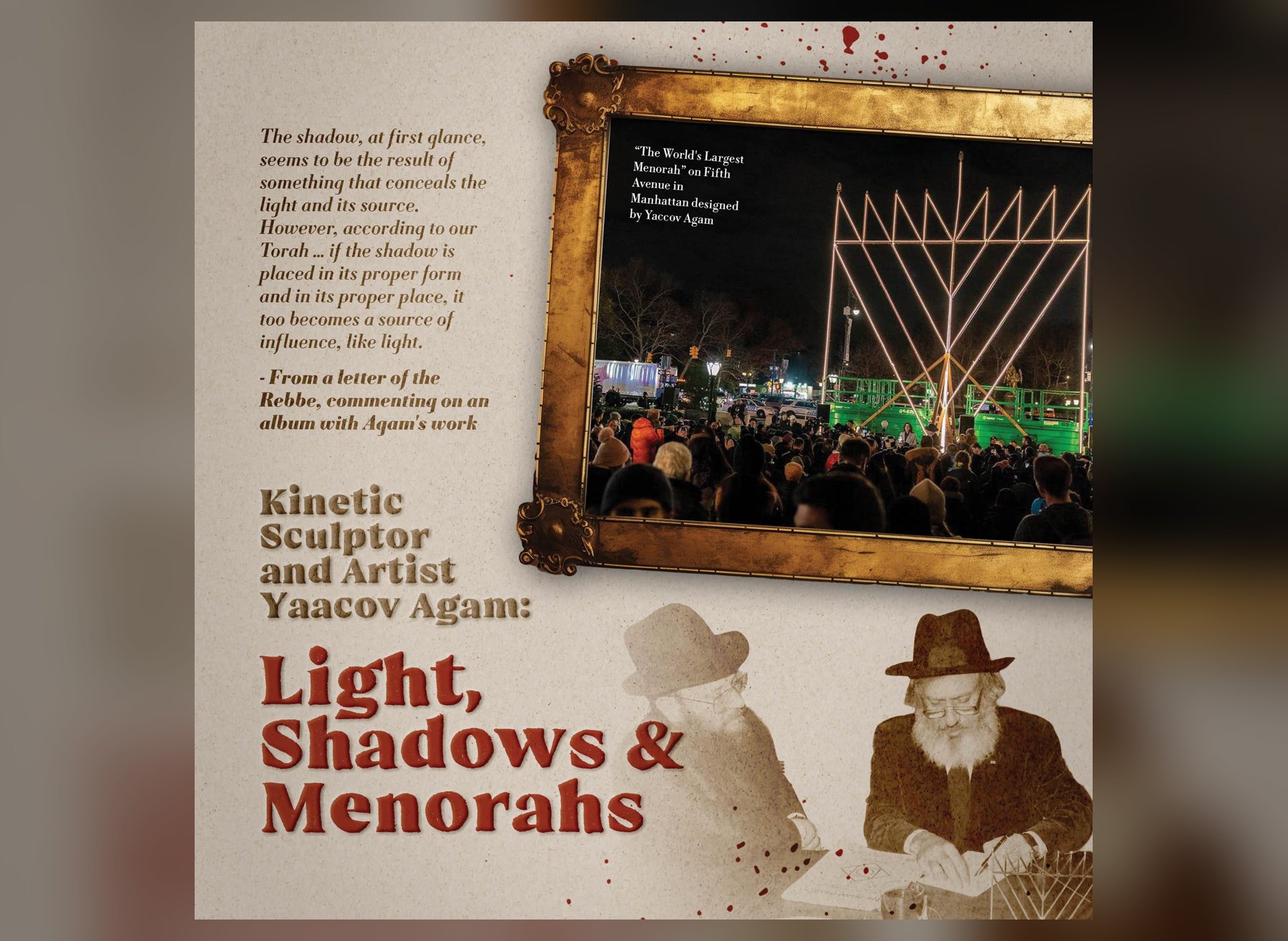
The artworks of artist Yaacov Agam can be found all around the world and are considered significant art pieces after he gained international recognition as one of the founders of kinetic art.
Yaacov Agam (Gibstein) was born in Iyar 5688 (May 1928) in Rishon LeZion, to Rabbi Yehoshua Gibstein and Kendal Yocheved Gibstein, one of seven siblings.
In his childhood, he studied in a traditional cheder, but in his adulthood, he went on to study art at the Bezalel School in Yerushalayim and later in Zurich and Paris.
At the beginning of his career, Agam worked on developing ‘Op Art,’ which deals with optical illusions. At age 27, he exhibited colorful wood reliefs at an exhibition in Paris entitled “Paintings in Movement,” which were unique in that the artwork changed according to the viewer’s position relative to it.
In the 1930s, Agam created sculptures that integrated water, fire, and music, operated by computer control. Among these works was the “Water and Fire” fountain at Dizengoff Square in Tel Aviv.
Agam also created many works in diverse fields: he developed the “Agamograph” technique, display using Plexiglas, designed stamps, invented the “Agamilim” writing method, where changing one letter in a word changes the entire word. He conceived a visual education program, and the Weizmann Institute collaborated with him on the “Agam Program” for developing visual thinking, primarily intended for early childhood education.
Many of his works are characterized by movement or changing appearance when the viewer’s perspective shifts. According to him, he was deeply influenced by mystical concepts in Judaism.
Over the years, Yaacov Agam held many exhibitions worldwide, including retrospective exhibitions at the Museum of Modern Art in Paris, the Stedelijk Museum in Amsterdam, and the Guggenheim in New York. Agam placed his works in the Élysée Palace in Paris in 1972 at the invitation of then-Prime Minister Georges Pompidou, and created a musical fountain in the La Défense district of Paris.
Throughout the years, he received various awards and certificates of appreciation for his works.
Since the 1940s, Agam has resided in France. After the passing of his wife Clila in the 1980s – who was a descendant of a Chassidic Rebbe – Agam began wearing a hat, and essentially became much more strengthened in his Judaism. Subsequently, he started growing a beard and wearing a large kippa, with tzitzis prominently visible beneath his jacket.
Connection with the Rebbe
Agam’s connection with the Rebbe began in the mid-1930s, thanks to his friend Mr. Yosef Ciechanover, who headed the Israeli defense mission the USA and was in close contact with the Rebbe. “When I would occasionally visit New York, he would take me to the Rebbe’s large farbrengens,” Mr. Agam recalled. “Thousands would be present at these farbrengens, and we would sit not far from the Rebbe. Sometimes, between sichos, when the crowd was singing, the Rebbe would exchange words with me.
“In these conversations, the Rebbe showed great interest in my artistic work. He asked me to send him photographs of my works.”
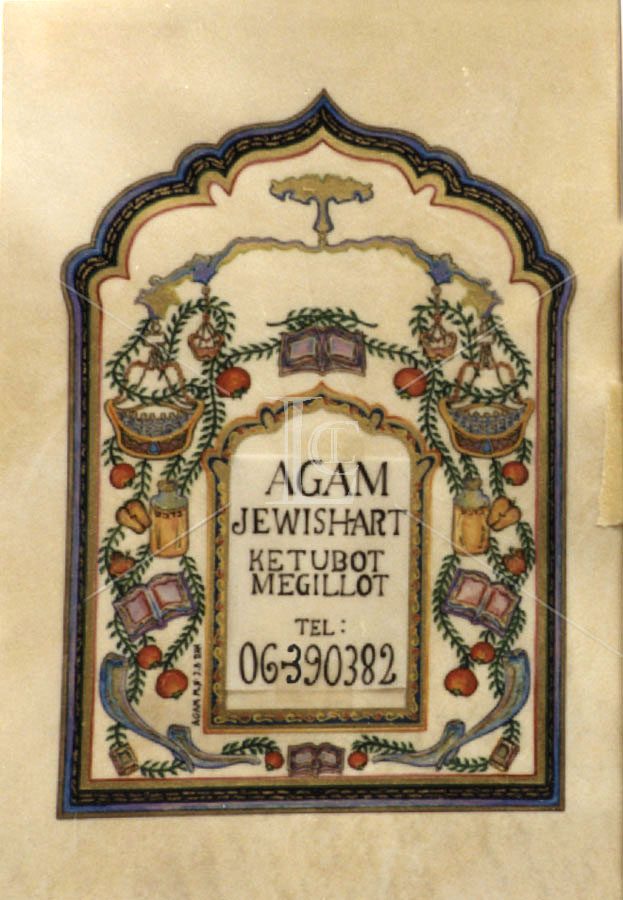
Prior to Yud-Aleph Nissan 5737 (1977), Agam sent the Rebbe a birthday greeting and attached an album with a selection of his works. Mr. Ciechanover presented the album to the Rebbe. In response, Agam received a long and fascinating letter that somewhat reflects the Rebbe’s approach to modern art (free translation).
B”H, 28th of Sivan, 5737
Brooklyn, N.Y.
To Mr. Yaacov Agam,
Shalom u’vracha!
Due to many preoccupations, my response has been delayed, and with it, my apologies.
First and foremost, I offer my heartfelt thanks for your blessings and good wishes. And I answer you with blessing with the words of our Sages z’l: “Anyone who blesses, is blessed by Hashem, the source of blessings,” and His blessing is far greater than the original. May Hashem bless you abundantly, from His full hand, with everything you require.
Additionally, I thank you again for the magnificent album. Even though it is entirely outside of my field, the overall impression is striking to the eye, even for someone who is not an expert in art. Surely, this work is intended not only for experts. Particularly, one can see originality in utilizing elements that, at first glance, have no apparent connection to art, such as light and shadow, lines, and various geometric shapes. The combination and fusion of these elements in good taste, as seen in the album, is impressive, even, as mentioned, to someone without an expert’s eye in this field.
I was especially impressed by the use of a range of colors, both primary and secondary, which form a beautiful illumination.
As is customary for the Jewish people, to seek and find in everything a point that relates to the mission of the Jewish people, the whole nation, and each individual, in the life of man on this earth, I take the liberty to make one comment, at least on a general level. Specifically, even in the words of the blessing written on the cover, besides the content and the wording, you have employed your artistic power with a color combination of the letters themselves along with their shadows.
The shadow, at first glance, seems to be the result of something that conceals the light and its source. However, according to our Torah, the Torah of truth, and in the words of our Sages, all that Hashem created in His world, He created for His honor. Thus, the shadow is also part of this. That is to say, if the shadow is placed in its proper form and in its proper place, it too becomes a source of influence, like light, even though the revelation of this light and its influence is in a different manner from the revelation and influence of light in its plain form. Just like in the aforementioned example, the impression of the letters by themselves is not the same as when they appear together with their shadow – this occurs when the shadow is in its rightful place, and its fusion with the light is in the appropriate manner.
From this, there is a general lesson, and together with it, also a specific one for human life, even in “shadow” days, the “gray” days. Although at first glance – in our physical and material world – the shadows seem to outnumber the lights, and material outweighs the spirit, etc., the person must fulfill his mission in this world according to the saying of our Sages, that even the shadow can be for the honor of the Creator. On the contrary, the light then surpasses the darkness, meaning that through, by, and in conjunction with the darkness, one can achieve this. And in this way, one can approach all matters of darkness in our world, as it is within man’s ability to “turn darkness into light.”
With respect and blessings, in the same spirit of gratitude for your good wishes and attentiveness.
Agam analyzed the Rebbe’s approach to his art:
“From the content of the letter and our conversations, I learned to recognize that the Rebbe was very aware of the visual significance of form. I don’t mean only artistic understanding, but the ability to see and feel things beyond verbal language. He could see things beyond the visible, like seeing the light behind the shadow.
“Judaism ascribes great significance to the visual. In the Torah, we find the rainbow in the sky, symbolizing the covenant between Creator and creation, Yaakov’s ladder, and other visually significant images. The word stops and defines, and therefore also hurts. But form is a living thing that creates and changes. There is no form in nature that does not change. The word is a lower stage of expression. Above it is poetry. Above poetry stands the song. Higher than the song are the quiet and silence within form.
“Most people don’t know how to ‘see’ and therefore are forced to translate everything into words. One translates to English, another to French, a third to Russian. And everything they cannot define in a word, they also cannot grasp in thought. This essentially makes them visually illiterate. The Rebbe deeply understood visual significance. Once we discussed visual education, and in this context, we mentioned the biblical verse, ‘And he saw that it was good’ – the ability to see.”
The World’s Largest Menorah
In the 1980s, the Rebbe spoke about placing menorahs in public places to publicize the Chanuka miracle. “It was important for us to fulfill the Rebbe’s words in the ‘big city’ in the most public and best way possible,” said Rabbi Shmuel Butman a’h, chairman of the Chabad Youth Organization in New York.
Thus, in 1978, a menorah measuring about ten meters was born. The menorah was called “The Largest Menorah in the World” and was thus reported in global media, which extensively and prominently covered its lighting ceremonies each day of Chanuka, essentially using it as a symbol of the holiday.
“We used a classic design. At that time, it was not yet common to make menorahs according to the Rambam’s specifications,” Rabbi Butman added. “After much effort, boruch Hashem, we found a company that deals with designing and building metal and iron products.
“The company wanted $5,000 for the design and construction, a not insignificant sum in those days. I then called the supporter Zev (William) Goldberg z”l, who was the president of the Diamond Exchange. He was so excited that he came to our office himself and donated the money.
“For nine years, the world’s largest menorah captured media attention, as a result of the unprecedented ‘pirsumei nissa – publicizing of the miracle.’ Every year, journalists and photographers flocked to document the lighting. Even The New York Times, which is not particularly friendly toward Jewish matters, made sure to send staff to cover the events.
“After the Rebbe spoke about the menorahs needing to be made with straight branches, it was clear that a change was needed. Indeed, in 1987, artist Yaacov Agam designed the menorah in its current configuration. A model of this menorah was privileged to stand on the Rebbe’s desk for three days.
“According to Yaacov Agam, the Rebbe wanted the menorah to be made to the largest size possible from a halachic standpoint – twenty cubits, which is about 32 feet. The cost of the menorah was $25,000.”
Yaacov Agam: Because the Rebbe placed great importance on the visual aspect, he also attached great importance to correcting the common misconception about the menorah’s shape in the Mikdash. It is customary to draw it with curved branches, similar to the relief on the Arch of Titus. However, the Rebbe, relying on the Rambam’s statement that the menorah in the Mikdash had diagonal branches, recognized the differences in meaning between the various shapes and insisted that the menorah of the Mikdash be drawn according to halacha and not in its Roman version.
Chabad Chassidim have worked and continue to work to spread the light of Judaism everywhere, and therefore I always found it appropriate to help, assist, and take part in their important endeavor.
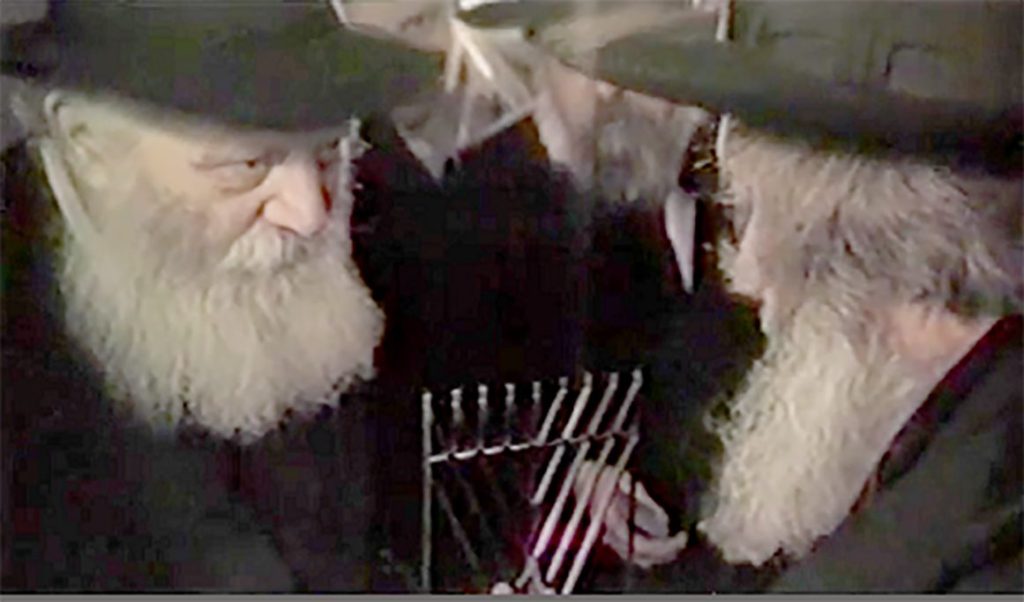
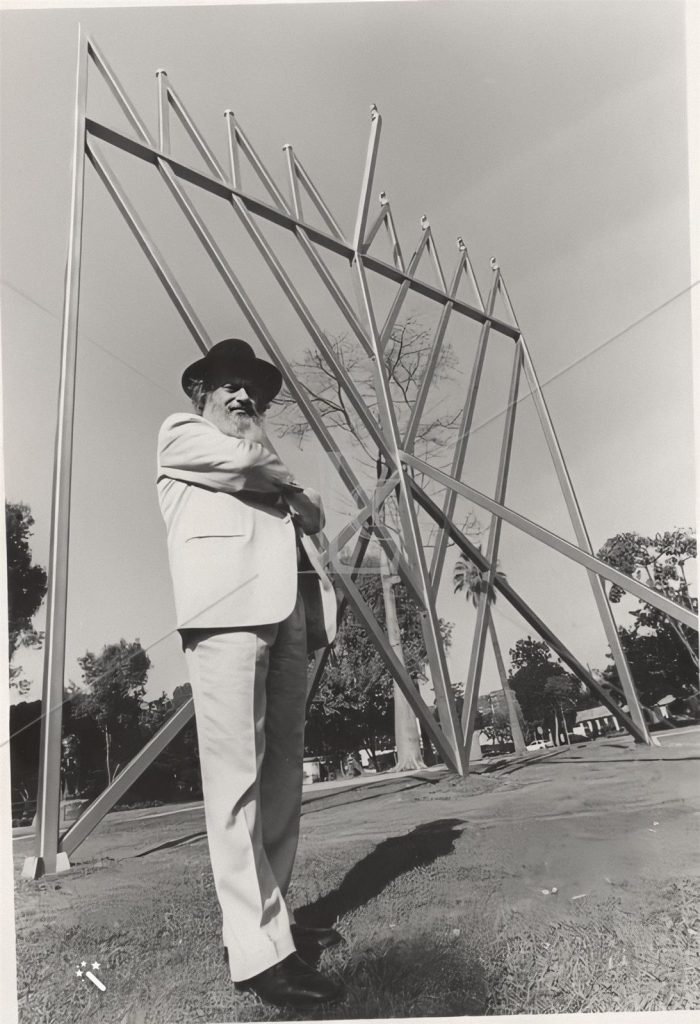
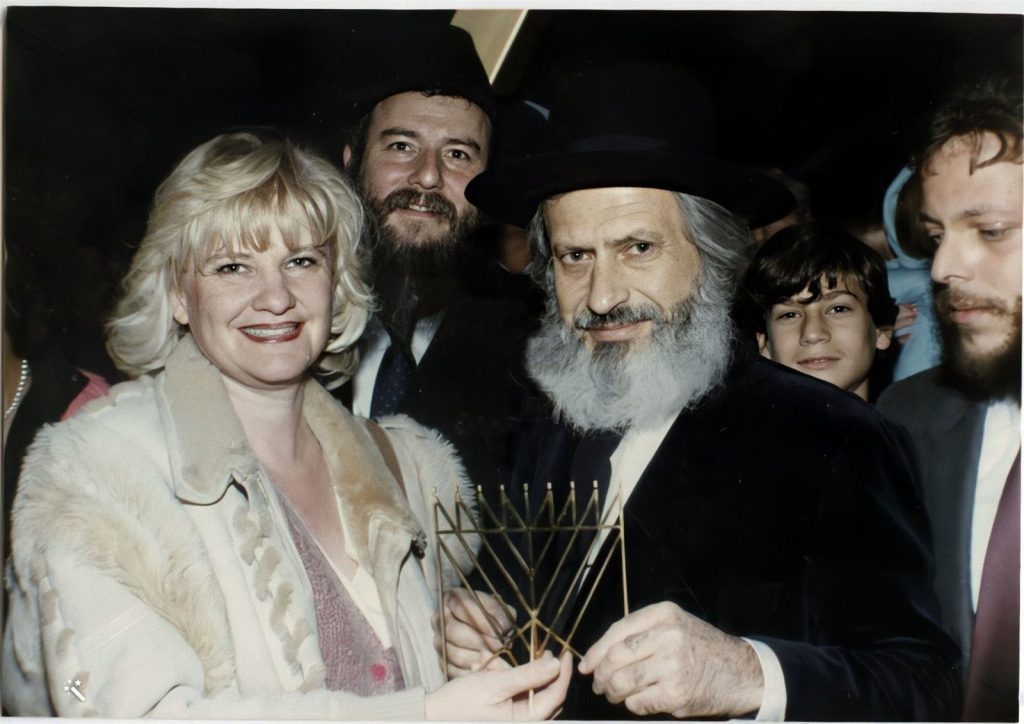
Chabad Chassidim approached me with a request to design a giant menorah to be placed in a public space in the city. The menorah, ten meters high – which is the maximum height permitted according to halacha – I designed in a form influenced by the diagonal branch shape of the menorah in the Mikdash. Three such menorahs were erected by Chabad Chassidim – in Manhattan, in Vancouver, Canada, and in Los Angeles. When I went to the Rebbe and presented him with a small model of the giant menorah, he was very enthusiastic about the beauty and special elegance I had given it…
After the giant menorah was placed on Fifth Avenue, in the heart of Manhattan, Mr. Agam came to the Rebbe on the 26th of Kislev 5747 (1986) and gave the Rebbe, as mentioned, a miniature model of the menorah he had just finished designing. The Rebbe responded with great warmth: “Thank you for designing the menorah in accordance with the Rambam’s view. You will light the menorahs in their full size in Los Angeles and New York – may this be a good beginning for the entire United States and the entire world.”
As Agam puts it: “The Rebbe gave Judaism what Chassidus initially provided – the ability for simple, working people to draw closer to the light of Torah and the opportunity to connect to the spiritual riches of Judaism.”
Helping Others Brings Only Blessing
Over the years, Mr. Agam assisted the activities of Chabad shluchim in various locations. One of the places he helped by donating his artworks was the Chabad House in the Krayot area. Rabbi Gluckowsky, the Chabad rabbi of Rechovot, connected him with them, as he recounted:
“One evening, Reb Zusha Wilyamowsky entered my home together with several Chabad Chassidim from Krayot, led by Rabbi Moshe Oirechman and his brother Rabbi Nosson from Acco. Reb Zusha began to speak about the fire that had struck the Chabad building in Kiryat Motzkin, and their plan to organize a fundraising evening at the Dan Hotel in Haifa to restore and expand the institution.
“Reb Zusha said that since I was in contact with artist Yaacov Agam (in the same year his wife had passed away, and Reb Zusha knew about the connection that had formed between us as a result of assistance during the shiva period), he requested that Mr. Agam bring one of his art pieces to be sold at a public auction to receive a decent sum.
“I asked Reb Zusha to speak with me on the side and updated him that since Mr. Agam lives in Paris, the relationship between us was not strong enough, and when it would get stronger, I thought to request something for Chabad mosdos in Rechovot. In response, he said: ‘I have a tradition from my teachers that when helping another Jew, no harm will come out of it, only blessing.’ I told him that anyway, my community would not accept this, but if it’s an order, I would accept. Rabbi Zusha immediately replied: ‘Order!’
“Indeed, Mr. Agam donated a special item for the dinner and even participated in it himself. Because of this, Chabad institutions in Krayot maintained contact with him for a period afterward. That same year I saw wonderful blessings from various directions, which taught me that we shluchim must be generous with each other and not, heaven forbid, be grudging toward each other – because from a good deed done for another Jew only comes blessing.”
The connection between Rabbi Oirechman and Mr. Agam continued for many years. At times, Rabbi Oirechman would include Yaacov Agam and his son in a visit for Shabbos in the Rebbe’s court, during which he participated in tefillos with the Rebbe, and even in a farbrengen, and was privileged to receive special encouragement from the Rebbe.
One of the years, he approached the Rebbe and told him about participating in the Chabad dinner in Krayot and that he was donating generously to them, as well as to Chabad in California. The Rebbe responded with a smile: “When you give a finger – they request the entire hand.” In other words: You must give more!…
* * *
“The Rebbe’s greatness is in that he succeeded in giving, sharing, and presenting the great spirituality that exists in the sources of Judaism to thousands of people,” says Yaacov Agam. “Through his words and actions, the Rebbe granted great meaning to life for many, and awakened their hidden and concealed faith. In this way, he provided a great spiritual momentum that burned and illuminated throughout the world.”
Beis Moshiach #1455 • pp. 22-28
© 2026 Beis Moshiach Magazine. All rights reserved.
This article originally appeared in Beis Moshiach #1455. You are welcome to share it with friends and family by email or in print, provided that you do not change, add to or omit any part of it, you credit the author and Beis Moshiach, and you include a link to archive.bmoshiach.org (written out in full in printed copies).
To republish this article in a newspaper, magazine, book or website, please request permission in advance at [email protected].