9 Things You Didn’t Know About the Rambam
Family Name: Ibn Abdallah
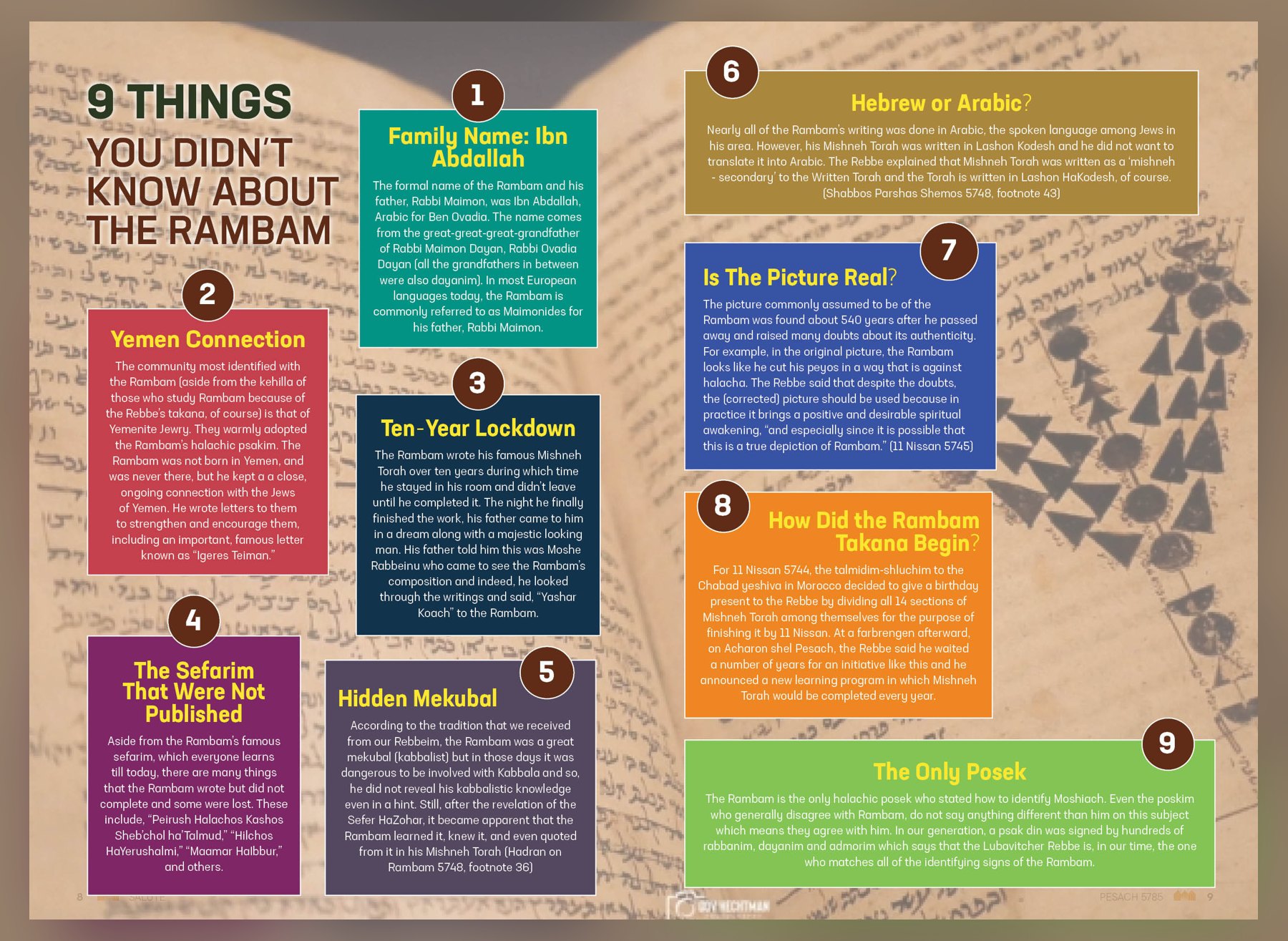
The formal name of the Rambam and his father, Rabbi Maimon, was Ibn Abdallah, Arabic for Ben Ovadia. The name comes from the great-great-great-grandfather of Rabbi Maimon Dayan, Rabbi Ovadia Dayan (all the grandfathers in between were also dayanim). In most European languages today, the Rambam is commonly referred to as Maimonides for his father, Rabbi Maimon.
Yemen Connection
The community most identified with the Rambam (aside from the kehilla of those who study Rambam because of the Rebbe’s takana, of course) is that of Yemenite Jewry. They warmly adopted the Rambam’s halachic psakim. The Rambam was not born in Yemen, and was never there, but he kept a a close, ongoing connection with the Jews of Yemen. He wrote letters to them to strengthen and encourage them, including an important, famous letter known as “Igeres Teiman.”
Ten-Year Lockdown
The Rambam wrote his famous Mishneh Torah over ten years during which time he stayed in his room and didn’t leave until he completed it. The night he finally finished the work, his father came to him in a dream along with a majestic looking man. His father told him this was Moshe Rabbeinu who came to see the Rambam’s composition and indeed, he looked through the writings and said, “Yashar Koach” to the Rambam.
The Sefarim That Were Not Published
Aside from the Rambam’s famous sefarim, which everyone learns till today, there are many things that the Rambam wrote but did not complete and some were lost. These include, “Peirush Halachos Kashos Sheb’chol ha’Talmud,” “Hilchos HaYerushalmi,” “Maamar HaIbbur,” and others.
Hidden Mekubal
According to the tradition that we received from our Rebbeim, the Rambam was a great mekubal (kabbalist) but in those days it was dangerous to be involved with Kabbala and so, he did not reveal his kabbalistic knowledge even in a hint. Still, after the revelation of the Sefer HaZohar, it became apparent that the Rambam learned it, knew it, and even quoted from it in his Mishneh Torah (Hadran on Rambam 5748, footnote 36)
Hebrew or Arabic?
Nearly all of the Rambam’s writing was done in Arabic, the spoken language among Jews in his area. However, his Mishneh Torah was written in Lashon Kodesh and he did not want to translate it into Arabic. The Rebbe explained that Mishneh Torah was written as a ‘mishneh – secondary’ to the Written Torah and the Torah is written in Lashon HaKodesh, of course. (Shabbos Parshas Shemos 5748, footnote 43)
Is The Picture Real?
The picture commonly assumed to be of the Rambam was found about 540 years after he passed away and raised many doubts about its authenticity. For example, in the original picture, the Rambam looks like he cut his peyos in a way that is against halacha. The Rebbe said that despite the doubts, the (corrected) picture should be used because in practice it brings a positive and desirable spiritual awakening, “and especially since it is possible that this is a true depiction of Rambam.” (11 Nissan 5745)
How Did the Rambam Takana Begin?
For 11 Nissan 5744, the talmidim-shluchim to the Chabad yeshiva in Morocco decided to give a birthday present to the Rebbe by dividing all 14 sections of Mishneh Torah among themselves for the purpose of finishing it by 11 Nissan. At a farbrengen afterward, on Acharon shel Pesach, the Rebbe said he waited a number of years for an initiative like this and he announced a new learning program in which Mishneh Torah would be completed every year.
The Only Posek
The Rambam is the only halachic posek who stated how to identify Moshiach. Even the poskim who generally disagree with Rambam, do not say anything different than him on this subject which means they agree with him. In our generation, a psak din was signed by hundreds of rabbanim, dayanim and admorim which says that the Lubavitcher Rebbe is, in our time, the one who matches all of the identifying signs of the Rambam.
Salute #1455 • pp. 8-9
© 2026 Beis Moshiach Magazine. All rights reserved.
This article originally appeared in Beis Moshiach #1455. You are welcome to share it with friends and family by email or in print, provided that you do not change, add to or omit any part of it, you credit the author and Beis Moshiach, and you include a link to archive.bmoshiach.org (written out in full in printed copies).
To republish this article in a newspaper, magazine, book or website, please request permission in advance at [email protected].