Kfar Chabad, Oil on Canvas
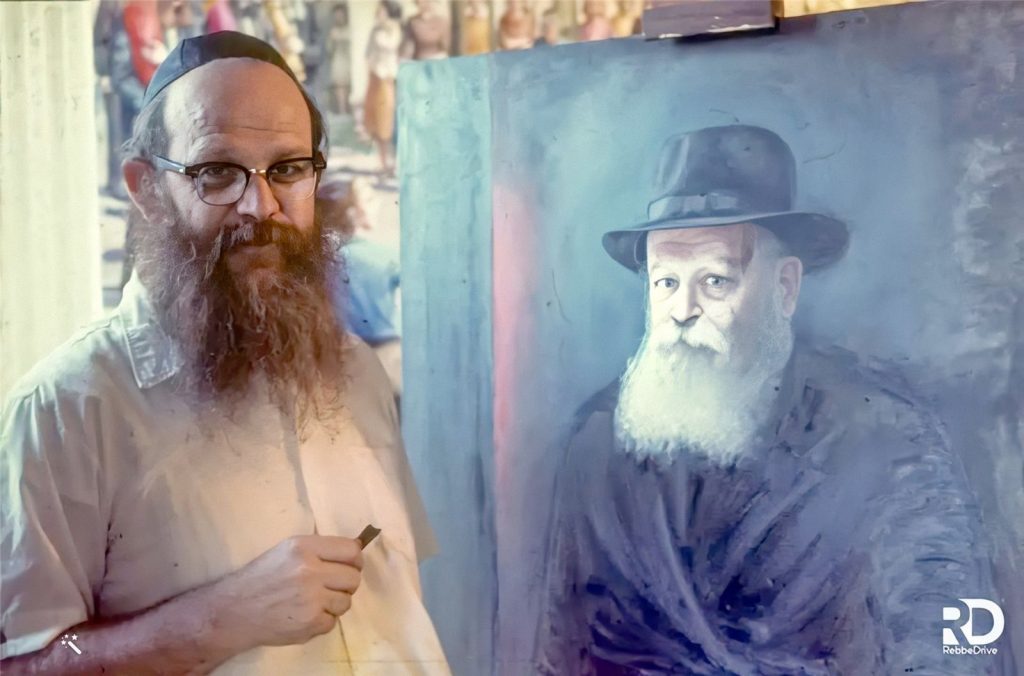
The Chassidic painter Rabbi Zalman Kleinman was born in Russia to his father Rabbi Yaakov and his mother Mrs. Rivka Kleinman. His parents arrived in Russia during World War I. The father was a Gerrer Chassid, a yerei shamayim, and very meticulous in his performance of mitzvos.
He spent his childhood in the city of Leningrad at his parents’ home, along with his two sisters, Fania and Rochel (Zamir). However, his happy childhood days were short-lived. In the summer of 1941, a front opened between Germany and the Soviet Union. Soon, battles, bombings, and hunger began to take their toll on the civilians. The front was rapidly approaching the great city of Leningrad. The young Zalman was only about eight years old at that time.
One day, the authorities announced the evacuation of all the children from Leningrad to a distant and safe place – both to save them and so that their parents could devote themselves to the defense of the city in peace of mind.
With worry and pain, R’ Yaakov Kleinman and his wife were forced to take their daughter Rochel out of the house and hand her over to strangers, on her way to an unknown place. Later, Fania, the thirteen-year-old, and her younger brother Zalman, the eight-year-old, were also forced to leave.
Shortly before the siege imposed on Leningrad, R’ Yaakov Kleinman managed to meet his sister, Mrs. Ita Sassonkin, at the border of the city of Leningrad. The meeting was emotional, and the farewell even more so. Before they parted, the two made a pact: whoever survives will take it upon themselves to care for the children of the other…
Countless tribulations befell young Zalman and his sister, who made every effort to protect her brother, but after a few months, the two were separated by the authorities’ orders. Zalman was sent to a children’s institution.
A small Jewish boy about eight years old, among a crowd of non-Jewish children, many of whom were older than him. His life was unbearable. Harassment, abuse, humiliation were his lot. The immense suffering was his portion for three and a half years, until he reached the age of 11.
Painting in Wartime
Even at this age, Zalman’s artistic talents were evident. One of the instructors at the institution where he stayed took a liking to him. Whenever she needed drawings, posters, and signs for her class, she would call Zalman from his class, and he would do all the drawing work for her, which angered his own class instructor for exploiting his talents for the benefit of a competing class.
In the year 5705, World War II ended, having cost millions of lives on the front lines and within the cities of Russia. People died from starvation, bombings, and the Nazis’ deportations to extermination camps.
Then it became clear that the couple, R’ Yaakov and his wife Rivka, who remained in Leningrad, died of starvation in the severe famine that prevailed in the city at that time.
In those days, the family was practically shattered. Fania, the older sister, worked in the Russian military industry. The sister Rochel was staying in an orphanage far away, in Siberia. Meanwhile, the younger brother was adopted by the gentile teacher. She organized all the formal documents for his adoption as her son. She loved him very much, cared for him as a son, providing him with nurture and all his needs. She valued him highly for his intelligence, for his talents in drawing and art, and for the knowledge he acquired through reading books.
After the war, he was about to return with her to her home in Leningrad, with the declared intention of severing all ties with his family forever. At her instruction, he sent letters to his sisters, in which he wrote, under her guidance, that we must sever all ties between us for eternity.
His father, R’ Yaakov Kleinman, from the next world, feared more than anything, beyond just his physical distancing from the rest of his family, the spiritual distance, that the young boy would abandon his ancestral heritage.
At this stage, divine providence intervened, aiming to extract the precious from the worthless and reunite the Chassidic family once again. Zalman’s aunt, Mrs. Ita Sassonkin, managed to contact her father-in-law, the Chassid Rabbi Nachum Shmaryahu Sassonkin. She joined him in Samarkand, where there was an active Chassidic community.
It seemed that she had finally found some peace, but one night, she dreamed that her brother woke her with a gentle touch on her shoulder and said just one word: “The children!”
She woke up trembling and immediately understood what it was about. At the outbreak of the war, they had made a pact that whoever survived the war would take care of the other’s children. The dream recurred again and again, and she had no choice but to share the story of the vow and the dream with her father-in-law.
He urged her to contact the children, which was indeed critical before Zalman was fully adopted. After a long and exhausting journey, she arrived at the children’s home where little Zalman had already been formally adopted by the teacher. He became emotionally attached to his adoptive mother and was very happy to return with her and all the children to Leningrad.
The aunt made efforts to convince the management and the instructor to give up the adoption. She explained to them that she was the child’s aunt, and her brother, the child’s father, had asked her to raise him if he died in the war. After many tears and pleas, Zalman, twelve and a half years old, was officially handed over to his aunt. Later, the aunt also picked up her niece Rochel, and the three returned to Samarkand, to their grandparents’ house.
Rabbi Sassonkin began to influence his grandson to return to a life of Torah and mitzvos, and he took responsibility for his education. He did this gently and with endless patience. With Rabbi Sassonkin’s wise and non-pressuring approach, Zalman began to draw closer to Judaism on his own, to ask, to know, and to learn.
A few months later, a grand Bar Mitzva celebration was held for him, according to the standards of those days of hardship and scarcity. Zalman recited a Chassidic maamar, and the listeners were filled with admiration for the child’s achievements, when just a few months earlier he did not know the basics and did not speak Yiddish.
In the year 1947, the Sassonkin family, along with their ‘adopted children’ from the Kleinman family, left Russia using fake Polish passports. After a long journey, they arrived at the final transit station in Paris, where they stayed for about two and a half years.
After a two-year stay in France, the family members were fortunate to immigrate to Eretz Yisrael aboard the ship “Artza.”
After a period of acclimatization, Zalman began studying at the ‘Tomchei Tmimim’ yeshiva in Pardes, Lod.
Bursting Talent
The painting talents that first manifested as a child during the war period burst forth in full force at this stage of his life. His friends from the yeshiva recount that they often found him sitting among the orange trees surrounding the yeshiva, brush in hand, painting with great fervor.
This passion for painting led him to leave the yeshiva in Lod and move to Kfar Chabad. Here, he began to dedicate himself to painting.
He didn’t have a proper place to live, but he tried to hide it from the people who asked him. He was content with what he had and didn’t want to take any assistance from others.
When Rabbi Ephraim Wolf, the head of the yeshiva, heard about Zalman’s way of life, he tried to help him. He approached Rabbi Sassonkin, who was his educator, and suggested that the boy live in the yeshiva and engage in painting “and no one would disturb him.” When Rabbi Sassonkin spoke about this with Zalman, he refused the offer, saying, “Is it not enough that I do not help the yeshiva? Should I live at its expense?”
Zalman continued to live this way until one morning Rabbi Elimelech Perman, of blessed memory, a widower and elder Chabad Chassid, who was accustomed to rising early, noticed him. One morning, when he arrived at the shul, he saw him sleeping on the bench as usual, with his hand serving as a pillow and his coat as a blanket. He approached Zalman with an offer to sleep on a folding bed in his apartment. At first, Zalman refused, but Rabbi Perman insisted, and eventually, Zalman moved in to sleep there. In due time, he managed to secure his own room.
Meanwhile, everyone already knew that Zalman painted with great talent.
They say that once Mr. Zalman Shazar, then head of the Jewish Agency, came to visit Kfar Chabad. The activist Rabbi Pinye Altheus brought him on a tour, including to Zalman’s room, and showed him his paintings. Shazar was very impressed and immediately awarded him a scholarship for art studies. Zalman approached several art schools and showed them his works, but in all of them, he was told that his level far exceeded the level of studies at that institution.
During that visit, Shazar saw a Chassidic painting illustrating a farbrengen of Chassidim full of vitality and emotion. Shazar expressed his astonishment that this was not the farbrengen he was familiar with (as is known, Shazar regularly attended the ‘official’ Yud-Tes Kislev farbrengens held in Kfar Chabad). R’ Zalman Kleinman was unfazed and replied in characteristically Chassidic simplicity: “When you are present, that is the ‘official’ farbrengen; what you see in my painting is the farbrengen after you leave…”
In 1954, Zalman enlisted in the army, and throughout his thirty months of service, he did not eat from the military kitchen due to his strict adherence to the laws of kashrus.
Already during his basic training, he became known for his drawing talent. The Chief Rabbi of the Army, Rabbi Shlomo Goren, transferred him to the military rabbinate and assigned him to decorate shuls in various military camps and illustrate the weekly magazine Machanayim. Since he was not attached to a permanent base, he received a food allowance, and the issue of kashrus was resolved.
The Chassidic Artist Gains International Recognition
At the end of his military service, he asked the Rebbe for permission to travel to the US to study painting. The Rebbe replied: If you want to study painting, the place is Paris, France.
He indeed traveled there and visited exhibitions and museums. There he met his soulmate, Rosa Neuhaus, a descendant of a rabbinical dynasty tracing back to the BaCH. The two married happily, and after their wedding, the couple moved to the US.
The lives of the Kleinman couple were not easy. Neither of them had parents, and they were without support. Initially, Zalman worked odd jobs, but his income was minimal. After the children were born, he began to earn money with great difficulty, including by illustrating for publishing houses. Over time, he started working at the Algemeiner Journal as an art editor and cartoonist. Gradually, he gained recognition as a painter, and his name preceded him. Over time, exhibitions of his works were held at the Brooklyn Museum, in Canada, in Philadelphia, and more.
But mainly, he gained appreciation and admiration in the Jewish world, among Chassidim. His paintings were a wonderful illustration of Jewish and Chassidic themes.
Once he gained recognition as a renowned painter, his financial situation improved, but he continued to live a modest lifestyle as before. Much of the money he earned was donated to tzedaka, mainly through “matan b’seiser” [anonymous giving].
R’ Zalman Kleinman was an honest man, modest and unassuming; a noble soul, possessing intellectual wealth in all areas of life. He quietly engaged in painting, and peacefully dedicated his free hours to studying Torah. He never sought fame or students. When parents came to him asking him to teach their children painting, he would say to them: “If the child is naturally inclined towards painting, I will agree to teach him. If not, do not pressure the child to learn it, because it is very hard work that requires immense inner strength.”
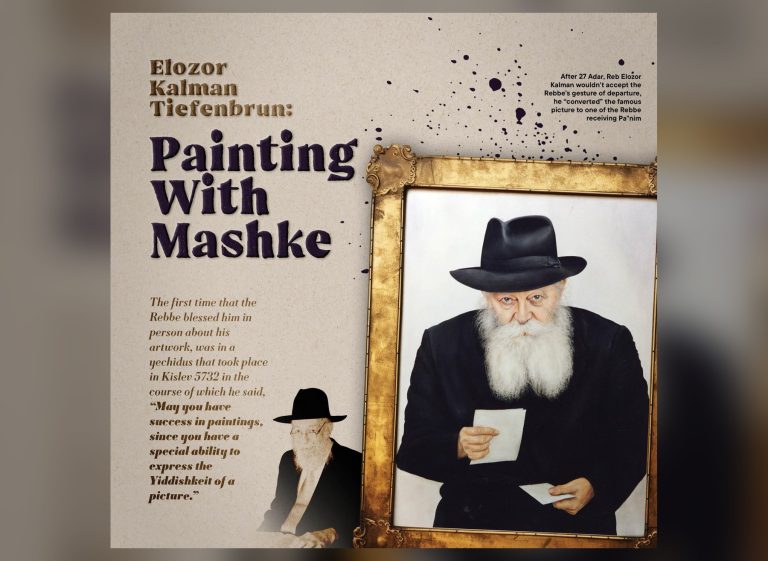
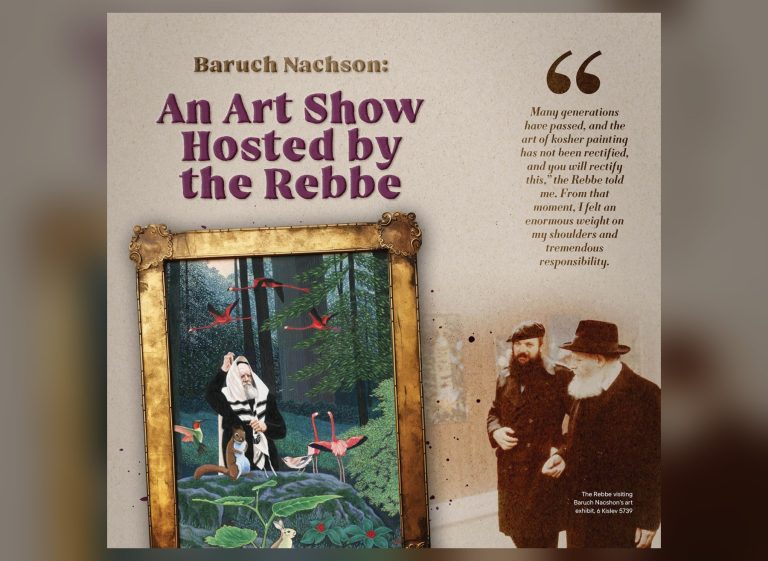
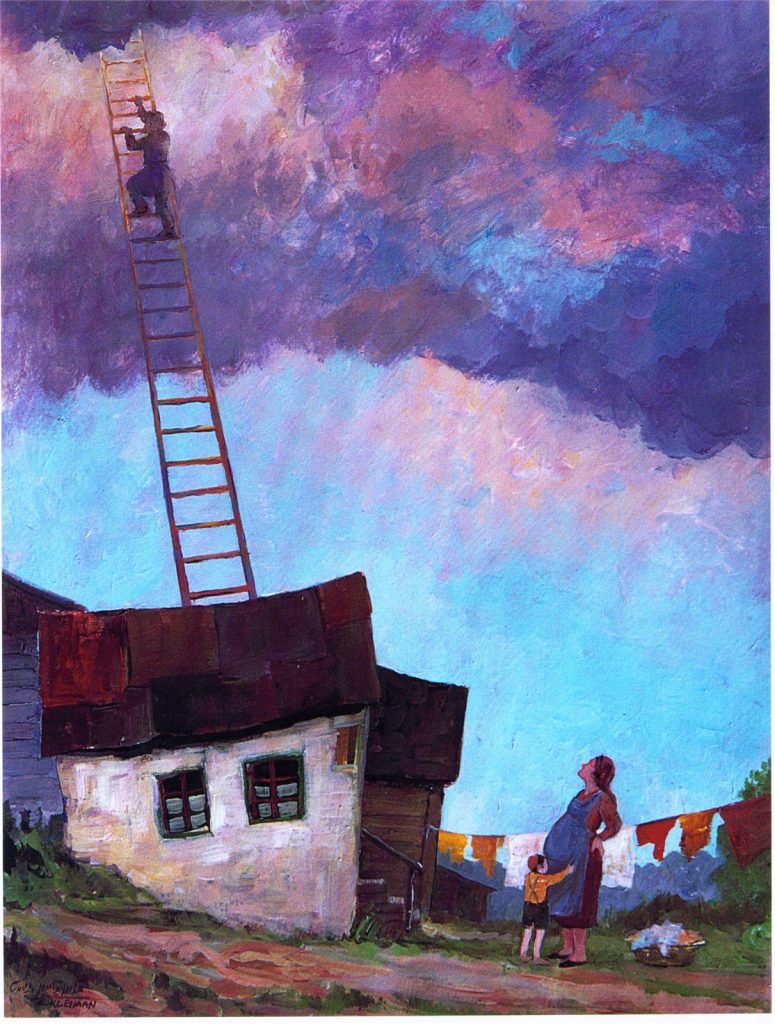
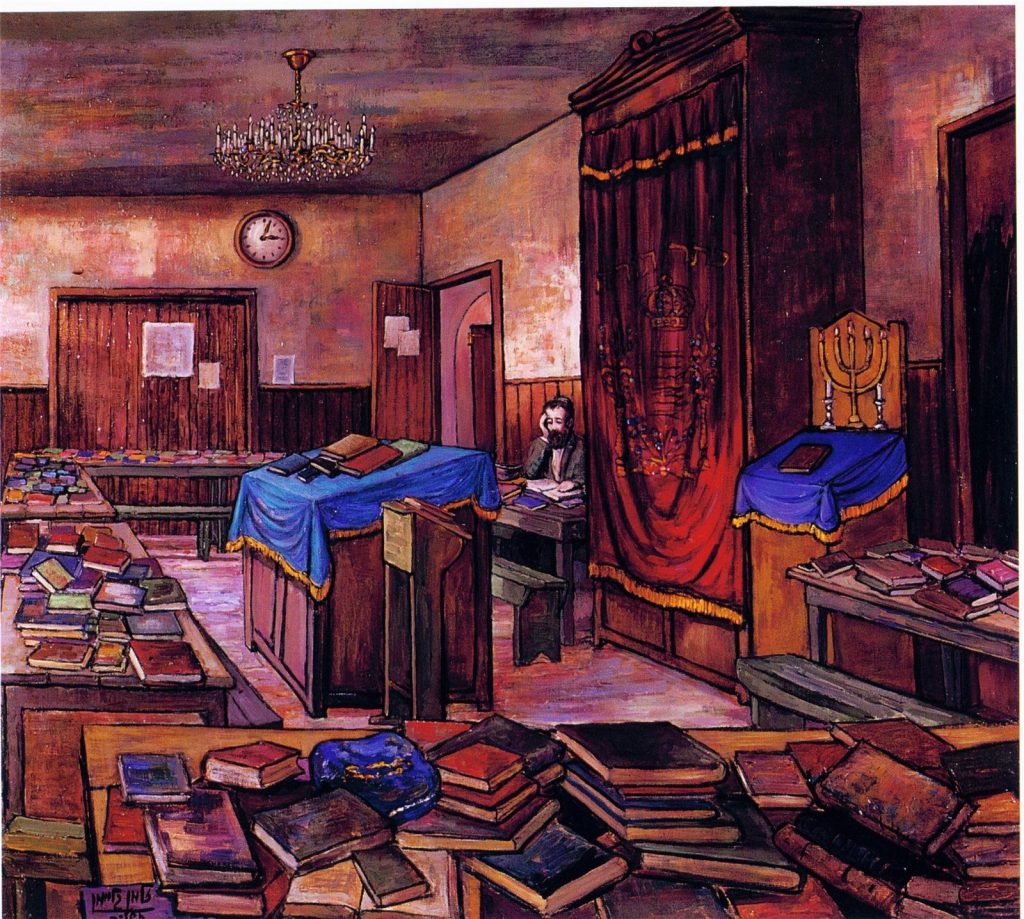
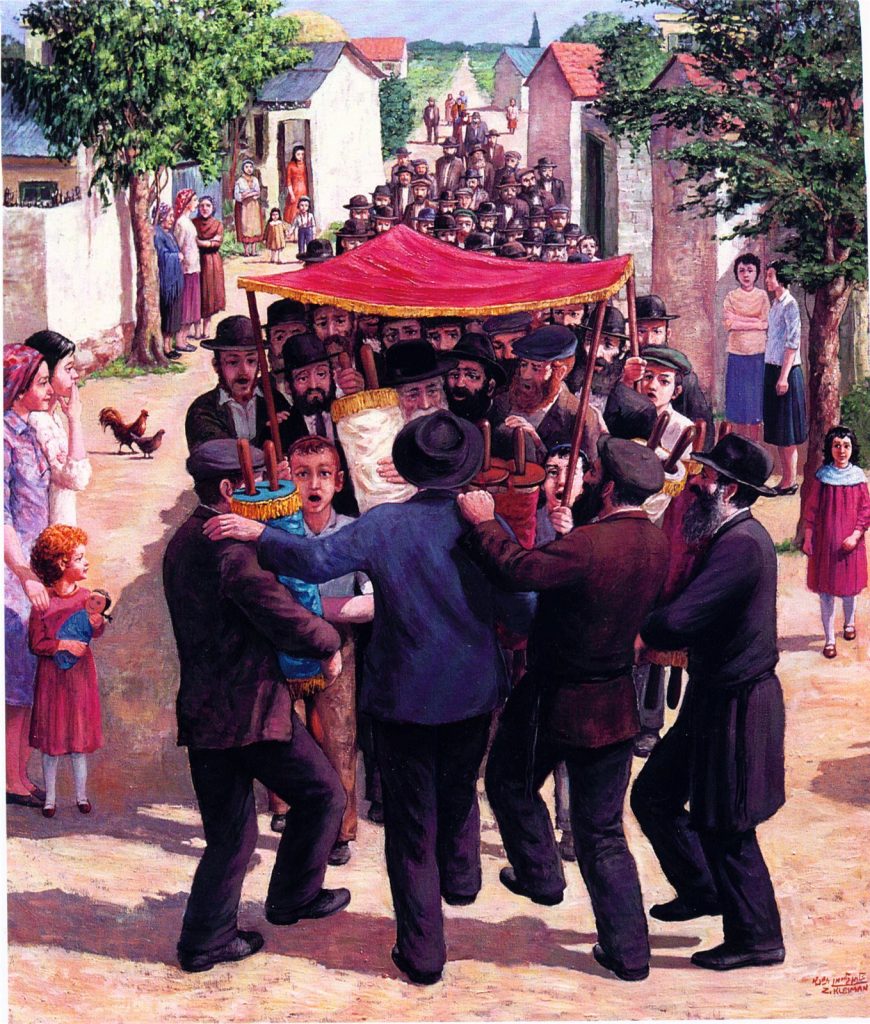
In his various works, he expressed his Chassidic feelings. His paintings are filled with Jewish and Chassidic themes, such as devotion in prayer, gatherings, Yom Kippur davening, kiddush levana, joyful Chassidic dances, and a hachnossas Sefer Torah. In addition to these, he also specialized in landscape painting, portraits, and book illustrations.
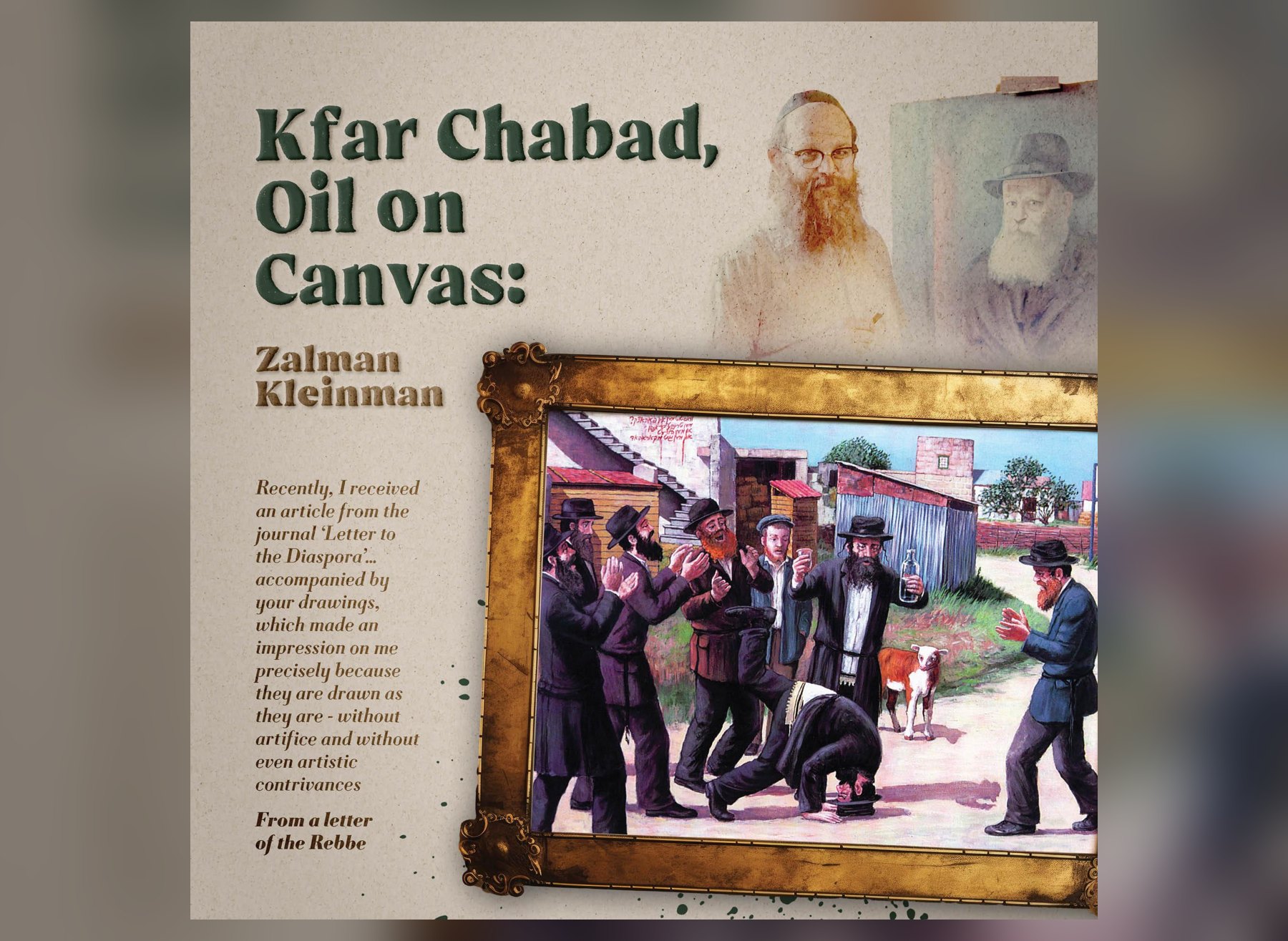
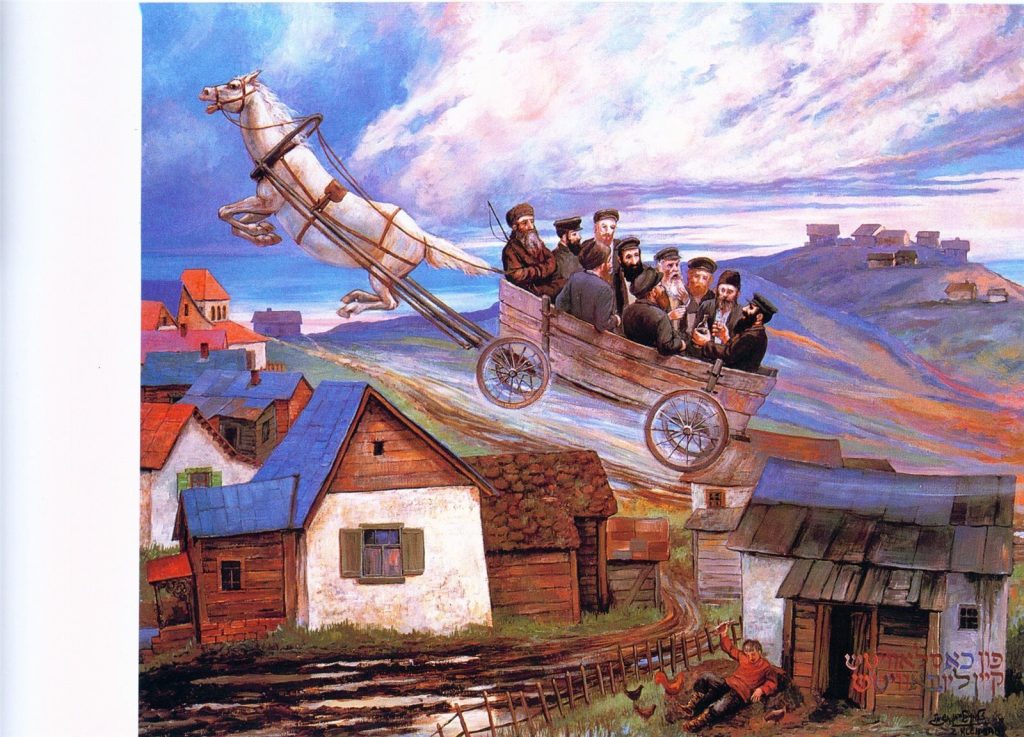
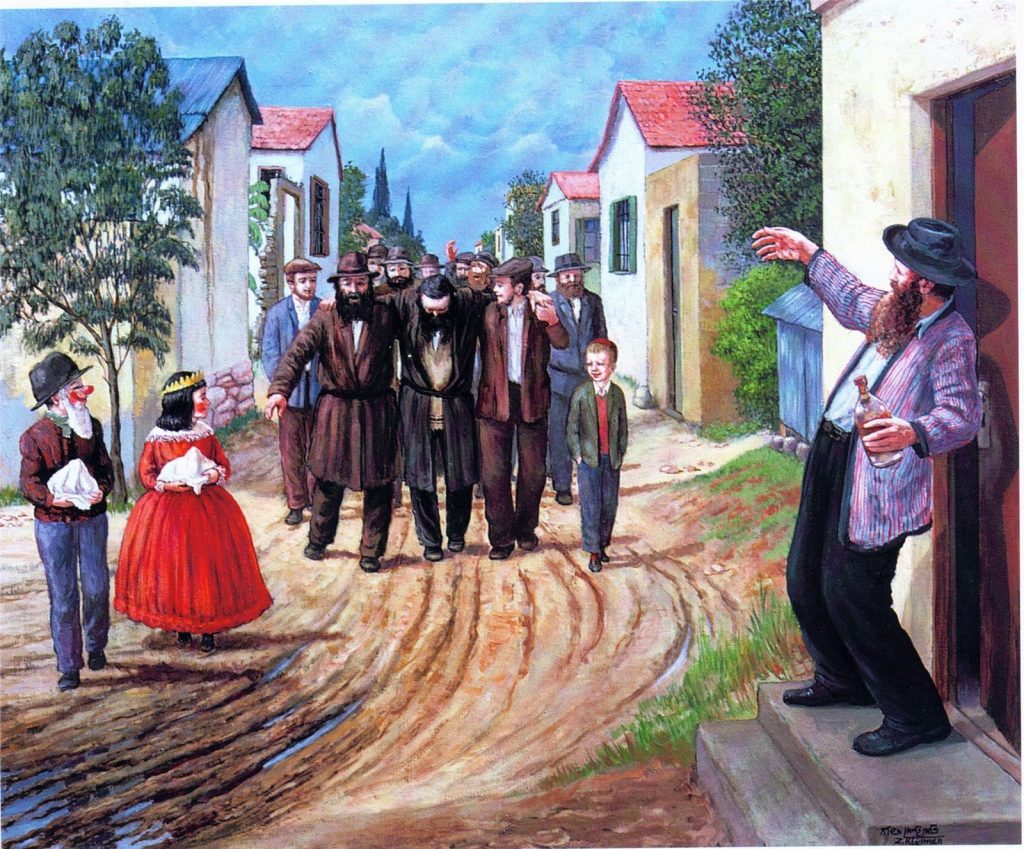
At first glance at a selection of his paintings, it seems that R’ Zalman loved to depict moments of devotion and prayer, but this is not the case. R’ Zalman also knew how to incorporate motifs of joy and even Chassidic humor, such as the famous painting “The Somersault,” or “The Madman,” as well as the drunk being “returned” to his home by his fellow Chassidim.
R’ Zalman would always look around him and draw. When he lived in Kfar Chabad, his paintings reflected the Chassidic atmosphere of the village in those days, with its old houses, shacks, puddles, and mud that filled the village. When he was in Crown Heights, he skillfully captured the surrounding atmosphere – American-style houses, snow, and even American cars that were double parked…
His paintings express a wide range of times and events, from biblical paintings such as Lot’s escape from the burning Sodom, the Covenant Between the Parts, the Splitting of the Sea, Dovid HaMelech, Shimshon HaGibor, and Yiftach HaGiladi, to the days of the ‘maggid’ delivering his sermon in the market, and the days of the Holocaust. R’ Zalman also excelled in depicting the Haggadah shel Pesach in his impressive collection of paintings.
Paintings that Made an Impression on the Rebbe
His works had a profound impact on viewers. They stirred in them longings and yearnings for Yiddishkeit, including in the hearts of Jews who were still distant from Yiddishkeit. His images are in thousands of homes around the world and in various institutions, both in the homes of Torah observant Jews and in other homes. Additionally, his illustrations fill many books today, which have been distributed and sold in tens of thousands of copies.
Regarding the impression his paintings made on those who saw them, one can learn from the letter the Rebbe wrote him (Igros Kodesh, Vol. 15, p. 572):
B’H, the 9th of Elul 5717
Brooklyn.
The avreich Zalman, may he live long
Peace and blessings!
Recently, I received an article from the journal ‘Letter to the Diaspora’ (in English, from the month of Tammuz 5717) accompanied by his drawings, which made an impression on me precisely because they are drawn as they are – without artifice and without even artistic contrivances. It would be appropriate and correct that in this manner he would create an entire album of Kfar Chabad, not only in its current state but also as it was when they first arrived there, so that in this album one could also see the development of the village, as well as the usefulness of the village’s current form, given the hope that it will develop even further, if this series of drawings is successful.
One should also consider establishing these [drawings] in print, whether as an album, a series of postcards, or individual postcards. The main point, as mentioned, is that the drawings should come in their natural simplicity. Do not be discouraged if someone says that for this purpose a photograph would be suitable and a drawing is unnecessary. As is evident in practice, there is a difference between a photograph and an artwork created by an artist, even one created in the artistic style closest to reality.
It is understood that if there are expenses related to presenting the aforementioned drawings, they will be paid from a special fund, including compensation for effort, etc., and I await his response with good tidings regarding the aforementioned.
It is unnecessary to add that my intention is not only for the houses and the like, but also and primarily drawings of village life – from the spiritual life within spirituality, down to the physical life in physicality.
With bracha for a kesiva v’chasima tova, and for good tidings as mentioned above.
Paintings that ‘Live’ for Posterity
At a relatively young age, he departed from this world, having endured much suffering in his short life. On the 18th of Menachem Av 5755, he passed away, leaving behind a generation of righteous descendants, true Chassidic children and grandchildren, who continue to work in the shlichus of the Rebbe. His Chassidic paintings continue to ‘live’ and illuminate thousands of homes, depicting true Chassidic scenes with intense emotion and vitality.
(Based on the memoirs of his sister, Ms. Rochel Zamir, in her book The Mission of My Life)
Beis Moshiach #1455 • pp. 14-21, 29
© 2026 Beis Moshiach Magazine. All rights reserved.
This article originally appeared in Beis Moshiach #1455. You are welcome to share it with friends and family by email or in print, provided that you do not change, add to or omit any part of it, you credit the author and Beis Moshiach, and you include a link to archive.bmoshiach.org (written out in full in printed copies).
To republish this article in a newspaper, magazine, book or website, please request permission in advance at [email protected].