Marriage Advice From the Rebbe Rayatz
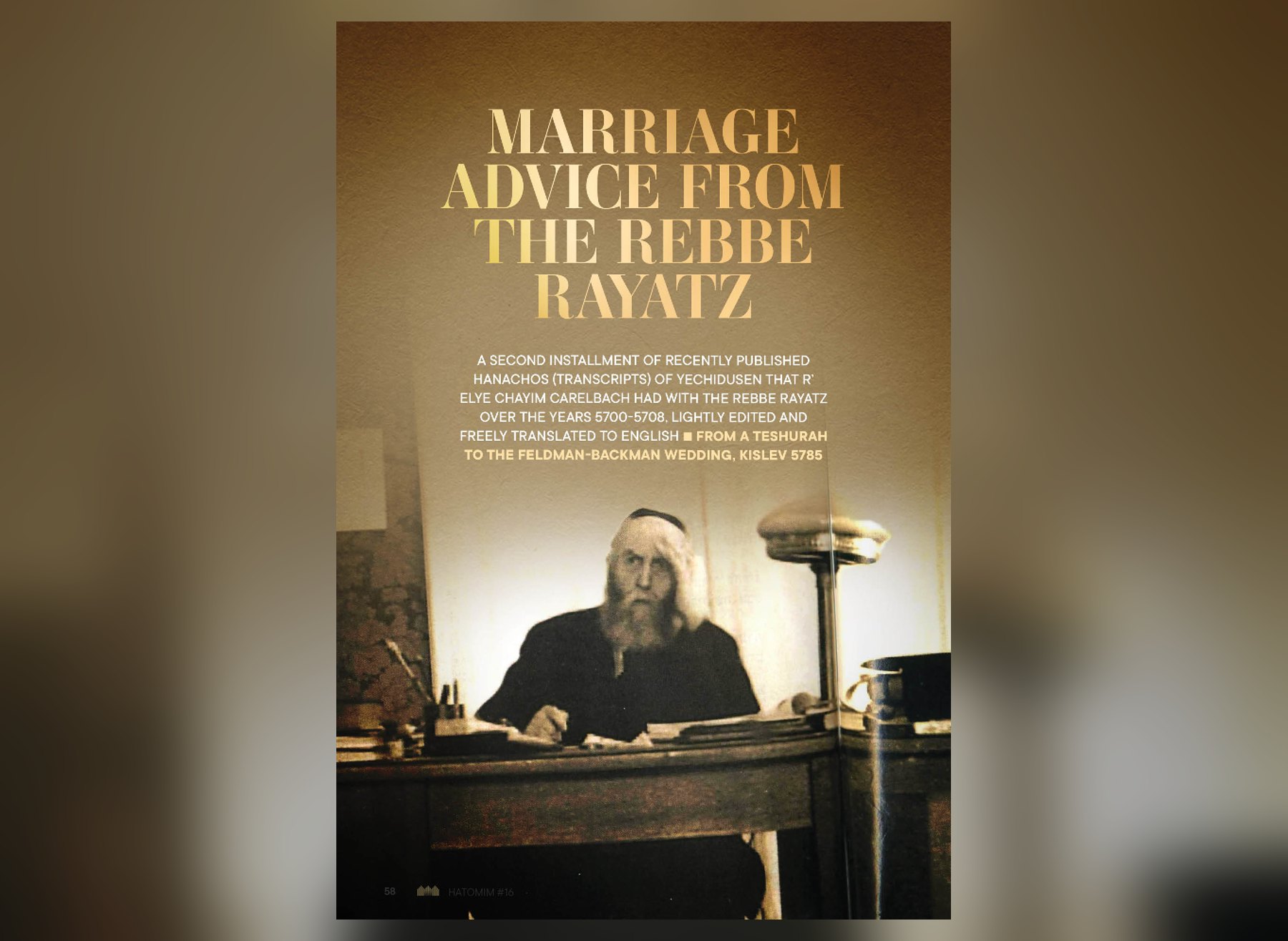
A second installment of recently published hanachos (transcripts) of yechidusen that R’ Elye Chayim Carlebach had with the Rebbe Rayatz over the years 5700-5708, lightly edited and freely translated to English. From a teshurah to the Feldman-Backman wedding, Kislev 5785.
– 4 –
Your Own Tomchei Tmimim!
יחידות של כ”ק אדמו”ר שליט”א בליל ב דר”ח אדר ב’ תש”ו בשעה 10:30
Yechidus with the Rebbe Shlita on the night of the 2nd of Rosh Chodesh Adar Bet, 5706, at 10:30 PM
THE REBBE: [After reading the kvittel (given on behalf of) Heering] The Eibeshter should help… One must be from Hashem’s army: be invested (“ligen”) in learning; one must work very strongly with himself in the matter of avoda.
EC: I asked if I could go to Tomchei Tmimim after Pesach.
THE REBBE: What about kibbud av v’eim (honoring father and mother)? This is what the Torah says, this is Hashem’s will – this is how it is and not otherwise. One must not be a yesh bifnei atzmo, an independent entity. You can learn [Chassidus] in all yeshivos [after finishing the formal schedule].
You come [to study] after you finish the [yeshiva’s] seder?! This will be “your” Tomchei Tmimim, to grow both in avoda and in learning.
THE REBBE: How is your brother’s health? Why won’t he become a rosh yeshiva? And you too, why won’t you become a rosh yeshiva?
EC: Where?
THE REBBE: Only in Tomchei Tmimim! For parnassa, both here and in another place in a [branch] of Tomchei Tmimim in the countryside [are options], but only in Tomchei Tmimim!
EC: [in that case,] won’t my parents just want us to go [study in the central] Tomchei Tmimim] itself?
THE REBBE: What do they want?
EC: They want us to learn for two more years after [we finish yeshiva].
THE REBBE: Why don’t they after 120 years?
THE REBBE: May the Eibershter help.
– 5 –
Go Into Rabbanus!
יחידות אצל כ”ק אדמו”ר שליט”א (לא אדע הזמן אבל בחורף) תש”ח
Yechidus with the Rebbe shlita (I don’t recall the exact date but it was in winter of) 5708
THE REBBE: […] You must certainly learn Yoreh Deah. There is hasmada (diligence) in time and hasmada in the subject matter. Everything depends on you. You have a lot of work.
Will you learn half an hour of Chassidus, a chapter of Tanya? The main thing is learning middos (character traits) of Chassidus.
[As to] getting married? What’s the rush? You need to take a rabbanus (rabbinical position), whether small or large, either in this place or another.
EC: I need to prepare myself.
THE REBBE: Certainly. The main thing is that today one must speak with kiruv (drawing close), not with richuk (distancing)… You must daven with a minyan…
EC: I asked about the order of learning after the wedding.
THE REBBE: Will you then have harchavas ha’daas (broadmindedness)? Two years after the wedding you should begin learning the four sections of Shulchan Aruch and their commentaries!
[I recall that the Rebbe said also that “four years after the wedding I should begin studying Choshen Mishpat] and he also mentioned [studying] Even HaEzer.
– 6 –
“I am Satisfied and Not Satisfied”
יחידות אצל כ”ק אדמו”ר שליט”א בליל ז שבט תש”ח מוש”ק בא תש”ח קודם התנאים שלי
Yechidus with the Rebbe on Motzaei Shabbos Kodesh, the eve of the 7th of Shvat 5708, before my Tenaim (engagement)
THE REBBE: I don’t have strength to speak.
THE REBBE: Mazal tov! I gave over to Reb Shmuel [Levitin] to tell you in my name: I am satisfied and I am not satisfied. I am satisfied with your path and I am not satisfied with your kibud av v’eim (honoring father and mother)… You are very backward in this. It is a mitzvas asei d’Oraysa, a positive biblical commandment and one must have great derech eretz (proper conduct) [to his parents. If not] one transgresses an aveira d’Oraysa (an explicit Torah prohibition)… You are very wild in this matter. One must become a mentch.
You simply don’t know the halacha of kibud av v’eim – that what they say goes (“is gezogt”)?! The main thing is that one must give them a lot of (“a fuleh”) nachas. Do you understand what is being said to you?
THE REBBE: The Eibeshter should grant that you should give your parents much nachas. Both of you should be very happy.
EC: [The Rebbe means me and] Shlomo or about the kallah?
THE REBBE: [I mean] you and your kallah, [as well as] you separately and your brother separately. The Eibeshter should send him the suitable shidduch. [But] now we’re talking about you.
THE REBBE: Tell the kallah in my name a heartfelt mazal tov. You should both be very happy in all your matters, have abundant parnassa, and both your parents should truly have full nachas from you b’gashmiyus and b’ruchniyus. Mazal tov. Listen to what I said to you!
THE REBBE: Mazal tov.
[Reb Elye Chaim noted about this Yechidus the following:
I went to ask the Rebbetzin [Nechama Dina to request an appointment for Yechidus through Reb Shmuel, and I had great wonder until today why they immediately let him in. The Rebbetzin came down to the Beis Medrash and told me: “Go up to my husband. For your mesiras nefesh for Tomchei Tmimim, you should go up tonight.”
Before I entered, Reb Shmuel Levitin entered and stayed there about half an hour or more. When he came out, he told me: “The Rebbe has very little strength, don’t stay too long.”
What the Rebbe said to Reb Shmuel about me, he hasn’t told me until now, only that I shouldn’t be wild.]
יחידות אצל כ”ק אדמו”ר שליט”א בליל יב אדר תש”ט בשבוע קודם חתונתי
Yechidus with the Rebbe on the eve of the 12th of Adar 5709, the week before my wedding
I was inside for about 15 minutes, but I don’t remember anything at the moment.
– 7 –
Marriage Advice: You Are Not the Wisest
יחידות אצל כ”ק אדמו”ר שליט”א בשושן פורים תש”ט יום חופתי בשעה 1
Yechidus with the Rebbe shlita on Shushan Purim 5709, the day of my chuppah, at 1:00
THE REBBE: Mazal tov! May Hashem grant that it should be at a good and successful time…
EC: [I asked what one should think during (or under) the chuppah].
THE REBBE: You know yourself.
[The Rebbe’s father wrote to the Rebbe before his wedding: “When you stand under the chuppah, think constantly about Yiras Shamayim (fear of Heaven). (This is what the Rebbe [Rashab] זיע”א told me for my wedding) and that you have children who fear Heaven, דור ישרים יבורך, an upright blessed generation, from your wife ‘תחי with whom Hashem blessed you.” (Likkutei Levi Yitzchok – Michtavim, page 227) – Ed.]
יחידות אצל כ”ק אדמו”ר שליט”א שלי ואשתי הדסה מרים שתחי’ יום אחר חתונתינו
Yechidus with the Rebbe shlita – myself and my wife Hadassah Miriam ’שתחי the day after our wedding
[The Rebbe smiled broadly when we entered and looked much at my wife]
THE REBBE: A heartfelt, inner mazal tov for the wedding. Previously I spoke from the perspective of the chassan, but today I speak from the perspective that I am an ohev Yisrael (lover of Jewish people) in general and an ohev mishpacha (lover of family) in particular.
Every person has a virtue and a deficiency. [But] not all people are baalei maalos (people of virtue), and the wedding is a tikkun (correction) for this, so that each one should learn the virtues of the other.
We must help one another. One shouldn’t convince himself that everything I say is wisdom and what the other says is not wisdom. You must discuss everything between yourselves.
[Looking at me the Rebbe said]: You don’t need to be so stubborn.
[Looking at Hadassah Miriam ‘שתחי, the Rebbe said:] Stubbornness must be thrown away. The wife achieves that it won’t be noticeable. Each one must hold that the other understands better than oneself.
THE REBBE: If you take my advice, I give my blessing that you should have true happiness for your entire life.
THE REBBE: When are you traveling away? Travel in good health. We should hear good news (matters) from you. You should write from time to time, unburden your hearts.
[The Rebbe gestured with his holy hand towards his holy heart. I recall and it seems he said “it will become lighter on your heart.” Mainly regarding unburdening, he took his holy hand and drew it over his heart from above downward].
THE REBBE: Write intimately. Write about the family. Be happy b’gashmiyus and b’ruchniyus.
* * *
דרושים ששמעתי מאת התנא דבי נשיאה הרמ”ש שליט”א בשב”ק ראה תש”ה*
Teachings I heard from the Chasana d’vei Nesiah, the Rebbe’s son-in-law, the Ramash shlita, on Shabbos Kodesh Parshas Reeh 5705
When the Rebbe [Rashsab] Nishmaso Eden was 4 or 5 years old, he entered the room of his grandfather the Tzemach Tzedek and cried. When his grandfather asked why he was crying, he answered: “Why doesn’t Hashem reveal Himself to us as He did to Avrohom Avinu, as it is written ‘And Hashem appeared to him’?” The Tzemach Tzedek answered him: “When a (righteous) Jew like Avrohom Avinu is ninety-nine years old and decides that he must circumcise himself, he is worthy for the Eibeshter to reveal Himself to him.”
To explain this matter:
At first glance, this is a valid question. The soul being considered, everyone – even a small child – is worthy of the revelation of the Shechina, since they are all rooted in Atzmus Ein Sof Baruch Hu, the Essence of the Infinite One, blessed be He. But if we consider the soul having descended below and being clothed in a body, then even regarding a complete tzaddik the Tanya writes that even if he has ahava b’taanugim [=the greatest degree of love to Hashem], it’s still considered yesh mi she’ohev, “there is someone who loves.” [i.e., he still senses himself to some extent and isn’t completely batel].
If so, even regarding Avrohom Avinu, [we may ask] why was it specifically to him that Hashem revealed Himself, as it’s written in the teachings of the Rebbe that revelation [of Elokus] is relevant even to the simplest of people?
[The answer is:]
In the service of the Creator, one needs to use all ten of his faculties. For example, if he has only love alone, then he may fall, G-d forbid, into arrogance. Or if one has only fear alone, then he will be humble (שפל) even in a place where it’s forbidden to be humble. Therefore, integration (התכללות) is needed.
If so, there are one hundred [levels] in the integration of the ten faculties
— this is the simple meaning in Pirkei Avos: “At one hundred, one is as if he died and became nullified from the world.” What is the Tanna telling us with this? (Rather, that tzaddikim even in their death are called living, because) “as if he died” means that tzaddikim see the Shechina after their passing. [Also,] one who used all ten faculties in their integrated form [“At one hundred”] – is as if he died and became nullified from the world (עולם), for concealment (העלם) is nullified for him. It can also be said that the world of existence is not considered existence to him.
This is Avrohom Avinu – who used ninety-nine faculties. Nevertheless, he saw that he had one kelipah (shell/impurity) and needed to remove it. This is the matter of circumcision, and then Hashem revealed Himself to him.
The idea [of this revelation] is:
At first glance, there’s a contradiction in Rashi, who said that [Hashem’s revelation was that] He came to visit the sick, and afterward said that [Hashem came] to inquire about his [Avrohom’s] welfare for it was the third day after his circumcision. [Why does Rashi associate both of these purposes in the visit?] Asking about one’s welfare is not the same as visiting the sick!
However, “fifty gates of understanding were created in the world, and all of them were given to Moshe except one.” This is difficult – what does this teach us [that all except for one were given to Moshe], it should have just said “forty-nine were given to Moshe”!
But this itself is the point: in truth, all of them were given to Moshe in potential (בכוחות), and if he works on reaching forty-nine gates of understanding, then he would be given him from Above as a gift the fiftieth gate. (See well in the discourse of the Rebbe in Kuntres Chai Elul for 5703.)
“Choleh” (sick) has the gematria of 49. This is the idea of Avrohom at 99 – he himself was embodying the matter of “choleh” (sick), and Hashem visited the sick – meaning the concept of 49. [When] “He asked about his welfare” he [gave him the fiftieth gate and thus] completed the hundred, similar to what the Mishna says in Uktzin, see there.
[Perhaps the Rebbe is referring to the end of Uktzin where it says that Hashem will, in the future, give every tzaddik 310 worlds – Ed.].
* See Tzaddik l’Melech Vol. 2 p. 3 for another hanacha of this sicha
HaTomim #16 • pp. 58-63
© 2026 Beis Moshiach Magazine. All rights reserved.
This article originally appeared in Beis Moshiach #1465. You are welcome to share it with friends and family by email or in print, provided that you do not change, add to or omit any part of it, you credit the author and Beis Moshiach, and you include a link to archive.bmoshiach.org (written out in full in printed copies).
To republish this article in a newspaper, magazine, book or website, please request permission in advance at [email protected].