3 Weeks of Opportunity
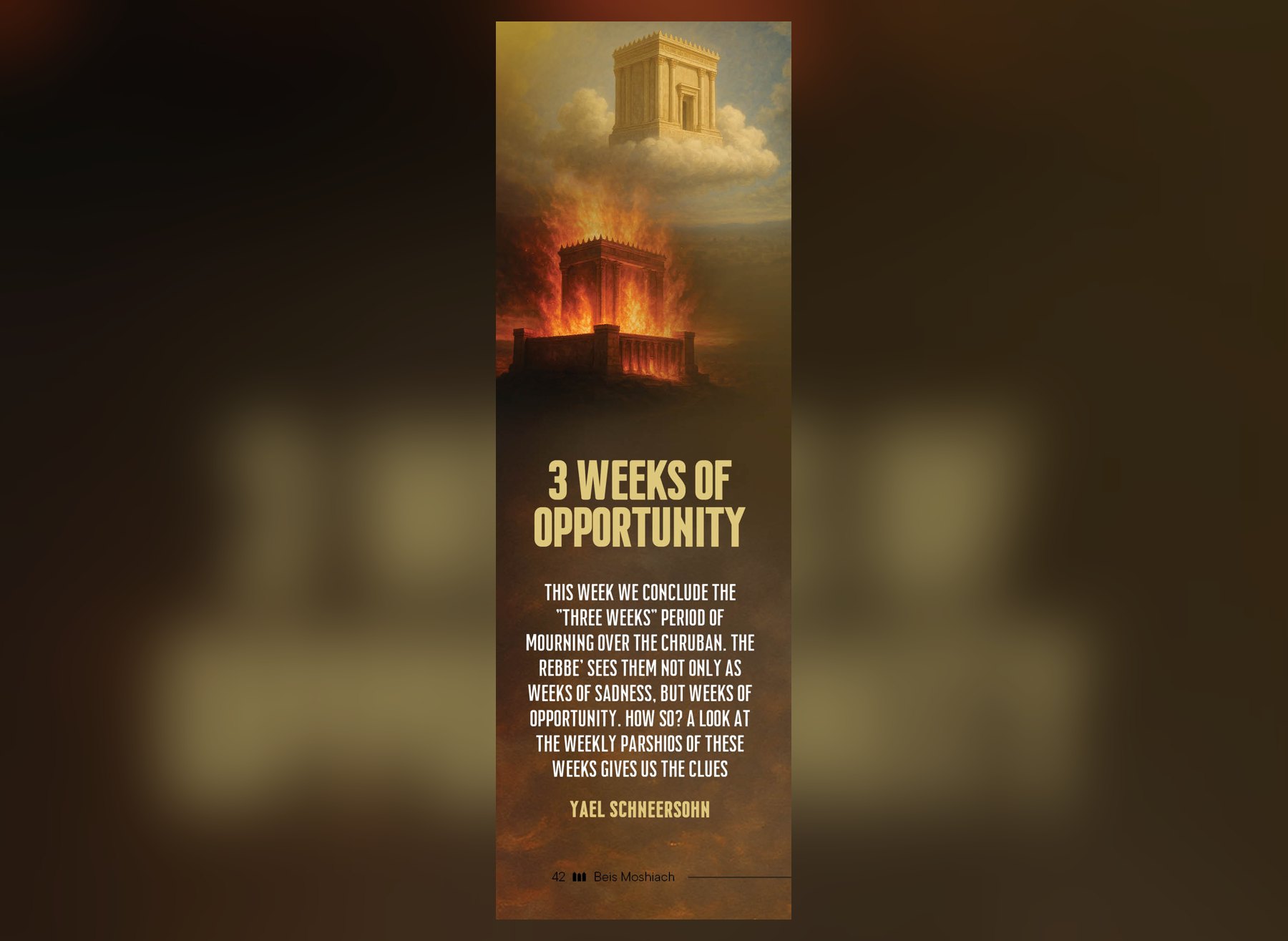
This week we conclude the “Three Weeks” period of mourning over the Churban. The Rebbe sees them not only as weeks of sadness, but weeks of opportunity. How so? A look at the weekly parshios of these weeks gives us the clues.
A “Stop” Sign
The days of “Bein HaMeitzarim” are a period of sorrow, of introspection, of mourning for what was and then was taken away. A tangible absence is felt in these days.
The days of “Bein HaMeitzarim” are a stop-sign, a period in which we stop for a moment from the daily race. There are no weddings, musical instruments are set aside, and pain and sorrow are present and deeply felt.
The days of “Bein HaMeitzarim” are not just a period in the calendar. We might encounter them at other times in our lives too – periods that are more difficult, times connected to loss or tangible pain. This can be a period of difficulty of any kind: mental, physical, or spiritual; a period in which we understand how far we are from the goal, how much we have strayed from the path, how much we still have left to complete.
It is difficult to experience loss, to mourn, to cope with an absence that cries out. But precisely from this place, the dark, the gloomy, the lacking – the Geula grows.
Only Good for Jews
The Rebbe, in his Geula perspective on these days, explains that precisely the depth of darkness is the depth of light. The 21 days of Bein HaMeitzarim, says the Rebbe, equals “ach” (but or only) in gematria, a hint to “ach tov l’Yisrael” (only good for Israel).
And what is good about them?
The Shabbosos of the Three Weeks, the Rebbe reveals to us, are the refuah preceding the blow. On Shabbos it is forbidden to mourn and grieve. Moreover, Rabbi Levi Yitzchok [the Rebbe’s father] says that specifically on these Shabbosos one should beautify and add joy, so that it should not appear, chalila, that we are mourning on Shabbos.
The inner reason for this: these three Shabbosos, “three of retribution,’ correspond to the three mochin, and the seven Shabbosos that follow them, ‘seven of comfort’ – correspond to the seven middos. It is known that the middos originate in the mochin. When a person contemplates in his mind, his emotions are aroused. This means that precisely these Shabbosos, which are seemingly Shabbosos of days of calamity, are what arouse and bring the Shabbosos of Geula that follow them.
The complete tikkun of the three mochin will be in the true and complete Geula. This is hinted at in the fact that on the Shabbosos of Bein HaMeitzarim we read Mattos, Masei, and Devarim – in which the division of the land is described, including the Trans-Jordan, which was given to the sons of Gad and the sons of Reuven. This inheritance in the Trans-Jordan is the beginning of the conquest and division of the three lands of the Keini, Knizi, Kadmoni, lands that we will receive in the true and complete Geula. That is, precisely from the place where everything appears dark, lacking, mourning and desolate – the Geula grows.
The Rebbe even says that ‘puranus/retribution’ in its sublime aspect is like ‘Pharaoh,’ whose root is in very sublime holiness – ‘all lights are revealed and disclosed from it.’
That is, these days of calamity, in an inner and deep way, are great days, days in which it is possible to turn everything around and reach the source, the most sublime and illuminated place. Our task, the Rebbe explains, is to illuminate them with the light of Torah, Torah study and its dissemination, and with the light of tzedaka and gemilus chassadim. With light that will reveal the deep pnimiyus, the true root of the destruction and mourning, and will transform these days into good days, days of joy and happiness.
Growing From the Darkness
So too, in personal life. Sometimes you feel that everything is dark and wild, and not necessarily in the sublime way… You feel absence, difficulty, loss, destruction. But everything depends on your point of view.
If you delve inward, into the root, you will see how redemption grows from difficulty, how from a seed that rots something new grows.
True, it might hurt, and even a lot. Sometimes it seems impossible. How can one see the light within the darkness, the building within the destruction, and the Geula within the exile?
But we, Chassidistes, believe in containing opposites. We know that the days of Bein HaMeitzarim are days of mourning and destruction, and we are careful about the laws. And yet, we also know that the inner root of exile is Geula, and that the root of these days is high and sublime – kindnesses so covered over that it is impossible to see them.
It is indeed difficult for us, in our limited vision, to see the good which is hidden in the days of Bein HaMeitzarim. It is not easy to find the light, to identify the sublime source, the high mochin that lead to middos, the complete tikkun.
But if we believe that this good exists, and that these days are actually days of Geula; if we believe in our ability to bring and reveal it, to see the source and the redemptive root of all the exilic darkness surrounding us, then we will merit the fulfillment of the promise “Then your light shall break forth like the dawn, and your healing shall spring up speedily,” and suddenly from within the darkness great light will burst forth.
From within the earth, in whose depths the small seed rotted, growth will rise – wondrous growth that only the Holy One, blessed be He, can grant us. And then we too will be able to say “I will thank You, Hashem, for You were angry with me,” and not only from emuna. We will understand and see this tangibly. We will know that all that we learned and repeated was not in vain. We did not believe and strive for nothing, there are fruits to the labor.
Because ‘hinei zeh Melech HaMoshiach ba,’ and the light of Geula illuminates the world without leaving any dark corner.
Sources: Sefer HaSichos 5750 Part 2 pp. 565-580
Beis Moshiach #1470 • pp. 42-43
© 2026 Beis Moshiach Magazine. All rights reserved.
This article originally appeared in Beis Moshiach #1470. You are welcome to share it with friends and family by email or in print, provided that you do not change, add to or omit any part of it, you credit the author and Beis Moshiach, and you include a link to archive.bmoshiach.org (written out in full in printed copies).
To republish this article in a newspaper, magazine, book or website, please request permission in advance at [email protected].