Chana, Why Are You Crying?
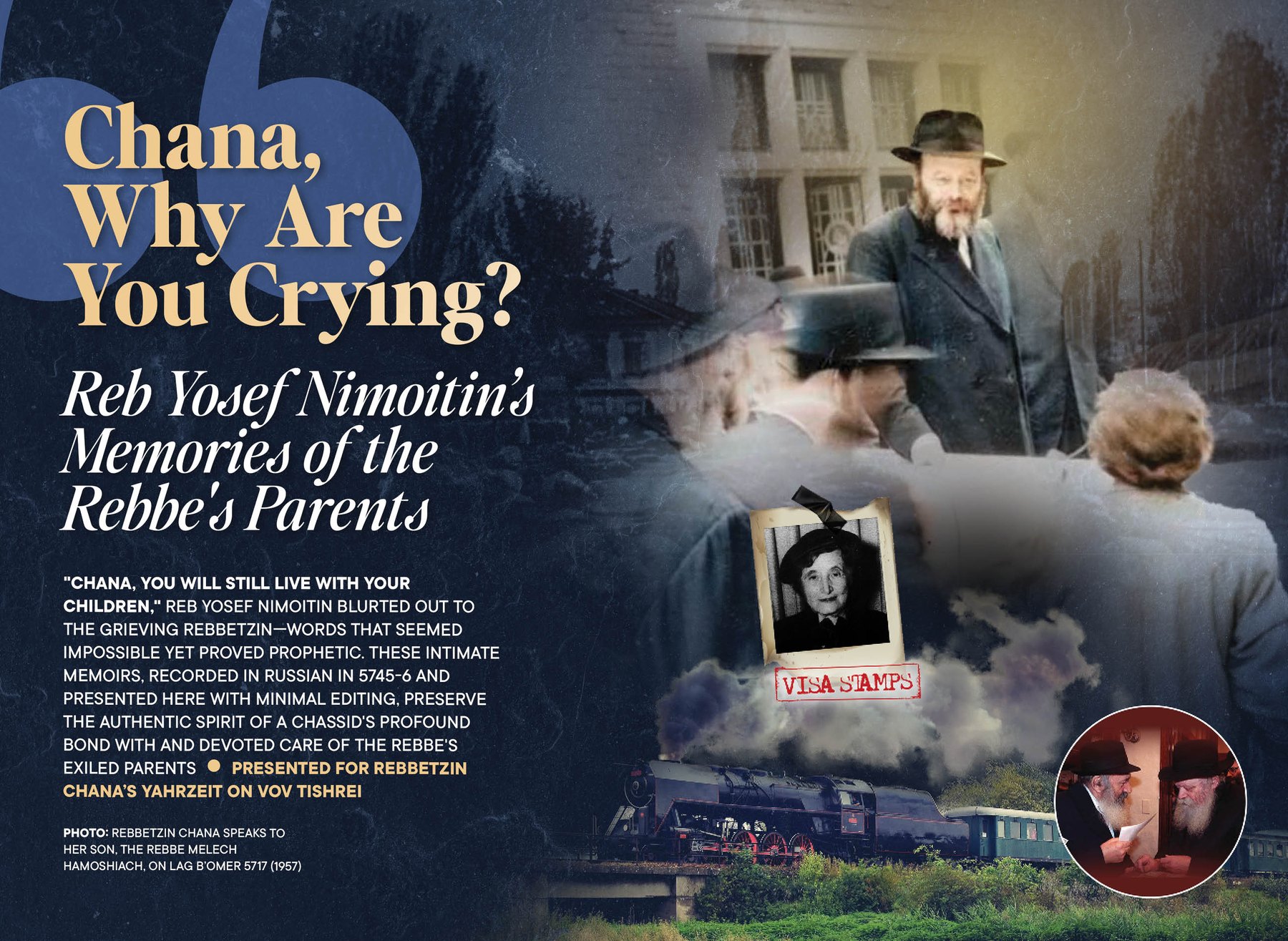
“Chana, you will still live with your children,” Reb Yosef Nimoitin blurted out to the grieving Rebbetzin – words that seemed impossible yet proved prophetic. These intimate memoirs, recorded in Russian in 5745-6 and presented here with minimal editing, preserve the authentic spirit of a Chassid’s profound bond with and devoted care of the Rebbe’s exiled parents. Presented for Rebbetzin Chana’s yahrzeit on Vov Tishrei.
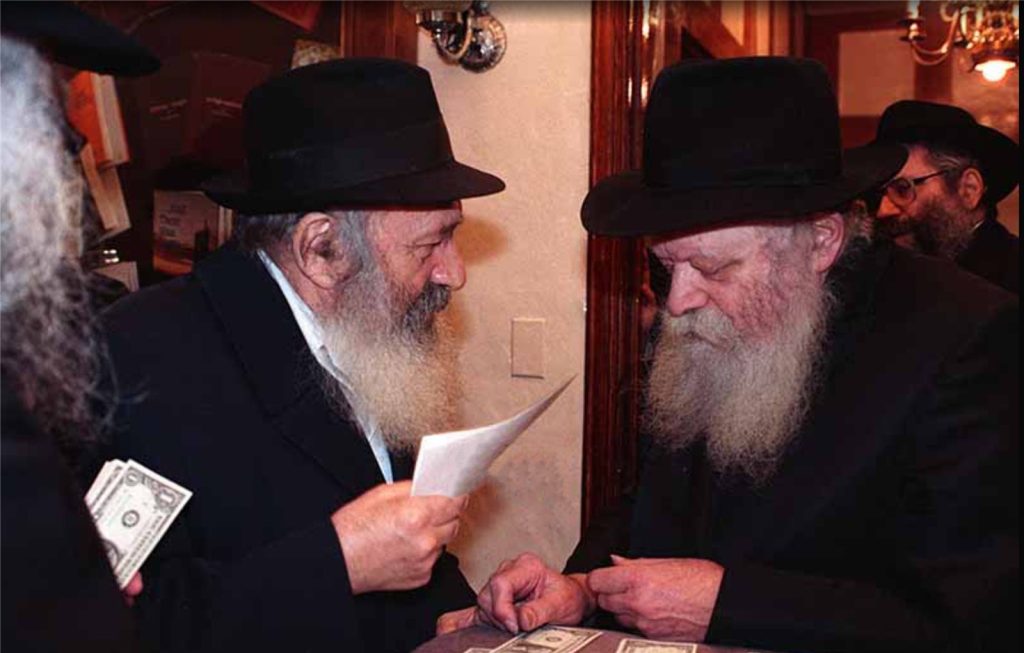
At the end of the 1950s, R’ Yosef Nimotin secretly built the only mikva in Alma Ata under the floor in a bedroom of their small home, and maintained it at great personal risk for two decades. During these years he also tended to the resting place of the Rav, Rabbi Levi Yitzchok. Throughout this entire period, the Nimotin couple served as pillars of Jewish life in the city. In 1979, the family received permission to emigrate from the Soviet Union, and R’ Yosef and Tzila settled near the Rebbe in Crown Heights. “I cannot repay you enough [for the service you provided to my parents],” the Rebbe once said to R’ Yosef in yechidus, “and I never want to finish repaying you.”
R’ Yosef Nimotin passed away on 14 Elul, 5751. The next day, the Rebbe personally participated in his funeral, apparently as a sign of gratitude and appreciation for his great work on behalf of his father.
R’ Yosef recorded his memories in Russian in 5745-6, and they appear here in translation with minor and necessary editorial changes as well as additions in parentheses.
Foundation of Self-Sacrifice
R’ Yosef Nimotin was born in Petersburg, Russia, on the second day of Rosh Hashana, 1910, the second of five children of R’ Shmuel and Ita Nimotin. His grandfather, Rabbi Yehoshua Nimotin, served as a chozer in the court of the Rebbe Maharash in Lubavitch.
With the blessing of the Rebbe Rashab, R’ Shmuel moved to Petersburg, where he later established a kosher restaurant to serve Jews passing through the imperial capital. The Rebbe Rayatz would also stay in his home and eat there when he went to Leningrad. He was also heavily involved in collecting funds for the Rebbe’s court despite the great danger involved. Several years after the Communist Revolution, R’ Yosef was sent to the underground Lubavitch yeshiva in the town of Nevel. He married his wife, Mrs. Tzila, in 1935, and the couple settled near his parents in Leningrad.
R’ Shmuel was arrested by the Soviet secret police on the night of Shabbos, 30 Menachem Av 5697, and was accused of anti-revolutionary activity and a terrorist-like approach toward ‘Comrade Stalin and the Communist Party.’ Without his family’s knowledge, he was executed on the 22nd of Elul that same year.
Following the Nazi invasion of the Soviet Union in the summer of 1941, R’ Yosef sent his wife and son, Binyamin, to safety in Alma Ata. Leningrad came under Nazi siege shortly thereafter, and R’ Yosef fled the starving city by crossing a frozen lake in a truck. When he arrived in Alma Ata, he discovered that their son had died due to lack of basic antibiotics.
In 1943, the Nimotin couple’s second son, Yehoshua, was born. The events described below begin about a year later, with the arrival of Rabbi Levi Yitzchok and Rebbetzin Chana to Alma Ata, shortly after Pesach 1944.
In 1946, the Nimotin couple’s third son, Levi Yitzchok (Lev), was born; R’ Yosef describes Rebbetzin Chana’s reaction to the name they gave him below. Later that year he helped Rebbetzin Chana reach Moscow, from where she traveled to Lvov and escaped from the Soviet Union together with a core group of the Chabad community, in what became known as the “Great Escape.” The window of opportunity to leave the Soviet Union closed before the Nimotin couple could take advantage of it, and so they settled near other Chabad Chassidim in the Ukrainian city of Chernowitz.
In the month of Kislev 1948, five Chabad Chassidim tried to escape from Chernowitz to Romania, but all were caught and arrested. With the Soviet secret police closing in on the community, everyone fled, with the Nimotins returning to Alma Ata. During the next two years, the secret police tracked almost everyone who had been involved in this escape attempt, and R’ Yosef was arrested in Kazakhstan on the 25th of Marcheshvan, 1950. He was sentenced to five years in the Gulag labor camp system, which was later extended to 10 years, before being released in a general amnesty in the month of Adar 1956. His years of forced labor, including in the frozen northern republic of Komi, led to medical complications for the rest of his life.
Suffering Faces
The following lines are excerpts from his account:
What I consider the first part of my connection with the Rebbe’s parents begins in the period before my arrest. At that time, we lived on Fifteenth Lane in Alma Ata, the third house from the square. We drew water for our needs from the other side of the square, at the corner of Sixteenth Lane. The ‘square’ that comprised the open area was completely natural, without any asphalt. In good weather, we crossed it directly; in rainy weather, we had to go around it, otherwise the mud would claim our shoes – along with our feet inside them.
Friday afternoon, erev Shabbos, I’m in the center of the square, loaded with two buckets of water. “Yosef, stop!” a friend shouts to me.
The square is large. I see a respected Chabad Chassid running toward me, out of breath. While catching his breath, he says quickly, “Yosef, if you could bring your father here, but it would cost 3,000 rubles, would you do it?”
“Of course!” I answer.
“Well,” Yaakov Yosef tells me, “there’s an opportunity to bring the Rabbi and Rebbetzin from Yekaterinoslav here – Rabbi Levi Yitzchok and Chana Schneerson. They have been exiled deep into Kazakhstan and are living in terrible conditions, far from other Jews. But for this, we need 3,000 rubles here and now.” Without discussing it further, since it was already close to candle-lighting time, I picked up my buckets and asked my friend to follow me. And so within a few minutes, I handed over the required sum.
Several weeks later, the Rebbe’s parents, Rabbi Levi Yitzchok and Rebbetzin Chana Schneerson, arrived in Alma Ata. I won’t try to describe the suffering face of the Rebbe’s father. It was ‘hard to digest.’
With their actions, two people – a man and a woman – forever carved their names in the history of the holy Lubavitch Chassidic movement. These two risked their lives to save the Rebbe’s parents from their hell on earth, and to bring them to the Chassidic community, to a freer environment where they received material and spiritual support. Their names: Mendel Rabinovitch. Bas-Sheva Altheus.
We all took part in the effort to bring the Rebbe’s parents to Alma Ata, but we, as they say, were like ‘freelancers,’ doing whatever we could. Mendel and Bas-Sheva were the ones who actually traveled to the place where the Rebbe’s parents were suffering and physically accompanied them to Alma Ata.
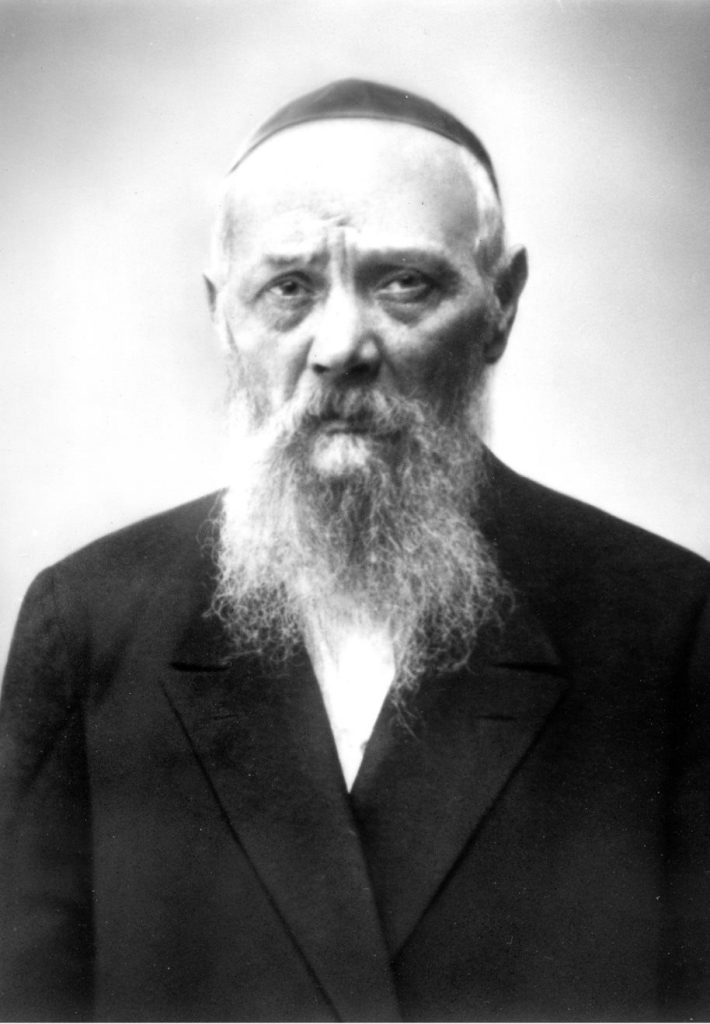
The first time I saw the Rebbe’s father in his full majesty was on Shabbos morning in our shul, which was in a cellar on Ninth Lane (‘oif der naynte linye’). With his spiritually penetrating gaze, he somehow drew all of us closer to him.
I davened together with Rabbi Levi Yitzchok on Shabbos. I don’t know what the others felt, but the feeling I had when he read the Haftora was as if I ceased to exist. We simply weren’t prepared for the great spiritual light with which this man filled the shul.
We rented an apartment for them. It had a rather narrow living room, about ten meters long, with the entrance at one end. At the other end of this long room was a window, and next to it a small table and chair. Here the Rebbe’s father would sit when he taught Chassidus. Everyone else stood.
After the arrival of the Rebbe’s parents, every Thursday evening a man named Tzaleh (Betzalel) would come to me, and I would give him money for the fund we established to support them.
A Mysterious Mission to Tashkent
At one point, the Rebbe’s father learned that I was planning to travel to Tashkent, a journey that according to the Soviet governmental system required special permits. And he asked me to stop by his house before my trip.
When I arrived, he received me with what seemed like special ceremony, as if someone receiving a serious mission. He gave me a sealed letter and asked me to deliver it to the address indicated on the envelope.
It was a 22-hour train journey to Tashkent.
I arrived on a hot, sun-drenched day. I was supposed to stay with my brother, Folye (Refoel), who lived in a distant neighborhood called Kraso. At that time, taxis were definitely not in fashion, but there were carts harnessed to donkeys waiting outside the station. Passengers placed their suitcases on the carts which were padded with straw, and sat beside them. The donkey driver walked alongside the donkey. And so, I settled in. For about three hours, the donkey paced slowly with its owner, jolting me forcefully the entire way.
Finally we reached the street and house number. I placed my suitcase by the gate, paid for transporting myself and the luggage, and continued deeper into the courtyard. I didn’t see anyone until I entered the building, where I greeted my brother, Folye. The first thing I did was show him the letter from the Rebbe’s father. “Where is this street, where is this house?” I asked him. He shrugged his shoulders. “This is the first time I’ve seen such an address,” he said.
I decided to ask my brother-in-law. I passed through the adjacent courtyard and entered his house, where clicks of knitting machines could be heard, making socks. My brother also worked on one of these machines. My brother-in-law, tense from his business, spoke to me through tangled threads. “Please, look!” I pleaded with him. “Read the address. This letter is from the Rabbi of Yekaterinoslav, Rabbi Levi Yitzchok Schneerson. I urgently must deliver this letter to the address on the envelope.”
He read it. “I don’t know,” he answered, and returned the letter.
And so I set out on foot to an unknown destination. It was around ten in the morning, and the sun was already scorching. I decided to try to locate the address through the postal service. I walked for hours, from one post office to another. Thirst began to weigh on me, but I was in the Uzbek-Central Asian quarters, where all the houses were closed, like an egg in its shell. I couldn’t find anything to drink on the way.
It was around four (!) in the afternoon when I finally found the street, and began looking for the house number. The street led to a shabby square, where I thought it ended. But after I crossed the square, I realized it indeed continued. There, on the side, I noticed a small hill on which stood a small house. I checked the number – it matched the one on the Rebbe’s father’s envelope. I climbed the stairs, rang the bell, and after a few minutes, the door opened slightly. An old man with a small beard, sunken cheeks, green eyes, a small oval mouth, and a black yarmulke on a snow-white bald head peered out.
Quietly and hesitantly, this small old man addressed me with the words, “Reb Yid, vos darft ir?” (‘Reb Jew, what do you need?’).
I answered, in Yiddish of course, “I have a letter for you from the Rabbi of Yekaterinoslav, Rabbi Levi Yitzchok Schneerson.”
The old man extended his withered, waxy-colored hand through the crack in the door, and I placed the letter in his hand. With that, the door closed.
Barely able to stand due to thirst and fatigue from the long, hot journey, I held onto the porch railing. I didn’t move. The lock clicked again, the door opened slightly, and the old man’s head appeared again. “Reb Yid, vos vart ir?’ (‘ Reb Jew, why are you waiting?’).
“I’m waiting for a response to the letter from the Rabbi of Yekaterinoslav, Rabbi Levi Yitzchok Schneerson!” I called out.
“Kayn entfer vet nit zayn!” (‘There will be no response!’), came the old man’s short answer. In a moment, the door slammed shut again and I heard the lock being locked. And I was left to return to distant Kraso.
I returned to Alma Ata to report to the Rebbe’s father, in detail, about what had happened.
When I entered the room, the Rabbi of Yekaterinoslav, Rabbi Levi Yitzchok Schneerson, became very alert. The Rebbe’s father’s thoughts and emotions were so intense and dynamic that they were even visibly expressed.
This was the first time I came into close contact with a person of this caliber. Carrying out missions for such a wise person is challenging. You must be prepared to answer unexpected questions about the mission – questions you hadn’t even thought of, requiring deep thought. As a result, I described everything in detail, including delivering the letter in Tashkent. It was difficult for me to watch the Rebbe’s father’s anxiety while he listened to my response.
When I finished, there was complete silence. Then it became clear to me that my story had deeply affected the Rebbe’s father.
The Words of the Tzaddik
Weeks passed, one after another. According to the established routine, Tzaleh would visit me every Thursday evening. The Rebbe’s father requested and insisted that all his missions be carried out carefully, on time, and with precision.
Tzaleh came to visit me as usual one Thursday evening. As I mentioned, I was in my own state of emergency, which could have easily escalated into a major crisis. I was terribly anxious when I saw Tzaleh. “Oh, R’ Tzaleh,” I called out, “if only you knew what trouble I’m in!”
Understanding my situation, Tzaleh parted and left without my contribution to the special fund. That Shabbos, toward the end of the day, we all gathered in the apartment of the Rebbe’s father, and he taught us Chassidus. We were about fifteen men. He was already very ill when we brought him to Alma Ata, and often during the lesson, he would say “I need to rest,” and we would all leave immediately.
On that Shabbos, after the Thursday I told you about, I arrived late and remained by the door.
“I need to rest,” I heard a weak voice say (it was the voice of Reb Levik). I was the first to turn around and start to leave. Then, that same voice, this time commanding, stopped me. “Yosef, I need you.” Everyone left, and I remained standing there. “Come closer,” he said. I approached the table. The Rabbi, with exceptional clarity and endowed with special holiness, stood up. He gently struck the table with his fist and said:
“What shall we eat?”
Seeing my confusion, at that very moment, the holy man changed. He embraced me, looked at me with a kind and gentle gaze, and said, “Go home.”
I am trying to reconstruct from memory the course of the event I am writing about.
Tzaleh came to me on that Thursday evening as usual. I found myself in crisis and did not fulfill my obligation to the Rebbe’s father; more precisely, I did not contribute to the fund that helped feed them. When the words “What shall we eat?” reached me, I was deeply stunned.
It took me a long time to understand their meaning.
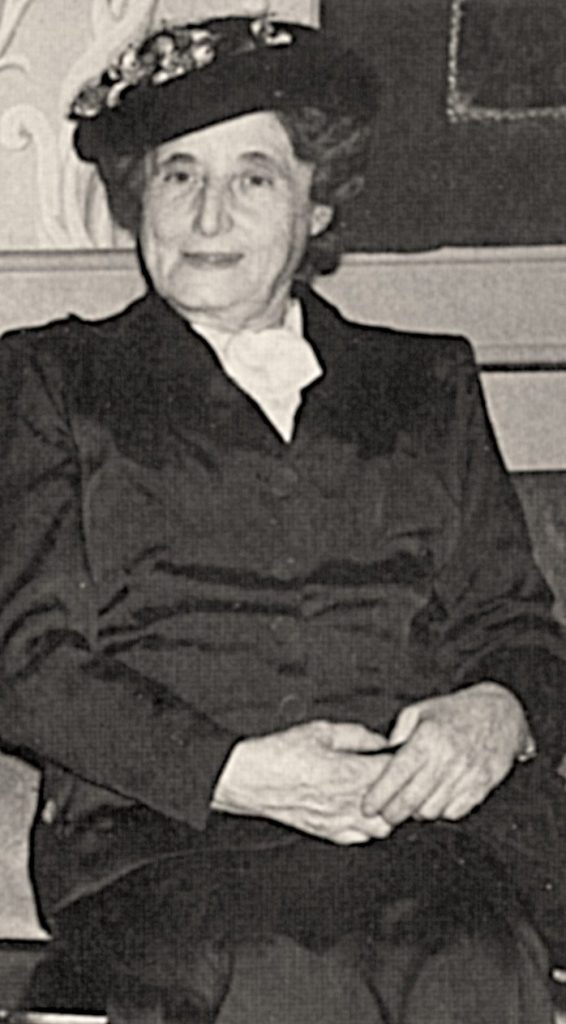
The Rebbe’s father is no longer in this world. The Rebbe’s mother lives in a small room on our same street. It’s Friday, and soon it will be time for lighting Shabbos candles. I pass by the window of the Rebbe’s mother – it’s wide open. I peek inside and see her at the edge of the room, with her back to the wall and her hands hanging at her sides.
I ask loudly, “Chana, have you prepared something for Shabbos?”
A weak answer comes to me: “Why are you asking, can’t you see my condition?”
Without saying a word, I go home quickly. I tell my wife, Tzila, “From today onward, our chicken stands on one leg.”
“Have you gone mad? What does that mean?”
“Chana Meirovna (the Rebbetzin’s Russian title) has nothing for Shabbos. Take a jar, pour some soup into it, put some chicken inside, and I’ll take it to her.”
When I returned to the window with the jar, the Rebbe’s mother was standing there. She extended her hands and accepted the food.
When I returned home, the words of Rabbi Levi Yitzchok, “What shall we eat?” echoed in my head. At the time they were spoken, the Rebbe’s parents had enough food, which is why those words, spoken by such a holy man, confused me so much.
Now I understood…
Chana, Why Are You Crying?
I must warn you that there will be no chronological order in my notes about my relationship with the Rebbe’s parents. That is, years have passed since the beginning of the events I described in the previous pages, and in some ways I wrote the end before the beginning. From here on, I will write about episodes that occurred in the time period in between.
The Rebbe’s father is still alive. They live in a large apartment. It’s a sunny day in Alma Ata, the house is bathed in rich greenery. I pass by their house and decide to stop. I stand on the threshold of the living room and witness the following scene:
The Rebbe’s mother is pacing quickly from one side of the room to the other, sobbing.
“Chana, why are you crying?” I ask. She slows down a bit and points toward the door on the right. “I went in to see him,” she says. “He was lying down, crying. I asked, ‘Why are you crying?’ He answered, through his tears, in few words: ‘With whom am I leaving you?…’”
She returns to her rapid walking, which has now become running, and continues sobbing loudly.
Stunned by the situation, and without thinking about my words, I don’t just say, but blurt out: “Chana, you will still live with your children.”
The Rebbe’s mother stops, gives me a burning look, and then continues again with her tears.
At first, I felt embarrassed, as if I had said something unrealistic and inappropriate. At that time, I couldn’t even dream that the Rebbe’s mother would live with her son, the Rebbe, in America for (more than) fifteen years.
But again, it was proven that truth is revealed in time, not in intellect.
The Medicine
The situation deteriorated tragically.
Again, it’s Friday. I remember it was two o’clock in the afternoon when the attending physician of the Rebbe’s father, Kuperman, entered my house. He gave me a prescription and said, “Get this medicine. Someone will come to take it from you soon.”
It wasn’t easy to obtain complex medicines – especially imported ones – in Alma Ata at that time. One street away, on the corner, there was a pharmacy. The person in charge lived like a monk – he wouldn’t communicate with anyone, and no one visited him. He didn’t accept money or gifts (that is, bribes). He was distant from both people and religion. Once he told me: “I know about you and you will always receive the medicines you need.” How he knew, I’m not sure, but he always kept his word. Every time I entered his pharmacy with a prescription, I left with medicine. Dr. Kuperman was aware of this.
I want to know the diagnosis of the Rebbe’s father’s illness. Therefore I ask the doctor: “What does the Rabbi suffer from?”
The doctor is silent and then says, “Don’t waste time, go and get it.”
I repeat my question, “What is the Rabbi’s illness?”
The doctor becomes angry and shouts, “So you want me to issue a death sentence on the Rabbi? Go get the medicine – it will ease the Rabbi’s pain.”
When I returned home, a man was waiting for the medicine.
The Last Shabbos in This World
(Shabbos, 16 Menachem Av, 5704): On Shabbos afternoon, a man came and said: “Reb Levik requests that you, R’ Yosef, come to him together with Tzila now.” Strange! He had never invited both of us, Tzila and me, on Shabbos afternoon.
As we approach the house, standing outside, by the gate, was Chana, the Rebbe’s mother. “What happened, Chana?”
“I have no idea; he asked for both of you to come.”
Deep in the courtyard, about ten meters from the gate, stands a bed. Rabbi Levi Yitzchok is lying in it. His eyes are closed, his face is absorbed in thought, his hands are slightly bent and rest near his heart. It’s clear that he is suffering.
Suddenly, his eyes open and focus intensely on both of us. He doesn’t move his hands. Then a weak voice, as if carried by the wind, says, “Come close to me!”
With his right hand he points toward Tzila, and we approach the bed. His first words: “Don’t think I always looked so frightening (‘strashenker’).” And then he begins to bless Tzila.
His voice fades, the words become blurred and then disappear. His eyes close, and he sinks back into unconsciousness.
This was our last conversation with the Rav of Yekatrinoslav, Rabbi Levi Yitzchok Schneerson, the Rebbe’s father.
The First Child Named After Reb Levik
After the passing of this holy man (on Wednesday, 20th of Menachem Av), his wife, the Rebbetzin, withdrew into herself. She no longer dressed beautifully for holidays and tried to be less in the company of people.
Time passed, and a son was born to us. We invited Rebbetzin Chana to the bris. When she entered, every corner of our house seemed to brighten. Tears sparkled in the Rebbetzin’s eyes when the child was called by the name: Levi Yitzchok. My son is the first child named after the Rebbe’s father.
A Chassid to His Very Bones
I am proud of the characterization I received from the Rebbe’s father. During one of the farbrengens with Rabbi Levi Yitzchok, he gave a verbal description of every Chabad Chassid living in Alma Ata. There were scholars in Chassidus and Nigleh, activists, philanthropists, and many others with various virtues, each with his personal merits. However, the last description was for me.
He said: “A Chassidisher beindl iz Yosef” = “Yosef is a Chassid to his very bones.”
This characterization doesn’t speak of my being an exceptional scholar or something similar. This is who he is, and that’s it.
Now let us accompany the Rebbetzin, the Rebbe’s mother, to Moscow, from where she will travel to her son, our Rebbe.
Transferring Rebbetzin Chana from Alma Ata to Moscow
I walk in the Ninth Lane, where the Rebbe’s mother lives. I reach the small window behind which the Rebbetzin resides and knock gently. She approaches and opens the window. “Hello,” I greet her, “How are you feeling?” Without waiting for her answer, I continue: “Do you have acquaintances or relatives in Moscow?” “Not really,” she says. “There’s a distant relative there, a teacher, but he’s far from our way of life. Why do you ask?”
“Here’s why: I’ve decided to help you get to Moscow!”
Rebbetzin Chana at this moment was very lonely, beaten down by life and depressed by her husband’s death. Surprising as it may be, she grasped onto my idea like a drowning person grasps at straw. She didn’t argue or resist.
“Fine,” she said.
I didn’t walk home in a regular walk, but ‘flew,’ carried by the thought I had in my head.
The first thing I do is tell Tzila: “I’ve decided to send Chana Meirovna to Moscow.”
I received a harsh and skeptical response: “Have you gone mad? To send an old and sick woman alone to Moscow? The train leaves Alma Ata on Sunday and arrives in Moscow on Thursday.” But I stood firm in my decision, without wavering for a moment, and searched day and night for a way. Then Hashem sent me an opportunity.
The Sludovnikov Family
In Alma Ata lived a family from Leningrad (the Sludovnikov family). Let’s first introduce the adults, then the young ones. Shmuel Yaakov, the grandfather; Chana, the grandmother; Mottel, their son; Devorah, their daughter-in-law; Rivotzka, their granddaughter; and Boranka, their grandson.
We knew this family back in Leningrad, and in Alma Ata we became close friends and lived next to each other. Mottel and I worked together in the same department at the same factory. He was the department head, and I was the supervisor. The war ended, and the young family members returned to Leningrad, but the grandparents stayed in Alma Ata.
The reason for leaving their elderly parents in Alma Ata had ended, and the children invited them to join them again. One main obstacle to this was obtaining train tickets for the Alma Ata – Moscow route. But I had a way to get them.
Shmuel Yaakov came to me and said “Yeshke, Mottel nemt unz in Leningrad, nem unz tzvei bileten” (“Yoska, Mottel is taking us to Leningrad, please get us two tickets”). I thought about it, considered the situation, and answered, “Fine, but you’ll travel to Moscow with two ‘Chanas’.” The idea confused him. “Here’s the thing: you’ll travel to Moscow with your Chana and Rabbi Levi Yitzchok’s Chana.”
Shmuel Yaakov strongly objected. “What are you talking about! I’ll be happy if I can bring my Chana there healthy!”
“In that case,” I replied, “there are no tickets!”
Shmuel Yaakov became agitated. “So you’re refusing to get tickets for the parents of your friend and colleague Mottel! I know where and from whom you get your tickets. I’ll go and get them myself.”
He turned around angrily and left, looking offended.
“Please, do that…” I called after him.
I was accustomed to getting tickets from a close acquaintance of mine, a Kazakh named Jumat, who was the father of the head of the supply department of the Academy of Sciences of the Kazakh Soviet Socialist Republic. Shmuel Yaakov, who lived on the same street, had seen me entering Jumat’s courtyard, which contained two houses. One was traditional Kazakh, with all the customs and ceremonies of Kazakh nationality, and the other was built in European style, where Jumat lived with his son.
Mischievous German shepherd dogs roamed the yard, which no stranger could enter. And if someone greeted him on the street, Jumat wouldn’t answer.
Jumat’s dogs frightened poor Shmuel Yaakov, and he returned to me, looking contrite.
“Tell me yourself,” he began, “can I really travel with two ‘Chanas’? If I travel with my wife in a compartment with two lower bunks, Chana will be on one, and I’ll be on the other. But with two ‘Chanas’, they’ll take the lower bunks, and I’ll have to climb to the upper bunk. Can I adjust myself to be there at all?”
“Listen to me, R’ Shmuel Yaakov,” I replied. “Your wife and Rebbetzin Chana will take the lower bunks in one compartment, and you’ll have the lower bunk in the next compartment. That’s how it will be until Moscow. Do you like this plan?”
“But it’s impossible to obtain,” he objected.
“Let me handle it,” I replied, “but do you agree?”
“If that’s the way it is, then I agree!”
“Then go home and start packing; you’re leaving on Sunday.”
Preparing for the Journey
I informed the Rebbe’s mother about her trip to Moscow on Sunday. She received it calmly, like a trip to the park; without excitement, without questions, she only asked me to help her pack her belongings. It wasn’t easy for me to obtain three tickets for lower bunks to Moscow, but I was sure that soon they would be in my pocket. On that Thursday evening I went to Rebbetzin Chana to start helping pack her belongings, as well as food.
At this time, the Rebbe had already sent packages to his mother, both clothes and food. There was a lot to pack. I worked until midnight, packing, folding, tying things. Chana Meirovna wanted to take everything with her; she didn’t want to leave behind even a thread or a piece of gefilte fish in the Soviet Union. Saturday night arrived, and I returned to packing. At one o’clock in the morning, the last knot was tied. Rebbetzin Chana held up like a heroine. She had no complaints about anything, and she also didn’t bother me with questions: How will the journey go…? Who will accompany her…?
Sunday arrives. Early in the morning, I’m on a heavy cart harnessed to a horse loaded with the Rebbe’s mother’s belongings. They start accepting and loading cargo two hours before the train’s departure. Rebbetzin Chana and the family arrive at the station by bus. Usually, cargo is sent on a special freight train, which means a long wait at the destination for the cargo’s arrival. I managed to load all their cargo into the freight car attached to the main passenger train. I enter the passenger car, and Chana and Shmuel Yaakov sit peacefully, chatting as if they’re going on a summer vacation. I notice that twenty minutes remain until departure, so I hurry to the nearby farmer’s stand.
I buy a basket of strawberries, return to the car, place it on the table by the window, hear the whistle, and exit quickly. Slowly but surely, the train sets off on its way…
I learned the end of Rebbetzin Chana’s story later. My words, “You will still live with your children,” came true.
The Final Obligation
(After Reb Levik’s passing, before the burial:) Morning. With sorrow on his face and anxiety in his soul, Moisha Chaim (Dubrawsky) came to see me. He said that the Rav – Reb Levi Yitzchok requested that no one who hadn’t been in water, meaning in a mikva, should touch him. This was the Rebbe’s father’s last request on earth.
At that time, there was no mikva in Alma Ata. “Let’s go to the quarry and immerse,” Moisha Chaim said to me.
Against the backdrop of Alma Ata, the magnificent Tian Shan mountain range glistens. At the edge of the city itself, there is a deep quarry – its name speaks for itself about the occupation of the people there: hard labor.
A river flows down from the mountains, known [in Kazakh] as ‘Arik.’ The water was very cold and flowed in a mighty and strong current from the high mountains that separate China from the Soviet Union. In their course, the waters were turbulent and thunderous, carrying stones within them. You immerse in one place, only to emerge in another.
We reached the ‘Arik’, and before I could get organized, Moisha Chaim quickly stripped off his clothes and jumped into the turbulent waters beside me. A few seconds later, I saw Moisha Chaim in the distance. Seeing the older man jump in without thinking twice, I also took the risk. Thank G-d, the water carried me to safety. Thus we continued to the funeral in silence, after fulfilling our final obligation (Reb Levik’s request).
Beis Moshiach #1477 • pp. 26-37
© 2026 Beis Moshiach Magazine. All rights reserved.
This article originally appeared in Beis Moshiach #1477. You are welcome to share it with friends and family by email or in print, provided that you do not change, add to or omit any part of it, you credit the author and Beis Moshiach, and you include a link to archive.bmoshiach.org (written out in full in printed copies).
To republish this article in a newspaper, magazine, book or website, please request permission in advance at [email protected].