Beeri’s Miracle Sukka: Finding Divine Shelter in a Kibbutz’s Ashes
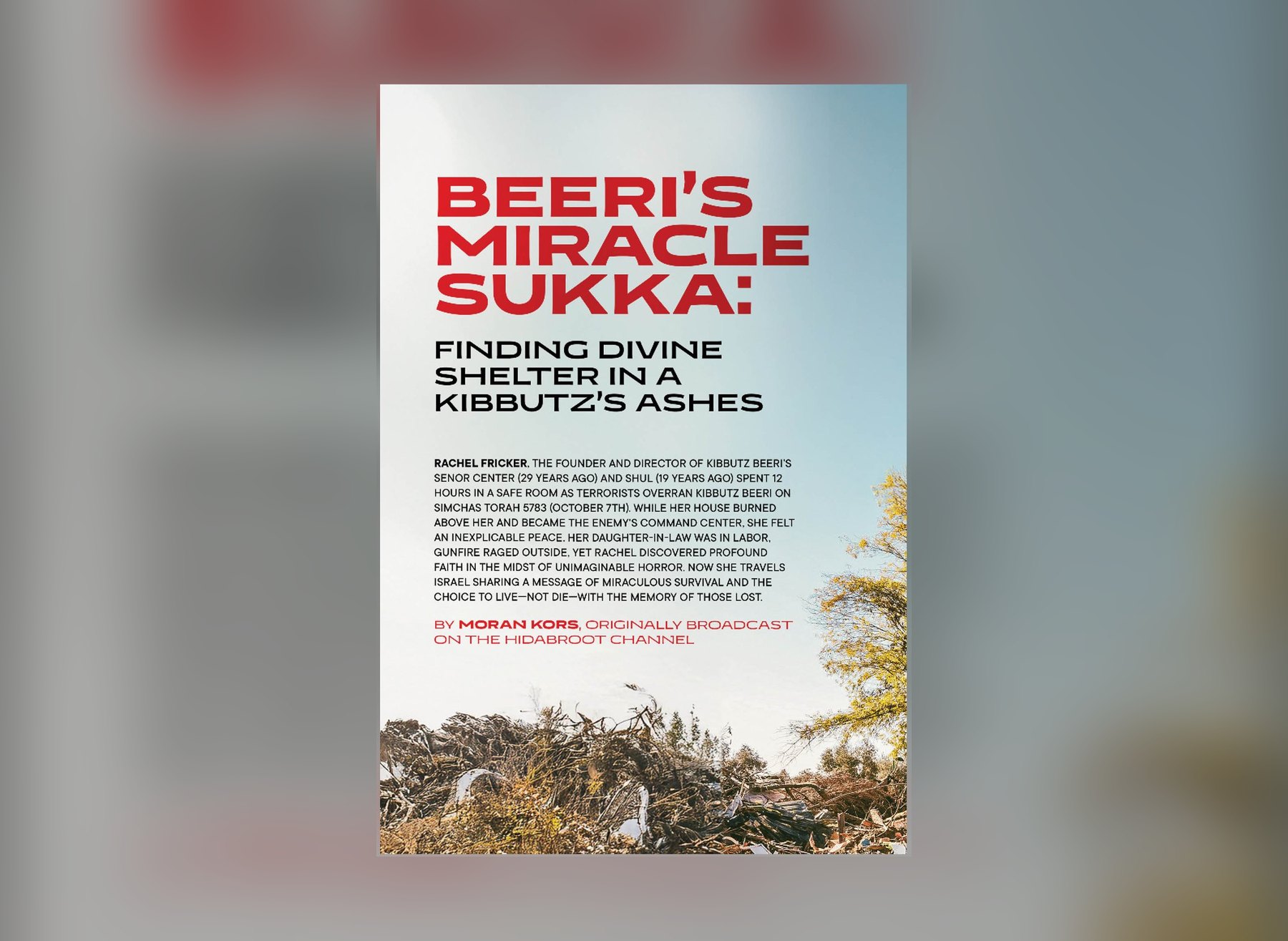
Rachel Fricker, the founder and director of Kibbutz Beeri’s senior center (29 years ago) and shul (19 years ago), spent 12 hours in a safe room as terrorists overran Kibbutz Beeri on Simchas Torah 5783 (October 7th). While her house burned above her and became the enemy’s command center, she felt an inexplicable peace. Her daughter-in-law was in labor, gunfire raged outside, yet Rachel discovered profound faith in the midst of unimaginable horror. Now she travels Israel sharing a message of miraculous survival and the choice to live – not die – with the memory of those lost.
Originally broadcast on the Hidabroot channel
I watched several of her interviews, and each time I was amazed anew by the supernatural powers of faith I saw in her. First of all, she talks about growth and recovery from pain, and about not being drawn to anger and victimization, but rather the opposite – to rise from there, and channel all energies into action, into activity. This is amazing to me; for me, she is an inspiration.
Rachel Fricker, 70, arrived at Kibbutz Beeri thirty-six years ago and established two very important buildings there over time: a senior home twenty-eight years ago, and a shul eighteen years ago.
‘I Didn’t Choose’
“I didn’t choose to come to Kibbutz Beeri, and I didn’t choose to establish a senior home,” Rachel begins. “Not at all. I ended up in some kind of program that I neither built nor planned. I’m originally from Ramat Gan. I went to Kibbutz Beeri for a trial period of one year following my marriage. I naturally placed my suitcases by the door, waiting and waiting for the year to pass. A year passed, and now, thirty-six years have passed.”
And where are the suitcases?
The suitcases are currently in the Dead Sea. It’s a different reality. I didn’t choose it, just as I didn’t choose to establish a shul. Two friends approached me who wanted to establish a shul and asked me to help them. Since I had previously established a senior home, they thought maybe I understood a bit about how to do this whole process.
In the end, I was left alone. One of the initiators died suddenly, and the other left the kibbutz abruptly. Over the years, I recruited a good friend named Yehudit Weiss, Hy’d. Her husband was murdered in the massacre and she was kidnapped and murdered. Later I also recruited Yossi Sharabi, Hy’d, with a very clear understanding between the both of us that he was younger than me and would replace me in my role at the shul. Unfortunately, we heard that he too was murdered. Why this happens, I don’t know. So I have another role. It’s possible I haven’t finished the work yet.
The Ultimate Answer To The Massacre
Let’s go back, if you will, to that Shabbos [Shemini Atzeres], let’s start from there. You’ve traveled a difficult path in the kibbutz over the years, the ‘Code Red’ alert isn’t new to you; you’re quite accustomed to it in the kibbutz. And what happened on that Shabbos? You spent hours in the safe room and when you were rescued, your granddaughter was born.
Correct. That’s the ultimate answer to Hamas. We came out of the event with a baby, the first granddaughter born to us. I received a great gift. I received both her and life – not just mine but that of the entire family.
Right during the moments of hell!
Absolutely. It only shows that everywhere, even in the darkest place, there’s always a ray of light that penetrates inside and illuminates something. And the great wisdom is to see that ray.
You sat for long hours in the safe room. What did you feel then?
It’s really hard for me to explain that feeling, a very, very strange feeling. There were such great contrasts between the sounds of explosions and the war raging outside the safe room, and the quiet that was both inside the safe room and within me. I was in a state of inner peace. Today, with the distance of time, I try to think and process those feelings to myself. I think there was a kind of feeling of acceptance in me, acceptance that if my time to die had come, then I’m ready, no problem. And it’s possible that’s also what gave me peace. But I also had a feeling of bitachon that I can’t explain, that we would get out of that place. I didn’t feel afraid.
All twelve hours in the safe room I felt that they would rescue us soon, I had a very great feeling of bitachon.
Throughout the entire time you felt this? Even though your house was their army’s headquarters?
The house was their ‘command bunker.’ The terrorists are running, going up the stairs and shouting, we hear dragging of weapons on the second floor, we even hear the looters, looting the bedroom because it’s adjacent to the safe room. We hear the voices, see the sights happening around us, and radio silence inside the safe room. Except for the neighbor’s hysteria, except for my daughter-in-law’s difficulty – after all, she was in her forty-first week of pregnancy, and the fear that she would give birth or might not survive, it was really quite difficult. But I felt peace of mind, as if accepting the decree, and whatever will be, will be.
I read Tehillim because it gave me tremendous bitachon, and what could I do? There was nothing I could do except, because I’m a nurse by profession, to calm the neighbor. That is, I was in a kind of action mode and silence. Silent, gathering a bit inward, not listening at all to everything happening outside. My children told about all kinds of sounds of women being dragged there, they heard screams, I didn’t hear anything, complete silence. A very strange feeling, by the way.
May I ask how you explain this?
I have no explanation. Look, I wasn’t worried about myself, I only worried about my children getting out alive. And that’s what I asked HaKadosh Baruch Hu. I had a kind of internal dialogue with Him. I always say I communicate with Him without a phone, for every request I go outside and speak, and it’s something that helps me very much. Some will say it’s not normal. And I must note that I ask Him for very many things, and I also get. Really. I rely on Him so much.
Because of the bitachon that you rely on Him, you get.
Birth Under Impossible Conditions
Let’s talk about giving birth in a safe room – in fear, in hysteria. How do you function?
I saw my daughter-in-law who was very brave. She said that she wasn’t feeling the baby’s movements and was very afraid, and it was necessary to calm her. I felt everything would be okay. I was a bit afraid she might suddenly give birth and maybe scream. Although I’m a nurse, thoughts passed through my head: “It’s dark and there’s no water, how can you manage a birth like this? And if right then the terrorists discover us inside?” But I strengthened myself from the knowledge, from that bitachon that we would get out of there. The bitachon was very strong.
I think the way a person reacts in emergency situations is something that’s embedded in their DNA. I’m used to operating in emergency situations because of the work I do, maybe that helped me, maybe a combination of emuna and this thing. In practice, labor pains began in the safe room but the birth itself occurred after we were rescued.
And then they rescued you?
We were saved twice. The first time Daniel Luria saved us from the burning house. And Elchanan saved us the second time. I received the recordings and was so moved, I must say I had a kind of happy excitement and was even a bit frightened, and I said to myself: “I sat quietly in the safe room and there was a war over our house outside!” They rescued us under very heavy fire. I hear the commander speaking and describing it like in a movie. I felt like I was in 1948, in the War of Independence. The very quiet voice, very confident, reporting where he is, how they’re reaching us, and how they inform us that we’re all in good hands, and they’re transferring us to a protected house. I was moved.
So, in the moments it happened, I didn’t feel what was happening. Really so many miracles happened to us. I have tears in my eyes when I hear the rescue moments. I listen to them again and again and say: “This can’t be.” Here, I’ll let you hear:
A: “Daniel, behind the Becher family, above that you have another row of houses… building number 606, Fricker family, it’s also going up in flames, you have six people locked in a safe room including a woman at 41 weeks, confirm you received. They’re suffocating in the safe room, they’re above the Becher family.” B: “Send me locations where there are more terrorists on the map, we’re fighting over Fricker’s house, there are terrorists here.” A: “Six people trapped in a safe room with a woman at 41 weeks, what else isn’t okay with them I don’t know, it’s not really clear, these are elderly people who contacted me about a quarter hour ago, this is the last location they sent, I can’t reach them in any way.” B: “The Fricker family is with me, I’m evacuating them.” A: “Every last one?” B: “Yes. Everyone. The Fricker family is with me in the secured house.”
I told you that during those hours I was inside the safe room I was very calm and peaceful. When I hear these recordings, I suddenly understand the enormity, understand more strongly the magnitude of the miracle, because I say to myself: “Soldiers came, fought for us, fought over the house, fought to get us out!” I don’t know how to say thank you for this.
They searched for us, they also got confused in the house, by the way, they reached another house and then they reached us. And they fought there outside, sounds of gunfire, a tank stands next to the house, and we’re in utter tranquility inside. Suddenly to hear this, it amplifies what happened there, people I don’t know arrive and take us out. It’s something that will stay with me forever and ever.
These were difficult moments, even if they were rescue moments, in those moments I felt everything mixing up, fear and joy together, and there are also ‘flashes,’ flashes of all kinds of sights as we jump from the window and go outside. A difficult time. Really difficult.
And we’re just one family among many that they saved. Imagine what the families go through. And those they couldn’t save, what do they feel. Not simple.
Today I reconstruct the events, I hear the voices, sometimes I speak and fall silent, because I have flashes of such images, I ache for everything that’s happening. Today I feel more the intensity and pain of what was there. In those moments it was a feeling of a very intense need to survive. To survive that place, to be saved. That’s what also gave us strength to get out of there.
Afterward, on the way out, to see the sukka miracle – the house is burning, and nothing happens to the sukka (see pic). There’s no explanation for this. Not only that, its fabric was white, it remained without any stain, the decorations are inside. Listen, it was no simple sight at all; this contrast between the smoke rising from the burning house, a strong stone house collapsing, and this temporary sukka that remains! This sight burned into my brain, and I didn’t understand then the magnitude of it. Only after time, when we reconstructed things, were there also insights to be had.
The Shul In Action
And what about the shul?
I reached the shul only two and a half weeks later, when two days before that I received a phone call from a soldier. He asks me if I have a key to the shul, and I, in utter wonder and naivete, say to him: “I had a key, but it burned with the house, break in.” They break in and enter the shul.
I’m full of excitement from everything happening there. The soldiers who entered Gaza and left it – two large battalions at that time, after they managed, after several weeks, to clear the houses inside Beeri – come and daven. In the shul there was unity that I hadn’t seen or encountered before. Meeting there religious soldiers with tzitzis, soldiers with tattoos, and seeing the love and brotherhood between them. This place didn’t just become a place of prayer, it became a place of social gathering. The soldiers slept in various places in Beeri, and gathered in the shul. There they davened, there they conducted conversations on all kinds of topics. It amazed me that despite the devastation, the shul remained. We continued to fortify and run it.
I received a phone call from a soldier I don’t know, and he tells me he very much wants to hold a bris for his son in the shul. I ask him why, and he says: “Because it’s very important to me,” and doesn’t explain beyond that. We decided to make a very small family event. A lovely family arrives, a guy arrives who isn’t dressed in uniform, I was asked not to photograph him. He’s one of those people who for security reasons are forbidden to be photographed and show their faces. I had been to many brissin, but not to something like this. The spirituality that was in that place, the prayers that were there…
At the end of the bris, the father approaches me, bursts into tears and tells me this story: “Rachel, listen, I wanted so much for you to allow us to do the bris in the shul, because my cousin was murdered near the shul.” And he said the following sentence to me, and I was very moved: “My cousin’s blood was spilled here, I decided to do my son’s bris here in the shul, what’s called ‘in your blood you shall live.’ I want his blood to be the counter to my cousin’s blood that was spilled.”
I said to myself: “Elokim, thank you for the privilege.”
After a few days I receive a phone call from the deputy commander of the Gaza Brigade, his son needs to be called to the Torah, and he wants to invite very few people, I understood his wife had died after being ill. He very much wanted to be called up specifically in the shul in Beeri. There was a small and very moving Torah reading. The reading was done in Yemenite pronunciation, and I’m Yemenite and was very moved.
A few days later, I receive a phone call, this time from a young man who tells me he’s a chassan and wants to get married at the place and there’s a custom among Ashkenazim to put ash on the chassan’s head. I wasn’t familiar with this custom. He asks me if he can take ash. I ask: “Ash? Come to my house, take all the ash there is in the house”… So there was also a wedding.
A very moving Hachnossas Sefer Torah also took place. We had a paramedic in the kibbutz named Amit Mann. She saved people and treated very many wounded in Beeri. Finally she was murdered in the dental clinic with two of our friends from the emergency squad. Her mother, who lives in Netivot, calls me and says: “Rachel, I so want to bring a Sefer Torah to your shul, I want the soldiers to read from this Torah until the war ends. Afterward I’ll take it.” And I ask myself: “What do I say to her? We have a small Aron Kodesh with two Sifrei Torah and a Haftorah scroll, where will I put the Sefer? How do I say ‘no’ to this mother?!”
I look around the shul and see a military Torah scroll on the side, that can be moved from place to place, and the Sefer Torah has a small, personal Aron. Aylon, who was the rabbi at the shul, says to me: “Rachel, I have an idea. Let’s build a special Aron in the shul for this Sefer Torah.” We built an Aron, and the soldiers take out the Sefer Torah and read from it, and it will return later to Netivot.
Rewarding Action
If I spoke about a ray of light within the darkness and gloom, this is what also gives me strength. To go out each time, to speak with people who are strengthened when they hear about the miracles happening here. It’s impossible to ignore the miracles. I still don’t understand the magnitude of the disaster, and I also don’t understand the magnitude of the miracle. I can’t manage to understand it. These are two such great contrasts.
I’m always asked: “Rachel, where does the strength and emuna come from? How do you continue to believe in HaKadosh Boruch Hu? What, don’t you know, don’t you see what happened to us?” And they describe all the descriptions of horror. And I say to myself in my internal dialogue with Elokim: “What do I answer? What do I say?” A complex and difficult question. And I say to these women who ask: Listen, I believe with the utmost simplicity with complete faith that this world cannot operate randomly; there’s Someone who runs it. I believe there’s a G-d who runs the world, and if I believe He’s the who runs it, I also rely on Him. If I rely on Him, I also don’t ask questions. I don’t ask because I won’t understand the answers, and it’s also not certain I’ll receive answers. I’m too small to ask, too small to understand things.
I know one more thing – we have no control over two things in our lives – not over the time we arrive in the world and not over the time we die. You can conduct a very long conversation just about these two ends; we only have responsibility for what’s in the middle. That’s our work in this place, each with their life path, people call it by all kinds of names, tikkun, it doesn’t matter what. We have action, and each person chooses what action they do.
I heard not long ago a lecture about post-trauma. Suppose two people go through the same situation, one experiences very severe post-trauma, and the other actually grows from it. Researchers examined the reason for the difference. It’s clear that both DNA and emuna give strength, but the most important thing is to get up and do something! Not for yourself. To do something for someone else.
What message do you convey in your lectures?
Each person needs to make their choices. I really didn’t choose to be in this place; I like to be under the radar. But some video went up to the media, and I immediately got calls from all kinds of places to come lecture. I’m really not fit to lecture, I was never a teacher, I become hoarse during the lecture… I have no experience in this field, I know how to be a nurse, not much more than that.
I go to the place I’m asked to go to, and I do so for two reasons: first, to make a kiddush Hashem, because I believe in this very much, and to tell about miracles. There are also difficult things that everyone hears about; about miracles they speak less, I want to be in this miraculous place. And second, if people tell me that the things I convey give them chizuk, I think I’ve accomplished something.
An additional message that’s important for me to convey: The dead are already dead, people were murdered, the best friends possible, the soldiers haven’t finished the war yet. The kidnapped haven’t returned yet. We, the survivors, will continue to live with the dead our entire lives. We’ll live it, we’ll experience it, but it’s forbidden for us to die with the dead, it’s forbidden for us. We must pick ourselves up in some kind of rebirth and continue forward, continue forward and do things, being connected with emuna, being connected with love. That’s what we must do.
I wish you success in everything you do, and that you always feel G-d’s hand with you.
Amen.
The Chassidishe Vibe #1478 • pp. 24-29, 32
© 2026 Beis Moshiach Magazine. All rights reserved.
This article originally appeared in Beis Moshiach #1478. You are welcome to share it with friends and family by email or in print, provided that you do not change, add to or omit any part of it, you credit the author and Beis Moshiach, and you include a link to archive.bmoshiach.org (written out in full in printed copies).
To republish this article in a newspaper, magazine, book or website, please request permission in advance at [email protected].