The Art of Jewish Joy: The Trick for Raising Content Children
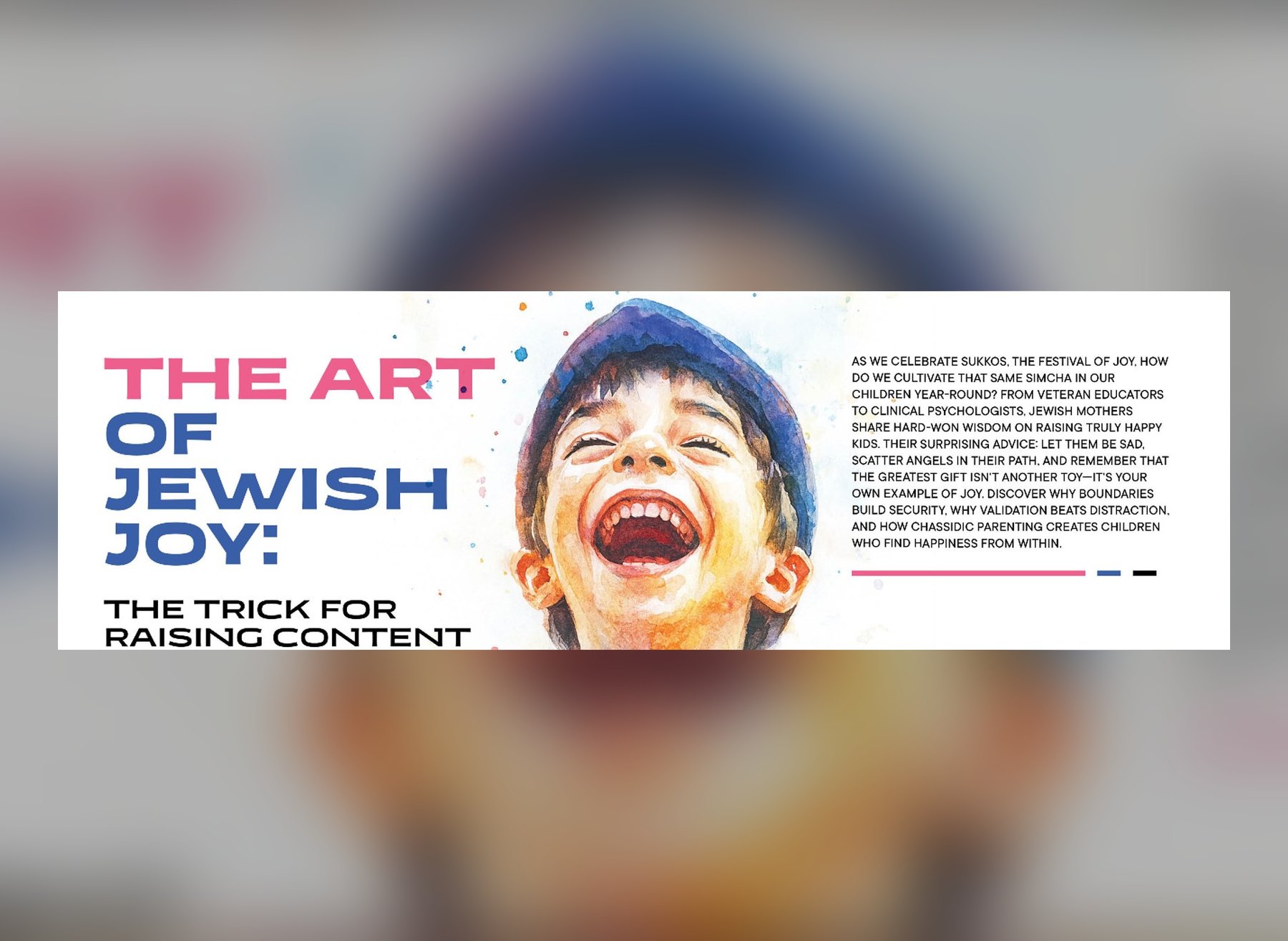
As we celebrate Sukkos, the festival of joy, how do we cultivate that same simcha in our children year-round? From veteran educators to clinical psychologists, Jewish mothers share hard-won wisdom on raising truly happy kids. Their surprising advice: let them be sad, scatter angels in their path, and remember that the greatest gift isn’t another toy – it’s your own example of joy. Discover why boundaries build security, why validation beats distraction, and how Chassidic parenting creates children who find happiness from within.
Sukkos Has Arrived – the Festival of Joy. It’s customary to view children as a symbol of pure, simple joy – joy that transcends all definitions. Yet we parents sometimes feel that the expression “to be happy like children” is a bit detached from reality. Our children seem to spend most of their time sad or irritable – because of a fight, boredom, being denied something, or simply because the food isn’t to their taste. Some children seem to have a default setting of sadness and irritability, and it takes a lot of effort to change anything in their emotional setup and help them feel joy.
How do we really raise happy children? Excellent question – with many possible answers.
A Dugma Chaya
Avital Arnon:
To raise happy children, we need to give them a dugma chaya of happy parents. There’s no other way. The idea of modeling behavior is valid in many areas, but when it comes to joy – it’s nearly critical.
A mother can starve herself, living on random coffee and cake throughout the day, while making sure her children have healthy, nourishing meals. Maybe when her daughters grow up, they’ll also prioritize only their kids? Possibly. For now, she succeeds in giving her children what she denies herself. She can also care for them meticulously, dressing them in clean, expensive, well-kept clothes, while neglecting herself. But when it comes to joy – this doesn’t work. Can a sad mother raise joyful children? Can a pessimistic, anxious mother raise children who are optimistic and full of zest for life?
When a mother works on cultivating simcha, trains herself to see the good in everything, speaks openly about hashgacha pratis, and thanks Hashem and the Rebbe for all the good she’s been given – it immediately affects her children. This becomes their mother tongue – the language they will speak forever, even if they learn other languages during their lives.
It’s worth learning a lot about joy and hashgacha pratis, and talking about it at home. It breathes special life into everyone and reminds both us and our children of the proper mindset.
One time, I was trying to catch a bus at a crowded shopping center. The bus was already at the station, and I grabbed my young daughter’s hand and ran toward it – but despite our efforts, we missed it. We had to wait another half hour in the heat, knowing all the kids and chores were waiting for us at home. I was feeling very down.
“Ima,” my little one asked cautiously, “was that bus driving away also hashgacha pratis, or not?”
Her question snapped me out of it, rekindled my faith, and reminded me that I am a believing Jew with a mission in this world. I smiled at her and explained that yes, it absolutely was. I gave her a drink of water and told her that sometimes a person misses a bus just so they’ll have the opportunity to make a bracha in a specific place, because a holy spark is waiting there.
She was very moved by the idea that everything happened just for her “Shehakol” bracha. And I thought to myself – what would’ve happened if I had been there alone, just stewing in my frustration all that time?
Want Happy Kids? Let Them Be Sad
Naomi Cohen, Veteran Kindergarten Teacher:
We all want our kids to be happy – and what won’t we do for that? Toy and candy stores exist solely thanks to the money we’re willing to spend to soothe our guilty conscience when they cry.
In my preschool, I meet all kinds of parents. The children are all the same – sometimes happy, sometimes sad. Always about silly things… It’s even written in the Tanya, right? “The young child gets angry and upset over trivial things…”
Some parents follow the “happiness here and now, whatever it takes” approach. The child falls? Here’s a candy. Feeling sad? A row of chocolate will fix it. Disappointed? Let’s immediately remove all obstacles. We’ll buy, we’ll fix, we’ll convince – anything to bring back that (temporary) smile.
Other parents take what’s called the “long and longer” path. They try talking to the small mind, which is now completely clouded with tears: “Really? You’re crying over that? Just yesterday you got so many sweets at the Bar Mitzva in shul! And anyway, it’s not even healthy.” Or: “Come on, instead of crying over that broken toy worth barely a shekel, why not look at all the good things you have in life? We have a home, a bed, tasty food, clean clothes…”
The parents are frustrated – because they’re right, but the child just cries harder. The child is frustrated, because – who cares about clothes in the closet or Mommy’s food (which he avoids anyway) if his toy car lost a wheel?
Let’s be real – when you miss the bus on your way to work and have to wait half an hour at the station, picturing your boss’s face when you walk in late – do you want me to remind you how amazing your husband is?
He is amazing, no doubt. But what does that have to do with anything?
So what to actually do? Just let them cry? Yes!

The child needs just one thing: validation – acknowledgment of their feelings and frustration. They don’t need you to immediately extinguish every negative emotion with a treat or redirect them to see how “silly” their crying is. Just be there with them in that painful moment. A loving hug. A statement like: “Oh no, how sad! That car was going so fast, and now without a wheel it’s barely worth anything.” Or:“You were waiting for that last bite of your popsicle, and it fell into the sand. Oy!”
Yes, it will be sad. The child won’t smile immediately. But they’ll calm down. And once you’ve given them permission to be sad – without trying to pull them out of it by force – they’ll be comforted. Much faster than you’d think. And only then will they allow themselves to be truly happy.
That joy will be deep and real – the kind of joy only children can feel. Not fleeting satisfaction that disappears the moment the chocolate is gone and stains the shirt.
And the greatest gift? They’ll learn how to truly comfort themselves, to feel real happiness from within – and not be dependent on external things to distract them or bring them momentary pleasure. Just imagine what kind of grounded, mature adult they’ll become. But if we keep training them to rely only on external gratification – they’ll keep chasing it into adulthood…
So please, allow your children to be sad when they’re sad. Be with them in their sadness. It’s the only way to raise children who are truly happy.
Scattering Good Angels Along My Children’s Path
Nechami Bernstein:
Children are born different – in their appearance, talents, and personalities. Some are naturally joyful, go with the flow, see the good, and are optimistic. Others are born more anxious, bitter, and harder to brighten.
Our children’s personalities aren’t up to us – but we can do our part to give them a happy life.

There are many tips on how to raise happy kids – attention, nurturing talents, listening, open communication between parent and child – all are important.
But as Jewish, Chassidishe mothers, we also have an indirect way to help our children. We can give them strength to face life’s challenges, to light their path, to soften it.
The more inner strength our child has with which to face life – and the more successfully they manage – the happier they’ll be, b’ezras Hashem.
Rabbi Michael Tayeb once told a story: He traveled to a faraway place for a farbrengen. Afterward, he went to the airport and found out his flight, scheduled for 11:00 AM, was delayed until 6:00 PM. At first, he felt disheartened, thinking of all the wasted hours in the terminal. But then he reminded himself of hashgacha pratis and that, as a Jew, he must make the best of it. Knowing that reciting Tanya purifies the air, he decided to walk around the terminal reciting chapters by heart. Each round took about 40 minutes. On his third round, a worker approached him and offered help. While Rabbi Tayeb tried to explain about angels, an Israeli young man came up and asked him to come with him. In a corner of the terminal, there were 17 Israeli guys – and they all wanted to put on tefillin. After helping them with the mitzva, he sat on the floor and farbrenged with them for a long time.
He felt that their spiritual awakening came from the holy words he had scattered all over the airport – and those words did their work.
As parents, we can scatter “good angels” for our children – who will protect and watch over them. As a mother, I can soften my children’s path by saying their personal perek of Tehillim. While cooking, I can recite Tanya by heart, say Tehillim, play Chassidishe niggunim in the background. That’s how I send good angels into their food, into our home, into their rooms. The more angels we scatter in their path – the more they will accompany and guard them. This is something we can always control. While developing talents or creating open communication requires cooperation from the child – this doesn’t. And the more we believe in this – the faster it will happen and the more powerfully it will work – and we will also merit to see the impact with our own eyes.
Another Point: The greatest gift we can give our children to ensure they experience a calm and happy childhood is good communication between the parents.
There was a time, between jobs, when I worked as a substitute assistant in various kindergartens. On one occasion, I filled in as a one-time assistant for a wonderful teacher named Ruti Amitai. She’s an extraordinary educator, and I learned a lot from her – both about teaching and about parenting.
There was one episode that stayed with me. A few girls were fighting over a doll. I took the doll from them and placed it on a high shelf. The teacher didn’t interfere; she just went on with her own work. After a while, one of the girls came up to her and asked for the doll back. She responded: “Ask Nechami. Nechami took it from you, and only she can give it back.”
I was pleasantly surprised. I was deeply impressed by the respect she showed me and the trust she placed in me. If I made a decision, she supported my choice and my judgment.
I believe this is something we can take into our homes – to respect the choices and decisions of our spouses. Such behavior creates harmony and a positive atmosphere.
If my husband made a certain decision regarding our child, I won’t come and say the opposite, or say, “Mommy thinks differently,” or “I don’t agree.” I also won’t challenge his authority in front of the children. I can call him aside, offer another perspective, or say in front of the kids, “Tatty, what do you think? Maybe there’s something else Mendy could try?” But I leave the final decision to him. If he chose a certain consequence or made a specific statement – it’s my responsibility to respect that.
I believe that when there is good communication between the parents, it gives the children a strong anchor – and from that, naturally flow happy, secure, and joyful lives.
The Chassidishe Vibe #1478 • pp. 18-22
© 2026 Beis Moshiach Magazine. All rights reserved.
This article originally appeared in Beis Moshiach #1478. You are welcome to share it with friends and family by email or in print, provided that you do not change, add to or omit any part of it, you credit the author and Beis Moshiach, and you include a link to archive.bmoshiach.org (written out in full in printed copies).
To republish this article in a newspaper, magazine, book or website, please request permission in advance at [email protected].