Echoes of Courage – Chapter 34: Russian or Ukrainian?

Previously: Eretz Yisrael: Moishy and Zalmy suggest that Mendy record the Russian neighbor through the hole in the wall. Tzvi knows Russian and he promises to help them if they obtain recordings.
Russia: The Rebbe Rayatz left the Soviet Union for free lands. The Chassidim were happy for the Rebbe but fearful for their Jewish future. Many of them went to the train station to part from the Rebbe before he boarded the train. Shulem missed it, arriving as the train pulled out.
Russia 5688
“Mazal tov.” Avremel and his wife welcomed a baby boy. His blond hair was already covered with a yarmulke from birth. At his bris, held eight days later, he was named Shlomo Chaim for Avremel’s father, a fine Jew.
When Shlomo Chaim was three, his brother Dovber was born, named for the Mitteler Rebbe.
* * *
It was the winter of 5698 when the communists started massive arrests of Chassidim. There were arrests nearly every night of venerable Chassidim who were suddenly removed from their homes and thrown into the cellars of terrifying prisons.
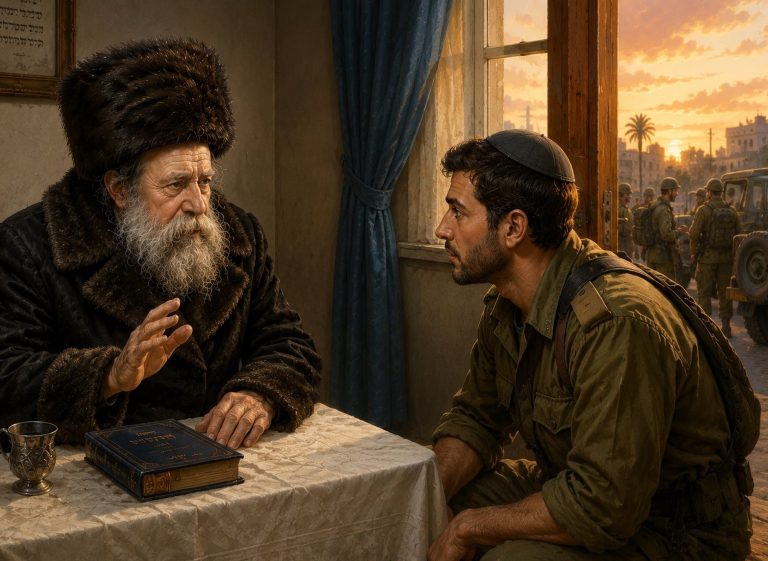
Many Chassidim, including R’ Chonye, felt that the ground was burning under their feet and that it was a matter of days before they would be arrested. His fellow Chassidim begged him to leave Leningrad and flee as far as possible but despite the danger R’ Chonye refused. He could not leave the community in Leningrad without a mashpia. When pressure on him to leave intensified, he arranged with three elder Chassidim to meet that evening in some hideout.
At the appointed time, the three Chassidim arrived, one after the other, with time spaces between them. They first checked to ensure that no additional eyes or ears were following them.
R’ Chonye took charge and in a trembling voice he said, “I gathered you here today as members of a Beis Din. I want you to pasken for me. As you know, many Chassidim have been arrested every day and taken to their cellars where they can’t see the light of day. My question is, according to halacha am I allowed to remain in Leningrad despite the pikuach nefesh or should I escape?”
There was silence. Nobody expected such a question. They were sure that, on the contrary, R’ Chonye would want to leave the city and run for his life.
“Why is it hard for you to leave Leningrad?” asked an old Chassid. “You can run somewhere else and, there too, continue to preserve Yiddishkeit.”
R’ Chonye gave him a penetrating look and then gazed upon the other Chassidim.
“Now, more than ever, it is forbidden to leave the city without a mashpia. If I escape, I know that the city will be in difficult straits. I remain here under an assumed identity and perhaps this will protect me from arrest. Please tell me what the din is in this circumstance.”
The elder Chassidim discussed it among themselves and then one of them announced, “According to halacha, you are allowed to remain in the city despite the great danger. You may continue maintaining tefillos with a minyan and farbrenging with Chassidim. However, if and when you feel the danger is coming closer, you must run as far away as possible.”
R’ Chonye thanked them and left, though not before checking that the street was clear. He returned home and continued sending dozens of letters all over Russia to Chassidim in various cities, to urge them to stand guard over Jewish chinuch. Since the Rebbe left Russia, the work on his shoulders had greatly increased. He felt that without special siyata d’shmaya, he would have long since collapsed.
It was 2 Adar I 5688 at two in the morning when there were powerful knocks at his door. The family members didn’t need to ask, “Who’s there?” since they knew, good and well. And still, a voice thundered from outside, “Police! Open immediately!”
Yerushalayim 5785
Night fell and Mendy went to sleep. The twins fell asleep quickly and he was able to get to work. He took a recorder and tried to put it in the hole in the wall but the recorder was too large.
He took a little screw and enlarged the hole a little bit. ‘Tomorrow, they’re going to fix the wall anyway. Nothing will happen if I make the hole a little bigger,’ he thought. He pushed the recorder in, gave it another once-over and went to sleep.
In the morning, after washing his hands he went to take the recorder but it wasn’t there! He looked carefully in the hole and saw that it had fallen into the wall.
After making sure his parents weren’t around, he took a long stick and put strong glue on the end of it. He then stuck the stick into the hole and touched the recorder. He then gently drew it out.
When he turned it on, he heard two young voices speaking to one another.
“Hey Shuki, look at what’s here in the wall!”
Another voice could be heard saying, “Levi, don’t touch it, it’s Mendy’s.”
“I’m just checking to see whether it’s powerful,” said the first voice. Then there was an unidentifiable noise and voices that sounded farther away.
“Look at what you did; you dropped it!”
“I didn’t drop it! I just touched it and it fell on its own.”
The argument was interrupted when an adult’s voice in the distance was heard saying, “Boys, get ready. You need to leave already for school.” The sound of a door closing was heard and then silence. Faint snoring could be heard and Mendy realized it was himself.
“What a commotion took place as I slept,” he thought. He forwarded the device to what was recorded at one in the morning and listened. The voice of an older man was heard speaking for a long time in Russian. Mendy took the recorder, left the room and put it in his briefcase. He would bring it to Tzvi in the hopes that Tzvi would translate what the Russian neighbor was saying.
Mendy met Zalmy, Moishy and Tzvi along the way and they walked into school together.
“I have the recording,” said Mendy with a triumphant smile. As they walked into class, their Rebbi walked in with them.
After davening and breakfast, the four left the room and went to the end of the hall to talk. Mendy brought the recorder with him and turned it on. The voices could be heard and Tzvi’s forehead furrowed in concentration.
“Okay, first of all, he is not speaking Russian,” said Tzvi to the astonishment of his friends.
Zalmy didn’t understand and said, “I can identify languages and it sounds like Russian, don’t play games with us.
“He’s speaking Ukrainian,” declared Tzvi, ending the argument which had just begun. “Russian is similar to Ukrainian and sounds almost the same but there are differences between the languages. I can understand it but it’s not Russian.”
“Then he’s not the interrogator!” Moishy whispered to his friends. Tzvi frowned and asked, “What? Who’s an interrogator? What are you talking about?”
“It doesn’t matter. It’s nothing important,” said Zalmy and he changed the topic. “So, what is he saying?”
“He’s talking on the phone with someone by the name of Stefan Pyotr. From what he said I understand that he wants to sell an apartment to someone that he once lived in which is in Kharkiv.
“Kharkiv is in Ukraine,” said Zalmy. “We need to find out who this Stefan is. Possibly, through him we will discover something else that will help us.”
Moishy proposed, “I’m going home now. I’ll ask my father to find out who it is. Maybe one of his friends knows this Stefan.”
He returned within a few minutes and said, “You won’t believe what I found out!”
To be continued
Beis Moshiach #1482 • pp. 59-62
© 2026 Beis Moshiach Magazine. All rights reserved.
This article originally appeared in Beis Moshiach #1482. You are welcome to share it with friends and family by email or in print, provided that you do not change, add to or omit any part of it, you credit the author and Beis Moshiach, and you include a link to archive.bmoshiach.org (written out in full in printed copies).
To republish this article in a newspaper, magazine, book or website, please request permission in advance at [email protected].