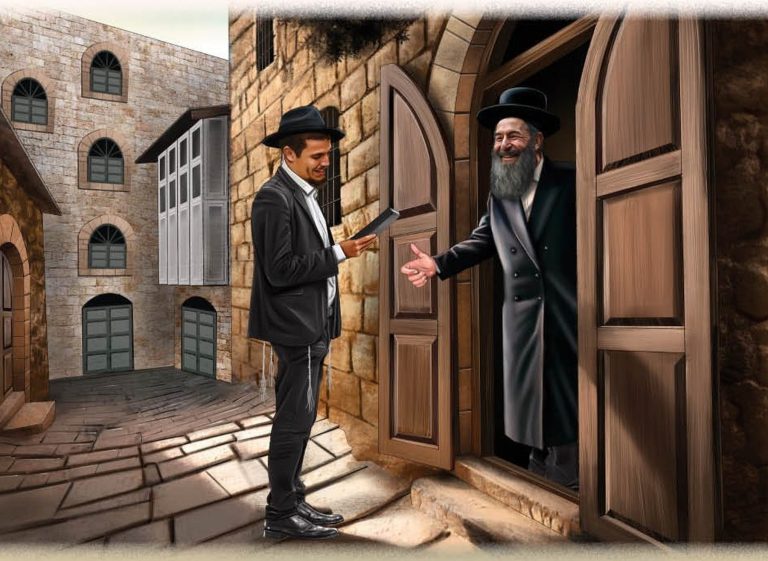
Yankel the Farmer and the Bus-Stop Man

“Yankel,” his father, Rav Chaim Tzvi of Poltava, would say, “a Jew stands straight—and he makes room for others.”
“I hear, Tatty,” young Yankel answered.
He was born in 5667 (1907) in Russia, to Rav Chaim Tzvi—Rav of Poltava—and Bas Sheva. Their house ran on Torah and on helping people. It wasn’t extra; it was normal.
“Leave the door open a little,” his mother said. “Someone will need a seat.”
By day, as a teenager, he helped his father and learned to run things fairly. By night he hummed a niggun and slid another chair to the table. As a young man he managed a small workshop and then a factory. He gave people work with dignity—simple, steady jobs. “This one is right for you,” he would tell a widow. “It’s light and honest, and the pay comes on time.”
When his father the Rav, passed, he told his mother and the younger ones, “Come live with us.”
“Where will we sleep?” they asked.
“We’ll fit,” he said—and they did.
* * *
He could fix a machine, a door, or a problem, and he guarded Shabbos like a treasure.
Reb Yankel Lipsker didn’t look for fights. They came to him because he wouldn’t let go of Shabbos.
“Friday we stop early,” he told the men in his factory. “Shabbos is not a suggestion.” In Soviet Russia, stopping for religion broke the rules—factories were expected to run straight through Friday night and even Shabbos, and bosses reported anyone who didn’t.
“You’ll lose money,” a foreman warned.
“I’ll lose more if I lose who I am,” Reb Yankel laughed.
By Monday he was called to the city. Same bench. Same judge.
“You closed again?” the judge asked.
“Yes,” said Reb Yankel. “For Shabbos.”
“People complain,” the judge said.
“People live,” said Reb Yankel. “And Jews keep Shabbos.”
The judge stamped a paper. “Go.” It didn’t make sense—others got fines or worse, yet each week Hashem turned the judge’s hand and Reb Yankel walked out free.
He went—and closed again the next Friday.
* * *
At night his home filled with voices. A farbrengen. Niggunim. “L’chaim,” he said on Shemini Atzeres, lifting a small cup. “Answer ‘amen.’ May Hashem help us see the Rebbe with our own eyes—soon.”
“Amen!” the room thundered. Someone laughed: “Yankel, you sound packed already.”
“Maybe I am,” he said, and the dancing began.
* * *
Then World War II reached them. When the Germans invaded the Soviet Union in 1941, families like theirs fled east. The Lipskers left their city and rode for days by train to Kutaisi, in western Georgia—about a thousand miles away. They were refugees now: new city, different language, less money. Food didn’t come easy.
“Taibel, we’ll manage,” Reb Yankel said quietly. “And we’ll help others too.”
Kutaisi had a hidden Chabad yeshiva—Tomchei Tmimim—learning Gemara and Chassidus in small groups. A boy kept watch by the door with a simple signal—because in Soviet times secret Torah schools were illegal. Police could take sefarim, arrest teachers, and question boys, so a blanket stayed nearby to cover the table fast.
“Boys need bread. Boys need heat,” said Reb Yankel.
“Yankel, we’re refugees too,” said Taibel. “We barely have enough ourselves.”
He nodded. “We’ll share what we have—and I’ll find the rest.”
That evening he carried up a bundle of firewood, tightened the loose hinge on the door, and quietly left money with the melamed of the yeshiva. “Buy coal. Buy bread. Tonight they learn warm.”
Near midnight a runner burst into shul, out of breath. “Home. Now. Soldiers in the street.”
Gunshots cracked nearby. The Lipskers stood all night saying Tehillim. Taibel, his wife, held the little ones. The older children stood straight, lips moving fast in Tehillim.
“Hashem, carry us,” said Reb Yankel.
At sunrise the shots stopped. Everyone in their house was safe. They knew it was time to pack again and move on.
* * *
Vienna was not home. It was after World War II had ended, and the city was crowded with refugees and soldiers. Two days before Rosh Hashana in 5707 (1947) they reached the city and were sent to an old army barracks. Long rooms. Iron cots in rows. Thin blankets. A shared stove at the end of the hall. On the wall, big paper lists told who could pick up bread, who had an appointment for papers, and who had to wait. Everyone waited.
***(Side note: On one wall someone had scratched a single word: “Pocking.” Pocking was a refugee camp in Germany after the war. Reb Yankel wrote the name down and passed it to the people searching for the Rebbe’s mother, Rebbetzin Chana, who had gone missing during the war. That small clue helped them find her, bring her to Paris, and then to safety. A quiet miracle—one word that saved a life.)
From Vienna, Yankel sent a telegram to the Rebbe: What should we do now?
After Yom Tov the answer came back, short and clear: “Travel to Paris.”
So they packed again and went.
* * *
Paris was calmer after the war, but it was still a refugee city. The Lipskers rented a small upstairs apartment, lined up for papers, and found simple work. Yankel helped new families who arrived later—translating, carrying their bags, finding a doctor or a bed. They were building normal lives again, one small job at a time.
During that period, Taibel had the honor of cooking for the Rebbe Rayatz’s son‑in‑law, the RaMaSh (later the Lubavitcher Rebbe), while he was in Paris to help his mother. The Rayatz—the Rebbe then—was already in America. It was quiet, respectful work doing the meals, and a great zechus for their home.

Before Pesach, the RaMaSh asked for real wine—not from raisins—and Yankel made sure it was done right.
After some time, guidance came: they should move to America and live near the Rebbe (Rayatz) in Brooklyn. “For this, you don’t need to ask—you just go,” the RaMaSh had told him.
* * *
In 5708 (1948) visas opened, and the Lipskers boarded a ship from France to America. The sea was rough some days and quiet on others. People were tired from years of moving.
“There’s a Yid here who needs a hot meal,” said Reb Yankel.
He set up a small cooking spot, and when Pesach came he cooked for his family—and for all the other Jews on the boat who needed it. Simple food, shared with a smile.
They had gone through so much—Krakow, Lodz, Vienna, Paris—always moving, always trying. Now the water spread wide and steady, and the days ticked forward toward a new start.
One morning the ship slowed. Docks, cranes, a skyline. America.
“Baruch Hashem,” said Taibel.
Reb Yankel squeezed his childrens hand. They were ready to live near the Rebbe, in Crown Heights; ready to be Chassidim in the Rebbe’s neighborhood; ready to build a normal life again—together.
* * *
When Reb Yankel, his special wife Taibel, and their six small, but strong, children walked into the office of Rabbi Yosef Yitzchok of Lubavitch, they held their breath. Together they called out, “Baruch ata Hashem, shehechyanu…” Thank Hashem we merited to live to see this moment.
“To see a family like this come out of Russia, I should be the one to say shehechyanu,” said the Rebbe Rayatz, and gave them all the brachos with a shining face.
Now they had their Rebbe and they were near good Yeshivos and Beis Yaakovs. They were not afraid of the police and were no longer in danger. But they did not have one single dollar—or a home. How would they buy their seven children clothes and food?
There were organizations that wanted to help people like the Lipskers, who had just come to America for safety. In those days, all the jobs in factories and offices worked six days, including Shabbos, not like today. They knew that if you had a farm, you could grow food and sell some, and keep Shabbos. So owning a farm was a good idea.
This is what the Rebbe Rayatz told Yankel, who was worried about not having any way to support his family.
“You can buy a farm.”
Yankel looked confused. His forehead was wrinkled. “How do I find a farm to buy? And of course which money will I use?”
The Rebbe Rayatz told him about the Jewish organizations that would give Yankel $10,000 in today’s money. That was enough money to start. About his first question, the Rebbe Rayatz said, “Go buy the Jewish newspaper. They have for-sale ads.”
Yankel ran out to the nearby candy store. He quickly paid ten cents to the busy man at the counter, and ran back into the Rebbe’s office.
The Rebbe Rayatz opened the Yiddish newspaper and put his pencil on an ad. It said, “Chicken Farm for sale. Hightstown, New Jersey. Call today!”
It was one and a half hours or more away by car. It was not a good farm. Even the people at the office who were giving the starting money said it was far beyond a bad idea.
“We heard about that one — the chicken farm, right? No, no, no. Stay far, far away.”
“Go for it,” said the Rebbe Rayatz. “Your older children could stay here in their schools, and they will come home for Shabbos. You should go there.”
Of course, Yankel and Taibel listened carefully to the Rebbe. They gathered their younger children and moved once more — this time, away from the very Rebbe they had spent so many years striving to live near.
When they drove into the New Jersey farm, they saw beautiful lilac bushes which smelled nice, and blackberry and cherry trees sprinkled all around.
“Maybe this will be a nice place,” said Taibel as she patted their new cow, Betsy.
Taibel milked the cow and made cheese and butter, while Yankel tried to figure out how to care for the chickens.
There was almost no rain that summer — through June and July of 1949, the fields stayed dry and cracked. In the northeast of New Jersey, a drought had set in. The chickens either stopped laying eggs or died, and soon there was nothing left to sell. It was anything but a good season for the farmers.
The Lipsker family did not make any money at all. Maybe afterall there was one thing Yankel Lipsker could not do: He could not be a chicken farmer.
“I did not send you to be a farmer,” said the Rebbe with a smile, when Yankel begged to be allowed to come back to Brooklyn. “Many other people can farm. I sent you to make Frum Yidden.”
“Aha!” thought Taibel and Yankel. So there was a reason they had ended up in this simple, empty town. They weren’t just farmers — they were shluchim, undercover on the Rebbe’s mission.
Every Shabbos, Reb Yankel walked about two miles—close to an hour—to the little shul in the nearby town of Roosevelt, where there were Jews.
Nearly everybody there were immigrants from Europe like themselves, and they only had a minyan on Shabbos morning. His kapote and hat made a strong impression—like a gentle wake‑up—bringing some neshamos out of the cobwebs to join him too.
Back then many Yidden who came to America were still finding their feet. They were refugees, working long hours just to pay rent. Factories stayed open on Shabbos. Stores needed cashiers on Friday night. Some families sent kids to public school. Yiddishkeit wasn’t always first on the list—not because they didn’t care, but because life here was hard and survival came first.
Soon there was a minyan on Friday night and Shabbos afternoon as well, and even a small learning session between Mincha and Maariv. He taught clear, interesting classes—Tanya, Ein Yaakov, and halacha—and he danced with each person on Simchas Torah. The shul changed from sleepy and quiet to alive and warm. People listened, learned more Torah, remembered mitzvos, and some even moved to bigger Jewish communities to live a fuller Yiddishkeit.
All this was from selfless devotion to the Rebbe. At the Yud‑Beis Tammuz farbrengen in 5709 (1949)—not long after they arrived on the farm—the Rebbe Rayatz asked if he had started any shiurim there yet. Reb Yankel answered, “Not yet, but we will begin soon.” After the farbrengen, the RaMaSh came over, smiling but puzzled.
“Why didn’t you tell my father‑in‑law that the shiur had already started?”
Yankel looked confused. “Why would I tell the Rebbe something untrue?”
“To give him nachas,” the RaMaSh said gently, “you could have said it already started.”
In those days there were no official shluchim in New Jersey. But that’s what Reb Yankel was—before there were shluchim—doing the Rebbe Rayatz’s work right where he stood.
* * *
It was hard and lonely for Reb Yankel and Taibel and their children. Their dream in coming to America was to live near the Rebbe, but out on the farm they barely saw him at all. Most days were feed, water, coops, repairs—and very few Yidden to reach.
Still, Yankel tried to come to 770 whenever he could. If there was a farbrengen of the Rebbe Rayatz during the week, he was there. On Yom Kippur he stayed in Crown Heights with his older boys, davening with the Rebbe and soaking in strength for the long weeks back on the farm.
The happiest times were when they had visitors. Their poor house and quiet fields suddenly felt full again. The Rebbe Rayatz would send bachurim from 770—groups of four or five—to bring joy and sefarim to small farms all around New Jersey. The boys slept on the hard benches in shul and went from farm to farm, reminding Yidden that they were not alone—that there was a Rebbe in Brooklyn who cared about them.
To be continued
Beis Moshiach #1482 • pp. 54-58
© 2026 Beis Moshiach Magazine. All rights reserved.
This article originally appeared in Beis Moshiach #1482. You are welcome to share it with friends and family by email or in print, provided that you do not change, add to or omit any part of it, you credit the author and Beis Moshiach, and you include a link to archive.bmoshiach.org (written out in full in printed copies).
To republish this article in a newspaper, magazine, book or website, please request permission in advance at [email protected].