When Students Become Children
When Chanuka comes around, there is much to discuss and write about. Whether it is about the importance of adding in Torah, mivtzaim, or the importance of pirsumei nisa to name a few. I would like to share an insight for those who are involved in Chinuch in a formal or informal capacity, as the foundation of the word Chanuka is Chinuch. This idea could really be transformative and I do not ever want to be accused of “This good pearl of wisdom was in your hands, and you tried to conceal it from me?” (Chagiga 3a).
Some background first: Sukkos in Crown Heights is a very uplifting yet challenging time for a yungerman with a family. It is very hard to try to balance the all-night dancing, farbrengens, mivtzaim and the need to be involved and present with the family and to make sure that they are involved and happy (in ways that children are made happy). It is truly a Yom Tov with no day or night.
On one of the days of Chol Hamoed this year, I arranged with my wife that she would take the younger kids to spend a few hours with a relative, so I could rest a little and spend some time in 770. I came to daven Mincha with the Rebbe’s minyan in 770 (at 3:15) and was quickly approached to join the “Kinus Hamechanchim” that would be taking place right after Mincha in the shul in the basement of 770.
What is this educators’ conference about? Over 40 years ago, Rabbi Yekusiel (“Kuti”) Rapp a”h was approached by Rabbi Chodakov, the head of the Rebbe’s mazkirus. Rabbi Chodakov told him that since many mechanchim come to the Rebbe for Tishrei, it would be a good idea if he would arrange a gathering so that they can share practical ideas from their experiences on how to better themselves in this very important area. While Rabbi Chodakov did not say that this idea came from the Rebbe, and he rarely would say so even it was, it was taken very seriously, and he would try to arrange this every year. Since his tragic passing ten years ago, a dedicated mashpia tries to continue the tradition.
I decided that since I had a little time I’d join, even though I knew that it was being done at the last minute and would probably not be very organized and professional. The scene was what I expected it to be: about a minyan of educators that sat together, unsure of what was supposed to happen. I suggested to those sitting there that being that we are already sitting, we should go round the table, and everyone should share a thought, story or experience.
To be honest, I did not expect to walk away with any new insights in Chinuch, as it was not a prepared event and the setting was very informal to say the least. But Hashem brought me to “the right place at the right time” and I heard a simple but transformative idea that I feel responsible to share.
* * *
This personal story was shared by the famous mashpia Rabbi Ofer Maidovnik of the Chabad Yeshiva of Tzfas. He told over that after a few years of being in Chinuch (in the 80’s) he felt that he hit a roadblock, he was just not connecting with the students. He wrote a letter to the Rebbe but did not receive an answer. The following Tishrei, he came to the Rebbe and he went into Rabbi Chodakov’s tiny office. Rabbi Chodakov told him to come back, as he has something he wants to discuss with him.
For some reason, he forgot to do so and the entire Tishrei passed. Before leaving Crown Heights, he once again went to the office of the mazkirus. Rabbi Chodakov saw him and asked him to explain why he did not come to him the whole month.
Rabbi Chodakov then told him the following (these are not the exact words): “In regard to Chinuch, the Torah tells us that ‘Veshinantam l’vanecha – eilu hatalmidim; we are instructed to teach Torah to our children and Chazal say that ‘children’ refers (also) to our students.”
“If we treat our students as our own children,” said Rabbi Chodakov, “and they feel it, then you will be successful in Chinuch. How does this express itself? That you do not just concern yourself with their spiritual welfare, but also their basic physical needs. It must concern you that they have what to eat, proper clothing to wear and all other needs.”
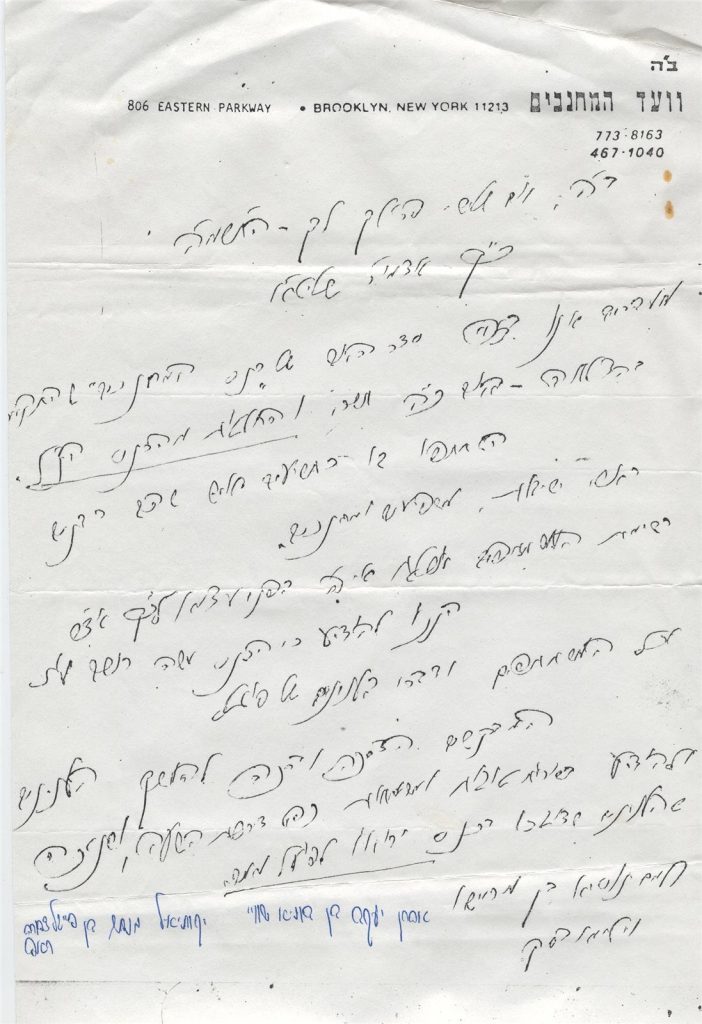
Rabbi Maidovnik said that while Rabbi Chodakov did not say that this was the Rebbe’s answer to his letter, he felt that he got the direction that he needed. He went back and worked on implementing this approach. Everyone knows that he has been one of the most beloved mashpiim and has impacted and influenced thousands of Talmidim.
A freilichen Chanuka and much success in Mivtza Chinuch!
Please feel free to share your thoughts on the above with me by sending me a personal email: [email protected]
Beis Moshiach #1488 • pp. 10-11
© 2026 Beis Moshiach Magazine. All rights reserved.
This article originally appeared in Beis Moshiach #1488. You are welcome to share it with friends and family by email or in print, provided that you do not change, add to or omit any part of it, you credit the author and Beis Moshiach, and you include a link to archive.bmoshiach.org (written out in full in printed copies).
To republish this article in a newspaper, magazine, book or website, please request permission in advance at [email protected].