The Empire of Light in the Island Country

From a Single Couple to Eight Chabad Houses Across the Islands
Last week, another massive typhoon struck the shores of the Philippines. ‘Fong-Wong’, the second within a week, left behind widespread destruction, millions of refugees, and tragically, fatalities. Winds of 143 mph wreaked havoc, and the entire country was declared a disaster zone. And within this chaos, the Rebbe’s shluchim empire operates like a steady lighthouse.
“If the entire world was created for the Jewish people, certainly this typhoon too has something good for us,” says Rabbi Mendy Axelrod, the shliach in Cebu, sharing a story from his shlichus on the ocean islands: “A traveler went to Camotes Island and was there alone during the typhoon. She was terrified. I connected her with a Jew who has a hotel there, and he gave her a room and took care of her. She promised G-d that if she comes out alive, she will do teshuva and keep all 613 mitzvos. Today she’s organizing a seudas hodaya at our Chabad House.”
He adds another interesting detail: “From the tremendous rain, all three reservoirs of our mikva filled up, and not just the reservoirs, but the entire immersion pool overflowed…”
This story is a drop in the ocean of extensive activity in the island nation. We spoke with the one behind this revolution, Rabbi Yosef Yitzchok (Yossi) Levi, the first shliach to the Philippines.
“The current situation,” Rabbi Levi opens, “is eight shliach families operate in eight Chabad Houses across the islands. All the shluchim except Rabbi Axelrod in Cebu, arrived after Covid. The virus created a situation where all the shluchim who were here (in places where outreach is only with travelers) left, because there was no work. After Covid, the Rebbe opened all the channels, and we began building the empire anew with tremendous force.”
1. Shlichus in a Distant Place With Distant People
Going to the Philippines was not self-evident. Rabbi Yossi and his wife Tiferet did not dream of going there; they didn’t even know where this republic was located on the map.
“Before I got married, I thought about a shlichus in New York,” he recalls. “But the Rebbe had other plans. About eight months after the wedding, my wife wrote to the Rebbe about whether to continue her chinuch work the next year. In response, the Rebbe writes to a Chassid who is leaving his chinuch work for a shlichus in a distant place with distant people. We understood that the Rebbe was designating a shlichus for us.
“A week after we opened to this answer, we traveled to my wife’s family in Florida, where we heard several times about the Philippines, each time in a different context. On one occasion we met an Israeli who stays frequently in the Philippines and he complained to me that a Chabad House still hadn’t opened in this country. I saw hashgacha pratis in this.”
The only thing R’ Levi knew about the Philippines was that it’s a distant country with thousands of its citizens working in Eretz Yisrael in care-giving positions… They wrote to the Rebbe about the idea, and the answer was positive.
The reactions around them were skeptical. “They advised me to first go there alone to check things out,” he recounts. “’Go alone,’ one of the mekuravim told me, ‘I’ll pay for all your travel and accommodation expenses there.’ He hoped that at this stage I would abandon the crazy idea. But we were determined.”
The departure involved another test. R’ Levi was in the process of obtaining a “green card” and the lawyer warned him that if he leaves the US before the process is complete, he won’t be able to return for the next ten years. He wrote to the Rebbe and received a special blessing for the shlichus. “That no longer bothered me,” he says. “I purchased flight tickets with complete faith… and indeed, at the end of the final interview, without any request from me, my passport was stamped with a special stamp allowing me to leave even before receiving the green card.”
The beginning in Manila, the capital of the Philippines, was not a bed of roses. The young couple, with his wife in an advanced state of pregnancy, moved from hotel to hotel as the money and kosher food they brought from New York were running out. The period was immediately after the horrific attack at the Chabad House in Mumbai, and the term “Chabad House” became familiar throughout East Asia. “This fact made it difficult for us to obtain a suitable place,” R’ Levi recalls, “as potential landlords feared their property would become a target for terrorism.”
The miracle didn’t delay in coming.
“One day, when we were sitting in the car after another failed attempt to find suitable shelter, my wife davened to Hashem that since we are the Rebbe’s shluchim, and our very existence in Manila is to find a place that will be a home for the Rebbe, she requests that the Rebbe’s zechus help us find what we’re looking for.
“While she was requesting this from the depths of her heart, a knock was heard on the car window. When we opened the window, a local stood there asking if we were looking for a place to rent. Skeptically, we got out of the car and went toward the building he showed us, and it looked like a dream to us. The building exactly suited the needs of a Chabad House as we had been searching for all along… We felt we received a heavenly shot of encouragement to start our work in this country.”
2. The Rebbe’s Bracha – “To Promote the Sheva Mitzvos”
They operated in this building for nearly ten years. When the place became too small for them, they began looking for a larger building. “Every time we wrote about this to the Rebbe,” R’ Levi emphasizes, “we received an answer whose meaning was to build a building. The Rebbe emphasized – not a rental, and not even purchasing an existing building, but new construction and specifically a building.”
Rabbi Levi began going out to meetings to purchase land, “when I barely have money for a taxi to get to the meeting,” he laughs. He conducted negotiations on imaginary sums, when he didn’t have a hint of an idea how he would obtain a tenth of the amount.
“From time to time, despair crept in,” he admits. “Each such time, I would write to the Rebbe and ask to be ‘released’ from this assignment… but the answer from the Rebbe was in the form of an even stronger push to engage in construction.”
The turning point came surprisingly. “It was actually in Japan, at a regional Kinus HaShluchim,” he recounts. “I read a sefer that compiled all the Rebbe’s sichos and responses on the subject of the Sheva Mitzvos Bnei Noach. In one of the chapters I saw that the Rebbe says that a shliach who is involved with the Sheva Mitzvos will have a bracha b’gashmiyus. The words struck me strongly and I left with a firm decision to increase my activity on this topic.”
When he returned to the Philippines, the bracha didn’t delay in coming. After writing to the Rebbe again that he had no financial wherewithal, he opened to an answer “to find someone who is interested in this and through them obtain a loan.”
That “someone” came in the form of a local gentile couple who approached R’ Levi after searching for spiritual answers. R’ Levi began studying with them regularly about the Sheva Mitzvos. “After knowing them for a month,” he says, “I dared to tell them about the building plan… To my great surprise they picked up the phone to the bank and arranged a loan to purchase land at a low interest rate.” They also went out to see five potential sites. R’ Levi wrote to the Rebbe: “In the answer, the Rebbe wrote to me that I must find a place closest to the current location of the Chabad House.”
They rushed to arrange an immediate meeting with a property owner adjacent to the Chabad House. After they signed the contract, he told them that he had just come from another meeting with owners of towers and malls in the area. They suggested he sell them the land at double the price he closed with Chabad. However, when he wanted to sign with them, he suddenly felt an inexplicable fear and literally fear of G-d. He left them… and came to complete the purchase.
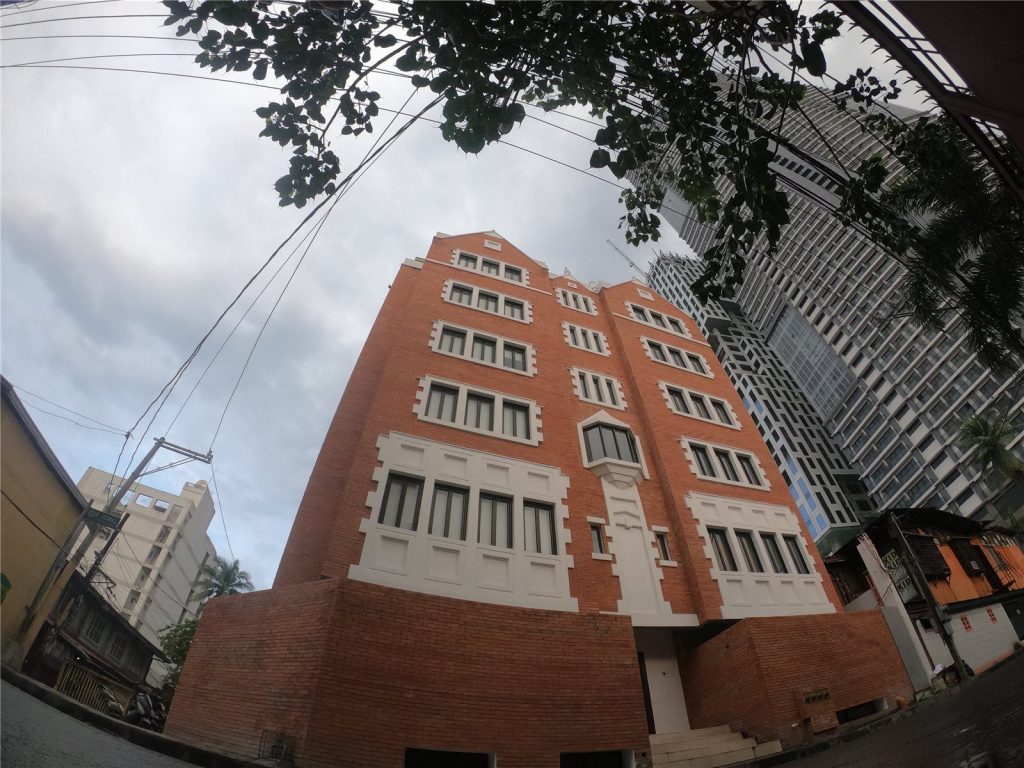
That’s how a massive nine-story building, with a 770 facade, containing a two-story shul, a kosher restaurant, a store, an event hall, a kindergarten, guest rooms, a magnificent mikva, and residential floors arose in Manila .
3. The Shlichus Surge After Covid
The magnificent building became the nerve center, but the real development, surprisingly, came specifically after the global pandemic. “Until Covid there were Chabad Houses for travelers in Clark, El Nido and Boracay,” R’ Levi explains, “but when the skies closed, they had nothing to do and they left. The only one who remained, besides me, was R’ Axelrod in Cebu who also has a community. After Covid, we started everything from zero.”
And that “zero” became eight active Chabad Houses. The activity is divided: “Manila, Clark and Cebu are both a kehilla and for travelers. The other five Chabad Houses are almost only for travelers, although there are also Israelis who live there.”
The numbers recall the Chabad House in Thailand. “Suddenly the Israelis rediscovered the Philippines. Once, in the late ‘80s, the Philippines was stronger than Thailand, and then it fell because of the security situation. Since we opened the Chabad House and the situation calmed down, it’s only going up and up.
“There’s one Chabad House here,” he recounts with admiration, “in Siargao, with the shliach Rabbi Menachem Mendel Shpindler, where the number of travelers is like in the Far East. 1,000 people for chagim, and every Shabbos 300-400 people! In Cebu there are about 100-150 on Shabbos. At ours in Manila there are minyanim three times a day, Chassidus classes, Gemara, Tanya, Halacha, Shaar HaBitachon. It’s a whole enterprise.”
The outreach with travelers provides countless soul stories. Here’s one from Rabbi Moishy Notik, from El Nido:
Erev Rosh Hashana, 250 people are expected for the meal, and the kitchen is falling apart. In the midst of the pressure, Rabbi Notik meets an Israeli sitting on the balcony, shirtless, “on a journey of self-discovery” and considering staying on the island. The rabbi asks him with utmost seriousness: “Do you see yourself married to a non-Jew?” The guy is offended to the depths of his soul: “Me? Never!” The rabbi explained to him that this is the natural trajectory for someone who stays alone so far away.
A few hours before Yom Tov, the fish arrived, and there’s no one who can prepare it. The rabbi asks the guy if he knows anything about preparing fish. The guy laughs: “Cooking whole fish is my hobby.” For hours he stands and prepares fish for all 250 diners. The connection was created.
R’ Notik asks everyone to come for the shofar blowing. The guy, who had already been without a phone since the eve of the holiday, was convinced to stay ‘until after the tekios’. After the tekios he was about to leave, and the rabbi tells him: “No, we meant the tekios of the second day.” Bottom line, he stayed all of Rosh Hashana, observed the entire holiday, and decided to keep Shabbos and holidays until the end of the trip.
A year later, the good news came from Israel: that same man returned to Eretz Yisrael, started keeping one Shabbos, and then another. He added kashrus, tefillin, went to yeshiva, and married a Jewish woman two months ago.
Another example of amazing hashgacha pratis with travelers is told by Rabbi Mendel Shpindler, from Siargao:
The preparations for the Seder night for about 1,000 people were frenzied. R’ Shpindler traveled 20 minutes to a secluded place, without cellular reception, to meet the event producer. The producer promised on the phone that he’s home, but when the rabbi arrived, the door was locked. No one there.
R’ Shpindler stood outside, completely stuck. Can’t call, and there’s no point driving 20 minutes back just to find out what happened. He simply waited. While standing there helpless, a character who looked as far from Yiddishkeit as possible stops next to him – long hair, chains. The guy looks at the rabbi and whispers in Hebrew: “Psst… is there a Chabad House here?”
It turned out he’s an Israeli who had no idea that Pesach was approaching. They talked for about fifteen minutes. Just when the guy said he needs to move on, the producer finally arrived. The producer’s unexplained delay, in a place without reception, was the precise hashgacha pratis to “chap” this neshama. That man attended the Seder, continued coming for Shabbos and became part of the community.
How do you run such an empire?
“First of all, it’s the Rebbe running everything,” R’ Levi clarifies. “After Covid I realized that we needed to look for new shluchim, and I saw how the Rebbe runs things and brings more and more shluchim here. We just need to constantly live in such a way that we are not interfering with the Rebbe. That’s the main thing.
“There was a story,” he recalls, “in which two young men wanted to come on shlichus to Siargao, which is booming. Both Rabbi Shpindler and Rabbi Moskowitz. I told them: ‘Whoever receives a positive answer from the Rebbe first – gets it.’ R’ Shpindler wrote first, but for various reasons he only arrived half a year after R’ Moskowitz was already in his Chabad House (in Boracay). Today I ask R’ Moskowitz, ‘Can you handle what R’ Shpindler is handling?’ He tells me ‘no’, and he thanks the Rebbe for setting him up in a place that perfectly suits his capabilities. The Rebbe arranges each one according to his keilim.”
One story about the miracles and wonders accompanying the shluchim on their way to the Philippines, is told by Rabbi Baruch Kirshnszaft, whose going on shlichus to Bohol was a test of emuna for him:
At Ben Gurion Airport, R’ Kirshnszaft, who was carrying a Sefer Torah, was approached by someone who asked: “Do you need help with the Sefer Torah?” It was none other than the head of Ben Gurion Airport’s security system. “My father passed away and I donated a Sefer Torah in his memory,” he said, “I can help you with this.” He got them through all the checks and ensured the Sefer Torah would board the plane.
The real drama came on the domestic flight from Manila to Bohol. A flight attendant stopped them at the plane entrance. “That is too large. The allowance is 70 cm, this is 90 cm. It must go down to cargo.” Rabbi Kirshnszaft stood firm: “The Torah is not going down. Either it’s with me, or I stay here.”
After an argument, the clerk offered a solution: “The only way is to buy an additional ticket for a seat.” The Rabbi agreed immediately: “Whatever it costs. We’re not missing this flight.” The clerk approached the computer, typed, made faces, called a colleague, and finally called the manager.
The manager approached the rabbi and said: “This is your lucky day… The system crashed and tickets can’t be purchased. Travel like this, but don’t try this again.” The Rebbe’s blessing that accompanied the Sefer Torah continued in the search for a place, when they found a central and exclusive place, so Jews could walk on Shabbos, and today the place is flourishing!
R’ Levi supports shluchim initially: “I try to help. I have some benefactors who give, and I give each new shliach a monthly amount, flights, help with the chagim. But the goal is that each one builds himself independently. And the most important thing – we work together, as one hand. We have a weekly shiur, a joint website.”
4. The ‘Bnei Noach’ Empire – The Rebbe’s Army
One of the major factors that propel the shlichus, as R’ Levi discovered on the way to the building, is the work with Bnei Noach. “In the Philippines it’s very strong,” he explains, “because they’re devout Christians searching for the truth, and they understand very quickly that ‘our fathers inherited lies’. There are entire communities here, of hundreds of people with their own centers, with whom we’re in contact.”
How did they get to this?
Through the internet. Someone got others to follow him, and they’re in contact with us, with Chabad Houses everywhere, and receive guidance from us. They see us as their rabbis and guides. We help them with divorce and marriage issues (according to Noahide laws).
And what’s the main point you convey to them?
To connect them to the Rebbe. That the Rebbe is the true Messiah. We explain that they need to fulfill the commandments not because it’s logical (not to steal and not to murder), but because G-d commanded, and that this commandment comes through Moses our teacher. That’s the emphasis. They’re gentiles who are connected to the Rebbe, write to the Rebbe in the Igros Kodesh and see miracles. My wife produced a video with a couple of shop owners who sell gold, who told how the Rebbe guides them in every step.
R’ Levi sees them as an integral part of the shlichus. “The Rebbe said this brings bracha b’gashmiyus to the shliach, and I saw this all along. The more I invested in the Bnei Noach shiur, the more bracha I saw.”
“Besides that,” he adds, “they’re part of our army. After all, you have 115 million residents and they need to be the Rebbe’s Chassidim. Whenever I need help, I use them. In searches for Israelis, in urgent deliveries to Chabad Houses before Shabbos, if something is missing for a chag, they’re always there. They’re part of the outreach activity.”
5. “Chai v’Kayam? Whoever Learns Chassidus Has No Problems”
At the Kinus HaShluchim 34 years ago, the Rebbe established that the main shlichus is to prepare the world to be mekabel pnei Moshiach Tzidkeinu. I ask R’ Levi to dive into the main point:
How do you instill the Besuras HaGeula and the Goel in such a complex place?
First of all, with Bnei Noach, there’s no argument at all. We say clearly that the Rebbe is Melech HaMoshiach and there’s no doubt about it at all. No one challenges this. The point is that it needs to be clear to you. When you’re not embarrassed by it, not about Melech HaMoshiach and not about ‘chai v’kayam’, and you say ‘Yechi’ with pride – no one has doubts. The moment you stammer, you make them doubtful.
I see this with our Sefardic Jewish brothers. They have pride in their siddur. Why would I have a Sefardic siddur in a Chabad House? It’s because every Sefardic Jew who comes to a Chabad House asks in the most natural way: where are the Sefardic siddurim?… Because it’s so clear to them; many shuls that don’t pray in nusach Sefard, have Sefardic siddurim too. It’s simple. Their simple assumption gave me an idea. We need such pride about Melech HaMoshiach. Wherever we go, we should ask, “How is there no Dvar Malchus here? How is it that they don’t learn the Rebbe’s sichos?”
And what happens when people come whom it does bother? Chareidim or former Litvaks…?
Today the world is ready. Everyone is ready. Even on the chareidi and national-religious street, when they talk about Moshiach – it’s the Rebbe. It’s clear to them. Once, as a child in Komemiyut, I remember how hard it was. Today it’s accepted.
As mentioned, you need to show up with complete confidence. To tell miracle stories of the Rebbe from the Igros Kodesh. Sometimes I tell them, “Listen, there are shluchim who won’t tell you this, because they think you’re not a ‘keili’ to be mekabel this, that you can’t understand deep things. But I think you’re smart enough and can be mekabel this.’ The moment you say that, they davka want to believe in it.”
But how do you get them to want to be part of it?
There is one answer: Chassidus. Whoever learns Chassidus has no problem with ‘chai v’kayam’ and with Melech HaMoshiach. For me, a transformation happened during Covid. Until then there weren’t many shiurim. During Covid, we sat and learned all day. Today there are Chassidus classes, maamarim. We study Pninei HaTanya every day, and we’re already at chapter 42. This entire sefer is one long farbrengen about how the Rebbe MH’M is chai v’kayam. Whoever goes through it, has no doubts.
There was a kibbutznik from Beit Shean here. Now, he puts on tefillin every day, he started keeping Shabbos. He told me how at his bar mitzva he yelled at his father “Why did you bring me to a rabbi? All my friends are jumping into the pool!” And here, 30 years later, the spark ignited. Kibbutzniks sit with me at night and learn Gemara Eiruvin. When you fill them with Chassidus and G-dliness, Moshiach becomes pashut.
6. An Empire of Logistics and Mikvaos
The rapid expansion requires a complex logistical system too. “People think the Philippines is small,” says R’ Levi, “but from where I am to Siargao is a two-hour flight. It’s like from here to Florida. Most Chabad Houses are on separate islands.
“Today, boruch Hashem we have an entire system. I have a large team of workers here, a fleet of vehicles, frozen deliveries to all Chabad Houses. We have our own slaughterhouse. Once it was a huge complication. Today we have shechita of chickens and sheep, there’s a cemetery, a kashrus system. It’s a whole operation.”
But the thing R’ Levi pushes for more than anything is mikvaos. “A mikva is already operating in the three veteran Chabad Houses. I constantly urge the new shluchim to hurry with this, in accordance with what the Rebbe said. Thank G-d, R’ Shpindler in Siargao, who is among the new shluchim, already bought land and is starting to build a mikva and Chabad House.”
7. “Imagining the Geula”
At the end of our fascinating conversation, I ask Rabbi Levi one last question:
If the Rebbe walks into your Chabad House in Manila now, what do you show him first?
“Where his place is,” he answers without blinking. “There’s a chair and shtender here for the Rebbe. People know this is the Rebbe’s place, and that the Rebbe will come and visit the Chabad House. I tell them that every Chabad House will be attached to the Beis HaMikdash, but the distance will depend on the size of activity in the place, and we need to work hard so ours will be the closest.
“Everything begins and ends at this point,” he summarizes, “that it’s clear in your head. That you imagine the Geula and you live it. ‘Live’ that in another moment the building is lifted, and you give this feeling to your family and your mekuravim, that we’re just another second away, it’s a matter of seconds. To picture and live it. That’s everything.”
“You Saved My Life”
The connections with locals, and especially with Bnei Noach communities, open doors in the most impossible places. “A few years ago I received a report from the embassy about an Israeli rotting in a remote prison and no one comes to visit him. He was a very wealthy man who fell into gambling and lost everything. The financial situation at the Chabad House was difficult. I wrote to the Rebbe: ‘If the Rebbe desires that I go visit him, where will we get the money?’
“That was on Thursday. On motzoei Shabbos, a large kashrus organization from Israel called me and asked me to go supervise a product at a factory. When I heard where the factory was located, I nearly fainted… Exactly in the same city where the Jew is imprisoned. The traveling, of course, was at their expense.
“The driver who took me to the factory was also a Ben Noach. On the way I learned that his cousin is deputy director of the prison, so my entry there was easily permitted.
“When I was brought into his cell, I saw he was in shock. I laid tefillin with him and served him a kosher meal. ‘You saved my life,’ he told me, and explained: ‘Every Sunday the priest comes to visit the Christian prisoners… and no one visits me. In the last week I broke, and informed G-d that if You don’t send me a sign that you’re interested in me, I’ll take my own life.’ He told me he had already made preparations the next day to implement his plan, and here I came to visit him…”
The Three-Year-Old’s Gift
Sometimes, what dozens of conversations can’t accomplish, a small child’s innocence does. Rabbi Levi tells of a meeting with a solitary Jew who previously lived in one of the Gush Katif settlements, from which he was expelled, who settled in a remote village in the Philippines. “The expulsion caused him severe mental turmoil until he decided to leave the country and settle as far away as possible. Each time I go out to milk cows in the area, I don’t miss a visit to him. His anger and bitterness were so great that he never agreed to put on tefillin.
“When my son turned three, I took him with me for a visit. The child approached him and told him that the gift he wants for his birthday is for him to put on tefillin.
“Faced with the child’s request he gave in. Sometimes it’s davka the gentleness and softness of children that break down barriers.”
The Surgery that Went Wrong and the Answer From the Rebbe
The Rebbe’s miracles accompany the shlichus at every step. “In the past, people from all over the world would come to the Philippines to trade in organs.” Rabbi Levi recounts a harrowing story. “An Israeli who fell into heavy debts came here to sell his kidney, when no one in his family knew about it.
“When I visited Jewish patients at the hospital, I met him and felt sorry for him. One day I get a phone call from him to come quickly to the hospital because his hours are numbered. I rushed over and saw that he was connected to machines. It turned out that the surgery in which his kidney was removed went wrong, and his health deteriorated rapidly. The body rejected the medications and the doctors were helpless.
“I rushed to write with him to the Rebbe, and the answer was ‘check tefillin and mezuzos’. I didn’t lose a moment, I called his family in Israel and after identifying myself, I requested they immediately check the house mezuzos and his tefillin.
“When I arrived the next day to visit him again at the hospital, I was shocked to meet him sitting in the lobby and sipping a cup of coffee. Two days later he was already on a flight back to Israel…”
The Lonely Soul on the Beach
One of the shocking stories that occurred with Rabbi Levi demonstrates the battle for every neshama. “One day, someone calls me from Tirat HaCarmel and tells me his son flew to the Philippines, and since he arrived, hasn’t made contact. The parents are worried he might have been arrested in Jordan. I tried to explain to him that the Philippines is a huge country, but I promised to help.
“At night, the mother calls crying,” he continues, “her husband had a cardiac event from the stress, and she begs me to find him, because it borders on pikuach nefesh. Another detail they told me about him: he has a strong hatred for anything that smells of religion.
“I went to a village located a three-hour drive from the Chabad House. I asked people, showed pictures, no one saw, no one heard. While wandering, I entered a new hostel. He wasn’t there either. When I was about to leave, I suddenly saw his French girlfriend, whom I identified according to the information I received from his parents.
“I approached her and asked where he is. She answered that he’s at the adjacent beach. I told her to bring me to him immediately.
“When I got to him, he didn’t even agree to speak with me. He started yelling at his girlfriend, asking why she brought me to him. I wasn’t impressed by his shouting, and despite the sharp anti-religious stance, I asked him to put on tefillin, here and now!
“He didn’t object, but pointed to his body in only swimwear, and asked how one can put on tefillin like this. Immediately I took off my shirt… He wore the shirt and put on tefillin on the beach, at the height of his escape journey from Judaism and Jews…”
The “Levi” Aliya That Waited for the Missing Person
The search for lost Jews yields amazing stories, like this one that occurred a week before Sukkos. “I received a call from a chareidi from Yerushalayim,” Rabbi Levi recounts, “who sadly said that one of his children, who belongs to one of the large Chassidic courts, was missing from home and they think he set his sights on the Philippines.
“I called Manila airport and indeed heard that a person with that name entered the country. We distributed his picture at police stations, hotels and transport stations. The family’s fear was that he’s walking around without his regular medications, and in such a state could harm himself. We received many calls but they were all cases of mistaken identity.
“Suspicion arose that he had gone to remote areas, but each time we wrote to the Rebbe, it seemed that he’s in the area and we acted according to this assessment. On erev Sukkos, his brother and his caretaker arrived. On Sukkos night we held a farbrengen during which we discussed who would receive the ‘Levi’ aliya the next day. Besides me there were five more Leviyim, among them the missing person’s brother.
“And then, on the spot, I announced that davka the missing brother would receive the aliya and that we must make a good hachlata so that he would be found. People were inspired and everyone made good resolutions.
“The next day, a few minutes before Shacharis, a policeman entered the Chabad House with news – the missing person was found. We went to the police station. It was sad to meet a Jew with a Chassidic appearance in such a state. It was apparent that he was hungry, his money and clothes were stolen from him, and all this time he collected charity.
“We released him and brought him to the Chabad House where he refreshed himself. And of course, he had the ‘Levi’ aliya…”
Beis Moshiach #1488 • pp. 12-24
© 2026 Beis Moshiach Magazine. All rights reserved.
This article originally appeared in Beis Moshiach #1488. You are welcome to share it with friends and family by email or in print, provided that you do not change, add to or omit any part of it, you credit the author and Beis Moshiach, and you include a link to archive.bmoshiach.org (written out in full in printed copies).
To republish this article in a newspaper, magazine, book or website, please request permission in advance at [email protected].