The Rebbe Who Captured a Historian’s Mind – and His Yeshiva’s Soul
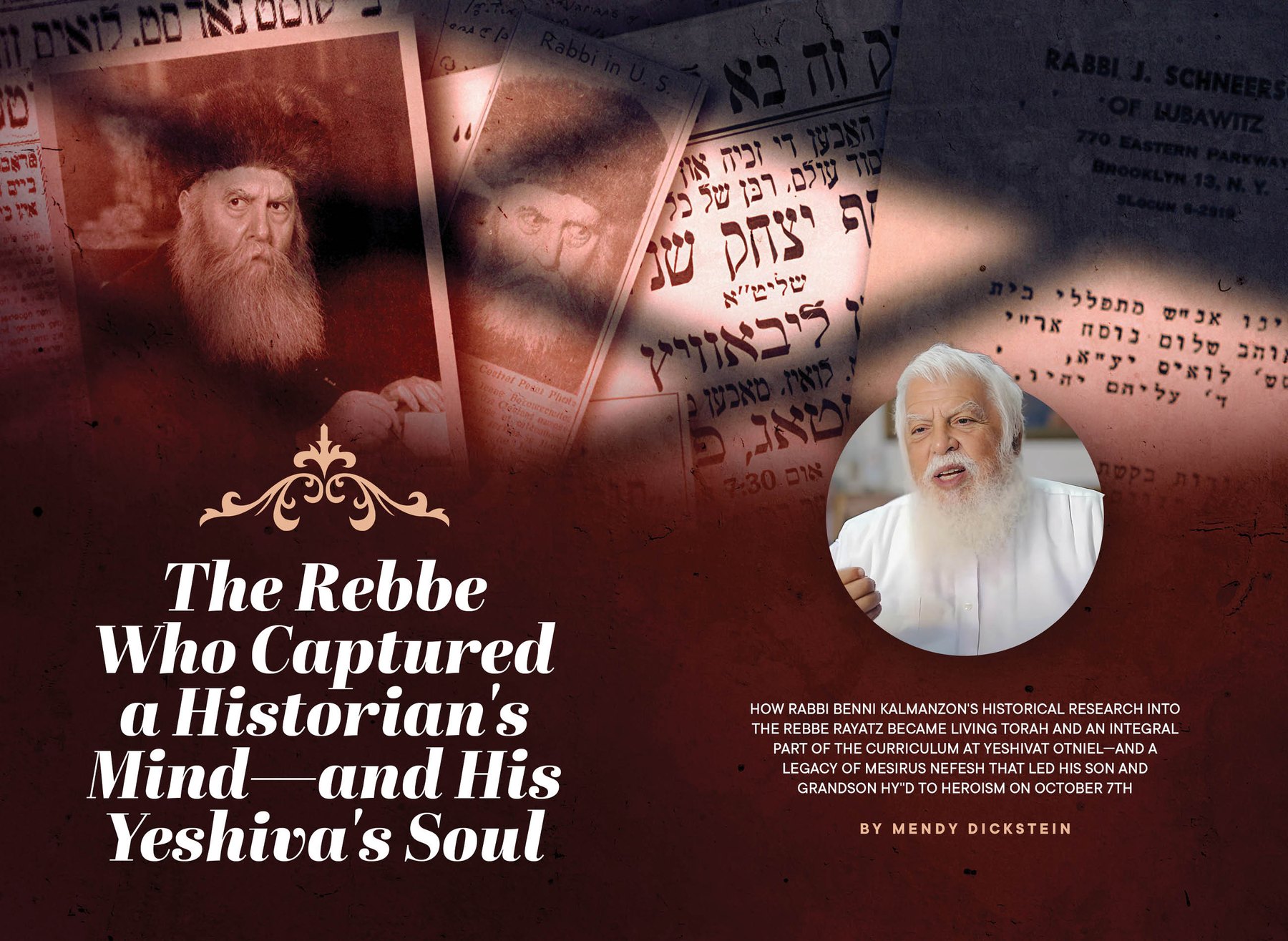
How Rabbi Benni Kalmanzon’s historical research into the Rebbe Rayatz became living Torah and an integral part of the curriculum at Yeshivat Otniel – and a legacy of mesiras nefesh that led his son and grandson Hy”d to heroism on October 7th.
The First Light of Simchas Torah 5784
The first light of Simchas Torah 5784 illuminated the skies of the south. The echoes of sirens were clearly heard as Elchanan Kalmanzon, hy’d, left his home in Otniel. A Mossad operative and IDF officer with the rank of captain, a father of five, did not wait for a call-up order. Something deep called to him, an inner calling he inherited from his home growing up, from Rabbi Benni Kalmanzon, to go to the front. Together with his brother Menachem and their nephew Itiel, they rushed toward Kibbutz Beeri, not yet knowing they were about to enter the pages of the history of the Jewish people.
One of the kibbutz survivors tells of that fateful morning: “The house was burning, we were trapped in the safe room, and suddenly Elchanan appeared like an angel from heaven. He rescued us gently through the safe room window, his radiant face instilled confidence in us. Those faces will remain etched in my heart forever.”
During sixteen consecutive hours of fighting, the three went from house to house, rescuing family after family, until the count of survivors reached about one hundred. In the last house, a bullet from a terrorist lying in wait in the corner cut short Elchanan’s life.
We speak in the library at Yeshivat Otniel, located south of Har Chevron, among shelves laden with sifrei Chassidus, including those of our Rebbeim. Through the window, the view of the Harei Yehuda rises majestically. In the room itself, one can feel that sense of a meeting between worlds, between Chassidus and the school of Religious Zionism.
The First Family Memory
Before we begin, can you tell us about the first family memory that connected you to Chabad?
“This mesirus nefesh,” R’ Benni Kalmanzon tells us in a special conversation ahead of Yud Shevat which marks the passing of the Rebbe Rayatz, “was not born from nothing. It grew from a deep family story that began in Moscow of the 1930s, during the days of Stalinist terror.”
In the dark streets of Moscow in those years, knocks were heard on the door in the dead of night. A small girl woke up and witnessed a rare moment of Jewish strength. Someone handed her father a small package, a package that was hidden in a false ceiling in the attic.
“A few nights passed, and her father woke her and her two younger brothers, and told them they belonged to an ancient people.”
And so on that night, in a small apartment in Moscow, an improvised Pesach Seder was held, with matzos that were inside the mysterious package. “He told them about the Jewish people and the Exodus from Egypt. My mother always said the matzos were ‘really not tasty,’ but it was a thin thread that connected her to Judaism.”
That package of matzos was part of a complex underground network operated by Chabad Chassidim under the leadership of the Rebbe Rayatz. Chassidim literally risked their lives to smuggle tashmishei kedusha, hold minyanim in basements, and pass the Jewish ember from generation to generation. This was an extensive system of clandestine activity, in which every Chassid knew that any action could be his last.
“The motto of the Rebbe Rayatz,” says R’ Kalmanzon emotionally, “was Ahavas Yisrael to the point of mesirus nefesh. Not just personal mesirus nefesh – which is a virtue that exists in Israel – but the ability to send a Chassid, knowingly, on a mission from which there’s a chance he won’t return. This requires special spiritual strength.”
This childhood memory was engraved in the heart of R’ Kalmanzon’s mother, a memory that would become one of the cornerstones in the deep connection her son would develop with Chabad Chassidim in general, and with the remarkable persona of the Rebbe Rayatz in particular.
The Family Journey from Russia to Eretz Yisrael
As mentioned, we are sitting in the library at Yeshivat Otniel, located to the south of Har Chevron. R’ Kalmanzon is a fascinating figure in the Israeli rabbinical landscape, founder and president of the yeshiva, a man who bridges worlds – Religious Zionism and Chassidus, academia and yeshiva, history and spirit. His eyes light up as he tells of his deep connection with Chabad.
When did your family make aliya to Eretz Yisrael?
“My father a’h, remained the sole survivor of his entire extended family that was murdered in the Holocaust and came to Eretz Yisrael after the war. The story of my mother’s aliya is interesting and constitutes a fascinating chapter in our family history.
“In 1934, the Communists permitted the aliya of a number of rabbis to Israel, in what was called the ‘Rabbis’ Aliya.’ Thanks to this, R’ Benni’s mother’s family emigrated to Eretz Yisrael. ‘The Communists permitted the aliya of rabbis even before the revolution,’ he explains. ‘It was part of an aid agreement with the United States during the famine period.’ The Chief Rabbi of Israel at the time, Rav Kook zt’l, placed the rabbanim on the list of immigrants.
However, despite the grandfather’s rabbinical background, the Communist years left their mark on the younger generation. Thus it turned out that R’ Kalmanzon’s mother, who knew almost nothing about Judaism, found herself in a religious teachers’ seminary after her aliya. “She does not remember it fondly,” he says with a smile mixed with sadness. “The teachers didn’t understand how it was possible that she simply didn’t know basic things in Judaism.”
He adds an interesting detail: “My mother’s family lived with the famous Yerushalmi tzaddik Rabbi Aryeh Levin zt’l, who vacated his home for them. It was a moving encounter between persecuted Russian Jewry and ancient Yahadus Yerushalayim. Rabbi Aryeh Levin, who was known for his tremendous Ahavas Yisrael, embraced the family warmly and lovingly, and showed them a different face of Judaism – no longer fear and secrecy, but light and warmth of kedusha.”
The circle of absorption for the new immigrants closed in the early 1970s, when the first aliya from the Soviet Union began. It was then that the young Rabbi Kalmanzon, together with his parents, found himself volunteering to help the immigrants. It was his first encounter as a bachur with the world of the Jewish underground in the Soviet Union, a world in which Chabad played a central role.
“I began to understand this story of involvement,” he recounts. “I interviewed people, I began to research specifically through history. I wasn’t yet connected to Toras HaChassidus. I didn’t really know it, but I actually started with the historical story.”
The Meeting with Rav Shagar and Drawing Close to Toras Chabad
The spiritual journey of R’ Kalmanzon himself was full of surprising turns. The home in which R’ Benni grew up was academic and cultural. He himself was born and raised in the Neve Shaanan neighborhood in Haifa. From a youth who studied in a regular high school, through a high school yeshiva in Netanya, he then went to Yeshivat HaKotel.
How did your initial connection to Chassidus come about, and what caused you to deepen and develop this connection?
“When I studied at Yeshivat HaKotel, I met someone who became my most significant teacher – Rabbi Shimon Gershon Rosenberg a’h, affectionately and admiringly called by his students: Rav Shagar. He was my first teacher in Chassidus,” he says with emotion. “I was very influenced by the study of ‘Shaar HaYichud VeHaEmunah.’ The concepts ‘yesh me’ayin’ (something from nothing), ‘ratzo v’shov’ (advance and retreat), the maamarim of the Alter Rebbe, ‘yichuda ila’ah’ (higher unity) and ‘yichuda tata’ah’ (lower unity), simply organized my place in life vis-à-vis the world and vis-à-vis HaKadosh Baruch Hu.”
Learning at Yeshivat HaKotel in those days was special. A small group of talmidim, led by Rav Shagar, dared to dive into the depths of Chassidus. “We were a tiny group,” he recalls, “although it’s worth noting that we weren’t forced to study Chassidus and Tanya underground like it was in other yeshivos; at Yeshivat HaKotel it was different. Perhaps we were perceived as strange in those years, but not something threatening or frightening. None of the yeshiva administration told us to stop this limud.”
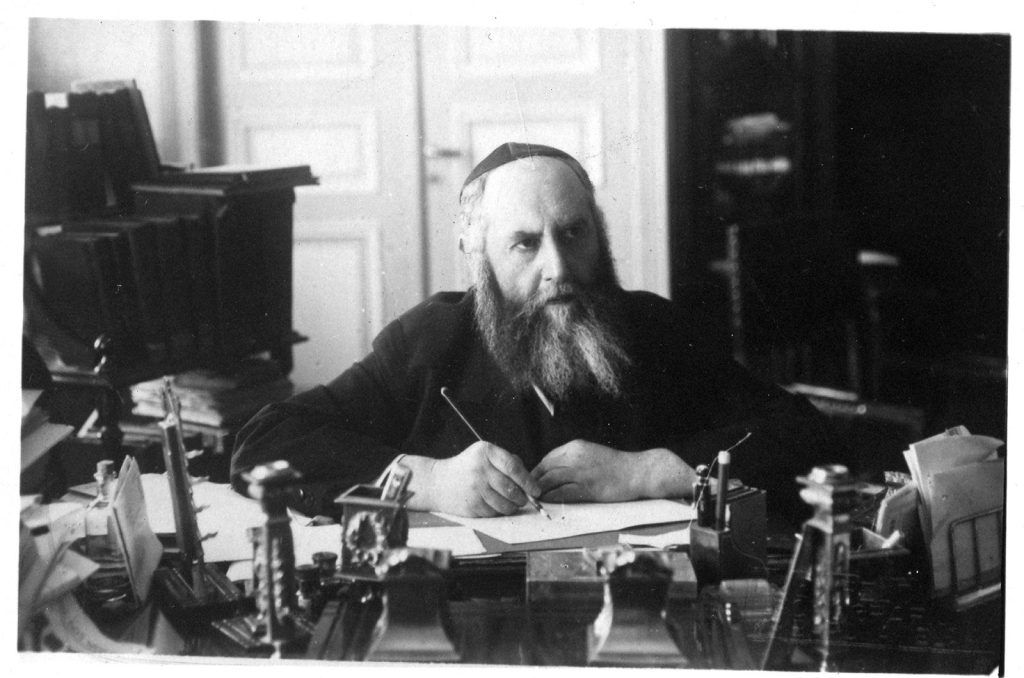
Parallel to his Torah studies, R’ Kalmanzon began to take an interest in Chabad history, and especially in the Rebbe Rayatz.
What drew you to research specifically the Rebbe Rayatz of all the Chabad Rebbeim?
“I began as a history student, later I also lectured, though on a limited scale, since my main occupation was heading the yeshiva.
“The research I conducted on the Rebbe Rayatz and his life story particularly drew me. In my opinion, he was the Rebbe in the most challenging time of the entire dynasty of Rebbes. He didn’t know a moment’s rest from when he ascended to the leadership, dealing with Stalinist Communism that was beginning to take over everywhere; then as Rebbe in Poland where he was forced to find his place among other Chassidic courts that ‘didn’t wish him well,’ to put it mildly.
“There were Rebbes who actually admired the Rebbe Rayatz for his steadfast path, like the Belzer Rebbe zt’l and the holy Rebbe of Piaseczna, hy’d, author of Aish Kodesh. Besides being neighbors, there was a deep spiritual connection between them. The Piaseczna wrote extensively about Chabad teachings, and the influence of Chabad Chassidus is evident in his holy writings.
“With the outbreak of the terrible Holocaust in Poland, the Rebbe Rayatz was forced to leave Europe and go into exile again, this time to the United States. Even when he arrived there, he knew no rest, but rather began a new spiritual struggle, but of a different kind, on American soil.”
As a trained historian, R’ Benni researched in depth the miraculous story of the Rayatz’s rescue from burning Europe. He chooses to highlight the Chassid, Rabbi Yisroel Jacobson, one of the distinguished Chassidim of that time:
“He was an exceptional Chassid,” he recounts enthusiastically. “Rabbi Yisroel Jacobson a’h left Europe and went to the US already in 1926. With the outbreak of WWII, the Chabad presence in America was minimal. Nevertheless, this Chassid did not retreat, but rather dug through the tunnels of diplomacy and through unconventional means succeeded in reaching President Roosevelt’s wife, who had decisive influence on her husband. He presented the Rebbe Rayatz as the leader of world Orthodox Judaism, and thus succeeded in getting him onto the exclusive list of Jewish spiritual leaders who merited to receive a visa to the United States.”
This was in a very complex period, when the US still maintained diplomatic relations with Nazi Germany, and it wanted to show it was doing something for the Jews in those early days of the war.
Besides the remarkable life story of the Rebbe Rayatz, what impressed you about his leadership?
“What impressed me particularly is the ability of the Rebbe Rayatz to lead his Chassidim in such a difficult and turbulent period. The motto of the Rebbe Rayatz throughout his life was – Ahavas Yisrael to the point of self-sacrifice,” he says. “The Rebbe Rayatz didn’t just send his Chassidim to sacrifice themselves, but he himself stood at the head of the battle, and modeled mesirus nefesh for others.”
The spirit of mesirus nefesh of the Rebbe Rayatz found a deep echo in the Kalmanzon family, when on Simchas Torah 5784, in the October 7th massacre, two sons and a grandson of R’ Kalmanzon from Otniel stormed to help rescue members of Kibbutz Beeri.
The Rebbe Rayatz arrived in New York at age sixty, in a wheelchair, suffering severe pain as a result of the torture he endured in Soviet prison. Additionally, he was completely destitute. Despite his difficult condition, he began to rebuild Chabad anew in America. “What’s amazing,” says R’ Kalmanzon, “is that within all the suffering and persecution, he continued to spread the depth of Chabad Chassidus. When you understand the concept of ‘tzimtzum shelo k’peshuto’ (contraction not in its literal sense), you understand that G-d is present everywhere equally, both within the Soviet prison, in the basement where Torah is taught in secret, and in the modern Crown Heights neighborhood of 1930s America.”
As an outside observer, what differences did you find between the Rebbe Rayatz and the Rebbe, leader of the seventh generation?
“Each period had its appropriate Rebbe,” he says reflectively. “Hashem arranged for the Jewish people that in each period there would be the Rebbe appropriate for that generation,” and he goes on to describe how in the difficult period of wars and persecution by the Communists, there was a need for a leader with willpower and uncompromising spiritual strength as characterized the Rebbe Rayatz, while when it was necessary to speak to American Jews with open love and hidden fear – the image of the Rebbe Nesi Doreinu, was more suitable.
Integration Between Worlds
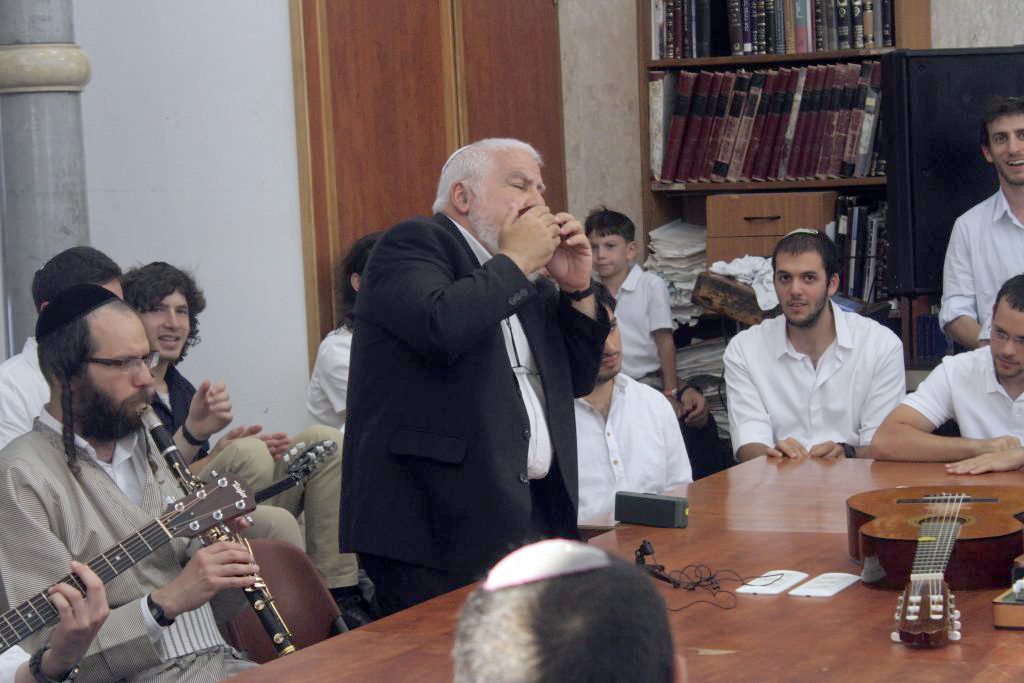
This deep Torah also found its way to Yeshivat Otniel, which R’ Kalmanzon established in 1987 together with Rabbi Ami Olami, hy’d, who was later murdered al kiddush Hashem. “Our idea in establishing the yeshiva was to integrate the depth of Chassidic teachings among students from Religious Zionism,” he explains. “In our yeshiva they study all the foundational books of Chabad – Tanya, Torah Ohr, Likutei Torah. We hold Chassidic farbrengens and sing Chabad niggunim. That’s what’s special about Chabad,” he says, “the ability to take the greatest depth of soul teachings and turn it into something practical and daily.”
At Yeshivat Otniel, the Chassidishe farbrengens in the yeshiva are not recorded, “so that the tzibbur will be pnimi” in his words, and they constitute an integral part of the yeshiva’s life. Even in podcast programs the yeshiva produces, deep Chassidishe niggunim are included, expressing the deep connection between the worlds.
R’ Kalmanzon, who meanwhile retired from the position of rosh yeshiva about three years ago and serves as its president, insists that Chassidic teachings continue to be an integral part of the yeshiva’s world.
R’ Kalmanzon, who as mentioned grew up in an academic and cultural family, with a rich background in classical music and literature, found in Chassidus a bridge between worlds. When he speaks about the deep concepts in Chabad teachings, like “tzimtzum shelo k’peshuto” and “ilah v’alul” (cause and effect), his eyes sparkle. “These sound like majorly theoretical things that have no practical aspect,” he explains, “but the truth is that whoever understands their meaning, understands that these are the most practical and most central things one can conceive. This shapes the ways of avoda and ways of learning of a Jew every day.”
The Rebbe Rayatz in the Mirror of History and Legacy
The story of the Rebbe Rayatz’s life span, as R’ Kalmanzon sees it, is a story of dealing with the challenges of the most difficult period in the history of the Jewish people. “In the period when he assumes the leadership, most of the Jewish people are more or less religious,” he explains, “and when he passed from the world, the vast majority of Jews are not religious, and all this due to events of physical and spiritual destruction at insane levels.
“The global events that occurred in those thirty years of his leadership were tumultuous and shocking events of physical and spiritual destruction at enormous levels: the Holocaust, Communism, and the Haskala.”
Despite all the difficulties and challenges, he believes that the Rebbe Rayatz was victorious in his struggle against the Haskalah. “In the battle between Chassidus and the Haskalah, the Chassidim won – not only do I claim this, but even a Marxist historian like Raphael Mahler believes in the Chassidim’s victory.”
The encounter between R’ Kalmanzon and the world of Chassidus began through history and deepened through Chassidic thought. As a researcher and academic, he was first drawn to the historical story of Chabad in the Soviet Union.
“Three years before I retired, I took a young and very talented rav to fill my place.” Today he remains in the yeshiva “only for ‘ahava b’taanugim,’ to influence. I teach talmidim today, but don’t bear responsibility,” he smiles wisely.
Even today, at Yeshivat Otniel, the students learn not only Chassidus, but also the way of life of mesirus nefesh and Ahavas Yisrael. R’ Kalmanzon, who bridges worlds and traditions, continues to pass on the deep message of the Rayatz, that true Ahavas Yisrael requires real self-sacrifice, not just in words but in deeds. “Even in our generation, when the challenges have changed, but are no less complex – the personal example of the Rebbe Rayatz continues to light the way – a path of deep faith in the power of the Jewish people to overcome any challenge.”
R’ Kalmanzon, as a student of Rav Kook, describes Rav Kook’s deep connection to Chabad, “who as is known was also very connected to Chabad. Even in his thought you can see the foundations of Chassidus.”
A final question: Besides self-sacrifice and Ahavas Yisrael, what else fascinated you about the Rebbe Rayatz?
“What amazes me in particular,” says R’ Kalmanzon, “is how the Rebbe Rayatz succeeded in combining intensive activity of leadership and hatzolas nefashos, with exceptional depth of thought. It’s amazing that a person who from his youth had no moment’s rest, succeeded in being such a giant in Chassidic teachings. When you study his maamarim, you see the enormous knowledge, the remarkable sharpness, the fact that everything fits in an amazingly organized way, everything in its place.”
He notes that he is perplexed regarding our Rebbe – “How did he succeed in combining enormous public activity with writing and thought of a mind-boggling scope?!”
Rabbi Kalmanzon brings the unique path of the Rebbe Rayatz to the coming generations among hundreds and thousands of his students at Yeshivat Otniel.
Beis Moshiach #1491B • pp. 24-31
© 2026 Beis Moshiach Magazine. All rights reserved.
This article originally appeared in Beis Moshiach #1491B. You are welcome to share it with friends and family by email or in print, provided that you do not change, add to or omit any part of it, you credit the author and Beis Moshiach, and you include a link to archive.bmoshiach.org (written out in full in printed copies).
To republish this article in a newspaper, magazine, book or website, please request permission in advance at [email protected].