The License Plate That Gave It All Away
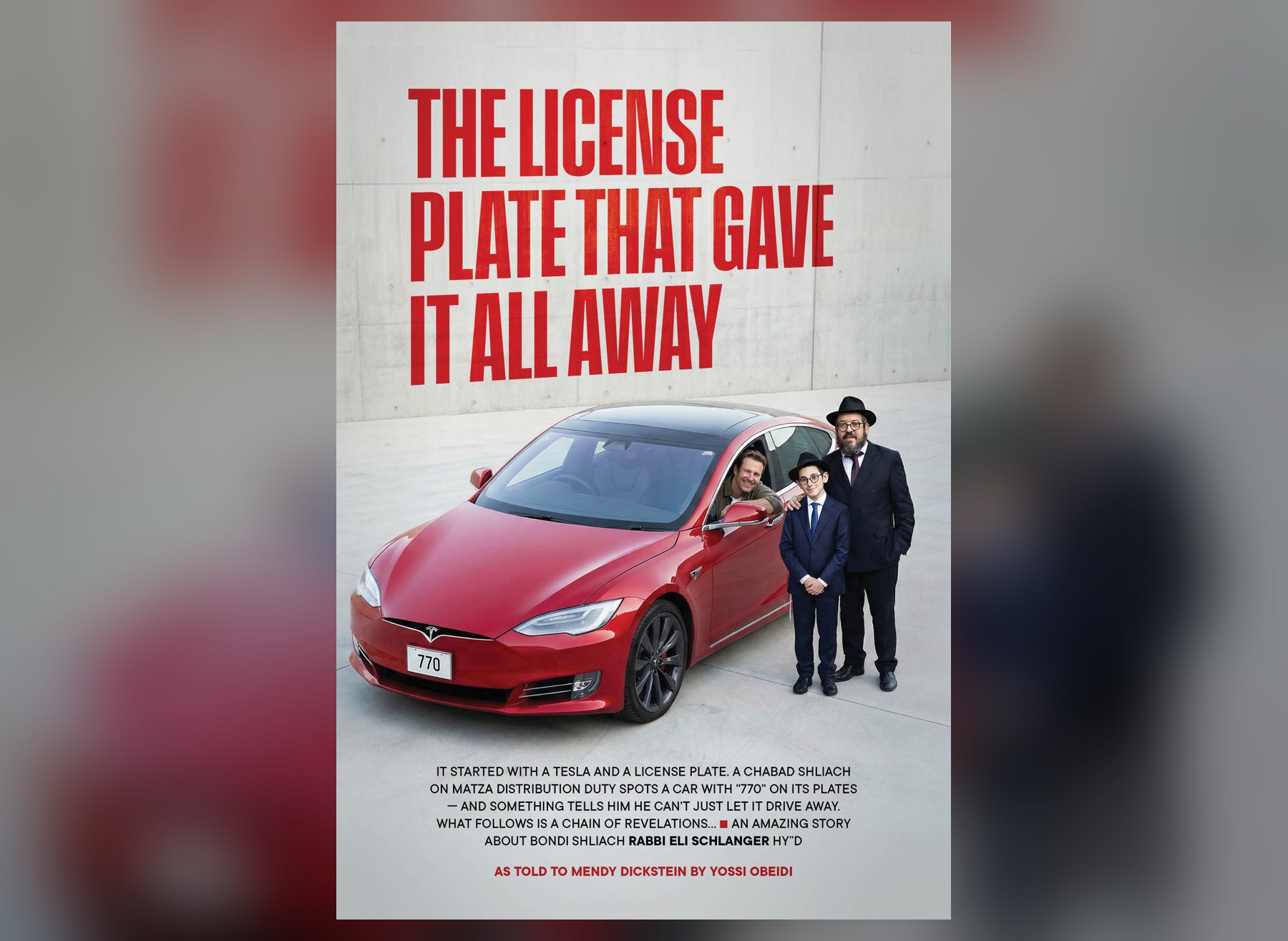
It started with a Tesla and a license plate. A Chabad shliach on matza distribution duty spots a car with “770” on its plates – and something tells him he can’t just let it drive away. What follows is a chain of revelations… An amazing story about Bondi shliach Rabbi Eli Schlanger Hy”d.
I
The garage in Beitar Illit had never looked so gray. Usually, when you walk in, R’ Yossi Obeidi greets you with a big smile, but this time, just two days after the horrific massacre in Sydney, Australia, the face of the famous “diagnostician” was marked by an unspeakable pain. It wasn’t just the shock that every Jew felt upon hearing the news of the brutal murder of fifteen pure Jewish souls on the first night of Chanuka; this was an open wound bleeding from within the heart.
The news of the kiddush Hashem of the devoted shliach, Rabbi Eli Schlanger Hy’d, transported Yossi instantly back in time, to a rare moment of open-hearted conversation in the courtyard of a Jerusalem hotel.
It had happened on Motzoei Shabbos HaGadol, Erev Pesach 5784.
The air in Yerushalayim had been dense and cool, carrying the weight of the war that had hung over everything since Simchas Torah. The shliach, Rabbi Eli Schlanger HY”D, had come to Israel at the head of a delegation from his community in Sydney, filled with purpose – to embrace the people. In the courtyard of the Leonardo Plaza Hotel, beneath a star-filled Motzoei Shabbos sky, Yossi had stepped outside to catch some air and relax with a cigarette, when he encountered R’ Eli. Their conversation flowed naturally, and since it was Erev Pesach, R’ Schlanger pulled from his memory a story that had happened to him years earlier in far-away Sydney, at precisely this time of year – a story that began with a license plate and ended with the “techiyas ha’meisim” of a Jewish soul.
II
“I was doing ‘Mivtza Matza’ with my son,” R’ Eli Schlanger told Yossi that night. “We were going around Sydney and distributing Shmura Matza. Suddenly my son shouted: ‘Abba, look! 770!’ I looked over and saw a luxurious Tesla with only that number on its license plate – 770. We stopped the driver on the side, we had to find out the meaning of that number…”
Out of the luxury vehicle stepped a local businessman who appeared, by all appearances, to be a complete non-Jew. When the rabbi asked him about the number, the man shrugged and said: “I don’t know exactly what it means, but you should know that this number has followed me my whole life – my home phone number, my office number, and so on. My mother told me this number is my good luck charm. She told me that thanks to the man connected to this number – I was born…”
R’ Schlanger, with the instinct of a shliach who never gives up on any neshama, didn’t let it go. “We have to call your mother right now,” he announced to the man. The call took place on speakerphone in the middle of a Sydney street, and it was earth-shattering.
“Mom?” the man asked. “There’s a Jewish rabbi here asking about the meaning of the number 770. Who is the man thanks to whom I was born?”
A long silence fell on the other end of the line, followed by a trembling, tearful voice. The mother, already a very elderly woman, broke down.
“It’s the Rebbe of Lubavitch,” she whispered. The man was stunned, but R’ Schlanger gently asked the obvious question: “Why? What is your connection to the Rebbe?”
And then the dam burst. The mother told them through tears that she was a Holocaust survivor. The horrors she had endured in Europe had seared an existential fear into her soul. She had drifted through many places until arriving in Australia, where she built a new life while concealing the fact that she was Jewish.
Years had passed since she married, and she had not been blessed with children. Someone told her about the great Rebbe in New York, and she sought his blessing. She received a blessing, and her son was born.
Yet she had sworn to do everything in her power to protect her son from any harm that might come to him because of his Jewishness. And so she had hidden his Jewish identity from him. Over the years she raised him as a complete non-Jew, so that his fate would not be like hers.
Despite this stubborn concealment, she wanted to give him a talisman to protect him, and she told him that the number 770 was a holy number – without revealing its source. That was why he had taken care to have that number embedded in his phone number, his license plate, and at every station of his life.
Now, in a conversation unfolding in the middle of the street, the truth was revealed: “You are Jewish, my son,” she told him. “I am Jewish, and therefore so are you.”
There, beside the luxurious Tesla, stood a man whose entire world had been overturned in an instant. He discovered he was a son of the eternal nation, the son of a Holocaust survivor, and the spiritual son of a great Rebbe whose home was in New York.
“Since then,” Rabbi Schlanger told Yossi with a pleased smile, “the young man underwent a transformation. He began observing Torah and mitzvos and became an inseparable part of our community in Sydney…”
III
Yossi heard this story from the shliach and felt a chill run down his spine. The story resonated powerfully with the tales of hashgacha pratis on which he had been raised in his own home during his childhood and youth – stories that illustrated how the Rebbe’s eyes saw into the distance.
“Your story,” Yossi said to R’ Eli emotionally, after a long contemplative silence, “reminds me of a story my father had with the Rebbe.”
Here Yossi opened up and told of his father, R’ Raphael Arnon Obeidi’s reserve duty service in the Eilat mountains immediately after the Yom Kippur War. The area his father was stationed in was prone to climate disasters. Sudden flash floods were routine, so much so that on one occasion the water had seeped in and flooded the military tents and the makeshift shul they had built in the center of the base. Yossi’s father, R’ Raphael Arnon, a yerei shomayim, was anxious about the fate of his tefillin. He knew that water was the great enemy of tefillin, and so he had taken extreme precautions from the outset: he wrapped the tefillin in many layers of sealed, hermetic plastic and kept them in a high, protected place.
One day, he sat down to write a letter to the Rebbe. It was a fairly routine letter in which he described his experiences from his military service, the situation at the base, and among other things mentioned, almost in passing, the floods that had occurred in the area. To set the Rebbe’s mind at ease, he emphasized: “But there is no need to worry, as my tefillin are safely and well protected in plastic wrappings – not a drop of water touched them.”
The reply that arrived from the secretariat at 770 struck R’ Raphael Arnon with astonishment. The Rebbe addressed neither the weather descriptions nor the protective plastic, but wrote just: “Check the tefillin.” He didn’t understand. He himself had testified that the tefillin were completely protected and dry! Nevertheless, emunas chachamim overrode logic, and on his first visit home, he took the tefillin and delivered them for inspection to an expert sofer.
The sofer opened the battim, examined the parchment briefly, and immediately ruled: the tefillin were pasul! Not because of water, not because of moisture, but due to a fundamental defect in the letters themselves. It turned out that the Rebbe, from his room in Brooklyn, had seen through the plastic and across the distances into the very beating heart of the mitzva – which was in urgent need of repair.
IV
Yossi Obeidi and his new friend the shliach R’ Eli Schlanger made the most of their unplanned encounter. After all, it was Motzoei Shabbos – the right time to tell stories of tzaddikim. There is great segula in this…
After a brief pause, Yossi Obeidi added: “That is the Rebbe’s miracle story with my father – but there is a miracle with me personally as well,” and here he began to tell the story, until the eyes of R’ Schlanger filled with tears.
* * *
It happened in the year 5747. My father traveled to the Rebbe and passed through the famous Sunday dollar distribution. The line was long – many people passed through to receive a blessing and a shlichus mitzva – but the pace was quick.
When my father’s turn came, the Rebbe’s face lit up. The Rebbe handed him five dollars. My father, a straightforward and sincere man, grasped the bills, counted them quickly, and raised his eyes to the Rebbe with an embarrassed look.
‘Rebbe,’ he said, ‘I only have four children at home. Perhaps there was a mistake? Perhaps I received one dollar too many?’
The Rebbe smiled that fatherly smile that knows the secrets of above and below, and said two words that became a prophecy: ‘Besuros tovos.’
The father left 770 excited and confused, clutching the five bills, wondering about the seemingly superfluous dollar and about the meaning of the mysterious blessing.
The answer was not long in coming. As was his weekly custom, the father called his wife in Israel from New York on Friday to wish her a ‘Good Shabbos.’
On the other end of the line, his wife’s voice sounded excited and different. “I have something to tell you,” she said. “I went to the doctor… we have good news. We are expecting another child…”
At that very moment, standing in a public phone booth in New York, the father understood that the fifth dollar had not been a mistake… It had been a preparation and a vessel of blessing for the new soul already making its way into the world.
“Nine months later,” Yossi concluded the story to the enchanted R’ Schlanger, “my brother was born – a healthy baby. The child the Rebbe had seen before his own parents knew of him.”
* * *
On that night of Motzoei Shabbos HaGadol 5784, beneath the skies of Yerushalayim, these three stories merged into a single burning farbrengen of faith.
Rabbi Eli Schlanger and the mechanic from Beitar Illit felt in that moment the well-known secret: the Rebbe is everywhere. He is present in the license plate of a Tesla at the edge of the world that returns a Jew to his roots; he is present in a reply letter to a lone soldier in the Eilat mountains; and he is present in an extra dollar given to a wondering father.
The author’s gratitude is extended to R’ Raphael Wahl and to R’ Yossi Obeidi.
Beis Moshiach #1496 • pp. 32-35
© 2026 Beis Moshiach Magazine. All rights reserved.
This article originally appeared in Beis Moshiach #1496. You are welcome to share it with friends and family by email or in print, provided that you do not change, add to or omit any part of it, you credit the author and Beis Moshiach, and you include a link to archive.bmoshiach.org (written out in full in printed copies).
To republish this article in a newspaper, magazine, book or website, please request permission in advance at [email protected].