Chabad in Tanzania: Machetes, Mayhem & Miracles
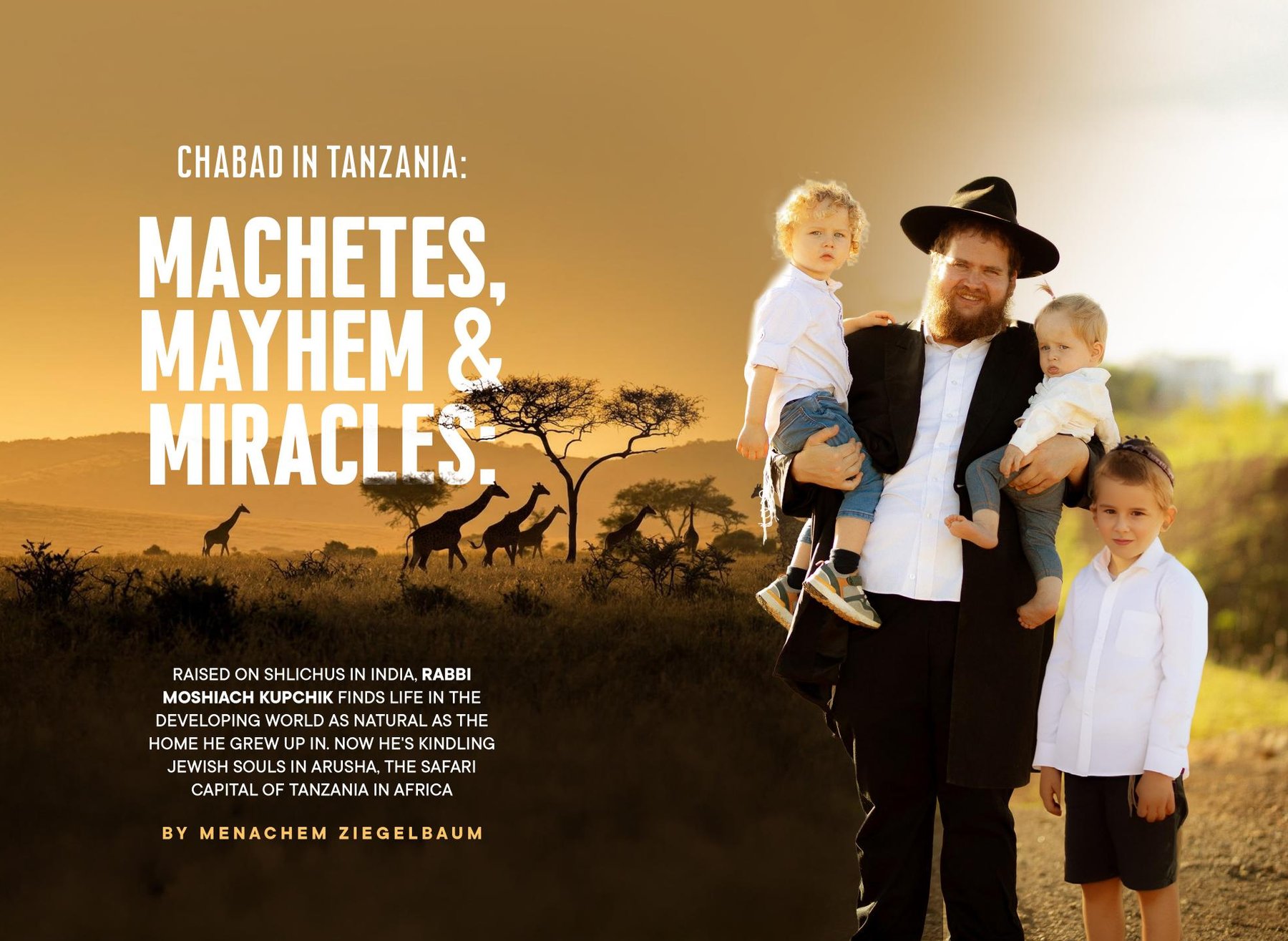
Raised on shlichus in India, Rabbi Moshiach Kupchik finds life in the developing world as natural as the home he grew up in. Now he’s kindling Jewish souls in Arusha, the safari capital of Tanzania in Africa.
Just before the Kinus HaShluchim 5786, while the world watched with concern as Tanzania’s political situation rapidly deteriorated, I interviewed the shliach working there, in the heart of Africa: Rabbi Moshiach Kupchik. The story of Rabbi Kupchik, the shliach in the city of Arusha, Tanzania, is the story of a shlichus with fire, miracles, tears, and a great deal of Geula.
The following incident illustrates the impossible reality in which the Rebbe’s shluchim operate: It was in the middle of Chol HaMoed Pesach, right before the start of Acharon shel Pesach. A jarring phone call to Chabad House in Arusha: a worried mother from Israel said her son, a young traveler, had vanished. “As if the earth swallowed him,” she said. Before contact was lost, he had managed to write to her that he had landed in an emergency situation and that the only solution was to “leave the country.”
Since then, silence. No sign of life. The family searched for him for a week without success, until someone told them there was a Chabad House in Tanzania.
“As I said, it was erev Yom Tov,” R’ Moshiach recounts, “just hours before sunset. I remember the father’s voice on the phone. There was real distress there. In those moments we understood that we were the only ones who could do something.”
The shluchim couple sprang into action. They circulated his photo in all the travelers’ group chats and tried to trace every shred of information. Then a chilling rumor spread: a body had been found in the forest, and its description matched the missing man’s details. The time, the age, the appearance, everything fit. “We realized we didn’t have another second to waste,” the shliach says.
R’ Kupchik immediately headed to the local police station, armed with the photo. There he discovered that the young man was not dead but under arrest. He had been held in custody for several days. No one knew. No one had reported it.
Time was tight. The holiday was beginning, but nothing could be done at that time because that day was a national holiday on which government offices were closed. Applications couldn’t be submitted, and detainees couldn’t be released. Even so, at the Chabad House they made sure to bring him kosher-for-Pesach food, tried to improve his conditions in custody, and made contact with his worried family.
The next day, on the Yom Tov itself, the shlucha Yachal Kupchik set out on foot, an hour’s walk, toward the government offices. “The Chabad House driver followed behind me with the money. I prayed the whole way,” she says.
In the end, after paying a fine of hundreds of dollars, and on the basis of prior connections and earlier assistance operations with government officials, the young man was released. He was brought to the Chabad House in the middle of Yom Tov, rested, recovered, and returned to Israel alive and well.
“For us, it was an example of Geula,” says R’ Kupchik. “Imagine: the young man sits in detention in an empty room with no toilet, no bed or mattress, not even a blanket to spread beneath him (or over him). He gets no food and has no contact with the world. Truly terrible conditions. And suddenly, in one moment, everything changes. Seeing him granted Geula in the midst of the holiday of freedom gave everyone at the Chabad House the feeling that this is exactly how, in the blink of an eye, we will merit the complete Geula.
“Sometimes you have to travel to the end of the world,” adds Mrs. Kupchik, “to ignite the burning spark of Moshiach in a Jew’s heart. That is the uniqueness of the Chabad House: precisely in the farthest place, the essence is revealed. We had a Jew who in Israel lived near the local shliach but never went to him and never spoke with him; and davka here, in distant Africa, the fire was kindled in him. Here on shlichus, we truly feel part of this immense enterprise that opens people’s eyes.”
Chaos Outside, Light Within
This story takes on added weight in light of the dramatic reports at the time. According to press reports, the country had been “sinking in recent days into sharp political and security chaos.” Following the general elections, in which the incumbent president won 97.66% of the vote, widespread rioting broke out.
The situation deteriorated quickly. The main airports in Dar es Salaam, Zanzibar, Kilimanjaro, and Arusha itself were paralyzed. The authorities cut off the internet almost entirely.
The US and Britain issued severe travel warnings for travelers, and Israel’s Foreign Ministry advised citizens to “avoid traveling to the country,” and those already there to “stay away from tense areas… and prepare for disruptions in food, electricity, and communications supply.”
And in the midst of this chaos, in the city of Arusha, the Kupchik family’s Chabad House continues to operate. While the roads to the airport are blocked and tourists are trapped, the Rebbe’s house continues to serve as a lighthouse. This house, which according to the shluchim’s figures receives hundreds of visitors each month, became a genuine refuge, a place to get information, a feeling of home and security. While the country collapsed, the shluchim continued their shlichus.
According to their activity summaries, in the past year alone they were involved in “over fifteen genuine life-saving cases,” from climbing rescues to assisting accident victims.
Flames Rising at the First Chanuka
Rabbi Moshiach Kupchik is the son of Rabbi Betzalel and Rochel Kupchik, the first shluchim who “jumped into the deep waters” and went on a shlichus to India, in the years when India was beyond the mountains of darkness.
Moshiach was a small child who grew up in the hothouse of shlichus. He knew quite well the enormous difficulties, tasks, and challenges. From his earliest day he was forged in the mold of shlichus work in difficult places and this helps him today in his shlichus of about four and a half years in the city of Arusha, in African Tanzania, which has about half a million residents.
Quite a few travelers from all over the world come to Arusha as it is considered Tanzania’s tourism capital, being the city closest to the safari areas in the north of the country.
In the past, Arusha’s economy was based mainly on agriculture, coffee plantations, and gemstones, but today its main economy comes from tourists who visit the nearby reserves, where one can go trekking or on safari. Its population consists of Christians, Muslims, and Hindus.
At Chabad House Arusha, amid the African chaos and the daily miracles, the Kupchik family is on a unique shlichus. “We live in a truly redemptive generation,” says R’ Moshiach. “My mother went on a shlichus to India when email had only just been invented. Today? We feel no disconnect from the world at all”…
How did the Chabad shlichus in Arusha begin?
R’ Kupchik describes it with his perpetual smile: “The Tishrei chagim of 5781 were the ‘pregnancy’ of Chabad House Arusha–Tanzania, and the 20th of Kislev, the Chag HaGeula, became its ‘birthday.’”
After Tishrei, the Kupchik family returned to Israel to organize for their shlichus. On Wednesday, the 20Kislev 5781, the Kupchiks landed there again: Moshiach, Yachal, Mendele (3) and Mussi (1.5), together with a quarter ton of equipment. “We arrived at the house after an exhausting trip. We were tired and hungry. The stuff we had left here after Tishrei would only arrive the next day…”
African reality struck them immediately: “There was no one to greet us with a kosher meal… The life of shlichus out there challenged us from our very first moments. Somehow we ‘organized’ a dinner.” A short while later, everyone fell asleep on mattresses from exhaustion.
Just four days later came Chanuka, their first Chanuka on shlichus. “Time is short and the work is plentiful. We had to start everything from scratch,” says R’ Moshiach. “Our first task: pirsumei nisa publicizing the miracle. The morning after we arrived, my wife went to the metalworking shop to order a large menora. We had no doubt that even here in remote Arusha there must be publicizing of the miracle! The time pressure was immense: that day was Thursday, Shabbos was approaching, and on Sunday everything is closed. That left one day to build a menora from scratch.
“Yachal gave instructions to the craftsmen,” Rabbi Kupchik describes the surreal scene. “The local metalworker sketched the plan in the sand. We had no idea what he understood or what would come of it… but ‘a great miracle happened here’: right before Shabbos began, a small truck arrived at the Chabad House courtyard with a large and beautiful menorah… Every evening Jews gathered for the lighting, and afterward sat down for a farbrengen with holiday delicacies. Each one told a personal miracle that had happened to him. They spoke about hashgacha pratis and about how only in the Geula will we understand how everything was for the good.
“One of the participants was a Jew who, sadly, is married to a non-Jewish woman. ‘In my childhood, Chanuka was the holiday I loved most,’ he told us. ‘In Tishrei I was with you on Simchas Torah, and since Simchas Torah, it has also joined the list of favorite holidays.’ One evening he lit the large menora with excitement, and we also gave him a personal menora for his home.”
But the defining story of that first Chanuka in Tanzania was “a flame rising by itself.” A local Israeli Jew who used to daven without tefillin (“because he didn’t have any”) came in Tishrei to put on the shliach’s personal tefillin every day. “His heart was so awakened,” says Rabbi Kupchik, “that when we traveled to Israel, he didn’t want to lose out… I decided to leave my precious tefillin with him, not without apprehension…
“On Chanuka, a shipment finally arrived containing new tefillin for him. The first sentence that came out of his mouth when he received the new tefillin was: ‘Now, on the family trip, I’ll put on tefillin with my brother too.’ I was moved to see how he had already become a shliach himself…
“Later, when I helped my son Mendele light candles, one of the candles didn’t light easily. I took the opportunity to explain to him that this is our role on the shlichus: to light the candles until the flame rises by itself. At the meal we held after the lighting, I told this episode to everyone present, and this man jumped up and said, ‘By convincing my brother to put on tefillin every day, I too caused a flame to rise by itself’…
“This year we launched a special Chanuka campaign; we worked for hours on cards with photos of the hostages, a QR code to scan their personal chapter, and the brachos for lighting. The project was welcomed enthusiastically by shluchim all over the world, and thousands of people from around the globe used it. The project began with a simple but profound initiative: to encourage people to do a mitzva in the merit of the hostages. Within a few days it became clear how much the idea touched hearts.
“People from all over the country and the world asked to take part, to feel they were doing something that carries light. In Arusha too, dozens of participants committed to light Chanuka candles all eight days, each in his own home, with special kavana for the merit of the hostages. The broad response and the excitement flowing from the communities and Chabad Houses were extraordinary.”
“I Want to Build a Jewish Home”
After that first Chanuka, it was time for the shluchim to enter the regular routine of shlichus life in the African country where they had landed only a short time before, with all that implies. “The summer seasons are devoted to travelers, and the period after the chagim is devoted to the community,” R’ Moshiach explains. “One of the Jews living here in Arusha was a young woman named Maya. The connection with her began back on Rosh Hashana, when she asked to come with her boyfriend to the tefillos and meals. This was a dilemma since the boyfriend was a local non-Jew. But she made her coming conditional on his coming, so we agreed.
“Since she started coming, a pleasant connection formed. Then came the first step on her part; she understood on her own that she is what matters to us, and from then on she didn’t come with him to the Chabad House again. After that we no longer had to agonize about the non-Jew coming to the Chabad House.
“Maya was thirsty for Judaism. She set up a Tanya class with my wife; during her visits to the Chabad House we spoke a lot about hashgacha pratis, about the Rebbe’s influence, and about the difference between Jews and non-Jews. You could feel how, from lesson to lesson, her soul was awakening.
“The climax was on Shevii shel Pesach, when Maya was with us at the Seudas Moshiach. She concentrated on the niggunim with dveikus, and my wife felt it was an eis ratzon. After Yom Tov, she sat down with her for a private conversation about the spiritual meaning of intermarriage.
“A week later came the defining moment. She came and told us that she was leaving him. She sat with us for a long time, and said, ‘We could have continued together, but I preferred, despite our bond, to leave. I’m at peace with it, because I don’t see myself living in a foreign land with a non-Jew and raising children disconnected from tradition. I realized that I want to build a Jewish home with a Jewish man’…”
At parting, before she flew back to Israel, Maya told the shluchim: “You were my family here, and I’m glad I ended up in Tanzania, because if it was to get to know the Almighty a little better, it was worth it!”
“How precious such a Jewish woman is,” the shliach concludes. “Fortunate are we that we merited to be the shluchim of the Rebbe MH’M!”
Trying to Keep Up
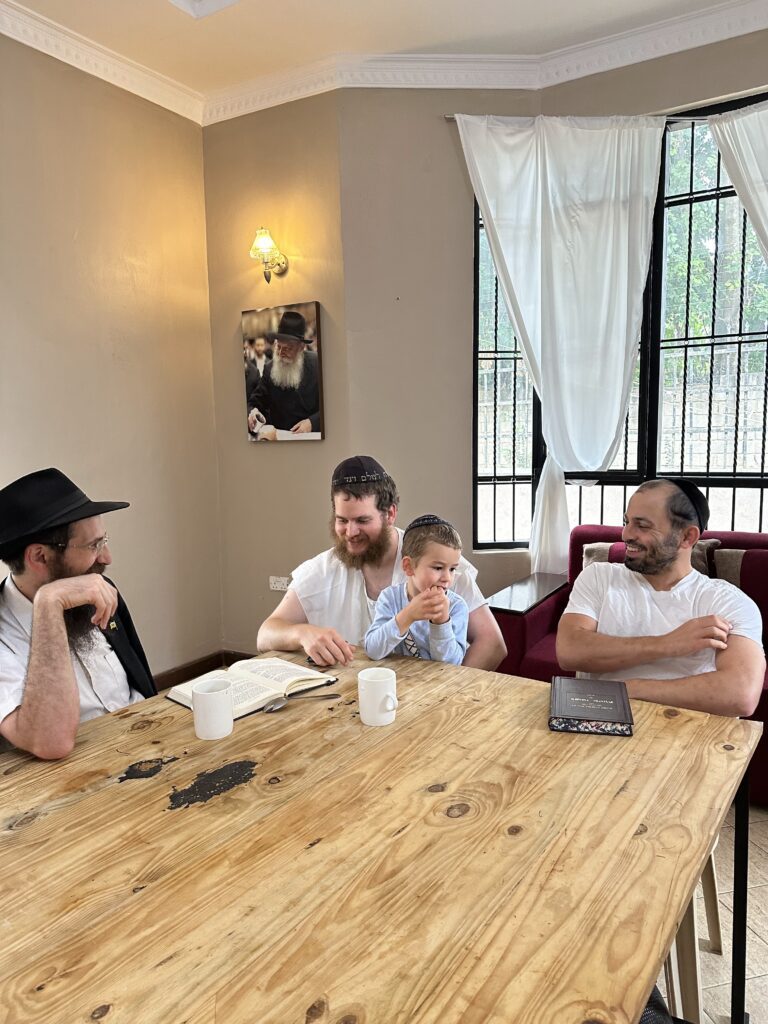
The shlichus is sometimes like a long-distance run. Since the beginning of their shlichus, the Kupchik family has gone to Eretz Yisrael twice, for a blessed reason: in preparation for a birth, boruch Hashem.
“Shortly after the birth, we returned to Tanzania with renewed strength and a reinforced ‘team’: me, my wife, Mendele, aged four and a half, Mussi, aged two, and Levi Yitzchok, the new shliach, less than two months old. Two years later, Shneur Zalman also joined the shlichus at six weeks old… It was important that he receive the vaccinations needed for a place like Tanzania even before arriving. A day after receiving the vaccines, we were back to the shlichus.
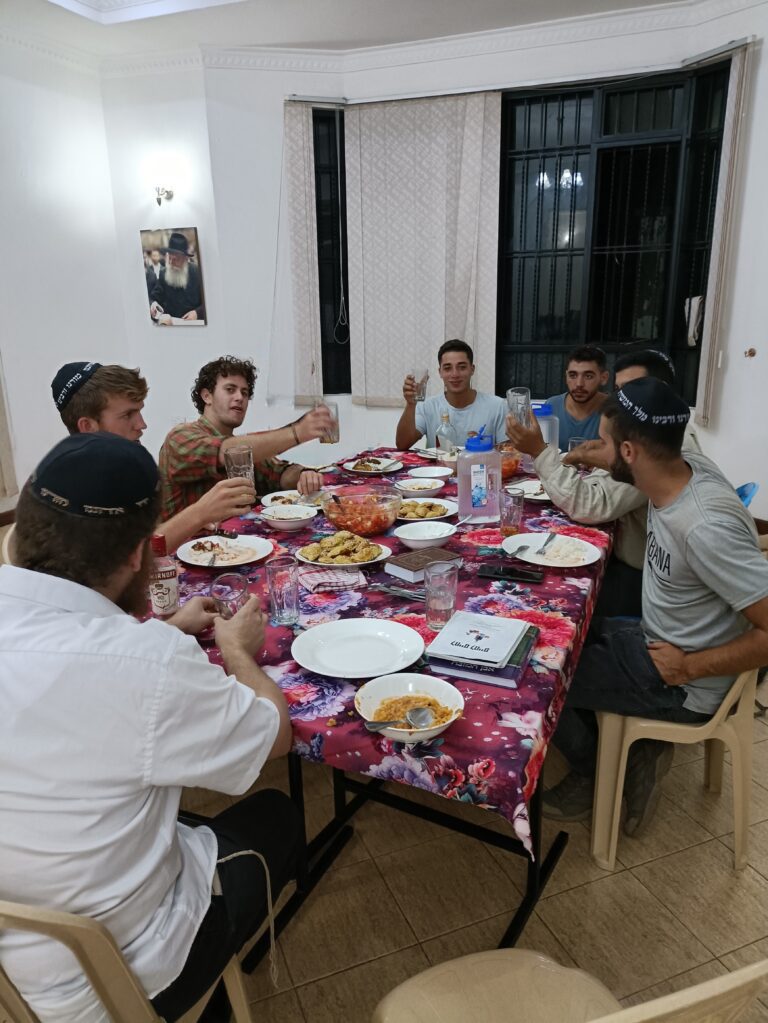
“We landed straight into a busy period. There was really no time to breathe. Every day we hosted suppers for guests. The climax of the week was Shabbos. In Arusha, as elsewhere, every Jew is considered a precious gem. There are no crowded Jewish communities, and Jewish travelers aren’t as numerous as in other countries. Even so, before the first Shabbos, when we received the Shabbos registration data, we suddenly discovered we didn’t have enough serving dishes. In the pressure of Shabbos preparations, I had to drive to a store to buy enough for everyone. When we thought we had solved the problem, we discovered on Friday night that there weren’t enough cups for the number of guests who came, boruch Hashem.
“During the week we made sure to buy more cups. Before the next Shabbos we discovered that, given the early registration, we were short of chairs. We quickly sent a driver to buy thirty more chairs. To be safe we also bought a few new tables, but even those weren’t enough. On Shabbos we improvised a table from a wooden board we had at home…
“By now we’re past the initial difficulties. We now have professional equipment, enough serving dishes and tables. In the summer months we comfortably host about 80–90 people every Shabbos, in a warm, family atmosphere.”
It turns out that the ‘young shluchim’ team has also gone to work, despite their young age. “Mussi, who is five, keeps standing up and asking to say a passuk. The guests are delighted and repeat after her. The result is amazing,” R’ Moshiach smiles. “Afterward we saw some of them walking down the street imitating her, saying the passuk again and again… How happy I was to see that even in the streets of remote Arusha, pesukim of Torah are being said, spiritually purifying the air”…
Mendele, who is seven and a half, also has a role: “At the washing of hands, he takes it upon himself to say the bracha with everyone, even the mitzva observant guests… Once, one of the guests wanted to draw him a picture of an elephant; after all, we’re close to the safari… But from the side I heard Mendele explaining to him that he should draw a different animal because an elephant is not kosher. We see the children’s influence on the community as well. Not long ago a Jewish woman who had visited Israel approached my wife; she had bought the children books on her own initiative, but reassured us that she had checked page by page to make sure the book was ‘tahor,’ as she put it…”
What do you do about kosher food? In Tanzania, presumably, there’s no grocery with kosher food, not even imported…
“It’s truly a difficult challenge. We have serious kashrus challenges here, but we do everything so that not only will we have plenty of kosher food, but we’ll also be able to provide kosher food to travelers and Jews in the area. It’s important to us that they be able to eat kosher. That they not feel they’re missing out on anything on their trip because of kashrus,” R’ Kupchik explains.
“This includes Chalav Yisrael, Pas Yisrael, and packed cooked meals for travelers going out on safari, by advance order.”
Here’s an unusual story: One Friday, late in the morning, a phone call comes in: a group of 13 travelers is stuck without kosher food. Their local tour company had promised them kosher meals for Shabbos, but suddenly it became clear that the company had meant “halal” (the Muslim version of “kosher”). Now they were stranded with no kosher meals!
R’ Kupchik tried to persuade them to come to the Chabad House, but they were too far away to reach it before Shabbos. The shliach looked at the kitchen: “We had already finished cooking the meals for Shabbos after we had prepared nice quantities of food and to start cooking from scratch for such a sizable group was not simple. We discovered that many basic things were missing: no vegetables, no flour (the meal begins with baking challahs, and there’s no kosher bread in the grocery…), and no… and no…
“Even so, we rose to the occasion. I called the driver to do shopping for us at the market, but he said he was too far away… I tried another driver, and he refused. Meanwhile my wife did whatever could be done in the kitchen, as if we hadn’t just finished the cooking for the Chabad House guests, but every minute it turned out that something was ‘missing,’ and something else was ‘missing’…”
Time was moving on and there was no driver. R’ Kupchik called a rav in Eretz Yisrael to ask whether it was permitted to send a non-Jewish driver who would travel on Shabbos to bring the food to the travelers. “I was impressed by the Rav’s response. A Rav so busy on Friday afternoon and he takes the trouble to make me feel so comfortable that I called… The Rav replied that since it is a public need, it is permitted to send the meals even if the driver travels on Shabbos, but it’s important to make sure that he sets out before Shabbos begins.”
With no choice, the shliach grabbed a motorcycle taxi himself and went to the market while his wife darted between the kitchen and the children who needed to be readied for Shabbos. By hashgacha pratis, a couple of guests who suddenly arrived took charge of the children, and the shliach’s wife could focus on the cooking.
“Meanwhile I’m running through the market from stall to stall,” says R’ Kupchik, now in a slightly joking tone. “I buy whatever comes to hand, a zucchini at one stall, a carrot at another… I also buy containers for packing the food. A round like this can take hours and I didn’t have the time for it. I had a local boy to my side to carry things for me, which shortened the process. That way, in under an hour I was back at the Chabad House with all the groceries.
“The driver arrived at 4:00 PM and we told him to wait outside, because the meals weren’t ready yet. When the meals were finally ready at 5:00 PM, we discovered that he had vanished and driven off… We ordered another driver, and the kosher food shipment set out only at 6:00 PM.
“We looked at the pots, and it turned out we had sent most of the food we had prepared for Shabbos for the Chabad House guests. Now the question remained: what will we and our guests eat on Shabbos?… Lucky for me, I grew up in India, the land of pressure cookers. We put a few chickens into the pressure cooker…,” laughs R’ Moshiach. He poured a little honey into the pot, spread it on the chickens, added a few spices, and prayed for a sweet Shabbos…
And then, the final twist: “I go upstairs and my wife asks me whether I made cholent for Shabbos. Oh, it had slipped my mind… The Shabbos angels from above helped, and the African helper from below, and within 7 minutes the cholent was on the fire.
“Only when we made Kiddush,” he concludes, “did we notice that it was actually our breakfast. But despite this challenge, we rejoiced in every moment of activity, and in every Jew who eats kosher food l’mehadrin.”
The shlucha Yachal Kupchik adds that “when it comes to kashrus, thanks and blessings go to my parents, Rabbi Liraz and Sarit Benisty, and my brothers and sisters, who help with all their heart and soul, both with the kosher food they send, and by coming here themselves at various times to help us.
“My in-laws, Rabbi Betzalel and Rochel Kupchik, are also the mental strength behind our shlichus. And Moshiach’s brothers too, some of whom are shluchim themselves around the world, every time something is needed, they go to real trouble to help us.”
I heard you started independent kosher shechita…
“True. The biggest challenge of all was local kosher shechita. Already in the first year that we opened the Chabad House, we discovered the need. We wanted to enable as many Jews as possible to keep kosher and to have plenty of kosher chickens, without depending on shipments arriving from abroad.
“When we took on the task,” he confesses, “we didn’t quite understand what we were getting into, and it’s good that way… shechita in a third-world country is a complicated, difficult story. For over a month I went around among factories looking for a suitable place. Everywhere there was a different reason why shechita couldn’t be done. One factory told me it only deals with pork. A second factory holds a government permit only for inspection, not for poultry.
“Finally, after a month, a saleswoman in a small shop suggested I coordinate a project between two factories. We went for a visit to the first factory and were very impressed by the huge plant and the advanced equipment. We went from machine to machine, while the factory manager explained to me that his factory has the capacity to prepare 1,000 chickens an hour.
A Shliach’s Real Profession
Rabbi Moshiach Kupchik relates:
Moshe, who lives in our community, is a Russian baal teshuva who lives in Tanzania on business. One time, when he came to the Chabad House, he wanted to buy kosher bread which we bake, and he asked how much it cost.
In a moment of inspiration I said to him, “Moshe, you know that selling bread isn’t our real business.”
He looked at me in surprise.
“Then what is your business?” he asked.
“Diamond dealer,” I said.
He looked astonished. What does a shliach have to do with diamonds?
Then I pointed at him and at his son and said, “You are a diamond and your son is another diamond and every Jew who comes here is a diamond. You are my business.”
Moshe was very impressed by this approach we got from the Rebbe, seeing every Jew as a diamond.
“It turned out that, for bureaucratic reasons, the factory hadn’t operated for five years. I was excited. I felt this factory was standing and waiting just for us, to enable kosher shechita for the first time in Tanzania’s history…
“Apparently I still hadn’t grasped what Africa is… We settled the details, and I hurried to buy a plane ticket for the shochet, the shliach Rabbi Eliyahu Chaviv from Ethiopia. But then, four days before the shechita, the manager called us to come to the factory. When we arrived, he showed us a room full of work tables, explaining that this is where the chickens would be processed. For a moment I was confused. What need is there for tables in a big factory where the chickens are supposed to pass automatically on a conveyor?
“The answer was classic African: ‘Ah, yes. We forgot to mention one small detail: there’s no electricity in the factory’…
“I was stunned. We were planning on using modern machines spread throughout the factory, but suddenly I understood that the whole process was going to be done by hand, simply because there’s no electricity… I protested to him: ‘But you wrote on the page that there would be machines in the factory?!’ And he replied: ‘I marked that on the page with a question mark’…
“There was no longer time to find another factory, and with no choice we drafted a new and detailed contract (without question marks) and started working. On the day of the shechita, we got the work done under impossible conditions. But then a new surprise popped up. The stickers marking the kashrus, which had been promised to us for Sunday, still hadn’t arrived, even though it was already Tuesday. The owner of the print shop sent a video showing they were ready. I asked him to send them quickly, but then it turned out that for some reason he had done the printing in Dar es Salaam, 12 hours away from us. Bottom line, no stickers…
“Africa is beyond place and time: a magnificently equipped factory, but without electricity; stickers ready, but not where you are… After ‘a bit of shouting,’ the print shop owner sent the stickers by air, and they arrived at the very last moment when we were packing the chickens.”
They began the shechita at five-thirty in the morning and finished packing the last portion at one in the morning. The goal was achieved: 770 kosher chickens, “Made in Tanzania.”
The story doesn’t end. A year passed, and a new shechita was needed. The previous factory already saw them as competitors and refused to work with them again. Only after two years was a new place found. But here too, the challenges were quick to come. Communication was problematic, and the day before the planned shechita, after a plane ticket had been bought for the shochet Rabbi Chaviv, the owner of the place didn’t answer the phone. It turns out he had tried to make contact on Shabbos, but since the shliach didn’t answer, he was offended…
“In the end everything worked out with him. The Jewish team actually consisted only of me and my wife, with our four little children helping, but not sufficiently skilled… Fortunately, Rabbi Mendi Neeman from Zanzibar flew in especially to help.
“Because the new place was small, we had to spread the shechita over two days, unlike the original plan. So Rabbi Chaviv shechted the last line and went straight to the airport, while I stayed to do the exhausting work of kashering. Since the shechita hadn’t been planned for two days, Rabbi Neeman also had to return to Zanzibar. So my wife, with two small children, sat supervising at the second factory so that there would be no halachic problem of meat ‘hidden from the eye’…
“Only two months later, the 700 chickens we shechted ran out, boruch Hashem, due to the busy season. A week before Rosh Hashana we did another shechita, which shows the expansion of the borders of kedusha in Arusha.
The stories are never ending and sometimes are even stressful. For example, the case of the shochet who came for two days to shecht 700 chickens, but his suitcases, with the knife inside them, for some reason didn’t arrive (a shechita knife, of course, can’t be brought in carry-on luggage on the plane itself). The workers hired for the chicken cleaning work left in annoyance. We had to turn worlds upside down to get a replacement shechita knife from Kenya, and even that arrived through open miracles,” says Rabbi Kupchik.
“At the last shechita we already had a larger team: Yachal’s family, the Benisty family, came to help us during the chagim, and so it was that although Rabbi Chaviv had only half a day to shecht 700 chickens, he managed to complete everything, thanks to the enormous help we had.
“In the end, it was all worth it,” R’ Moshiach Kupchik sums up the grueling work, “to enable the Jews of Tanzania and the guests to eat kosher b’hiddur.”
“Ashreinu that we merited to be the shluchim of the Rebbe,” he concludes the conversation. “Every action of ours, every Jew who lights a candle or puts on tefillin, is another move toward the Geula.
“Here, in the heart of Africa,” adds Mrs. Kupchik, “we feel it especially, that the entire world is ready to welcome Moshiach Tzidkeinu. We just need to light the final spark, and then we are redeemed!”
Immersion in a Deep River
In Arusha they don’t think of stopping. “We are working very hard on purchasing land for a mikva and for a Chabad House. Our location is an ideal destination for young couples who come to travel, and in all of Tanzania there is no kosher mikva! To immerse, one has to travel two hours to a river that occasionally has crocodiles, and immerse at a depth of more than two meters.”
Rent is also very expensive, and the building is now, boruch Hashem, becoming too small to host the travelers, especially in the summer months. We hope that even before we launch the campaign to purchase land and build, Moshiach Tzidkeinu will come teikef u’miyad mamosh.
Beis Moshiach #1529 • כ״ו חשון תשפ״ז • pp. 24-34
© 2026 Beis Moshiach Magazine. All rights reserved.
This article originally appeared in Beis Moshiach #1529. You are welcome to share it with friends and family by email or in print, provided that you do not change, add to or omit any part of it, you credit the author and Beis Moshiach, and you include a link to archive.bmoshiach.org (written out in full in printed copies).
To republish this article in a newspaper, magazine, book or website, please request permission in advance at [email protected].