Which Tefillin Did Moshe Rabbeinu Wear?
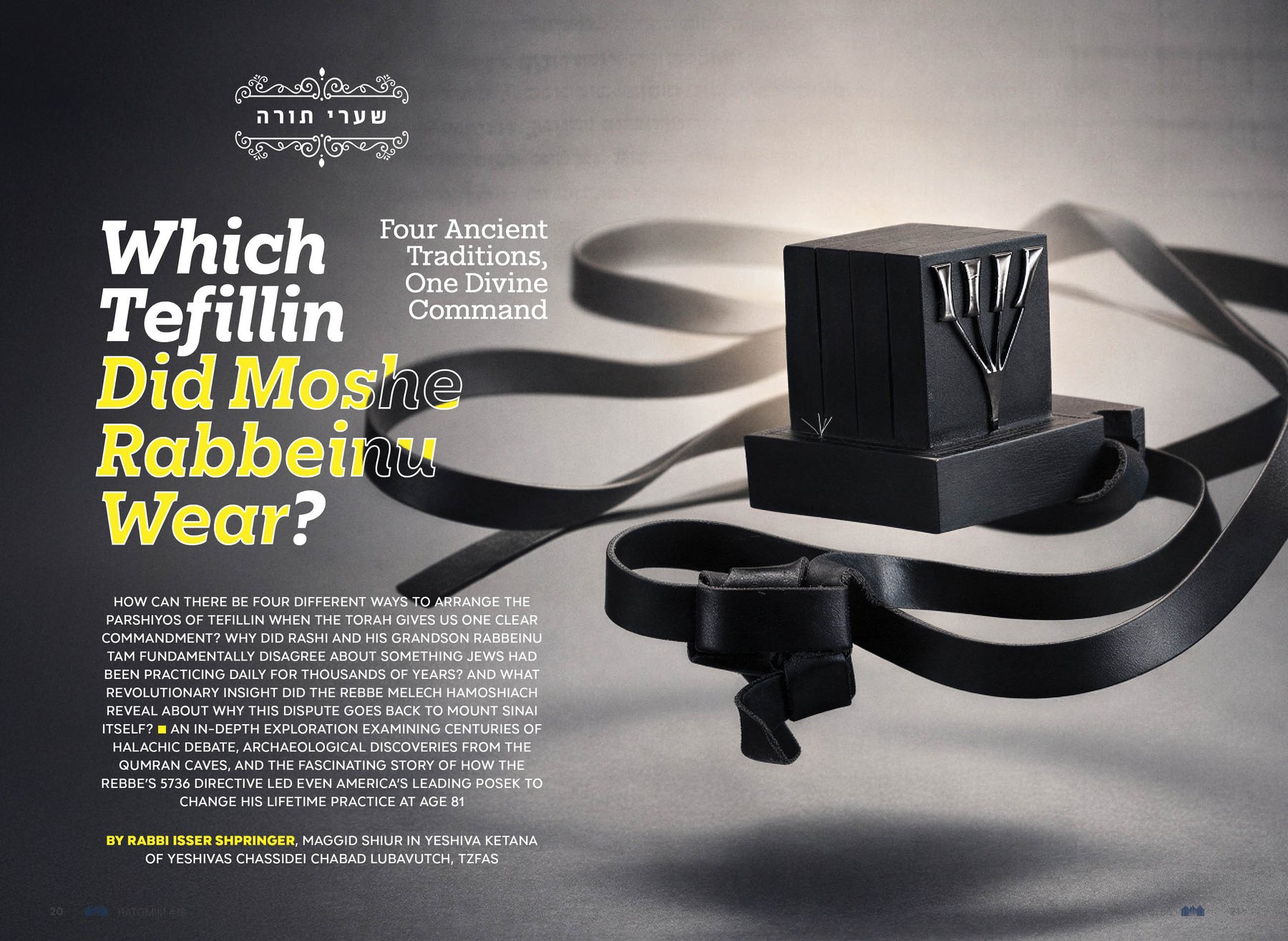
How can there be four different ways to arrange the parshiyos of tefillin when the Torah gives us one clear commandment? Why did Rashi and his grandson Rabbeinu Tam fundamentally disagree about something Jews had been practicing daily for thousands of years? And what revolutionary insight did the Rebbe Melech HaMoshiach reveal about why this dispute goes back to Mount Sinai itself? An in-depth exploration examining centuries of halachic debate, archaeological discoveries from the Qumran caves, and the fascinating story of how the Rebbe’s 5736 directive led even America’s leading posek to change his lifetime practice at age 81.
Introduction: The Four Parshiyos
The Torah commands us to place four parshiyos (passages) in the tefillin: “Kadesh Li” (Shemos 13:1-10), “V’haya Ki Yeviacha” (Shemos 13:11-16), “Shema Yisrael” (Devarim 6:4-9), and “V’haya Im Shamoa” (Devarim 11:13-21). As the Mechilta states: “The mitzva of tefillin consists of four parshiyos.”
While there’s no dispute about which parshiyos to include, a fundamental machlokes (dispute) emerged among the Rishonim (medieval authorities) about their proper arrangement within the tefillin’s compartments. This isn’t merely a theoretical question—since according to some opinions, incorrect arrangement renders the tefillin completely passul (invalid).
Rashi and the Shimusha Rabba: Following the Order in Torah
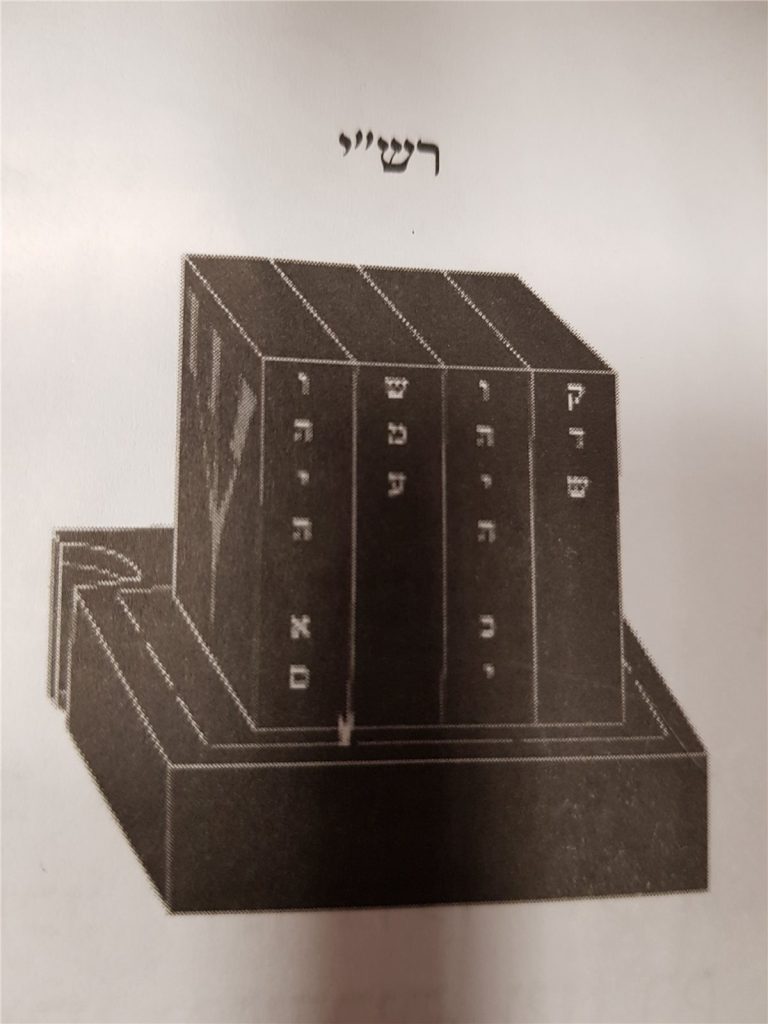
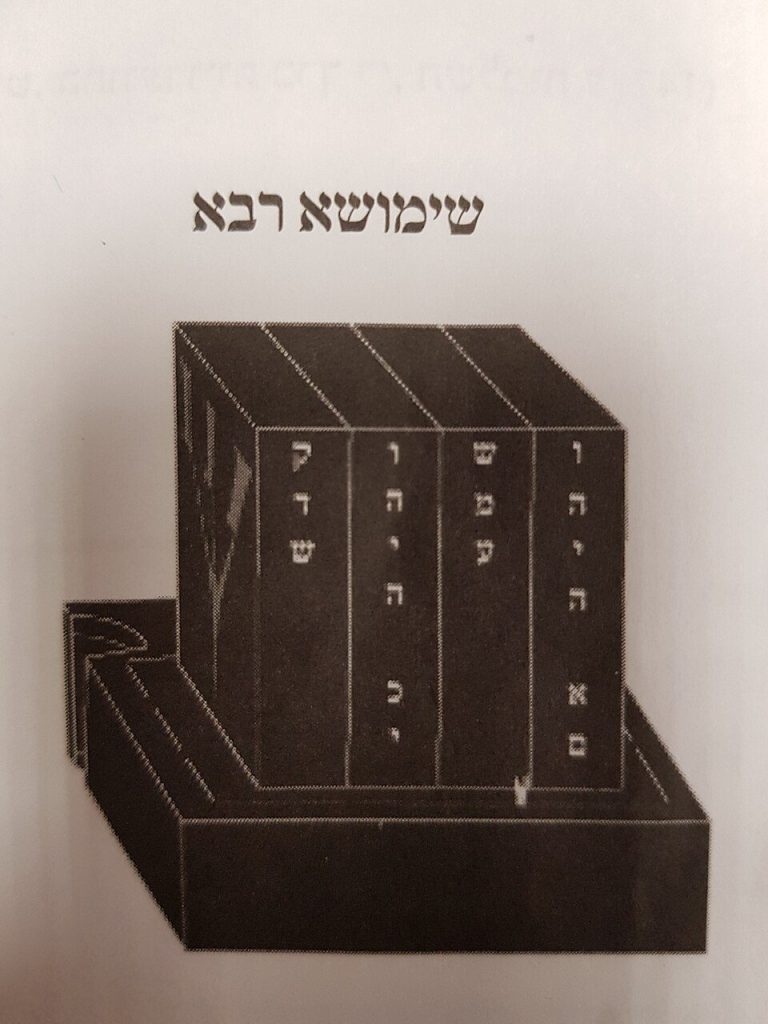
Both Rashi and the Shimusha Rabba maintain that the parshiyos should follow their order as written in the Torah: “Kadesh,” “V’haya Ki Yevi’acha,” “Shema,” “V’haya Im Shamoa.” However, they disagree on a crucial point – from whose perspective we define ‘right’ and ‘left.’
Rashi (Rabbi Shlomo Yitzchaki, 1040-1105) holds that we arrange them from the perspective of the reader facing the wearer. Thus, “Kadesh” sits in the leftmost compartment of the wearer (rightmost for the reader).
The Shimusha Rabba, an ancient text attributed to Rav Sar Shalom Gaon (who headed Yeshivas Sura in Bavel approximately 1,100 years ago), agrees with the sequential order but maintains we begin from the wearer’s right, not the reader’s right.
This distinction only matters for tefillin shel rosh (head tefillin) with separate compartments. For tefillin shel yad (arm tefillin), where all parshiyos are written on one parchment, both agree on the arrangement.1
Rabbeinu Tam and the Raavad: Havayos in the Middle
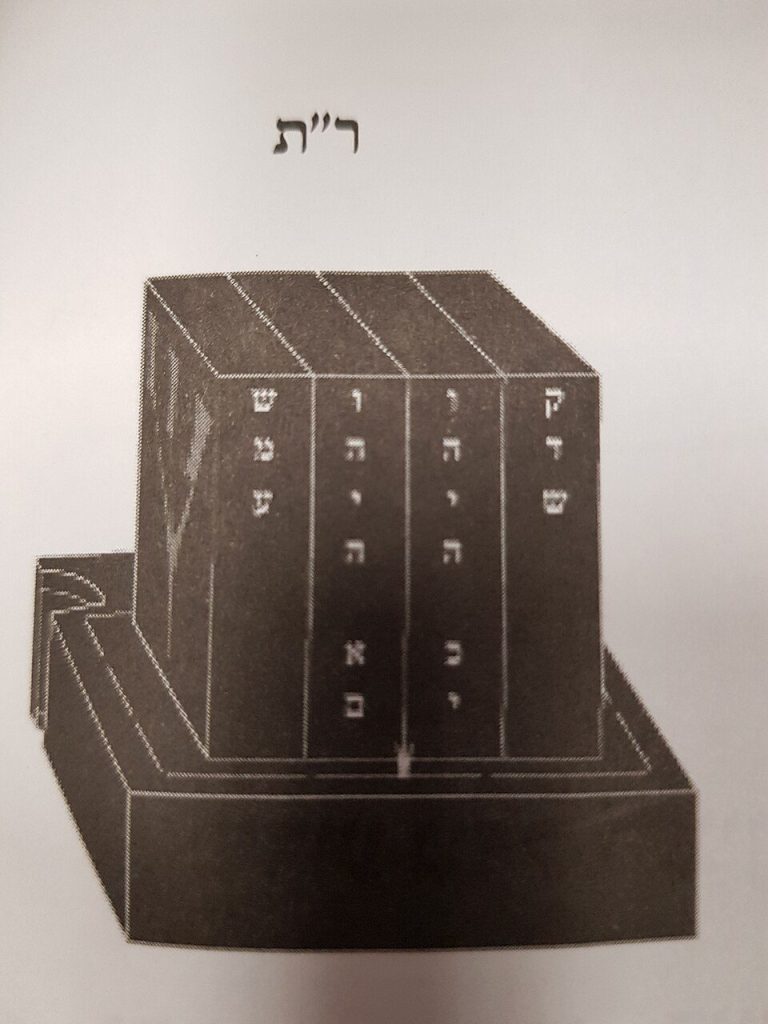
Rabbeinu Tam (Rabbi Yaakov ben Meir, 1100-1171, Rashi’s grandson) revolutionized the understanding of the sugya. He argued that the two parshiyos beginning with “V’haya” belong in the middle compartments. His order from the reader’s right: “Kadesh,” “V’haya Ki Yeviacha,” “V’haya Im Shamoa,” “Shema.”
Two mnemonic devices emerged for this arrangement:
“Havayos b’emtza” (the V’haya passages are in the middle)
The passages beginning with shin (“Kadesh” and “Shema”) align with the shin letters on the tefillin’s exterior2
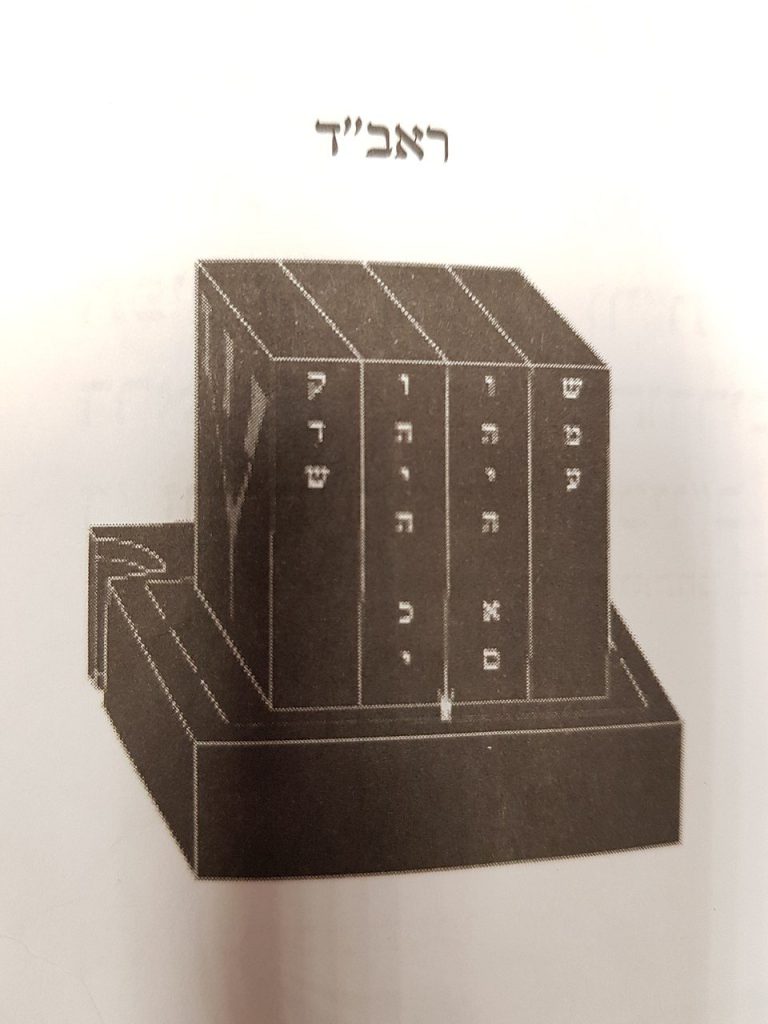
The Raavad (Rabbi Avrohom ben Dovid of Posquières in France, 1125-1198) agrees with placing ‘havayos’ in the middle but, like the Shimusha Rabba, takes the wearer’s perspective rather than the reader’s.
The Gemara in Menachos (34b) brings two contradictory Beraisos about the arrangement. The first states: “Kadesh Li and V’haya Ki Yeviacha on the right, Shema and V’haya Im Shamoa on the left.” The second reverses this.
Abaye resolves the contradiction: “There’s no difficulty – one refers to the reader’s right, one to the wearer’s right.” The Gemara concludes with the critical phrase: “V’hakorei korei k’sidran” (and the reader reads them in order).
This final statement becomes the crux of interpretation. Rashi understands it to mean the passages follow their sequence in the Torah. Rabbeinu Tam interprets it as referring to the order of how they are arranged in the tefillin, not how they appear in the Torah.
What brings Rabbeinu Tam to suggest this reading of the Gemara?
Rabbeinu Tam’s Question from the Menorah
Rabbeinu Tam raises a compelling question against Rashi’s interpretation from a seemingly unrelated sugya about the Menorah in the Beis HaMikdash.3
The Gemara there discusses whether the Menorah was positioned north-to-south or east-to-west. The proof for the east-to-west position comes from the passuk about the ner hamaaravi, “the western lamp” which burned for 24 hours: “Aaron shall arrange it from evening to morning before Hashem.” Chazal understand that specifically this one lamp – the western lamp – must be “before Hashem” (facing the Kodesh HaKodashim to the west), while the other lamps are not. Now if the Menorah were positioned north-to-south, all seven lamps would be equally “western.” Therefore, it must run east-to-west, making one lamp distinctly more western than the others.
Rabbeinu Tam points out an apparent inconsistency: Regarding the Menorah, only one lamp is designated “western” – not half the lamps. Yet in our sugya about tefillin, the Beraisa divides them evenly: two parshiyos on the right, two on the left. If we applied consistent logic, shouldn’t the Beraisa say Kadesh on the “right” (like one lamp is “western”), and the rest on the left?
This leads Rabbeinu Tam to his revolutionary interpretation: The Beraisa isn’t simply dividing the parshiyos into right and left halves. Rather, it’s describing the order of placement. When it says “Kadesh Li and V’haya Ki Yeviacha on the right,” it means when you begin placing these two from the right, you encounter these two parshiyos in sequence. Similarly, “Shema and V’haya Im Shamoa on the left” means when you begin from the left, you encounter these two, and so it ends up that you have the ‘havayos’ in the middle!
The key insight: The first two parshiyos are placed starting from the right and moving left, while the last two are placed starting from the left and moving right. This creates the arrangement known as “havayos b’emtza” – with the two V’haya passages meeting in the middle.
A strong argument indeed, but the Rishonim who defended Rashi answered that the tefillin and the menorah are very different. Tefillin sit precisely in the middle of the head, naturally dividing into two right and two left compartments. The Menorah, however, wasn’t centered in the Beis HaMikdash, making only one lamp truly “western.”4
A major question arises when studying this machlokes: True, there’s room to debate the meaning of the Gemara’s language. But how could Rashi and Rabbeinu Tam argue about how to arrange the parshiyos in tefillin? They could simply check the ancient tefillin of their fathers and grandfathers to see how the parshiyos were arranged and follow that tradition!
The answer is that although this dispute is named after Rashi and Rabbeinu Tam, they didn’t originate this machlokes. Both Rashi and Rabbeinu Tam’s approaches represent ancient traditions in tefillin arrangement. Each of them explained and supported one existing tradition with their interpretation of the Talmudic sources.
We see this in how the Alter Rebbe discusses this:5 “Concerning the order of these passages, there is an ancient difference of opinion among the Geonim of the early generations which was perpetuated by Rashi and Rabbeinu Tam…”
This reveals something profound about the nature of this dispute: it’s not a case of later authorities innovating new practices, but rather of great scholars providing Talmudic support for traditions that existed in different communities. Rashi and Rabbeinu Tam “lent” their names and authority to practices that predated them, which explains why checking ancestral tefillin wouldn’t have resolved the question – different communities had different ancestral traditions.
As we’ll see in the next section, the Rambam’s correspondence with the scholars of Lunel confirms this geographic distribution of practices, with entire regions following one tradition or the other, completely unaware that an alternative existed.
The Rambam’s Revealing Letter
When the scholars of Lunel (a city in the Provence area of France) obtained copies of the Mishne Torah they were shocked to discover that the Rambam ruled like Rashi – but they had never even heard of such an arrangement! They wrote their question to the Rambam who responded back in a letter.
The Rambam’s response provides fascinating historical insight:
“What arose in your minds about the order of the parshiyos… this was my original understanding too. The tefillin I had in the West [Spain] were made this way. There was someone who wrote a book about tefillin – Rabbi Moshe from Cordova – and this book misled me and misled all the people of the West before me…”
But then comes the revelation:
“However, many Geonim disputed this. All the people of the East and all the people of Eretz Yisrael from ancient times disagree. The trusted sages opened the tefillin of Rabbeinu Hai Gaon and found them written in the order I wrote in my work.”
The Rambam continues with a dramatic account: “Rabbi Moshe Deri [a Chacham from Morocco, whom the Rambam attributed to prophetic powers in Iggeres Teiman], when he came from the West to Eretz Yisrael, had tefillin like your community’s. When they showed him the words of the ancient Geonim and their proofs, he threw away his tefillin and made new ones according to the [proper] order!”
The Mystery of Rabbeinu Hai Gaon
This correspondence reveals a clear geographic pattern:
Spain and Provence: Exclusively followed Rabbeinu Tam;
Egypt and Eretz Yisrael: Exclusively followed Rashi;
Babylon: Evidence suggests primarily Rabbeinu Tam (though this is disputed);
Both sides claimed Rabbeinu Hai Gaon supported their position. Rabbi Menachem Azaria of Fano (the “Ram’e MiFano”), an Italian posek and mekubal who wrote extensively on this topic, suggests two possibilities: either Rabbeinu Hai Gaon wore multiple types of tefillin (being uncertain himself), or he changed his practice over his lifetime, and different groups examined tefillin from different periods.
The Smag and Mordechai report a remarkable discovery: when the bimah over Yechezkel HaNavi’s tomb in Bavel collapsed, ancient tefillin were found following Rashi’s order. This provided tangible evidence for the antiquity of Rashi’s arrangement.6
However, the Derisha questioned this proof: perhaps these tefillin were buried precisely because they were invalid? The Bach counters that if only the order was wrong, they could simply be rearranged – burial suggests the parchments themselves were damaged from use.
The Rishonim also cite a Yerushalmi (no longer extant) on Seder Kodshim that supports Rabbeinu Tam’s arrangement, creating an interesting paradox since Eretz Yisrael followed Rashi’s practice.7
The Qumran Tefillin and Their Significance
In recent times, ancient tefillin following Rabbeinu Tam’s arrangement have also been discovered, confirming both traditions have ancient roots.
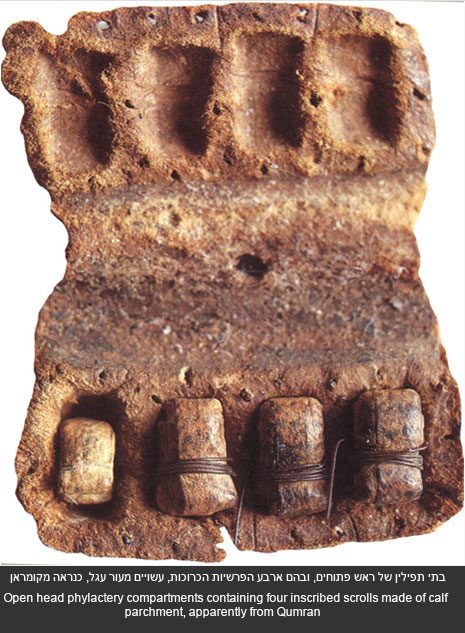
In 5728 (1968), Prof. Yigal Yadin – archaeologist, former IDF Chief of Staff, and leader of the expedition that discovered the Bar Kochba lettersacquired ancient tefillin from an antiquities dealer that originated from the Qumran caves near the Dead Sea. This marked the first time parshiyos were found inside the actual tefillin batim, wrapped in goat hair.
The tefillin revealed fascinating details: The compartments were formed by indentations, with three grooves perpendicular to the stitching creating the shape of a ‘shin’ – fulfilling the halachic requirement that “the ‘shin’ of tefillin is a halacha l’Moshe miSinai.” The parchments were written on fine parchment with black ink in extremely small letters.
Most significantly, the order of the parshiyos essentially followed what we call “Rabbeinu Tam’s method”: Kadesh, V’haya Ki Yeviacha, V’haya Im Shamoa, Shema.
The discovery caused a lot of excitement in the Torah world, but, of course, archaeological findings cannot establish halacha, especially since these tefillin had many deviances from halacha, such as their shape and even more intriguing: these tefillin included the Aseres HaDibros!
The Rebbe’s Analysis: Why Archaeological Finds Don’t Resolve the Dispute
In a sicha, the Rebbe discussed this:8
“What was recently discovered in caves near Jordan – tefillin from very early generations made according to Rabbeinu Tam’s method – poses no difficulty for Rashi’s position. For even in those earlier generations there were two methods (of Rashi and Rabbeinu Tam) regarding the tefillin parshiyos.”
The Rebbe then adds a crucial caveat: “In general – one cannot prove anything from tefillin discovered in the aforementioned caves, because we cannot know the reason for burying the tefillin in that location: whether the reason was because these tefillin were not kosher, and therefore they were buried in geniza, or whether these tefillin were kosher but were hidden out of fear of the Romans, etc.”
He continues with a parallel example: “Similarly, regarding what was found in those caves – partial scrolls from Tanach, where there are several differences between these scrolls and our Mesorah regarding missing and extra letters, etc. – one cannot prove anything from this at all. On the contrary: it’s possible these scrolls were buried precisely because they were not written properly, like any holy object that becomes invalid – one doesn’t burn it but rather buries it in geniza.”
The inclusion of the Aseres HaDibros in the Qumran tefillin provides clear evidence that these followed practices later rejected by mainstream halacha. The Sifrei explicitly states that the Aseres HaDibros “are not for binding [in tefillin]” (einan b’kshira) and therefore also “are not for daily recitation” (einan b’shinun).9
This Tannaic source demonstrates that already in the Mishnaic period, Chazal explicitly ruled against including the Aseres HaDibros in tefillin. The Yerushalmi confirms this was to prevent heretics from claiming only the Aseres HaDibros were divinely given.
This crucial distinction separates the Qumran finds from other archaeological discoveries. While ancient tefillin following Rabbeinu Tam’s arrangement represent a legitimate alternative tradition, the Qumran tefillin with their Aseres Hadibros represent a practice definitively rejected by Chazal. These weren’t buried because of damage or persecution, but likely because they followed an invalidated halachic approach – making them clear candidates for geniza, not proof of ancient practice.
The Derisha-Bach Debate and the Qumran Distinction
The Rebbe’s analysis echoes but transcends an earlier debate between the Derisha and the Bach about ancient tefillin found near Yechezkel’s tomb that followed Rashi’s order. The Derisha argued these couldn’t serve as proof – perhaps they were buried specifically because they were invalid. The Bach countered that if only the order was wrong, the parshiyos could simply be rearranged; burial suggests the parchments themselves were damaged from use.
However, the Qumran tefillin present a fundamentally different case that actually validates the Rebbe’s broader point. Unlike the theoretical invalidity the Derisha suggested, the Qumran tefillin contain concrete deviations from accepted halacha.
Here, the Bach’s logic doesn’t apply – these weren’t tefillin that could be “fixed” by rearranging parshiyos. They represent practices that were definitively discontinued.
However, the find can help us understand why this machlokes existed and why it was never resolved. It clearly shows that there was a tradition like Rabbeinu Tam and Rashi for as long as Jews have been wearing tefillin as we shall see in the Rebbe’s original explanation.
Even accepting that Rashi and Rabbeinu Tam didn’t create new practices but rather supported existing traditions, a deeper question remains: At what point, and how, could such a fundamental dispute have begun? After all, tefillin have presumably been worn continuously since the Torah was given through Moshe Rabbeinu. At any moment when doubt arose, couldn’t people simply check the tefillin of previous generations and continue following that established tradition?
The Rebbe shared a fascinating and original explanation for this enduring dispute in the same 5742 sicha: it dates back to Moshe Rabbeinu himself!
“Which tefillin did Moshe Rabbeinu himself wear?” the Rebbe asked. His answer: Moshe received this mitzva in general terms without specific details. After receiving the law, while Moshe could analyze and debate it, Yehoshua and others could legitimately interpret it differently based on the principles of Torah given at Sinai. Thus, both arrangements existed from the very beginning.10
The Rebbe cited the mystical work “She’aylos U’Teshuvos min HaShamayim” where the author asked in a dream which arrangement was correct and received this response: “Both are the words of the living God. As there is dispute below, so there is dispute above. The Holy One, blessed be He, says ‘havayos’ in the middle, while the entire heavenly academy says ‘havayos’ in their order.”11
This explains why checking ancestral tefillin couldn’t resolve the dispute – both traditions are equally authentic and ancient! Furthermore, according to kabbala they all represent various levels of the mitzva and tefillin and both should be worn as will be explained below.
[Some Acharonim suggest another possibility: Perhaps Moshe Rabbeinu taught the general Jewish people according to one method, while to the “remnant whom Hashem calls” – a select group – he taught an additional method and instructed them to wear two pairs. Over time, a dispute arose about which tefillin fulfilled the basic obligation and which represented a hiddur (enhancement). Checking old tefillin couldn’t resolve this, since both types were found, but no one knew which was the primary requirement and which was the enhancement.
However, it appears that the Rebbe’s explanation – that the matter was given to Moshe in general terms and the dispute began in his very generation – stands unique in Jewish literature. The Rebbe’s explanation is more logical because we can assume that the primary tradition would be preserved unlike as these Acharonim suggest.]
The Tzemach Tzedek and his sons wore all four “pairs” of tefillin. The “Tefilla L’Moshe” (by Reb Moshe Meshel Gelbstein, a Chabad rav in Yerushalyim in the previous century famous for his Mishkanos L’Abir Yaakov about guarding the place of the Beis HaMikdash these days) records testimony from Reb Nissim the sofer, who was close to Reb Hillel of Paritch: he witnessed Reb Hillel wearing Shimusha Rabba tefillin for Mincha, “and presumably he acted according to his Rebbe, the Tzemach Tzedek.”
The Rebbe Maharash would cover his head with his tallis for several minutes after davening while secretly donning Shimusha Rabba tefillin. Once, a young man peeked under the tallis and witnessed this practice and got a tap on his nose…
Even during his final illness, the Rebbe Rashab wore “Shimusha Rabba of Rabbeinu Tam” – which is actually Raavad tefillin. In Chabad tradition, these are grouped together because both Shimusha Rabba and Raavad share the fundamental innovation of taking the wearer’s perspective.
The Rebbe explained to Rabbi Moshe DovBer Rivkin (who recorded the Rashab’s hanhagos in the final days of his life in this world in his book “Ashkavta D’Rebbi” along with his commentary and many notes from the Rebbe) that this terminology comes from the verse in Tehillim (37:37): “שְׁמָר תָּם וּרְאֵה יָשָׁר כִּי אַחֲרִית לְאִישׁ שָׁלוֹם – Guard the perfect one and see the upright, for the end of that man is peace”:
“Tam” = Rabbeinu Tam
“Yashar” = Rashi

“Shalom” = Rav Sar Shalom (author of Shimusha Rabba)
Since both Shimusha Rabba and Raavad are represented by the same figure, they share this designation.
The Rebbe Rayatz wore them, even in soviet prison with great mesiras nefesh as recorded in the Rebbe’s prison diary. He also instructed the Rebbe Melech HaMoshiach to begin wearing them although the Rebbe was apprehensive at first because of their great holiness.
The Shulchan Aruch rules that the primary obligation follows Rashi, but “God-fearing individuals should fulfill both opinions.” However, the Mechaber adds a crucial caveat: “Only one who is renowned for piety should do so,” to avoid appearances of religious arrogance.13
Some wear them both together, but the Alter Rebbe writes in his Siddur: “It is customary to wear Rabbeinu Tam tefillin after prayer without a bracha.”
For generations, Chabad Chassidim would request permission from the Rebbe to begin wearing Rabbeinu Tam tefillin, often receiving specific conditions related to their spiritual practice. Here are just a few examples from the Rebbe’s correspondence:
“Regarding your question about wearing Rabbeinu Tam tefillin – surely you are careful about tevilas Ezra and also study pnimiyus HaTorah, without making a vow, and therefore you should begin wearing them…”14
“Regarding your question about Rabbeinu Tam tefillin: Certainly you should try as much as possible that your prayer be in purity… and therefore it is proper to wear them.”15
“When to begin wearing them – at what age – depends on feeling.”16
These responses show that wearing Rabbeinu Tam tefillin wasn’t automatic even for Chassidim. The Rebbe would evaluate each individual’s spiritual readiness, often linking permission to practices like ritual immersion, studying Chassidus, or maintaining proper kavana during prayer. This personalized approach continued until the watershed announcement of Purim 5736.
The Purim 5736 Revolution
On Purim 5736 (1976), the Rebbe made a groundbreaking announcement: given the spiritual darkness of our times, everyone should wear both Rashi and Rabbeinu Tam tefillin, beginning from two months before Bar Mitzva.
The Rebbe provided two primary justifications:
Many authoritative works starting with the Tikkunei Zohar and especially the Arizal’s writings, emphasize the importance of both types – removing concerns about appearing arrogant. [Interestingly, the Aruch Hashulchan, a non-Chassidic posek, writes that “regarding what the Beis Yosef wrote – that only one who is established and renowned for piety should do this – nowadays the practice of wearing Rabbeinu Tam tefillin has spread in many countries, and there is no concern of arrogance. Anyone may do so, and blessing will come upon them.”]17
The spiritual challenges of our era, including the proliferation of secular knowledge, require additional measures for proper subjugation of mind and heart to divine service
This directive had impact beyond Chabad. When Rabbi Moshe Feinstein, one of American Jewry’s foremost halachic authorities, learned of the Rebbe’s teaching, he too began wearing Rabbeinu Tam tefillin at age 81 years after he stopped for various reasons, writing a teshuva about his decision.18
Looking Toward Moshiach
The Rebbe taught that in the era of Moshiach, all Jews will wear all four types of tefillin. This represents both complete fulfillment of the mitzva according to all opinions and perfect achievement of tefillin’s spiritual purpose – total subjugation of mind and heart to divine service.
As the Rebbe explained in a sicha, this practice will then achieve two perfections:19
The physical mitzva will be fulfilled according to every legitimate interpretation;
The spiritual dimension of binding our minds and hearts to Hashem will reach its ultimate expression.
Currently, wearing all four types remains limited to individuals of exceptional spiritual stature, but the coming redemption will make this practice universal.
Conclusion
The tefillin controversy spans from Moshe Rabbeinu to Moshiach, encompassing the full sweep of Jewish history. Rather than viewing this dispute as problematic, we can see it as reflecting the Torah’s infinite depth – ”seventy faces to the Torah” – and the legitimacy of different approaches within authentic tradition.
The contemporary practice of wearing multiple types of tefillin connects us to all streams of our mesorah, from the ancient traditions preserved in different Jewish communities to the revelations of the Arizal and the directives of our Rebbeim. As we await the complete Geula, this practice serves as both a bridge to our past and a preparation for the future perfection of this fundamental mitzva.
Based on the comprehensive analysis in the Hebrew Hatamim supplement of Beis Moshaich, Issue 45, 3 Tammuz 5777,
Footnotes
1. The Alter Rebbe writes in Siman 32:70 that “l’chatchila one should be careful that the head of the parsha be placed on the right side of the reader who stands facing the one wearing them, so that if he comes to open them and read them they will be placed before him according to their law, for we find that the order of their placement in the battim are arranged according to the right of the reader who will read in order…”
2. Rosh, Hilchos Tefillin Siman 5. The mnemonic devices are also brought in the Alter Rebbe Siman 34 Seif 3. It’s interesting to note that the daf in Maseches Menachos dealing with this topic, and the siman in Tur/Shulchan Aruch on this topic, have the same number: “34.”
3. Menachos 98b
4. The Rosh there, and others. See also Bach Siman 34, and Yaavetz on the Gemara there for additional answers.
5. Shulchan Aruch OC 34:3

6. Brought in Beis Yosef Siman 34
7. See “Seder Parshiyos” p. 12 and onward
8. Hisvaaduyos 5742 Vol. 4 p. 1930
9. Sifrei; see also Yerushalmi Berachos 3:3
10. Hisvaduyos 5742 Vol. 4 p. 1930; See also Likkutei Sichos Vol. 21 p. 187
11. She’aylos min HaShamayim, Siman 3
12. Pri Etz Chaim Shaar HaTefillin Perek 10. Also in the famous sefer “Megaleh Amukos” published in 5357, in Ofan 172
13. Shulchan Aruch OC 34:3; see the Alter Rebbe there
14. Igros Kodesh vol. 15, p. 383
15. Ibid. vol. 16, p. 18
16. Ibid. vol. 18, p. 265
17. Aruch Hashulchan Siman 34:5
18. Igros Moshe Chelek 6 Orach Chaim Siman 9. See also “Shemen Sasson MeChaveirecha” Vol. 4 in his entry, and more details about this story in following article
19. Sichos Kodesh Parshas Terumah 5752
20. Likkutei Sichos Vol. 2, p. 507
21. See Ram’e MiFano d’h “v’achti,” and “Chasan Sofer” Shaar HaTotafos Chapter 30 at the end of the chapter
The Ram’e MiFano
Rabbeinu Menachem Azaria of Fano was born in 5308 (1548) in Italy.
Since he inherited great wealth from his forefathers, he combined Torah with greatness. With this money he performed many acts of charity, including supporting impoverished Torah scholars and printing books. Among the most famous books he was involved in printing were “Pardes Rimonim” by the Ramak, and “Kesef Mishneh” on the Rambam by Rabbi Yosef Caro. Both were sent to him by the authors themselves when he was young.
He was great both in revealed Torah and in Kabbala. In Kabbala, he initially studied the teachings of the Ramak, and later Rabbi Yisroel Sarug, who was among the students of the Arizal, came to Italy, and from him Ram’e learned his teachings, and became accomplished in this path of Kabbala as well.
He was among the great disseminators of Kabbalistic teachings in Italy, both through Torah classes he delivered orally, and through his many books, such as “Asara Maamaros,” “Yonas Elem,” “Mayan Ganim” and many others. In addition to his books on Kabbala, he also wrote on revealed Torah, and the famous sefer in this field is his responsa, which has been published in many editions.
Regarding the Torah teachings he wrote in the pamphlet “Yemin Hashem Romema,” there was someone who sharply attacked him. When asked about his response to these words, he replied: “I am the one signed by the rabbis as M”A (initials of his name – Rabbi Menachem Azaria). This is my name, forgiving sin, and this is my remembrance, pardoning insult. And this is a decisive answer to everything written and everything that will be written against ‘Yemin Romema’ of mine. For I did not speak from the outset for my honor, and in a place of mockery it is time to be silent. For the truth will show its way to those who fear Hashem and think of His name. I am for peace, and when I speak to do the will of our Father in Heaven, ‘Let every soul praise the Lord, Hallelujah.’”
He passed away in 5380 (1620).
Who Was Rav Sar Shalom Gaon?
Rav Sar Shalom served as Rosh Yeshivas Sura during the Geonic period, approximately 1,100 years ago. Yeshivas Sura was the central yeshiva throughout most of the Geonic era, and “Gaon” was the official title for the head of the yeshiva (in both Sura and Pumbedisa). Some suggest the title is an abbreviation of the full designation “Rosh Yeshivas Gaon Yaakov.”
His name “Sar Shalom” (Minister of Peace) may have been given as an expression of yearning for the future redemption – a particularly fitting name given his connection to the verse “ki acharis l’ish shalom” (for the end of that man is peace) that the Rebbe used to explain why both Shimusha Rabba and Raavad tefillin share this designation.
While little is known about his personal life and family, many of his halachic rulings have been preserved by subsequent authorities. Both Geonim and Rishonim quote his decisions with great reverence and respect. In our generation, a comprehensive collection of his teachings was compiled from throughout Jewish literature, published as “Teshuvos Rav Sar Shalom” (Yerushalayim, 5736/1976).
That the Shimusha Rabba – containing such fundamental innovations in tefillin practice – remained attributed to this somewhat mysterious figure for centuries, with his identity only clarified in the Arizal’s time, adds another layer to the enigmatic nature of these ancient traditions.
How Precise is The Center of the Head?
Interestingly, an important practical difference between Rashi tefillin and Rabbeinu Tam tefillin emerges from their main dispute. This applies to how precisely the tefillin must be centered on the head.
The Alter Rebbe in his Piskei HaSiddur on Hilcos Tefillin emphasizes: “One must be careful that it [the tefillin shel rosh] be exactly in the middle of the width of the head, for they said ‘Kadesh and V’haya Ki Yeviacha on the right, and Shema and V’haya Im Shamoa on the left.’ With Rashi tefillin where the parshiyos are in order, the difference between right and left is minimal – merely the groove between V’haya Ki Yeviacha and Shema. Therefore, one must be extremely careful about this.”
This highlights a significant practical distinction: With Rashi tefillin, since the parshiyos follow biblical order, the dividing line between “right” and “left” falls precisely between the two middle compartments. Even a slight misalignment could theoretically place the wrong parshiyos on the wrong side. With Rabbeinu Tam tefillin, where the V’haya passages are in the middle, there’s somewhat more margin for error in centering.
Why Not Shimusha Rabba and Raavad Tefillin?
Unlike Rabbeinu Tam’s tefillin, the poskim don’t mention a requirement to wear Shimusha Rabba or Raavad tefillin (even to avoid the safek) for several reasons:
First, these represent an exceptionally high spiritual level not applicable to everyone. As the Rebbe explains, these tefillin are reserved for yechidei segula – individuals of exceptional spiritual stature.20 The requirement for maintaining a guf naki b’yoser (bodily purity) while wearing these additional tefillin is particularly demanding.
Indeed, some individual Chassidim received permission from the Rebbe to wear all four types, including my grandfather, the Chassid Rav Baruch Pariz. When Chassidim would ask about wearing these additional types, the Rebbe would evaluate each case individually – but significantly, he never made it a public directive or mivtza (campaign) as he did with Rabbeinu Tam tefillin on Purim 5736.
The reason for this distinction may be explained based on the following halachic analysis: According to the Shimusha Rabba, one fulfills the obligation b’dieved (after the fact) with Rashi tefillin, and according to the Raavad, one fulfills it b’dieved with Rabbeinu Tam tefillin. The critical requirement is that the outer parshiyos must be the correct ones. Even if there’s a reversal between right and left placement, one still fulfills the basic obligation.21
This crucial halachic difference explains the Rebbe’s approach. While Rashi and Rabbeinu Tam fundamentally disagree about what constitutes valid tefillin – each holding the other’s arrangement doesn’t fulfill the mitzva at all – Shimusha Rabba and Raavad represent refinements within these positions. There’s no clear halachic imperative requiring everyone to wear them, unlike the genuine safek (doubt) between Rashi and Rabbeinu Tam that the Shulchan Aruch addresses.
Therefore, while the Rebbe encouraged all Jews to fulfill both primary opinions through wearing Rashi and Rabbeinu Tam tefillin, he reserved Shimusha Rabba and Raavad for those individuals with exceptional spiritual preparation. While all four represent authentic traditions from Moshe Rabbeinu, the practical requirement for the general public extends only to resolving the fundamental dispute about validity between the two primary methods.
The Shimusha Rabba: From Obscurity to Recognition
The Shimusha Rabba’s journey from the Geonic period to acceptance is particularly intriguing. Despite being written centuries before Rashi, it wasn’t recognized as a distinct method until the time of the Acharonim.
Throughout the entire period of the Rishonim, the name of the “Gaon” who authored the Shimusha Rabba remains unmentioned. The first source identifying him, as far as I can determine, appears at the beginning of the Acharonim period in the writings of the Arizal, where the text is attributed to Rav Sar Shalom Gaon.12 Since then, this attribution has become accepted.
The text includes several innovations beyond the order of parshiyos:
Tefillin should measure “two fingers by two fingers” (4 cm x 4 cm according to some calculations);
The right ‘shin’ should have three heads, the left four;
Specific letters require crowns (taggin);
Throughout the period of the Rishonim, the Shimusha Rabba was either grouped with Rashi (by those focusing on the order in the Torah) or with Rabbeinu Tam (by those who misread the text). Rav Yehuda Barceloni even suggested the text contained scribal errors and should read like Rabbeinu Tam!
The Rosh notes that while the Shimusha Rabba’s ruling about the ‘shin’ letters became universally accepted, “the world did not adopt” its measurement for tefillin size. Only with the Arizal do we find renewed emphasis on this measurement.
The Ram’e MiFano definitively established it as a separate shita. He writes powerfully: “This Shimusha Rabba was said in the name of the Geonim whose words are words of tradition. About them it is written ‘wisdom is good with an inheritance,’ for they inherited from the Savoraim, and many kuntreisim [pamphlets with early versions of the Shas] reached them from the first edition of Rav Ashi containing clarifications not explicit in our Gemara.”
Resolving the Textual Challenge: “V’hakorei Korei K’sidran”
The Gemara concludes its discussion about tefillin arrangement with the phrase “V’hakorei korei k’sidran” (and the reader reads them in order), which poses different challenges for each shita besides Rashi’s.
How Rabbeinu Tam deals with it was discussed inside.
The Raavad explains this refers only to the last two parshiyos, “Shema” and “V’haya Im Shamoa.” Even though we begin from the wearer’s right, since his method places “havayos in the middle,” the final two parshiyos change the sequential order – and about these the Gemara says the reader can read them “in order.”
For the Shimusha Rabba, this phrase seems problematic. According to his method, only the wearer reads them “in order,” not the reader facing him.
The Ram’e MiFano offers a bold solution: This phrase wasn’t in the original Gemara text. Rather, “one of the great authorities who held like Rashi and the Rambam added it as a marginal note, and it was copied into the text, as happened in many known places.” This would make the Raavad’s position smoother as well, without forcing a partial interpretation.
Furthermore, the Ram’e MiFano argues that the Gemara’s opening question “Keitzad sodran?” (How are they arranged?) clearly addresses the wearer who arranges the tefillin, not the observer. He calls this “an obvious, true, and compelling point.”
However, our current texts (including early printings) read “keitzad sidran” not “sodran,” and Rashi’s camp apparently understood this with a chirik vowel under the samech, avoiding this difficulty.
HaTomim #18 • pp. 20-37
© 2026 Beis Moshiach Magazine. All rights reserved.
This article originally appeared in Beis Moshiach #1491B. You are welcome to share it with friends and family by email or in print, provided that you do not change, add to or omit any part of it, you credit the author and Beis Moshiach, and you include a link to archive.bmoshiach.org (written out in full in printed copies).
To republish this article in a newspaper, magazine, book or website, please request permission in advance at [email protected].