Weaving Tomorrow’s Reality
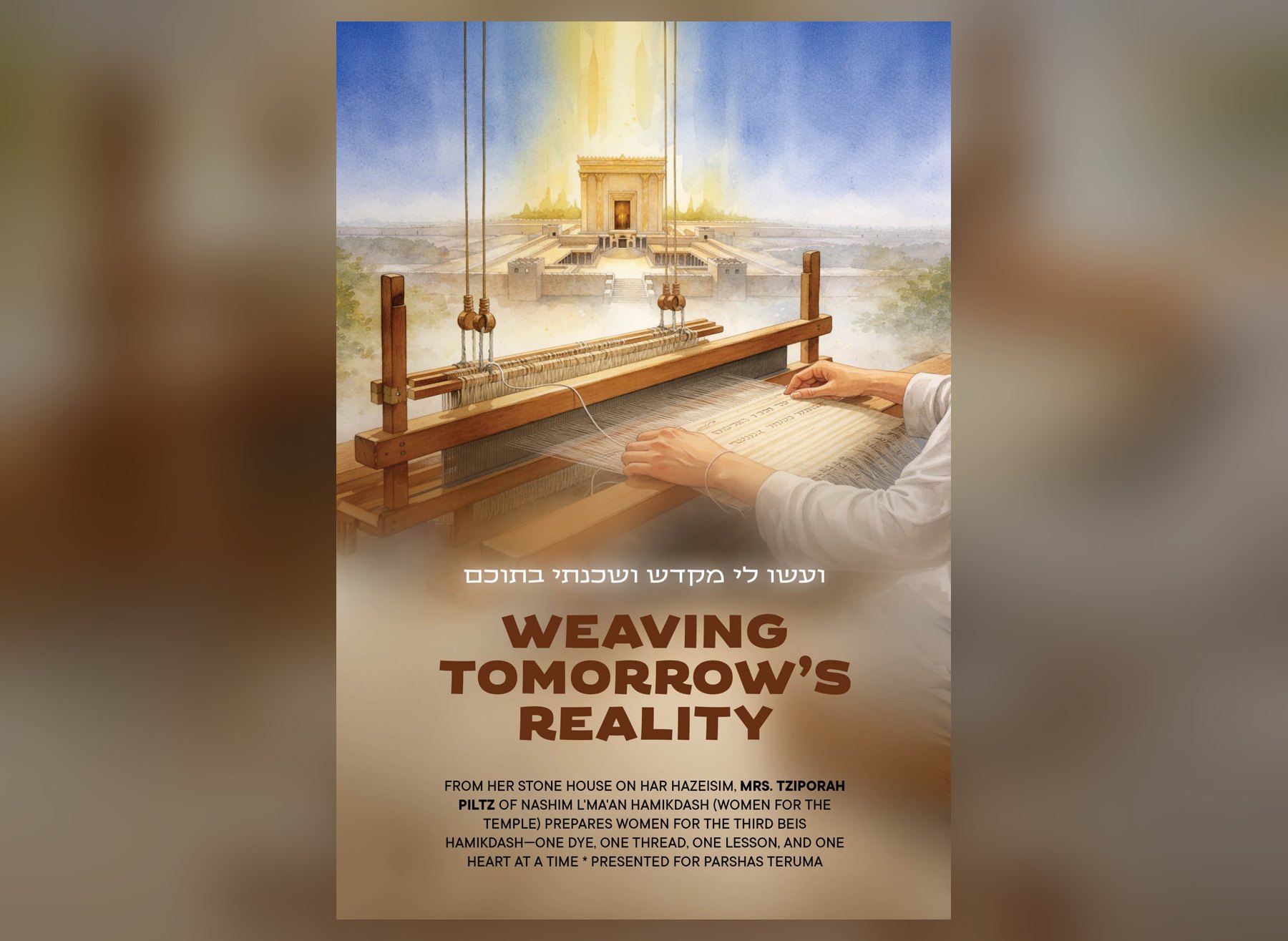
From her stone house on Har HaZeisim, Mrs. Tziporah Piltz of Nashim L’Ma’an HaMikdash (Women for the Temple) prepares women for the third Beis HaMikdash – one dye, one thread, one lesson, and one heart at a time. Presented for Parshas Teruma.
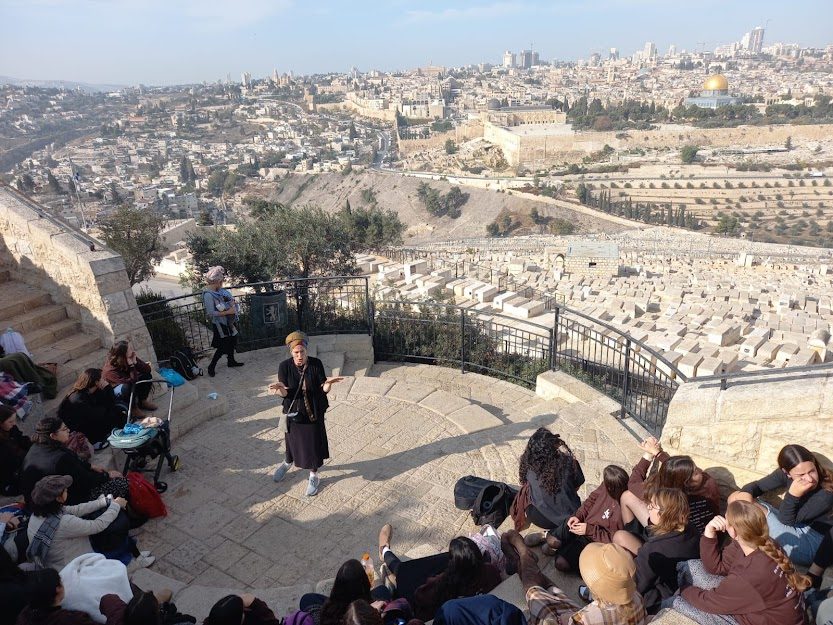
For over twenty years now, she’s been living on Har HaZeisim (Mount Olives), in a neighborhood of the Holy City of Yerushalayim sadly dominated by hostile Arabs. Her century-old stone house sits in an area encircling the Old City.
When the city was under Jordanian control, Arab residents ripped up tombstones from the Jewish cemetery and used them as paving stones for the paths to their homes. Today, she and other Jews represent the most determined Jewish presence among the Arabs in Jerusalem.
From her windows, she has a permanent view of the Temple Mount – though for now, we still haven’t merited to see the Beis HaMikdash standing there in all its glory. Living there still means living with the Beis HaMikdash. The Kosel with her morning coffee. The pain of the Shechina’s exile at sundown. Dreams at night of aliya l’regel.
Har HaBayis spreads out so close before her that she feels she could reach out and touch the beautiful view with her fingers.
She deliberately chooses to host and organize events there – walking distance from the Kosel, in a house overlooking the place of the Kodesh HaKodashim. This feeling of closeness – the physical presence in the very place where it all happened – creates a unique sense of yearning and true anticipation, and not just during the Three Weeks between the 17th of Tammuz and Tisha B’Av.
Her connection isn’t just about location. She’s also active as a member of the “Nashim L’Ma’an HaMikdash” Movement, delivering fascinating lectures on the Beis HaMikdash. Please meet Tziporah Piltz.
Shalom, Tziporah!
Bracha v’shalom. I want to mention something just as wonderful as living here:
What really strengthens our connection to the Beis HaMikdash, brings us closer, and sustains that feeling of longing is continuous learning. We’re a group of women who meet once a week to study everything about the building of the Beis HaMikdash and its sacred worship in depth.
Our group is quite small. Naturally, not many women can invest the time to come weekly and study the Beis HaMikdash in such detail. But for those of us who do – the subject lives deep in our hearts.
When you learn about something continuously and invest real effort in it, you can’t help but feel connected to it and live it.
What do you learn?
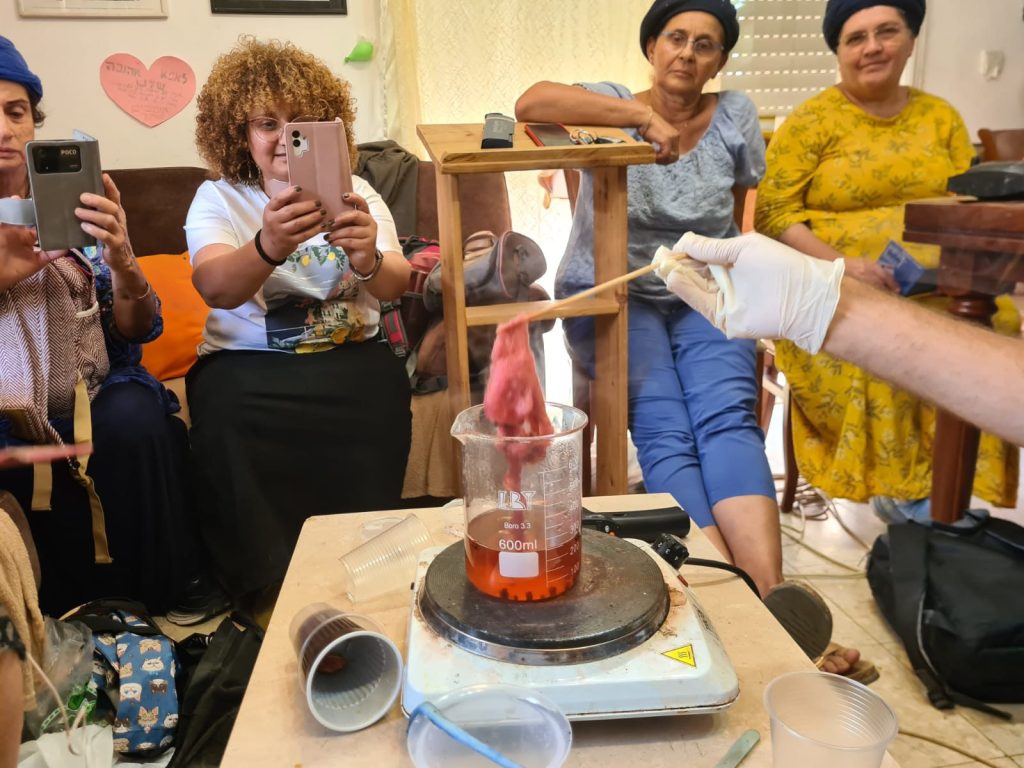
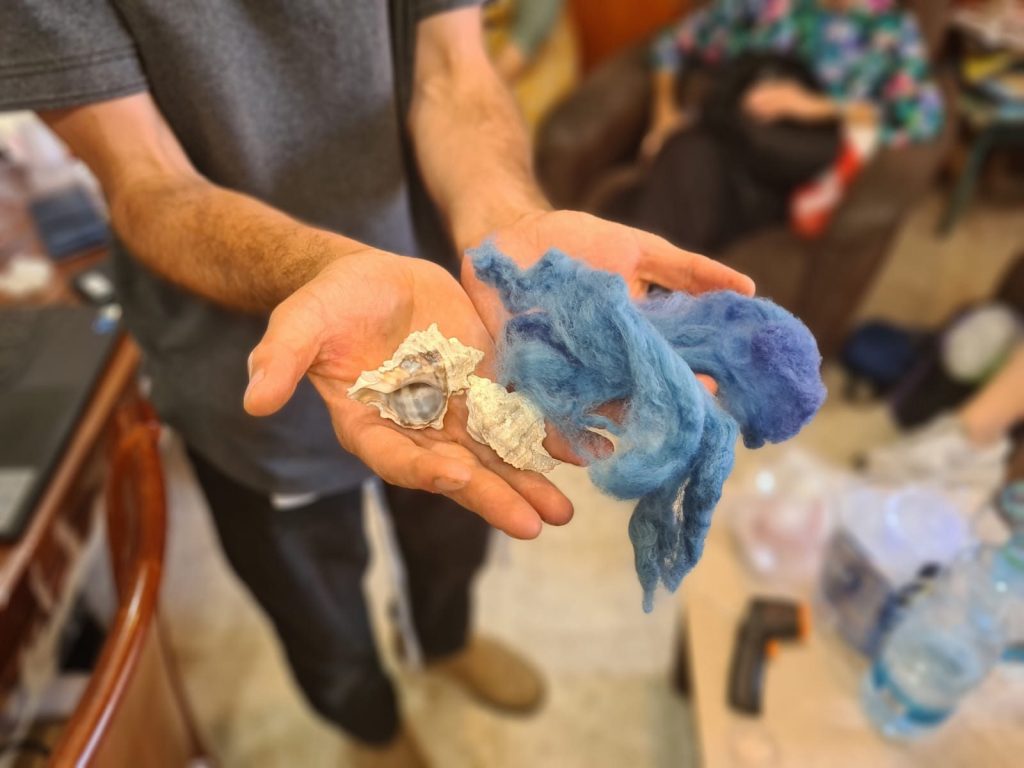
We study Rambam together – halachos like the Laws of Tumah and Tahara or the Laws of Korbanos, the prophecy of Yechezkel, and more. Sometimes we learn on our own, sometimes we bring in expert lecturers on various subjects, and we even go out for field trips. Once, we traced the route of the Sanhedrin’s exile, visiting all the places where the members were exiled from the Beis HaMikdash after its destruction. Another time, we gathered the various components of the ketores, the holy incense, as part of a research project – identifying which herbs today correspond to the ones used back then, where they grew, and how they produce the material that creates the amazing aroma of ketores. We also went out to collect the worm used to create the crimson dye that was used extensively in the kohanim’s garments and the paroches.
We’re dealing with a history that has collected nearly two thousand years of dust during our exile, and soon everything will become relevant and practical again.
There’s nothing more exciting than that.
Tell me about the tola’as shani, the “crimson wool” – did you manage to produce the same color that existed back then?
There’s a professor named Zohar Amar from Bar-Ilan University who studies this subject thoroughly. We went to the location where the worm that makes this dye is found, learned about it and became familiar with it, then moved on to the dyeing process. We put wool into hot water, and when we added the worm, we could watch the wool change color.
We also went out to explore the color of techeles produced by the chilazon snail (though there’s a dispute about whether this is the same techeles that existed back then).
How else does your learning translate into practical terms?
Much of our learning is theoretical – unfortunately, there’s no way to implement everything we learn during this time of galus. Even after we found a para adumah, a red heifer, we learned the entire process it goes through until the actual burning. We studied the various kinds of spiritual impurity in depth, the laws of tahara, its restrictions, and how it’s performed. But we can’t actually become purified right now.
On the other hand, there are specific things we can implement, and that’s very exciting. For example, Machon HaMikdash sells actual kosher bigdei kehuna, priestly garments, that kohanim can buy and keep. So once the Beis HaMikdash is rebuilt very soon, they’ll be able to use the garments in their holy avoda.
Purchasing garments like these – which can’t be used now and is made ready only for avoda in the Beis HaMikdash – expresses a strong connection to the Beis HaMikdash and a deep sense of longing. It also shows Hashem our willingness and readiness to serve in the Third Temple right now!
Since we’re talking about the Third Beis HaMikdash – do you study that as well?
Yes. The prophecy of Yechezkel is quite complex and requires deep study. Rabbi Menachem Makover is a rav who specializes in this subject, and we’ve been privileged to hear and learn from him about the Third Beis HaMikdash. We studied thoroughly the appearance of the Third Beis HaMikdash as prophesied and its unique characteristics.
There’s a dispute about whether people will build the Third Beis HaMikdash when Moshiach comes, or whether it will descend from Heaven already built. The Aruch LaNer compares the Beis HaMikdash to a body and soul – the vessels are the body and the indwelling of the Shechina is like the soul. So while human hands can build the body and the vessels, the spiritual dimension – the indwelling of the Shechina – will certainly come from Above. (The Rebbe bring this explanation as well as others, among them that the Beis HaMikdash will descend from Heaven already built and enhanced – Beis Rabbeinu SheB’Bavel – but its gates will be missing and still breached. Our task will be to complete them – ”Her gates are sunk into the ground” – thereby transforming the Beis HaMikdash into a complete, ready-made structure.)
Another significant aspect is how the Shechina dwells in the different Holy Temples. In the Third Mikdash, there will be an eternal fulfillment of “v’shachanti b’socham – And I will dwell among them.” The indwelling of the Shechina will be at the highest possible level. We know that five things were missing from the Second Mikdash, including the Aron Kodesh, the Urim V’Tumim, and the fire on the altar. When the Third Mikdash is rebuilt, the fire will return in the most lofty manner: “But I will be for it a wall of fire around.”
There’s no doubt that this kind of study strengthens our anticipation for its rebuilding. (The Rebbe notes this as a reason for learning Hilchos Beis HaBechira during the Three Weeks, and throughout the year in general.)
That’s quite moving. What do you actually do in “Nashim L’Ma’an HaMikdash”?
In this movement, we’ve set a goal of raising awareness and longing for the Beis HaMikdash among women. The Holy Temple and the Redemption aren’t some faraway dream anymore, the way they were in years past, and women need to be ready to take action in anticipation of the Beis HaMikdash’s actual construction. We have a wide variety of initiatives throughout the year – study days, workshops, tours, and a special course for the Nine Days, which the Rebbe said is an especially appropriate time for learning the Rambam’s Hilchos Beis HaBechira.
One of our regulars is a jeweler who creates jewelry pieces connected to the Beis HaMikdash. I wear a beautiful chain depicting the Beis HaMikdash, for example. Another friend makes tambourines of the Geula, inspired by the prophetess Miriam – you can get special decorative tambourines from her. One woman specializes in everything related to preparing the various menachos, grain and meal offerings in the Beis HaMikdash in addition to the regular sacrifices – the pan-baked offering, deep-fried offering, oven-baked offering, and others not from living creatures, like the unleavened loaves and the Omer offering.
I personally connect better when I can actually see things – a picture is worth a thousand words. So I lead guided tours where we reveal and experience the things we’ve learned about in the places where they happened.
For some of our activities – like special tours throughout Eretz HaKodesh – other women join us who aren’t part of our regular group. This naturally instills in them a sense of connection to the Beis HaMikdash in one form or another.
Sometimes women feel that the Beis HaMikdash is less relevant to them. After all, women aren’t Kohanim or Leviim. So how exactly is the Beis HaMikdash relevant to a woman?
We’ve raised this question in our lectures and gatherings: “What is the Beis HaMikdash to me?”
Then we talk about its holy site and how the Beis HaMikdash relates to women – the Ezras Nashim, the sacrifices a woman brings after birth, the women who wove in the Lishkas HaParochos, and more.
Recently, a mother of a bas mitzva girl called me. She wanted to incorporate some Beis HaMikdash content into this exciting day. So we arranged a program centered on women in the Beis HaMikdash. There was a compelling tour focused on the women of the Tanach, designed for bas mitzva girls and their mothers, with particular emphasis on the Beis HaMikdash and its connection to us.
So it’s no wonder – when the subject comes up and is discussed, when our special bond as women is highlighted, and we deepen our knowledge, even women become extremely connected.
Some of us run workshops, giving the whole group an opportunity to experience the process firsthand.
I’ll give you an example: One of our workshops teaches wool weaving using a loom. We have the tools and the wool, and after learning the skill, the opportunity to try it themselves is an unforgettable experience that leaves a powerful impression and connects them to the Beis HaMikdash.
Which communities are your activities specifically aimed at?
Naturally, I turn to the frum community, which is already familiar with and connected to these concepts at its foundation. As observant Jews, we say in davening three times a day, “May our eyes behold Your return to Tziyon in mercy.” We understand that we’re supposed to long for the Beis HaMikdash and the offering of the korbanos. So the discussion resonates better and creates a stronger connection compared to groups for whom this whole concept isn’t part of their daily lives. In most lectures, the audience connects to the material quite well and the reactions are very positive.
It’s also interesting that even when I speak before a connected audience that’s waiting with great anticipation for the building of the Beis HaMikdash, I get some really surprising, moving, and enthusiastic reactions from women who don’t actually know in depth what it all means! They ask for the building of the Beis HaMikdash, they’re familiar with the general appearance from the outside, along with a few other essential elements – and that’s it. So our goal is to make this subject accessible to everyone and help them feel that they’re part of it. Baruch Hashem, the responses have been very good.
The feeling of shlichus and the vision of everyone taking an active role in hoping and praying for the Beis HaMikdash drives us to take action. And of course, the positive responses and seeing with our own eyes how this knowledge creates a connection – all this gives us even more strength.
We pray that we should merit very soon to see the complete building of the Beis HaMikdash with the True and Complete Redemption!
Tziporah gives lectures, workshops, and various tours about the Beis HaMikdash. Tel.: +972-52-586-6384.
Beis Moshiach #1495 • pp. 42-45, 49
© 2026 Beis Moshiach Magazine. All rights reserved.
This article originally appeared in Beis Moshiach #1495. You are welcome to share it with friends and family by email or in print, provided that you do not change, add to or omit any part of it, you credit the author and Beis Moshiach, and you include a link to archive.bmoshiach.org (written out in full in printed copies).
To republish this article in a newspaper, magazine, book or website, please request permission in advance at [email protected].