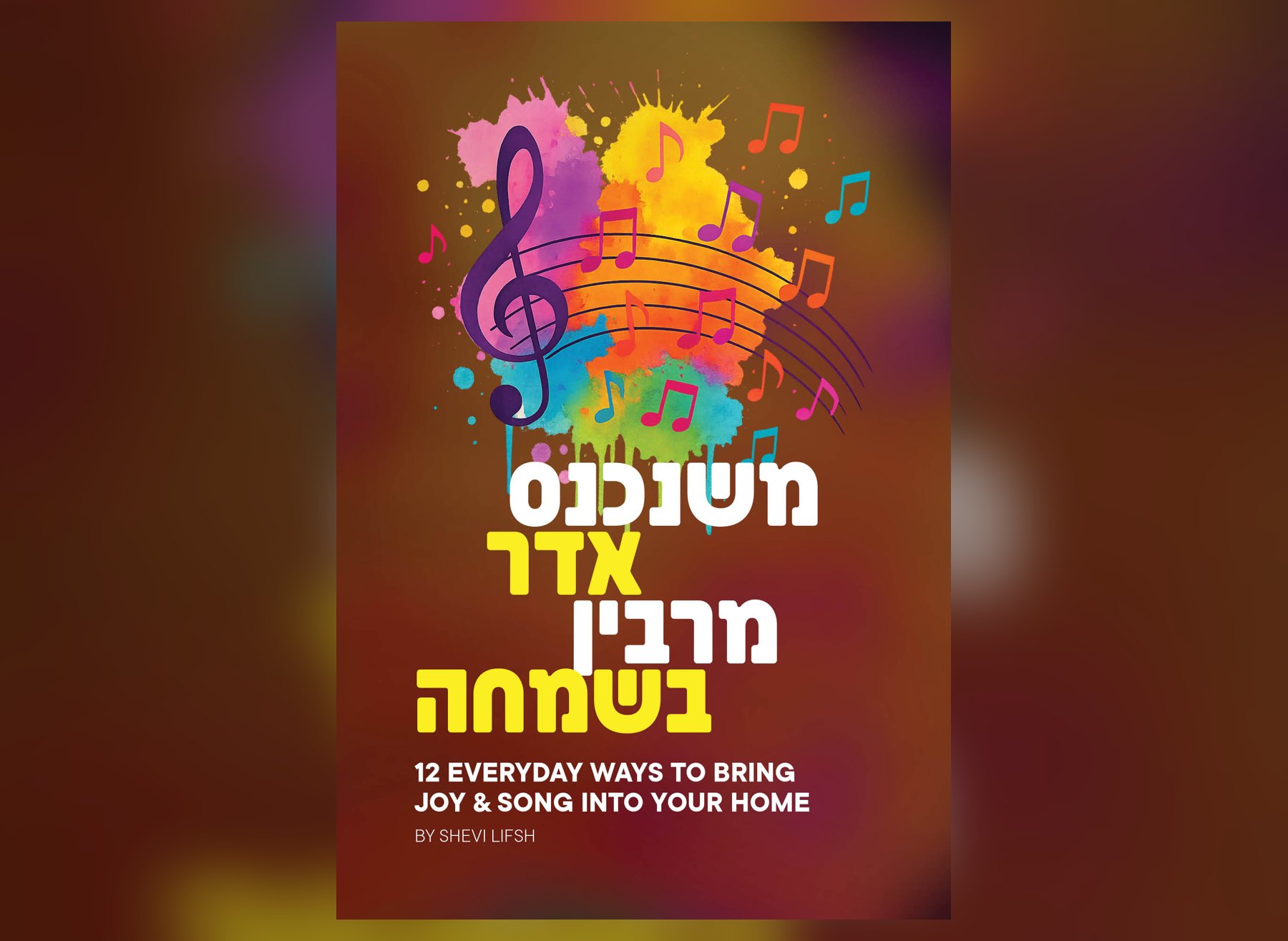
12 Everyday Ways to Bring Joy & Song Into Your Home
Dear mother, remember: for your children, your voice is the most beautiful sound in the world. They don’t want to hear a famous singer with a nightingale’s voice – they want to hear their mother. For them, your voice creates the safest and nicest place that exists.
A Personalized Lullaby: The moments before bedtime are the most powerful time to instill security and calm in children. Take a simple, familiar niggun and “dress it” with words of praise for your child: “What a sweet boy Shneur is, his face shines with light, how beautifully he helped put away the groceries today…” Even if you’re not a great poet, and it doesn’t fit the niggun or rhyme perfectly – that’s completely fine. These words, wrapped in a mother’s niggun, penetrate straight into the subconscious, are engraved in the heart, and build the child’s self-confidence.
A Nigun for Every Time and Moment
Waking up: Our entire day is influenced by how we wake up. Instead of waking the children with pressure, begin the morning with songs that give energy of kedusha. Why is this so important? Because the first niggun that enters the ears in the morning sets the tone for the entire day. Play “Modeh Ani” songs or lively, joyful niggunim. Even while tidying the house or preparing sandwiches, music transforms technical chores into joyful avodas Hashem, filling the home with a positive atmosphere that repels sadness.
Before Shabbos begins and after it ends: On Friday, when tension rises, play calming niggunim or Shabbos songs that usher in the right atmosphere. On Motzaei Shabbos, break the feeling of weekday mundanity and open the new week with niggunim of deep devotion and positive energies of emuna and bitachon (“Al Tira Avdi Yaakov,” “HaMavdil”).
At the Shabbos table: This is the only time during the week when everyone sits together – without screens, without noise or interruptions – and hearts open. Sing together favorite camp songs the children know, moving niggunei deveikus, and let each child choose a niggun they love. This is when the family bonds and becomes one unit. You can also play niggun games based on the Alef-Beis and more.
Women’s quality time: During “Raava d’Raavin,” when the boys and men are in shul, is a wonderful opportunity to sing at home with the girls and younger children – family songs and niggunim. You can let the girls choreograph a dance, create a family “performance,” and use this time for a shared elevation of kedusha and simcha.
On the road: Long trips can be an exhausting time of arguments in the back seat – or a magical time of bonding – if you play songs everyone loves in the car. If children travel by school bus or public transportation, equip them with players containing quality content and niggunim. The trip then passes more quickly and with much greater joy.
According to the season: The Chassidic calendar sets the rhythm of the home. Play niggunim according to the time of year: in Elul, the stirring niggunim of the Yomim Noraim; on Chanuka, “HaNeiros Halalu”; before Pesach, niggunim connected to Pesach, and so on. Music immediately sets the mood and connects children to the spiritual essence of the Chassidishe date – without the need for long explanations.
Noach’s Teiva: Chabad Niggunim Only
It’s worth remembering that Chabad niggunim contain immense richness. Today’s repertoire is broad, and within Chabad niggunim themselves there is a wide range of styles, so every child can connect to a style they love. Since I grew up in such a home, where only Chabad niggunim were played, I can testify: I never felt that anything was missing. On the contrary – I am entirely grateful to my parents for instilling this principle, which kept our neshamos refined and connected.
Tanya and Mishnayos Songs: The easiest way to memorize is through song. Play Tanya songs, perakim of Mishnayos, or pesukim in the background, and the children will absorb the holy words while playing, without any effort at all. Rabbi Sholom Ber Engel (and others) have made audio tracks available which turn the home into a “singing Beis Medrash.” [See http://www.jewishaudio.org/rabbi-sholom-ber-engel/tanya/01-01.htm ]
Technology in the Service of Holiness: A Home Studio
One of the most precious assets for a family is recordings of shared songs that are always pleasant to replay (for internal family use – both boys and girls may sing). For a major event, one can record in a professional studio, but it’s absolutely not required. Today, home technology allows us to easily create recordings on a computer, with a simple speaker and microphone that are already available.
A Song for Every Celebration: A bar mitzva? An upsheren? A birthday? Take a simple backing track and record family members offering brachos or singing a rhyming song you composed. It doesn’t have to be professional – these songs are etched in the heart forever.
A Song for the Trip to the Rebbe: Preparing to travel to the Rebbe? Record a family song that prepares the children for the journey, filled with longing and anticipation to see the King. This is a project that can occupy children for a long time – from writing the lyrics, to composing the niggun, to the technical production. It becomes a keepsake that lasts forever and turns the preparation into an experience.
Songs in Challenging Times: When there is difficulty or crisis, instead of talking it through endlessly, one can simply sing it. A niggun of bitachon, sung together, can melt fears and anxieties far more effectively than any conversation that appeals to logic.
* * *
Remember: songs are engraved in the memory of young children and are never forgotten. A child may forget what you said to them, but they will not forget what you sang to them. And as the Rebbe says and emphasizes in Dvar Malchus, Parshas Beshalach:
“Just as at Yetzias Mitzrayim, ‘the righteous women of that generation were confident that the Holy One, blessed be He, would perform miracles for them, and they took tambourines out of Egypt,’ so too in the Geula from this final galus, the righteous women of Israel… together with prayer, supplication, and the demand from the Holy One, blessed be He, to bring the Geula immediately – right now – stemming from a feeling of pain and bitterness (‘Miriam,’ from merirus)… are permeated (also and primarily) with a feeling of joy, and the greatest joy, expressed through song, due to the great confidence that ‘hinei zeh (Melech HaMoshiach) ba,’ and has already come!”
Our singing at home does not just create an atmosphere; it is our tool to hasten and bring the Geula.
Beis Moshiach #1495 • pp. 46-48
© 2026 Beis Moshiach Magazine. All rights reserved.
This article originally appeared in Beis Moshiach #1495. You are welcome to share it with friends and family by email or in print, provided that you do not change, add to or omit any part of it, you credit the author and Beis Moshiach, and you include a link to archive.bmoshiach.org (written out in full in printed copies).
To republish this article in a newspaper, magazine, book or website, please request permission in advance at [email protected].