The Moshiach Gap
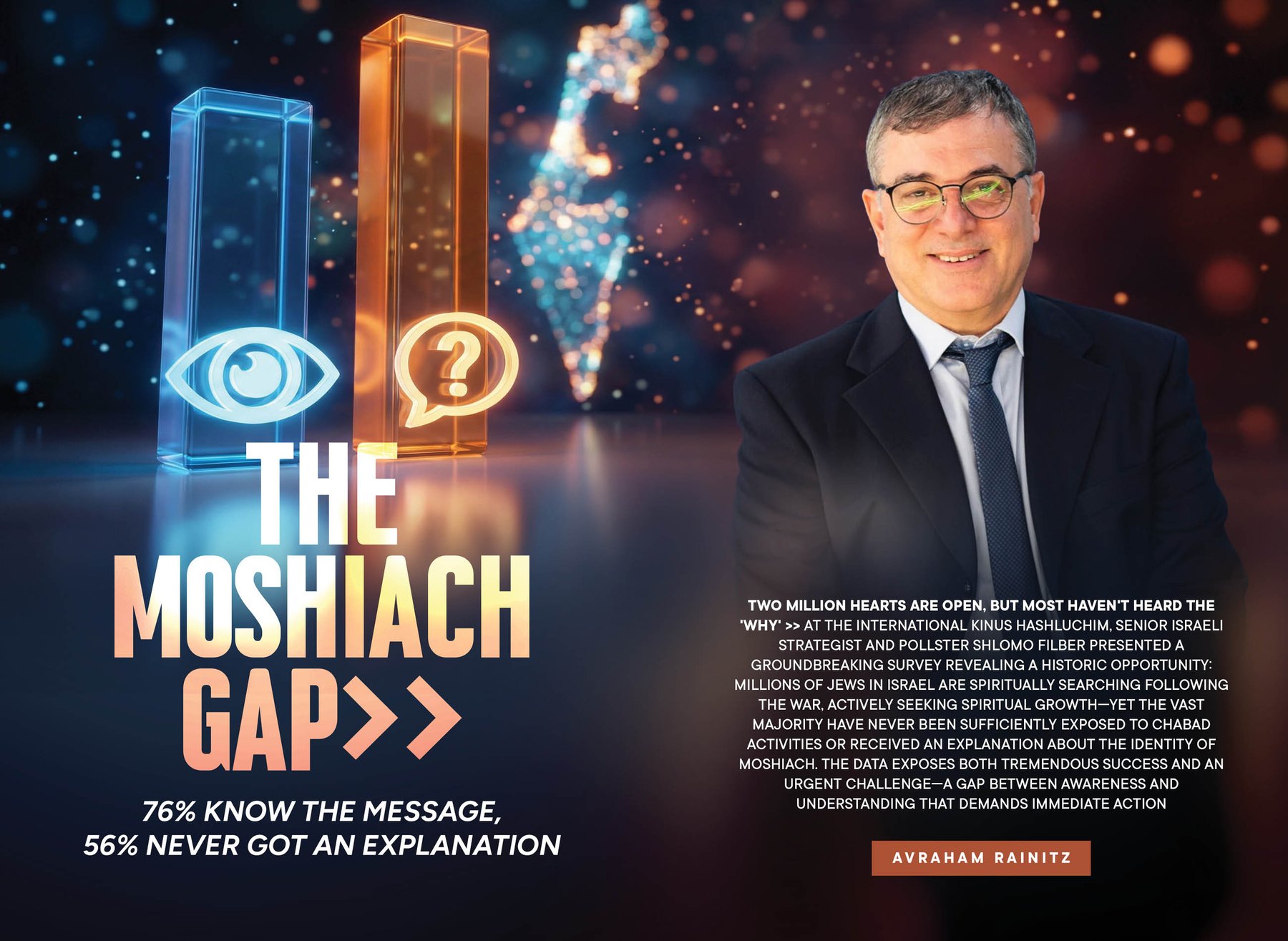
Two million hearts are open, but most haven’t heard the ‘why.’ At the International Kinus HaShluchim, senior Israeli strategist and pollster Shlomo Filber presented a groundbreaking survey revealing a historic opportunity: millions of Jews in Israel are spiritually searching following the war, actively seeking spiritual growth – yet the vast majority have never been sufficiently exposed to Chabad activities or received an explanation about the identity of Moshiach. The data exposes both tremendous success and an urgent challenge – a gap between awareness and understanding that demands immediate action.
In many Merkos Publications books, some to this very day (like the siddur and Hayom Yom), a brief description of the divisions of Merkos L’Inyonei Chinuch appears. One of its divisions, Number 14, was a division for collecting statistics. We don’t know much about this division and what it has done, but it’s certainly telling that the Rebbe Rayatz and the Rebbe who headed Merkos saw value in collecting data to help strengthen Yiddishkeit properly.
There’s a story told about one of the Rebbe’s first shluchim. One night at 4:00 AM, the phone rang in his home. The shliach, out of habit of constant availability, washed his hands and went to answer. On the other end was the Rebbe’s secretary, Rabbi Chodakov a”h.
“Are you awake?” Rabbi Chodakov asked in his quiet but firm voice.
“I am now,” the shliach replied, trying to understand the reason for the urgent pre-dawn call.
Rabbi Chodakov continued: “How many Jewish children have you managed to enroll in the Jewish school in your city?”
The shliach, who had invested days and nights on chinuch, answered with noticeable satisfaction: “Baruch Hashem, we’ve already brought 200 children into Jewish education!”
Then came Rabbi Chodakov’s next question, which struck like thunder: “And how many Jewish children live in your city?”
“About 10,000,” the shliach stammered.
The silence on the line was deafening.
Then came a rhetorical question that should serve as a compass for the entire army of shluchim: “You have 10,000 Jewish children in the city, and you enrolled only 200? So how can you sleep?!”
This story echoed with renewed force at the International Kinus HaShluchim earlier this year. The atmosphere in the enormous hall was, as usual, one of tremendous hisorerus, spiritual elevation, and pride from the very gathering of thousands of shluchim from all corners of the globe.
But then the organizers surprised everyone. Two figures took the stage: Shliach Rabbi Dudi Caplin, director of Beis Chabad in Cozumel, Mexico and alongside him an unusual presence – senior Isreali strategist, pollster and media figure Mr. Shlomo Filber.
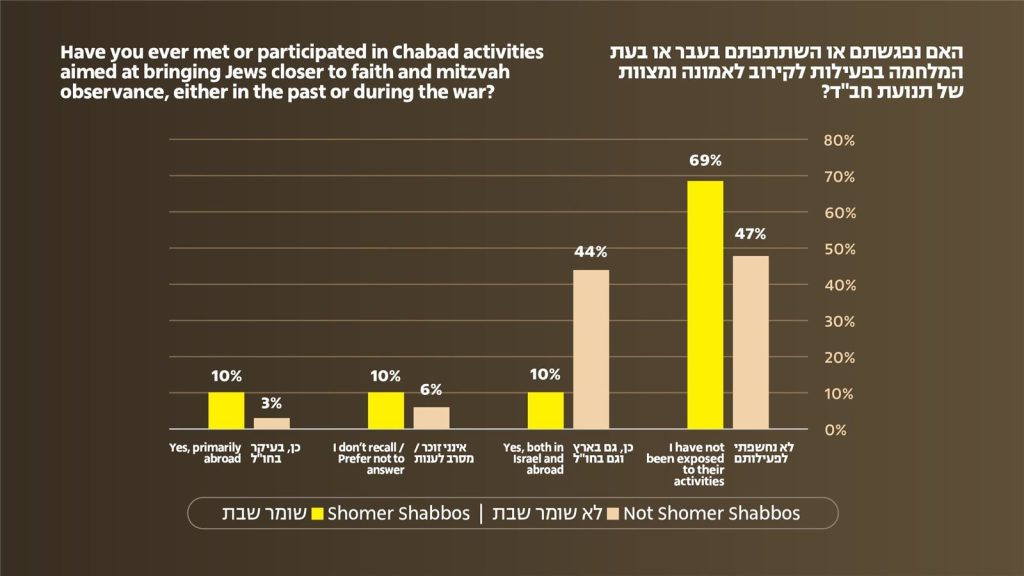
For long minutes, a comprehensive and startling survey conducted in Eretz Yisrael was presented to the thousands of shluchim – a survey that sought to map the state of emuna among the people following the war, the exposure to Chabad activities, and most importantly – the public’s awareness to the Rebbe’s Besuras HaGeula.
The data was sharp. On one hand, great satisfaction: a tremendous awakening among millions of Jews. On the other hand, Rabbi Chodakov’s question echoed with greater force: How can we rest when 63% of our fellow Jews (this in Israel alone!) declare they haven’t been sufficiently exposed to Chabad activities? How can we be satisfied when, while most of the nation (76%) has heard there’s a message about the identity of Moshiach, but almost none of them (56% of the 76%) has ever received an explanation about it?
As Filber explained in an interview afterward: “Every single percentage point in this survey equals 80,000 Jews!” The calculation is simple and shocking. Millions of Jews are still waiting. The shlichus is far from complete!
A Million People Have Opened Their Hearts
Filber’s survey is sharp and clear: Am Yisrael is undergoing a tremendous spiritual upheaval, just like after the Six-Day War, when the Rebbe called again and again to take advantage of the opportune moment.
The first question posed to the public was: “To what extent have the events of the massacre, the fighting, the successes, and the return of hostages affected your personal faith and your connection to Yiddishkeit?” The results were complex: 16% testified that their emuna weakened. But simultaneously, 16% testified that they greatly strengthened in emuna, with another 9% strengthening somewhat. In total, 25% of the nation has drawn closer to Yiddishkeit – an enormous figure that translates to about two million people!
In our conversation with Filber, and in a workshop he held for hundreds of shluchim, he analyzed the apparent contradiction between strengthening and weakening: “Don’t let the number ‘16% weakened’ confuse you,” he explained. “When you dive into the data, you see that the weakening comes almost entirely (21%) from the ‘non-Shomer Shabbos’ sector. From analyzing other surveys and in-depth conversations, this doesn’t necessarily reflect actual spiritual distancing. It’s more a type of protest expression. This is a public that defines itself as ‘left-wing,’ angry at the Chareidi and religious establishment following politics and the rift in the nation. It’s more a political statement, not a theological one.”
In contrast, the strengthening is authentic and comes from across the spectrum. Among Shomrei Shabbos, approximately 50% strengthened in emuna (33% ‘greatly’ and 17% ‘somewhat’).
But the truly interesting data, Filber noted, is among those who aren’t Shomer Shabbos. There too, 14% (8% ‘greatly’ and 6% ‘somewhat’) declare strengthening.
“Here comes the most important point in the entire survey,” Filber emphasizes. “We asked those who strengthened how this was expressed. Among the non-Shomer Shabbos public, the overwhelming majority (19%) answered that it’s expressed ‘in internal feelings only, without behavioral change.’ Some will dismiss this and say ‘it’s just emotion.’ I tell you – this is the real thing. This is the beginning of a process. The heart has opened. When a person admits this, he’s essentially saying ‘I’m ready to receive.’”
Filber, who maintains close contact with diverse populations, describes the situation with a vivid expression: “I think in this case, more than the cow wants to nurse, the calf wants to suckle. These people are searching and they have a need. Their hearts are much more open now; you can reach them much more easily.”
As an introduction to Filber’s lecture, I mentioned the Rebbe’s words after the Six-Day War, about how there was then a tremendous awakening, a “blast of the great shofar,” but it wasn’t properly utilized and faded away.
Filber connects to these words: “That’s exactly what I see with professional eyes, and I’m trying to convey to you shluchim. There’s now a great wind of strengthening, and this is an opportunity that must be seized with both hands. It’s not certain it will return. More than a million non-religious people whose hearts have opened – this is here and now. It’s not something that can be spread over 10 years.”
The Moshiach Paradox: Tremendous Victory and Startling Gap
The most fascinating part of the survey directly touched the main message – the Geulah message and the identity of Moshiach.
Here, the data was nothing short of amazing.
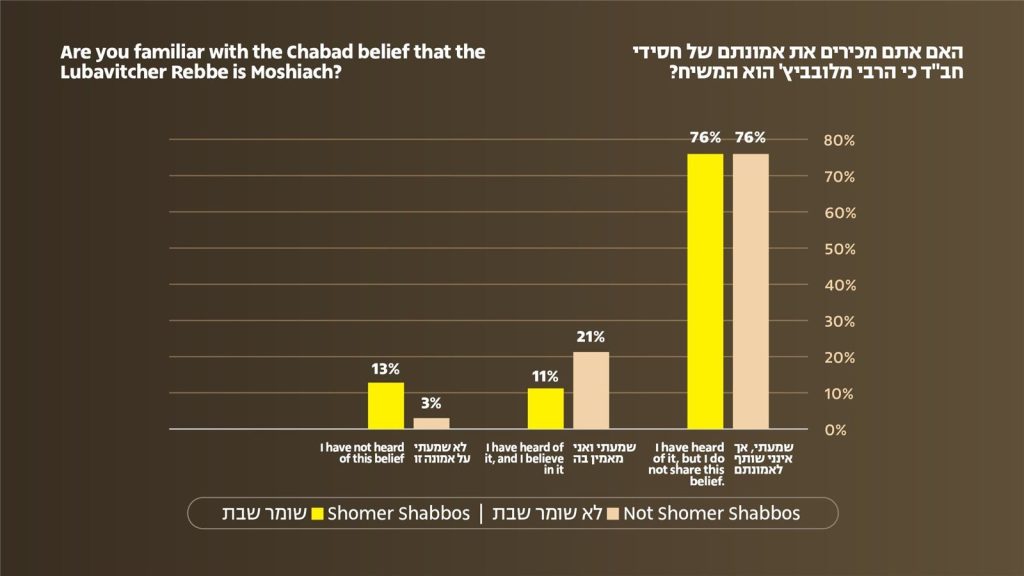
The victory: An overwhelming majority – 76% of the general public in Eretz Yisrael – knows about Chabad Chassidim’s belief that the Rebbe is Melech HaMoshiach. The message has been heard. The message penetrated and was absorbed.
The challenge: Of those same 76% who know what we believe, only 14% of the general public (21% of Shomrei Shabbos and 11% of non-Shomrei Shabbos) answered that they too believe this. The overwhelming majority answered: “I heard it, but I don’t share it.”
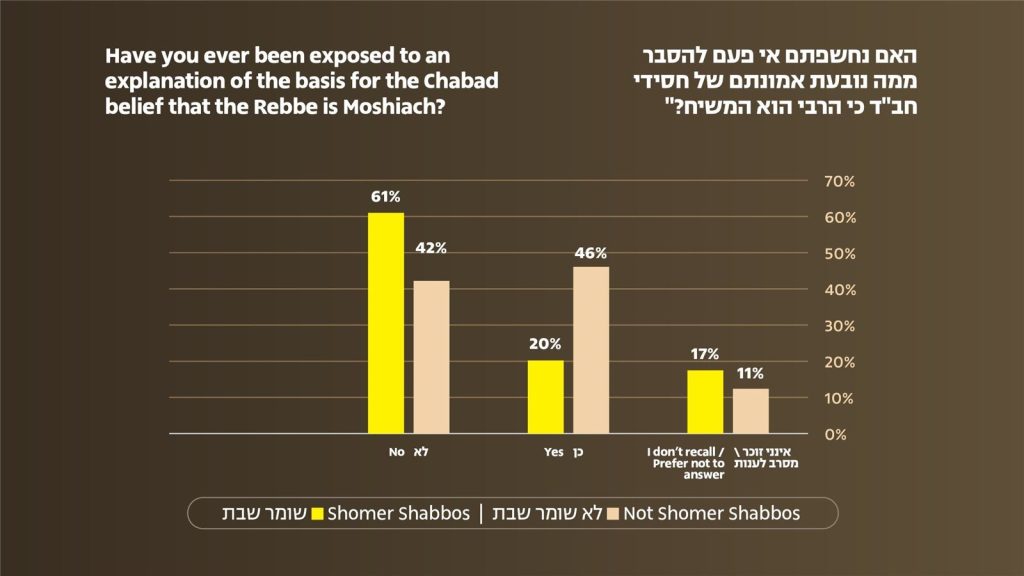
Why? What is this gap between knowledge and belief? The answer came through another question in the survey, perhaps the brightest signpost placed before the army of shluchim: “Have you ever been exposed to an explanation of what Chabad Chassidim’s belief that the Rebbe is Moshiach is based on?”
The results: Most of the public, 56%, answered “no.” Only 28% has ever been exposed to an explanation (among Shomrei Shabbos, 46% were exposed to explanations, but even in this public 42% answered they didn’t receive explanations).
“This is a wake-up call!” Filber sharpened the point in the interview with Beis Moshiach: “There’s a huge gap here. You’ve publicized the ‘what’ without providing the ‘why.’”
Before this survey he conducted, Filber has never heard the Rebbe’s words that “the world is ready to hear the Geula message,” but that’s exactly what he said in his professional language: “People aren’t rejecting you out of active opposition; they simply reject because they don’t understand. No one bothered to explain to them. What the survey proves is that your door is wide open; the public isn’t hostile toward Chabad. On the contrary, because of your ahavas Yisrael and your work l’shem shamayim, you’re not required to break down walls. You just need to enter through the open door and start explaining.”
He added a fascinating insight: “You need to understand that the word ‘meshichi’ (messianic) has become a positive word in Israel. The left tried to use it as a derogatory term against the believing and right-wing public, but it backfired. Because the believing public is so large, the label became a badge of honor. Today we have a Shin Bet head who they say is ‘meshichi.’
“As a professional, I want to clarify that when people identify with the concept of ‘Moshiach,’ they’re not necessarily thinking about the Moshiach we mean. This concept is perceived by the public as ‘hope for better days,’ as redemption from troubles. But this atmosphere is a tremendous opportunity for you to take this concept, which is already positive, and infuse it with the content of Chabad’s teachings about the generation of Geula.”
This Is the Time to Think Outside the Box
In the workshop for shluchim, Filber didn’t just present data. As a professional strategist and PR consultant, he offered a pointed strategic analysis of the tremendous force called ‘Chabad’ – and what it lacks to exhaust its potential.
“I see organizations all the time,” he said. “And I tell you: you’re in a situation no organization is in. You’re not competing against a rival or opponent. You’re essentially competing against yourselves. You have 10 million Jews you need to reach, and no one is interfering with you along the way.”
According to him, it’s important to adapt activities to a new reality. “Chabad has a veteran toolset – tefillin, Shabbos candles, mivtzaim. Excellent tools. But you may need to build an additional level of thinking and new tools.”
The striking example he gave is the phenomenal success of the tzitzis campaign during the war, which became the soldiers’ “spiritual bulletproof vest.”
“Did you stop to ask ‘why’? Why specifically tzitzis? The real survey you need to do now isn’t a phone survey, but to sit with 500 of these soldiers and ask them ‘what did this do for you?’ From there will come the answer to the right way to touch hearts.”
Filber suggested several strategic directions for thinking “outside the box”:
In places of crisis: “The moment when the heart opens is when people are in a difficult moment of distress. In hospitals, during times of mourning, in broken families or in financial difficulties. When people are in crisis, they’re looking for an anchor. If someone comes who knows how to embrace and give good advice and encouragement – they’ll remember him forever.”
He told about a shliach in California who helped the son of a millionaire who deteriorated into drugs, and how that father, out of gratitude, has since supported all the shliach’s activities.
Recruit the influencers: “You won’t reach this youth through Chabad houses,” he said in response to a question about pop singers using concepts of “neshama.” “You need to bring the singers, these social media influencers, here, to 770. Give them a tour, give them an experience. They’ll return to the audience of tens of thousands of followers they have, and become your ambassadors in places where you have no footprint.”
One of “their own”: Filber used Channel 14 (a right-leaning, Yiddishkeit friendly TV channel that has risen to prominence in recent years) as an example of a consciousness shift. “Why did the channel succeed? Because people like to see someone on screen who resembles them. A huge public felt invisible, and suddenly it sees itself.
“Same with you. If you want to reach soldiers, let a soldier who returned from battle and strengthened be your ‘presenter.’ Not instead of you. Alongside you. He’ll speak their language and break barriers that you, as shluchim, can’t always break.”
“You Value Yourselves at Less Than You’re Worth”
Toward the end of the lecture, Filber was asked: “You’ve been here with us for several days now, you experienced Shabbos with thousands of shluchim, you saw the activities. What’s your personal impression?”
Filber’s answer stunned the shluchim in the hall. He paused and said honestly: “I think you value yourselves less than you are.”
He quickly explained: “I’m not speaking on a personal level. I’m speaking as someone who looks at organizations. Chabad is the Foreign Ministry of the Jewish people. You have no idea what tremendous power you have. The State of Israel or the Jewish people don’t have as effective a force as Chabad has. My feeling is that you’re not using it. You’re occupied with day-to-day matters, with ‘small things’ – with one person and another person. This is indeed holy and important, but your power as a system is tremendous, and you’re far from exhausting it.
“You’re clean of ego and politics. And that’s a huge advantage. You have no competitors. Who will compete with you for this position? You’re an organized army, with a fighting doctrine, with emuna and with a path. That’s a huge difference between you and any other group. I see here an organization with tremendous potential. The only question is whether it will fully capitalize on it.”
The Question That Won’t Let Us Sleep
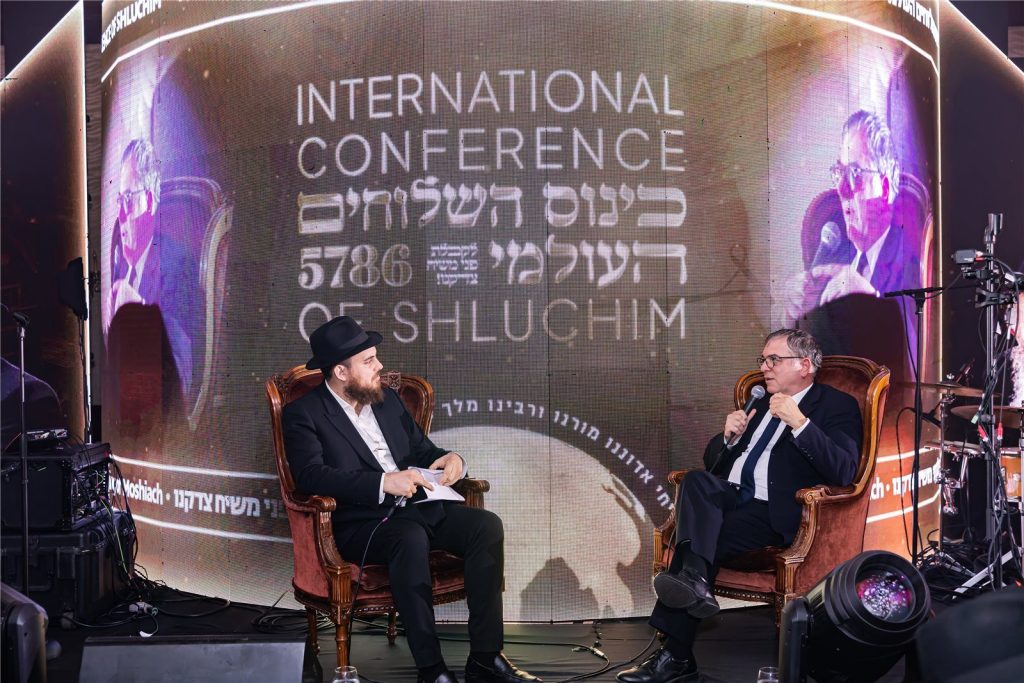
Filber’s words, an “outsider” who saw the system from within with professional tools, echo back to that 4:00 AM phone call. The Rebbe, through his secretary, is troubled at that hour and wants to clarify “how can you sleep?” And here, decades later, comes a senior strategist, presents dry data, and tells us exactly the same thing.
Two million Jews in Eretz Yisrael have already opened their hearts and souls and are seeking meaning. Millions more (63%) are still waiting for us to knock on their door. The vast majority of the nation (76%) has heard the message, but is waiting (56%) for someone to finally explain the “why.”
This is a historic opportunity, and the only question that remains open is: Will the army of shluchim pick up the gauntlet, adopt new tools, think “outside the box,” and complete the only shlichus – to prepare the world to greet Moshiach Tzidkeinu.
After the Six-Day War, the Rebbe Cries Out: Take Advantage of the Nation’s Awakening
In the weeks and months following the Six-Day War, the Rebbe demanded efforts to ensure that the awakening of the Jewish people to teshuva be utilized for practical matters in keeping mitzvos, so that it would be eternal and sustainable and constitute preparation for Moshiach’s coming:
“The constant responsibility and privilege placed on every Jew to bring other Jews closer to Yiddishkeit exists now even more so, and particularly regarding tefillin, which the hour calls for, and there’s still need for the virtue of ‘All the peoples of the earth will see that Hashem’s Name is called upon you, and they will fear you,’ which according to Chazal refers to tefillin shel rosh,” the Rebbe said.
On numerous occasions the Rebbe repeated and emphasized the special importance at this time of Mivtza Tefillin and the privilege of sharing this great mitzva with our fellow Jews, both as a virtue for the nation’s success and as a foothold for bringing the masses to practical and consistent closeness to Hashem and His Torah and mitzvos.
“During the Six-Day War, the entire world saw the open miracles that were not clothed at all in natural ways – that Hashem performed for the Jewish people. This miracle should have caused ‘I will raise my nes (banner) on the mountains’ – ’nes’ meaning elevation – to elevate the Jews through Jewish conduct and thereby express their recognition that this was a miracle and gift from Heaven. And consequently, they should have immediately increased in Yiddishkeit through building shuls and batei medrash, mikvaos, and certainly settling [all parts of] Eretz Yisrael” (Purim 5740).
On Rosh Hashana of 5728 (1967, months after the Six-Day-War), the Rebbe delivered the maamar on the passuk “V’haya ba’yom ha’hu yitaka b’shofar gadol – And it shall be on that day, a great shofar will be sounded,” in which the Rebbe noted that regarding several matters, the concept of “a great shofar will be sounded” has already begun, “and certainly in recent times when we saw tangibly that many who were initially in a state of lost and dispersed, Rachmana litzlan, awakened in teshuva through the sounding of the great shofar.”
Rabbi Shmuel Avidor HaKohen, an Israeli journalist, merited to hear decisive words from the Rebbe on this subject:
RSA: What should be written now in the newspaper about continuing the awakening from the “Six Days”?
The Rebbe: I started regarding Mivtza Tefillin, and truly everything can be accomplished, even the most difficult matters…
Also in a yechidus with Rabbi Moshe Tzvi Neria z”l, leader of the Bnei Akiva yeshiva network that took place on Rosh Chodesh Kislev 5728, the Rebbe mentioned: “Regarding the opportune time that exists following the wondrous victory of the Six-Day War, when there’s no place even for doubt, and it’s clear that only Hashem’s hand did this, that it should be utilized for awakening to call upon the Jewish people to return to Hashem – what is explained in the maamarim of Derech Chaim on the passuk ‘And it shall be on that day, a great shofar will be sounded,’ that the expression ‘will be sounded’ without specification, and it doesn’t say who the one sounding is, teaches that it will sound by itself. And the concept in this is that since the sounding of the ‘great shofar’ is to awaken the lost and dispersed, therefore, the sounding will be by itself, without any awakening from below at all.”
To journalist Eliyahu Amikam, the Rebbe wrote in those days:
“I read your articles also during the Six-Day War, but I didn’t find in them the main, simple, obvious message… It’s necessary to say simply that Jews must be ‘Jews,’ meaning: to put on tefillin, keep Shabbos, be careful about kashrus and family purity. The girls need to dress as their grandmothers dressed… If Jews would be ‘Jews’ in these days, they would immediately be redeemed, that’s what should have been said now.”
Beis Moshiach #1495 • pp. 12-20
© 2026 Beis Moshiach Magazine. All rights reserved.
This article originally appeared in Beis Moshiach #1495. You are welcome to share it with friends and family by email or in print, provided that you do not change, add to or omit any part of it, you credit the author and Beis Moshiach, and you include a link to archive.bmoshiach.org (written out in full in printed copies).
To republish this article in a newspaper, magazine, book or website, please request permission in advance at [email protected].