An Hour With Yerushalayim’s Sephardic Chief Rabbi
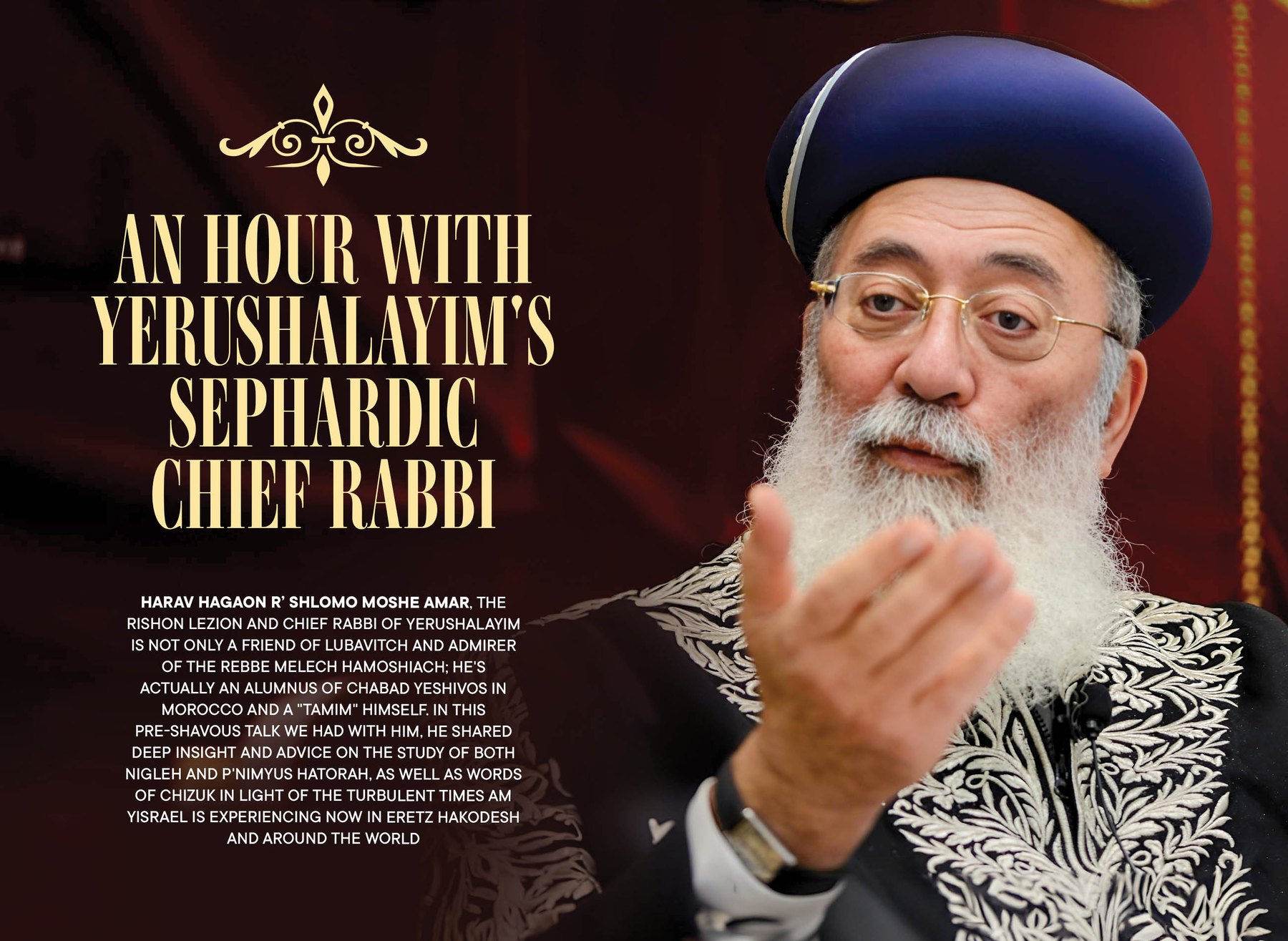
HaRav HaGaon R’ Shlomo Moshe Amar, the Rishon LeZion and Chief Rabbi of Yerushalayim is not only a friend of Lubavitch and admirer of the Rebbe Melech HaMoshiach; he’s actually an alumnus of Chabad yeshivos in Morocco and a “Tamim” himself. In this pre-Shavuos talk we had with him, he shared deep insight and advice on the study of both Nigleh and P’nimiyus HaTorah, as well as words of chizuk in light of the turbulent times Am Yisrael is experiencing now in Eretz HaKodesh and around the world
If one could describe the experience of being in Rabbi Shlomo Moshe Amar’s office and in his presence in any way, it would seem that the description that expresses this best is: koras ruach (spiritual contentment). This is what it was like when we went up to the office of the Gaon Rabbi Shlomo Moshe Amar, shlita. The Rav’s conversation is entirely interwoven with Torah and its underlying messages, in which he is constantly immersed.
Rabbi Shlomo Moshe Amar is the Sefardic Chief Rabbi of Jerusalem, with a rich rabbinical resume. He served as the Rishon LeZion and Chief Rabbi of Israel, and as the Rabbi of Tel Aviv. Over the years, he has written many sefarim in all areas of Torah, and today he is considered one of the leaders of Chareidi-Sefardic Jewry.
He is also an ardent admirer of the Lubavitcher Rebbe and his shluchim, and a great friend of Chabad-Lubavitch.
Becoming A Proper Receptacle
We are in the days of preparation for the holiday of Shavuos, the time of the giving of our Torah. What is the proper way to prepare for receiving the Torah?
“Receiving the Torah indeed requires preparation,” R’ Amar responds. “The more Torah a person adds in the days before the giving of the Torah, the more he merits to attain his ‘share’ (in Torah) on the holiday of the giving of the Torah. ‘And they shall prepare that which they bring,’ teaching us that everything depends on preparation. We need to prepare our keilim/vessels in anticipation of the giving of the Torah.
“The preparation for each thing shows its importance,” adds the Rav, illustrating: “A person who buys a sack of potatoes in the market does not conduct research and inquiry before the purchase. He enters the store and buys it. In contrast, if we are dealing with an electrical appliance that costs a considerable amount, he inquires beforehand, sometimes even going and checking what is cheap and what is expensive, which company is better, and so on. All the more so if a person wants to buy a house – he takes mortgage experts and a lawyer to thoroughly check all the details and fine points so that he doesn’t get tripped up or make a mistake. We thus learn that the value and worth of something can be measured by the preparation that is made.
“So too, if we value the holiday of Shavuos, it requires proper preparation.”
The Rav gives an example of preparing suitable vessels from a well-known story in Nach: “When the woman told the Navi Elisha, ‘I have nothing and the creditor is coming to take my two sons,’ Elisha asked her: ‘What do you have in the house?’ And she answered, ‘Your maidservant has nothing in the house except a small jar of oil.’ A tiny drop with which one can anoint a little finger. The Navi said to her, ‘Fine, if there’s even a little then there’s something for the blessing to rest upon, and as such bring ‘empty vessels, do not skimp.’ When the prophet told the woman to prepare vessels, she knew what to prepare, because he spoke to her about oil. She didn’t prepare sacks or baskets; she knew she needed to prepare jars and barrels suitable for oil.
“When we are told to receive Torah, we must consider what suitable vessels we should prepare. Bottles and jars are not appropriate, nor are sacks and baskets. Here the preparation is not in physical vessels, but in clearing the inner recesses of the soul. Our soul can receive infinity, but ‘the Plishtim stopped them (the wells) up and filled them with earth,’ and when the soul is filled with earth, there is no water in the wells, and ‘there is no water but Torah.’ If we clear the inner wells – the soul, from desires and wants, then there will be room to receive Torah without limit, water that will never cease, because there are no limits to G-d’s gift. This is what we must prepare. (Lavan’s statement) ‘And I have cleared the house’ – Rashi explains from idolatry (avoda zara) ; idolatry is work that is ‘foreign (zara) to the Holy One, blessed be He.’
“A person is required to clean the houses of the soul by breaking the desires of the body and his animal soul (as explained at length in the holy book of Tanya). That is why we recite Pirkei Avos on the Shabbosos between Pesach and Shavuos, in order to break the desires that summer brings with it.
“Clearing the houses of the soul is done by cleansing it from bad middos – in turning away from evil; and by practical dedication to Torah study – in doing good,” adds R’ Amar. “One needs to know that clearing out has great value. Sometimes a person rouses himself and says: ‘Whatever will be, will be, I will follow G-d,’ and he closes his business in the middle of the day to go study Torah. These actions give him strength, power, and also special divine assistance. A great light illuminates all his limbs. The very dedication and effort open great gates above.”
So far, the Rabbi has spoken about the way of preparation for the giving of the Torah, but what about the study itself? In what way should a person ‘give himself over’ in Torah study?
Indeed, after all the preparation, one must, of course, make a cheshbon ha’nefesh (spiritual accounting) of the learning itself. Our problem is that we engage in Torah, but weakly. It is stated in Gemara Shabbos (88b), “Rava said: For those who incline to the right in it, it is an elixir of life; for those who incline to the left in it, it is an elixir of death.” For those who incline to the right in it, it is an elixir of life – Rashi explains: like a person who engages in something with his right hand. And for those who incline to the left in it – like a person who engages in something with his left hand, weakly, it is already called an elixir of death. Is this not remarkable!
Sometimes we wonder, it is written that the Torah purifies, cleanses, and renews, gives counsel and sound wisdom, but we study and do not feel these changes. The reason is because we do not study continuously; we study and stop, “a little here and a little there,” and as the well-known saying goes, “the water doesn’t boil and the food doesn’t cook.” The learning must be done in a uniform continuum.
“Indeed, there are situations where there is no choice,” the Rav qualifies, “but when there is no choice, Hashem knows; when there are absolutely essential things, G-d helps, but one should not waste time on nonsense. Idle talk in the middle of learning destroys a lot. A person starts to study and stops to talk; thus, an entire winter can pass, and the person has learned here and learned there, but he has not changed, he has not become a person who thinks differently. All this is because there was no continuum that could ‘cook’ to bring the person to change. It requires very high retzifus (continuity) and much effort.
“If so, it is clear,” says the Rav, “that the toil of Torah includes great preparation on the part of the person, but one must remember that everything a person does and prepares himself for receiving it, is nothing compared to the Torah itself, which is deeper than the sea, and without G-d’s kindness to us, we could not approach and touch it at all.”
The Rav continues:
This is the reason why this day is called the giving of the Torah (Matan Torah), and not the receiving of the Torah (Kabbolas ha’Torah), because the great virtue is in the fact that G-d gave us His Torah, about which it is said in the Gemara (according to the Ein Yaakov version), “I have written Myself into it, I have given” – I put myself inside. The Holy One, blessed be He, is found within the Torah.
On the pasuk, “When a man dies in a tent,” Chazal taught us, “The Torah is only established in one who kills himself over it.” However, no matter how much you advance in learning, that’s not everything. Just as a person cannot walk on foot to the moon, so too, and even more so, a person does not have the ability to reach the Torah without G-d’s kindness, who gave it to us on the 6th of Sivan. But what depends on you – do completely.
This is also the explanation of the statement of Chazal, “Rabi Yitzchok said: If a person tells you: ‘I have labored and not found’ – do not believe him; ‘I have not labored and found’ – do not believe him; ‘I have labored and found’ – believe him.” Seemingly, after the labor, he should have used the expression ‘achieved,’ not ‘found,’ because a metzia (find) comes unexpectedly. And indeed, this is the thing – everything that is done will not be proportionate to the Torah itself. It is a privilege that G-d gave us. Even after the labor, the Torah is still in the category of a find, which is beyond knowledge.
Hashem is “the giver of the Torah,” giver – in present tense, every day they shall be new in your eyes. We just need to prepare ourselves to be vessels for this. A person who truly labors and toils in Torah – finds that he has received more than he labored for. This is the spiritual quality of the day.
Pnimiyus Ha’torah – The Heritage Of All
At the giving of the Torah, besides the ‘revealed Torah,’ the inner dimension of Torah was also given. We would like to hear about the virtue of studying pnimiyus ha’Torah.
When we consider what our sages established for us to study on the night of Shavuos (the ‘Tikkun’), we see that besides the Five Books of the Torah, the Mishna, etc., one of the central things said on this holy night is the ‘Idra Rabba,’ where all the inner Torah is condensed into few words, as it is brought in the holy Zohar.
The holy Ari writes in Shaar HaKavanos that one should try to understand a little what the words mean, but even one who does not understand, the holy letters alone affect him.
It used to be that the secrets of Kabbala were given only to the select few in each generation, in the sense of “The hidden things belong to the L-rd our G-d.” The holy sages came, the holy ‘Ohr HaChaim,’ the holy Baal Shem Tov, and his disciples the Maggid of Mezeritch and the author of the Tanya, and wrote their wonderful compositions in a way that even our intellect can receive the secrets of the inner Torah. This is indeed part of the PaRDeS (acronym for the four levels of Torah interpretation: Pshat, Remez, Drush, Sod) of the Torah, and we cannot escape the obligation to study it.
The leaders of Chassidus foresaw the decline of the generations and made the secrets of the Torah accessible to us, so that we would have a sense of “those who taste it merit life,” “each river (demographic within the Jewish nation) and its course.” Every Jew can and should study Chassidus. One does not need to be a Chassid to study Chassidus, for Chassidus is the heritage of all.
There are things in the Torah, even in the Chumash, that cannot be understood without the help of the teachings of Chassidus. We think we understand, but in fact we do not understand. From here you learn the greatness of the importance of studying Chassidus in all its offshoots. All are holy, all have been sanctified in Israel, all have become invaluable assets within the study halls and in the possession of those who toil in Torah.
Among the works of Chassidus, one should especially recommend studying the holy sefer of Tanya by the Alter Rebbe. The study of the Tanya is fundamental and changes the approach to material life and spiritual life. The holy Tanya elevates a person in a special way and causes the daily life of a Jew to appear completely different. Thanks to the Tanya, a person is elevated to a different state of being. I myself am privileged to study the sefer regularly, and I see it as a fundamental work in avodas Hashem for every Jew wherever he is.
A Rabbi Raised On Chassidus
The Gaon Rabbi Amar was born in Casablanca, Morocco, to his parents Eliyahu and Miriam Amar. He spent his childhood years in the ‘Otzar HaTorah’ and ‘Neve Shalom’ schools. Later, he was privileged to study at the local Chabad yeshiva and was under the wing of the Rebbe’s shluchim – Rabbi Sholom Edelman, Rabbi Shlomo Matusof, and Rabbi Yehuda Leib Raskin.
In 1962, at the age of fourteen, he immigrated with his family to Eretz Yisrael and settled in Pardes Chana.
After his years of study in yeshivas, he began to work in chinuch. Alongside his educational work, he continued to progress in his studies and was given semicha as a dayan by the Av Beis Din in Haifa, Rabbi Yaakov Nissan Rosenthal, whom he considers his primary teacher.
After a period in which he served as head of the kashrus system and a dayan in several Battei Din in Eretz Yisrael, he was elected in 2002 to serve as the Chief Rabbi of Tel Aviv. In this position, he succeeded in making many changes in the field of kashrus, and changed the face of the rabbinical system in the city for the better.
In 2003, Rabbi Amar ran for the position of ‘Rishon LeZion’ and won by a majority of votes. Thus he began to serve in the Chief Rabbinate alongside his friend Rabbi Yona Metzger, the Ashkenazi Chief Rabbi.
During his tenure as Chief Rabbi, he made many trips to strengthen Judaism in Eretz Yisrael and abroad. He often visited the Rebbe’s shluchim around the world.
During that period, R’ Amar became one of the prominent leaders of Sefardic-Chareidi Judaism. After the end of his tenure as Chief Rabbi, he continued to live in Yerushalayim and engage in piskei halacha for members of the Sefardic public, in giving regular shiurim, and in guiding young bnei Torah. He was frequently invited to give speeches at conferences and gatherings, and was considered one of the senior Torah figures.
On the 27th of Tishrei 5775 (2014), at the end of the election campaign, Rabbi Amar was elected to the position of Sefardic Chief Rabbi of Yerushalayim alongside his colleague Rabbi Aryeh Stern, who was appointed to serve as the Ashkenazi Chief Rabbi.
Chassidic Joy And Chassidic Kiruv
The warm education that Rabbi Amar received in his youth at Chabad schools in Morocco greatly influenced his future path in spreading and disseminating Torah to all audiences, communities, and circles. Over the years, he has maintained constant contact with Chabad Chassidim and with the Rebbe’s shluchim wherever he goes.
He expresses his warm relationship with the Rebbe and the work of the Chabad movement many times through visits to Chabad mosdos and regular participation in various conferences and special events.
It is known that you were privileged to study at the Chabad yeshiva in Morocco, where you became acquainted with the Rebbe’s shluchim, with the Rebbe, and with the Chabad movement. We would like to hear about those days.
The spiritual rescue that the Rebbe’s shluchim orchestrated in Morocco – is very great. In those years, a great spiritual crisis was taking place within Moroccan Jewry with the establishment of the ‘Alliance’ network throughout the country. The destruction caused by the schools of ‘AIU’ (Alliance Israélite Universelle, or by its other name ‘Alliance’) was very great, and there was no day whose curse was not greater than the previous one, Hashem yerachem. Many casualties fell and distanced themselves from religion as a result of these schools and others like them.
There were even Chachamim who were misled by them and agreed to these schools. There were Rabbanim who preached publicly and cried out about these evils, and warned people about the danger inherent in them, may Hashem save us.
The Rav continued in somewhat poetic fashion:
Then, Hashem sent His shluchim through a holy man who carried the generation on his shoulders, as the wet-nurse carries the suckling child, he is the Honorable and Holy Admor, the holy Gaon of Lubavitch, whom the ruach Hashem accompanied to guide his steps. He constantly made great campaigns; his heart did not rest and he did not give sleep to his eyelids, and he would call mightily to his shluchim, these ‘emissaries of the Divine’ to go to places unknown to them or to their fathers, where they did not understand the language, dialect, and customs.
And they fulfilled his word with true humility and perfect bittul, and placed Hashem before their eyes and listened to the voice of their Rav who is like an angel of the L-rd of Hosts, and they reached every place with energy and desire, with complete willingness and a desiring soul, and did their work, the holy work, with grace and kindness and mercy.
And when they arrived in Morocco, they established educational institutions of pure holiness in several cities, for all levels and ages, and God’s desire succeeded through their hands.
I Too Am A ‘Tamim’
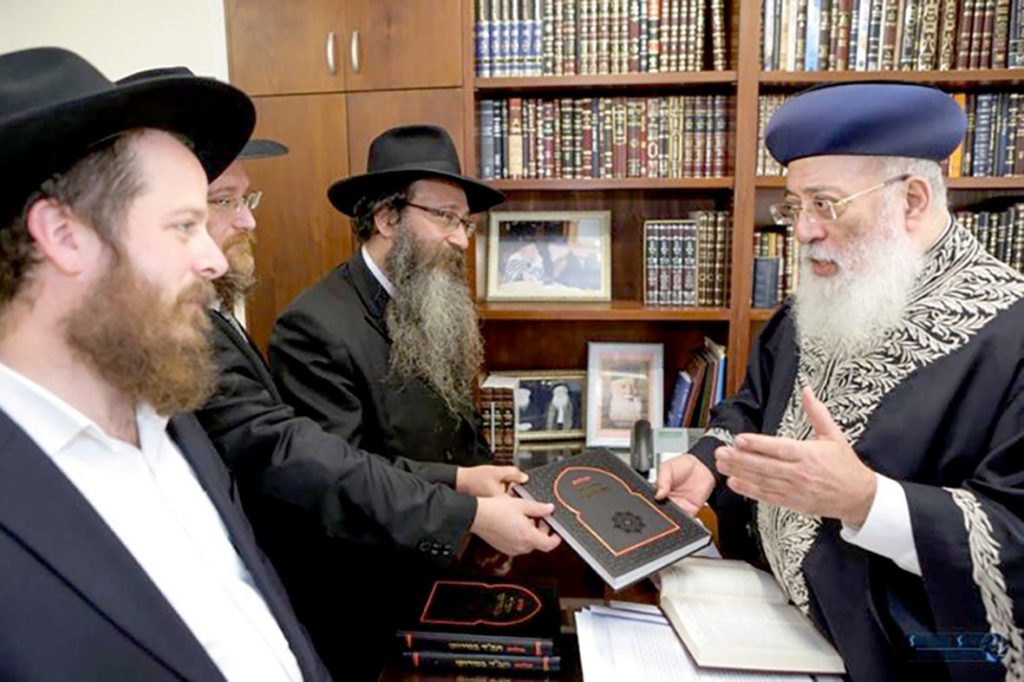
A few years ago, Rabbi Sender Wilschansky presented R’ Amar with the third volume of the Sefer ha’Tmimim. R’ Amar leafed through the book with great interest, and said with satisfaction: “I too am a Tamim, since I studied at the Chabad yeshiva in Morocco.”
Referring to his time studying at the Chabad yeshiva, the Rav says:
Although it was only a short period, I managed to learn a lot of Chochma, Bina and Daas.
What I learned then during that time at the Chabad yeshiva is engraved in my memory and has accompanied me throughout my life. There I saw for the first time what a Chassidishe farbrengen is, and there I heard for the first time about the Rebbe. In that place, I learned what Chassidic joy and Chassidic kiruv are, and it amazes me till this day.
While there, I got to know one of the special ones among the Rebbe’s shluchim, Rabbi Shlomo Matusof, a Jew whose entire being was an example of mesirus nefesh for Judaism. My fellow students and I felt that this man was a person above and beyond, and we treated him with great respect. Later I learned that the Rebbe valued his work. He was the head of all the institutions in Morocco, and found favor and positive regard from all the rabbanim and dayanim there.
I also met the rabbanim-shluchim, Rabbi Leibel Raskin and Rabbi Sholom Edelman, wonderful people whom the Rebbe’s blessing accompanied everywhere, ‘at home and in the field,’ and everything they did – Hashem made successful in their hands, fortunate are they and fortunate is their portion. Following them and because of them, many young people were saved from the claws of the ‘AIU,’ and from them came many great and mighty Torah scholars, who are found throughout the country and the world and continue to teach Torah and Chassidus.
Amazing Phenomenon
“This phenomenon of sending shluchim to Morocco is, in my eyes, a wonder of wonders,” notes R’ Amar, with a tone of amazement clearly heard in his voice:
There were three or four people, all from Russia with a different mentality, a different language, and different customs (Ashkenazi customs), but when the Rebbe told them “Go to Morocco” – they went, they didn’t make any calculations about the fact that it was a different world. And so, without a telephone and without communication with the outside world, they arrived there, with not even a single penny in their pockets. They had to take care of all physical and spiritual needs.
It’s not just about their personal needs alone, but also the needs of the large institutions they established, and despite this, they did not flinch and dedicated themselves to spreading Torah with their bodies and souls. There they lived their lives, all their children were born there, and to this day they speak the Moroccan language. There is no doubt that all this stems from the power of the Rebbe and the power of spreading Torah and instilling Torah among the Jewish People.
When I remember those shluchim who gave their souls, I am happy to see the generation of today’s shluchim growing stronger and stronger. The shluchim’s mesirus nefesh for the Rebbe and for Am Yisarel protects them and their children from foreign winds.
It is fitting for all of today’s shluchim [adds R’ Amar], to emulate the shluchim of that generation, when no positions, property, nor money held any place for them. It is understood that “their views are not identical,” etc., and not every shliach is like his fellow and can reach such a level of dveikus to the meshaleiach – the Rebbe, but it is required that the shluchim not have additional matters that take up space beyond complete dedication to another Jew, and to the Rebbe’s ratzon – “to rectify the world b’malchus Shakai.”
Everything Is Happening To Prepare For The Coming Of Moshiach
We are experiencing a long war, and great hatred from our enemies surrounding us from all sides, who stand ready to destroy us. What message do you have to convey to the readers?
Indeed, the haters of Israel have raised their heads and are trying to destroy us. But it is known that the Geula is built stone by stone, and the building is already being completed. In many ways, one can see this like the development of the world of Torah in the Holy Land and in the teshuva movement that we talked about earlier. So too, this terrible and difficult war which was forced upon us on Simchas Torah. All these processes encourage and strengthen the expectation to continue and prepare for the coming of Moshiach with complete trust in Hashem that He will not abandon His people and the flock of His pasture.
As I said, we are now in the midst of the process of the revelation of the Geula, and b’ezras Hashem, this stage of the hisgalus will soon end, and then the full stature of the Geulas Yisrael through Moshiach Tzidkeinu will be revealed .
R’ Amar is optimistic about the future: “All wickedness will be consumed in smoke; these are the final convulsions of evil. We all need to unite on this Yom Tov in true prayer; to ask that the Holy One, blessed be He, say enough to our troubles, and that we all merit the coming of Moshiach speedily in our days.”
With Joy And Pnimiyus
The Rebbe customarily wishes and blesses in the days leading up to the Yom Tov of Shavuos (in the name of the Rebbe Rayatz): “Kabbolas ha’Torah b’simcha u’b’pnimiyus.”
One depends on the other. To be b’simcha, there must be pnimiyus. And when one understands the Pnimiyus ha’Torah, there can be true joy. Pnimiyus ha’Torah has a reality that has no equal.
“While we are still talking about joy,” adds the Rav with a smile, “there is a story that I regularly tell every Simchas Torah. I heard the story from Rabbi Broida, who served as the head of the Beis Din in Petach Tikva (I believe his wife came from a Chabad Chassidic home).
“The Rebbe Rayatz had a Litvishe genius friend (I don’t remember his name), and would meet with him from time to time and talk in learning. Once, that gaon asked the Rebbe about the nature of a Chassidishe farbrengen. Sitting together and talking and inspiring one another, all good and fine. But what is the meaning of the vodka, what is this strong drink for? Does one who studies Torah in depth need vodka to rejoice and be uplifted?
“The Rebbe Rayatz answered with a mashal of a prince whose father tried to educate him to no avail until he decided to sentence him to death. All the ministers and heads of the kingdom came and pleaded with him not to do this to his only son. The king considered and decided to exile him to a remote place where he would be forced to work hard for his livelihood, and forbade him to say that he was a prince.
“The son arrived at the place of exile, and after a day or two when he saw that all his food was gone, he went and found work with a dairy farmer. The pampered son had to become acquainted with terrible living conditions and nearly wanted to die, until he adapted to his new situation. Every day he would receive one penny and with it, he would buy himself a piece of bread and two olives.
“One day he said to himself, what will become of me if one day I fall ill, how will I support myself? He built himself a wooden box, and every day he would spend only half a penny, saved from his bread, and would keep the other half in that box for a day of reckoning.
“Three years passed and his father’s compassion was stirred for his son and his longing grew stronger. He was convinced that he had returned to the proper path. He sent him a letter in which he informed him that in two weeks a carriage would come to return him to his home.
“The son rejoiced with great joy and was totally overcome. But how would he express his joy? If he told those around him that he was a prince and that he was about to return to the palace, they would consider him a fool.
“What did he do? He broke open the wooden box, and with all the money collected there he bought bagels and brandy, and announced to all the villagers about a big celebration. Everyone came from young to old. And they ate and drank and got up to dance.
“Says the Rebbe Rayatz: Looked at superficially, everyone is dancing, and he is with them and like them. But the difference is that everyone is dancing because of the liquor, but the prince continuously touches the letter in his pocket and constantly feels it.
“In the nimshal: The prince is the Jewish soul. The ignorant villagers in the barn, that’s the body. The soul wants to dance and be elevated when it receives illumination from G-d. But how will it cause the body to cooperate and rejoice with it?
“Therefore, they sit at a farbrengen and say ‘l’chaim,’ and while the body rejoices, the soul rejoices because of the divine illuminations.”
Before we left, we asked for and received from the honorable Rabbi Amar his blessing for the readers of Beis Moshiach among the entire house of Israel:
“May the learners and toilers merit, and may all the house of Israel merit, to rise and be elevated in the levels of the Torah, until we merit the coming of a redeemer to Zion and the fulfillment of the prophet’s words – ‘A new Torah will come forth from Me’ from the mouth of Moshiach Tzidkeinu very soon.”
Amen and Amen. Yashar Koach!
Beis Moshiach #1461 • pp. 22-31
© 2026 Beis Moshiach Magazine. All rights reserved.
This article originally appeared in Beis Moshiach #1461. You are welcome to share it with friends and family by email or in print, provided that you do not change, add to or omit any part of it, you credit the author and Beis Moshiach, and you include a link to archive.bmoshiach.org (written out in full in printed copies).
To republish this article in a newspaper, magazine, book or website, please request permission in advance at [email protected].