Bentching Brings Big Brachos

From the TzaddikStory.org collection
After Rabbi Yehoshua Balkany got married, something very unusual happened. That year, he went to the Rebbe for yechidus not once, not twice, but eight times.
Back then, this was almost unheard of. Most people only went once a year, maybe on their birthday, for an anniversary, or right before their wedding. But for some reason, the Rebbe kept inviting him back. Of course, every single time, he came.
One time, Rabbi Balkany had a very big decision to make.
He’d been offered a job by the Ponevezh institutions in Ashdod, Eretz Yisrael, to open a girls’ school. They were ready to build him a house and pay him very well, if he accepted and moved to Eretz Yisrael. The illustrious rosh yeshiva of Ponevezh, Rav Kahaneman himself, had even come to visit and encourage him to take the position.
But Rabbi Balkany was only twenty-three years old and had been married for just one year. Feeling unsure, he went to ask the Rebbe for advice.
“Rebbe,” he said, “I was offered a job in Ashdod to start a girls’ school. They want me to move to Eretz Yisrael. Should I go?”
The Rebbe looked deeply at Rabbi Balkany. Then, he asked a surprising question: “Do you ever bentch after eating without a siddur?”
Rabbi Balkany thought for a moment. “Sometimes, if I don’t have a siddur with me, I bentch by heart,” he answered honsetly.
The Rebbe then explained something that Rabbi Balkany would never forget:
“The tzinor, the pipeline for parnassa, comes through the shapes of the letters of bentching. Every single letter has power. Those letters bring down all the shefa and bracha that come from bentching.”
Rabbi Balkany understood that the Rebbe was answering him clearly. He realized that the Rebbe was telling him that to be successful with his parnassa, he didn’t need to move to Eretz Yisroel and accept the job. He just needed to stay where he was and be careful to bentch properly, from a siddur.
And so, even though they promised him so much parnassa, he didn’t take the job in Ashdod. He made sure to always bentch properly, so the brachos could flow down through the letters in the siddur.
* * *
A while later, Rabbi Balkany spent Shabbos in Evergreen, a beautiful bungalow colony where many Lubavitcher families stay during the summer. He was asked to speak in shul, and he shared what the Rebbe had told him about bentching.
The next year, when Rabbi Balkany returned to Evergreen for another Shabbos, something amazing happened.
One by one, people came over to him. “You should know,” one person said, “since hearing your story last year, I’ve never bentched without a siddur again.”
Another added, “Our whole family now makes sure to bentch from a siddur at the Shabbos table.”
By the end of Shabbos, eleven different people had told him the same thing! They had all been moved by the Rebbe’s words about the power of bentching properly. And they had each worked hard to always bentch from a siddur, even though it wasn’t always easy.
But the story isn’t over yet.
One day, many years later, a man from a very well-known Lubavitcher family called Rabbi Balkany. This was after Gimmel Tammuz, when we were no longer able to see the Rebbe b’gashmiyus.
“I need to speak with you urgently,” he said. “Can I come to your office?”
Something must be very wrong, Rabbi Balkany realized. “Yes, come right away!”
When the man arrived, he was pale and looked shaken. “I just lost my job,” he cried. “I hardly have any money left. What should I do?”
With tears in his eyes, he continued. “I went to 770. I cried and spoke as if I was standing before the Rebbe and told him everything. I told him I don’t know what to do anymore, and that I feel completely stuck.
“When I finished and started to walk out,” he said, “I suddenly saw your face in front of me. I felt I’d received a message from above to come speak to you. That’s why I’m here.”
Just then, the door opened, and Rabbi Balkany’s secretary stepped in.
“There’s Rabbi so-and-so is on the phone,” she said. “He needs to speak with you right away.”
Rabbi Balkany turned to the man. “I’m so sorry about this. Do you mind if I take the call? It seems like it’s urgent. I’ll try and make it fast.”
“Not at all,” the man said. He even stood up, ready to leave the room.
“There’s no need,” Rabbi Balkany said. “Please stay.”
The man sat quietly, listening.
On the phone, the rav said, “Last Motzaei Shabbos, at a Melaveh Malka, you spoke about bentching. I didn’t hear everything. Can you please explain what you meant?”
Rabbi Balkany began to explain.
“I was talking about how people rush bentching,” he said. “They try very hard to make foods which ideally should be hamotzi, like bread and rolls, into mezonos using funny loopholes. It’s strange. People can stand and talk for twenty minutes, but five minutes of bentching feels too long for them.”
Then he repeated what the Rebbe had told him:
“Every word of bentching is powerful. Every letter has strength. The Rebbe told me clearly: Looking at the letters in the siddur while you bentch brings parnassa with many brachos.”
Meanwhile, the man sitting in his office was listening to every word. When the phone call ended, the man stood up.
“I don’t need to speak to you anymore,” he said softly. “You’ve already helped me. Now I know why the Rebbe sent me to you. He wanted me to hear this message.”
* * *
That night, when the man returned home, his wife greeted him. “You left home so early this morning, I didn’t have a chance to tell you about the dream I had last night!” she said.
“In the dream, I was standing in line for dollars. When I stood in front of the Rebbe, I began crying. I told him we don’t even have regular groceries in the house.”
She swiped the tears from her eyes and continued. “The Rebbe looked at me and asked, ‘Do you look into your siddur when you bentch?’”
The man stared at his wife in shock. He could hardly believe what he was hearing! The Rebbe had sent them each the same exact message but in two totally different ways: I know that you’re having a hard time with parnassa. If you will bentch while reading a siddur, you will have abundant brachos.
The brachos we’re waiting for are already there, letter by letter, right in front of us. We just have to pick up the bentcher and look inside.
(Heard firsthand from Rabbi Balkany)
the bentcher on the top shelf
It happened in Meron, one of the holiest and happiest places, on Lag B’Omer, one of the holiest and happiest days of the year.
Thousands of people had come to celebrate. Then, in a single terrible moment, everything changed. A tragic accident occurred on Lag B’Omer in (5781) 2021, and forty-five Yidden lost their lives. There were simply too many people in Meron at one time, and that was dangerous. It was packed too tight, and people got hurt and even crushed.
The shock spread quickly – many had passed away. Soon, people were traveling from near and far to comfort the families who were sitting shiva.
In the city of Bnei Brak lived a sofer named Chaim Gins. Not long before, his five-year-old daughter had passed away, and he knew how sad that had felt.
I must go comfort the families and share whatever strength I have, he thought.
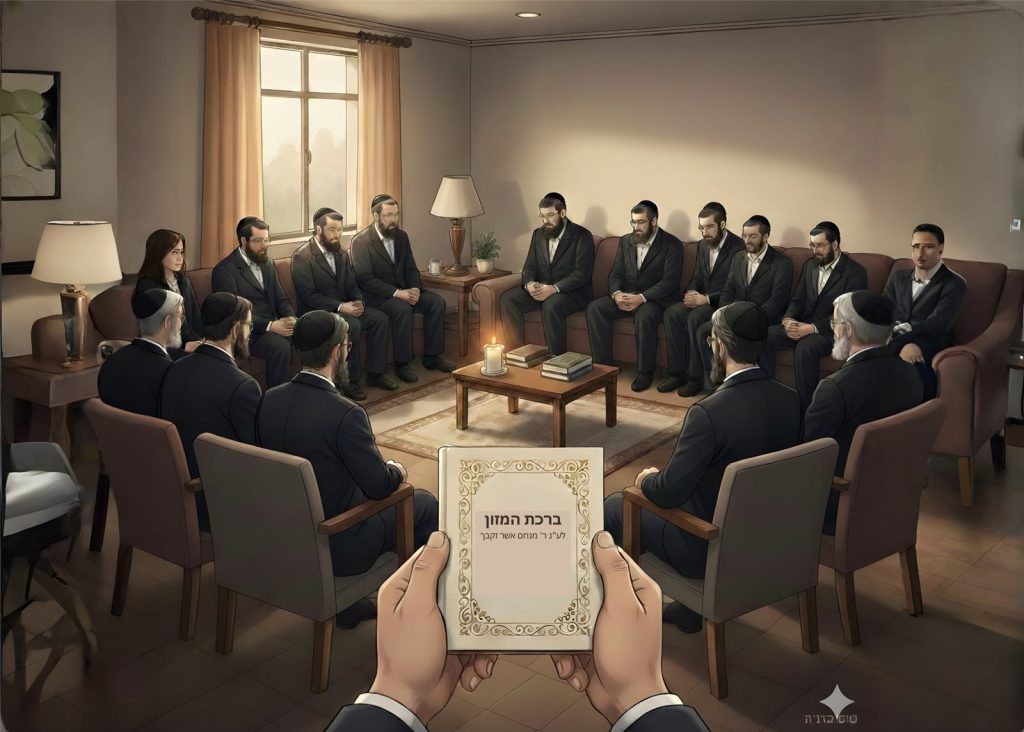
The first family he went to was the Zekbach family, his neighbors, who were sitting shiva for their twenty-four-year-old son, Menachem Asher.
Chaim sat quietly among the many visitors who came in and out. Some people spoke softly. Some cried. Others simply sat and listened.
As he sat there, he saw that they were giving out bentchers. On the cover, it said: The last wish of Menachem Asher was to bentch from a bentcher. See inside to read the letters.
“What does this mean?” he asked.
His family said that, eight years earlier, on Erev Yom Kippur, Menachem Asher had made a hachlata to always bentch from a bentcher.
“He never bentched by heart,” they said. “If he went to a wedding or a bar mitzva, he would only wash if he knew he’d have a bentcher to bentch with.”
Chaim left the shiva house feeling very moved. He’d come to give them strength, but he left feeling strengthened himself. He decided to make a hachlata to always bentch from a bentcher.
A month passed, and life slowly returned to its routine. Chaim, who wrote tefillin and mezuzos, now was struggling to find new work.
He showed samples of his writing to different people, but they all said, “Your writing is nice, but it’s not what we’re looking for.”
He didn’t know what to do. Nobody was hiring him as a sofer. After another disappointing job interview, he was walking down the streets of Bnei Brak and stopped by a bakery for a bagel.
From there, he went to an apartment where sofrim often sat and wrote. He washed, ate, and was about to bentch.
But then he remembered: I made a hachlata to always bentch from a bentcher!
He looked around for a siddur or bentcher, through drawers and all the shelves. A few minutes passed, but he still couldn’t find one.
Should I bentch by heart…? He thought. Right then, he thought of his neighbor’s son. He knew he should do the same. He wouldn’t bentch without a bentcher.
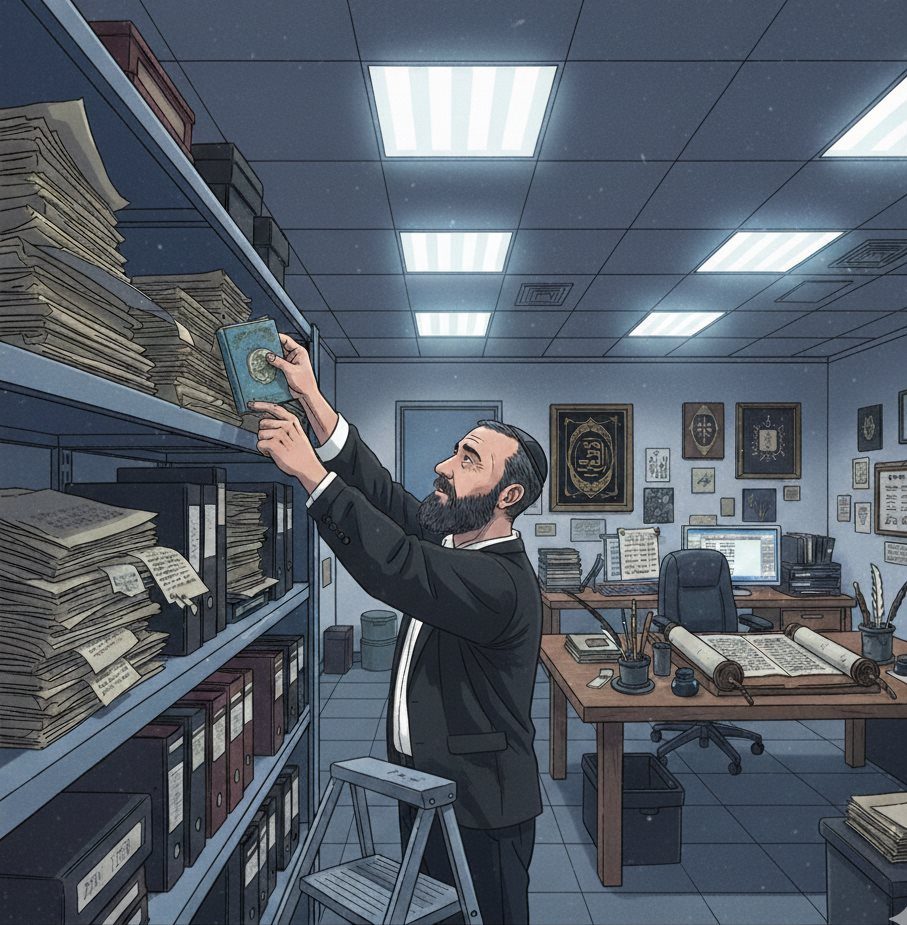
He looked around the room once more, more carefully this time. That was when he noticed a stack of papers pushed far back on a high shelf. He reached up, moved them aside, and underneath, he finally saw it.
A bentcher.
Chaim took it down and opened it. Right away, he noticed how the letters were written in Ksav Ashuris, just like a sofer writes!
Wow, look how beautiful this print is! He thought. Maybe I can try copying this to make my writing even better.
After bentching, he started copying the letters. For three full hours, he copied the entire bentching, slowly and carefully, letter by letter, until his own writing looked just like the letters in the bentcher.
Five minutes later, his friend walked in. “I was just offered a job to write a Sefer Torah, but I’m too busy. Can you do it?”
“I’d love to,” Chaim said.
“Okay,” the friend said, “but they’ll want to see a sample of your writing before giving you the job. Can you give me something to show them?”
“Sure,” Chaim replied, handing him the pages of the bentching. “I just finished writing this.”
Half an hour later, his phone rang.
“I showed them your writing,” his friend said, his voice filled with excitement. “And they love it! They want to hire you.”
Chaim sat up straighter. “I’ll do it! Who’s giving me this job?”
“Rabbi Shmuel Dovid Friedman, from Boro Park. He wants to help write a Sefer Torah for each of the forty-five people who passed away on Lag Ba’Omer.”
“Wow,” Chaim said. “Who’s the family I’ll be writing the Sefer Torah for?”
“The Zekbach family,” his friend replied. “They want to write a Torah in memory of their son, Menachem Asher.”
Chaim sat frozen in his spot, stunned by the news.
Menachem Asher Zekbach’s careful bentching had inspired him to search for a bentcher just a few hours earlier. And now, he was being asked to write a Sefer Torah in Menachem Asher’s memory!
Everything had come together in the most incredible way.
The Sefer HaChinuch says, anyone who’s careful with bentching, his needs will be provided for with honor and dignity his entire life. When we bentch from inside a bentcher, Hashem can send us brachos in ways we never expected.
(Heard from Rabbi Yoel Gold)
Beis Moshiach #1496 • pp. 54-59
© 2026 Beis Moshiach Magazine. All rights reserved.
This article originally appeared in Beis Moshiach #1496. You are welcome to share it with friends and family by email or in print, provided that you do not change, add to or omit any part of it, you credit the author and Beis Moshiach, and you include a link to archive.bmoshiach.org (written out in full in printed copies).
To republish this article in a newspaper, magazine, book or website, please request permission in advance at [email protected].