A Doctor, A Judge, and a Rabbi
From the TzaddikStory.org collection
Shirley was our first daughter, born in 1988. We love her more than words could describe. But when our bundle of joy was three months old, she began spending hours screaming and crying. She wouldn’t sleep, wouldn’t eat, and barely even stopped to breathe. We were lucky when Shirley fell asleep for just ten straight minutes.
After a particularly hard fit one night, my husband and I decided to take Shirley to the emergency room. We spent five hours in the hospital, bumped from one doctor to the next. Some said, “She’s a baby; babies cry,” but when we said we knew something was wrong, they took a closer look.. At last, we were called into the pediatric director’s room. His face told us all we needed to know – whatever he had to say, it was bad news.
“We discovered a very serious tumor on Shirley’s brain. We’ll do everything in our power to save her, but you may want to prepare for the worst.”
My husband and I stared at the doctor in shock. We couldn’t believe what he was saying. Shirley, our perfect little princess, was dying, and she wasn’t even a year old yet.
“We have Shirley on sleep medicine. You should go home to pack. You’ll be in the hospital for a long time.”
I burst into tears and took Shirley into my arms, hugging her close as we left the room. I kept whispering to myself, “What do we do…? What do we do?”
* * *
I walked out of the hospital heartbroken. It was Friday afternoon, and the sun was shining down like a spotlight. A young girl approached and put a hand on my shoulder.
“Are you Jewish?” she asked me.
I nodded. She handed me Shabbos candles.
“Are you okay?” she asked. “Why are you crying?”
I waved my hand to tell her not to worry and started toward a bench in front of the building. But the girl was insistent, and she followed me.
“My name’s Mina,” she told me. And maybe it was the fact that she was a stranger, or that she was a Jew, or that she had been so kind to me, but minutes later, I found myself sobbing to her about the terrible news I’d just received.
“I’m from Mexico,” Mina told me. “But I’m studying in Crown Heights now. There’s a great rabbi there who can perform miracles. Come with me to meet him on Sunday, when he hands out dollars.”
Mina handed me her number, and the Rebbe’s address: 770 Eastern Parkway. She promised to be in touch, Sunday morning.
I smiled and watched her leave, knowing full well I had no intention of going to Crown Heights for dollars. I didn’t know anything about Chabad, and I certainly didn’t believe in miracles.
I stayed with Shirley, my little princess, at the hospital over Shabbos. My husband came to replace me on Motzaei Shabbos so I could freshen up. At home, I found a message from Mina on my answering machine.
“Don’t forget about tomorrow,” she’d said, confidently. “We’re going to get a blessing from the Rebbe.”
I chose not to return Mina’s call – after all, I had no intention of going with her. But the next day, at eight in the morning, Mina called again.
“Do you need a ride?” she asked. “Or directions?”
At that moment, I realized something – my daughter’s life was hanging in the balance, and the doctors weren’t hopeful she’d live to see her first birthday.
What did I have to lose by believing in a few miracles?
I made arrangements with Mina, and we made our way to 770. When we got there, the line was long, and the weather was freezing.
“We should go back,” I said. “No use waiting in the snow.”
But Mina insisted. “Trust me,” she begged. “The Rebbe will be able to help you. All you need is a little patience.” With a sigh, I listened to Mina and waited with her. For hours, we stood, watching people approach the holy man and walk away with dollars.
The entire ritual seemed foreign to me. But I was doing this for Shirley. Two hours later, it was finally my turn!
Despite my South American history, I’d lived most of my life in the United States – but I did speak Spanish. Having moved as a toddler, I had no accent. No one really knew I came from South America, and no one knew I spoke Spanish. So, when I stood in front of the Rebbe, I told him in fluent English, “My daughter, Shirley, is very sick.”
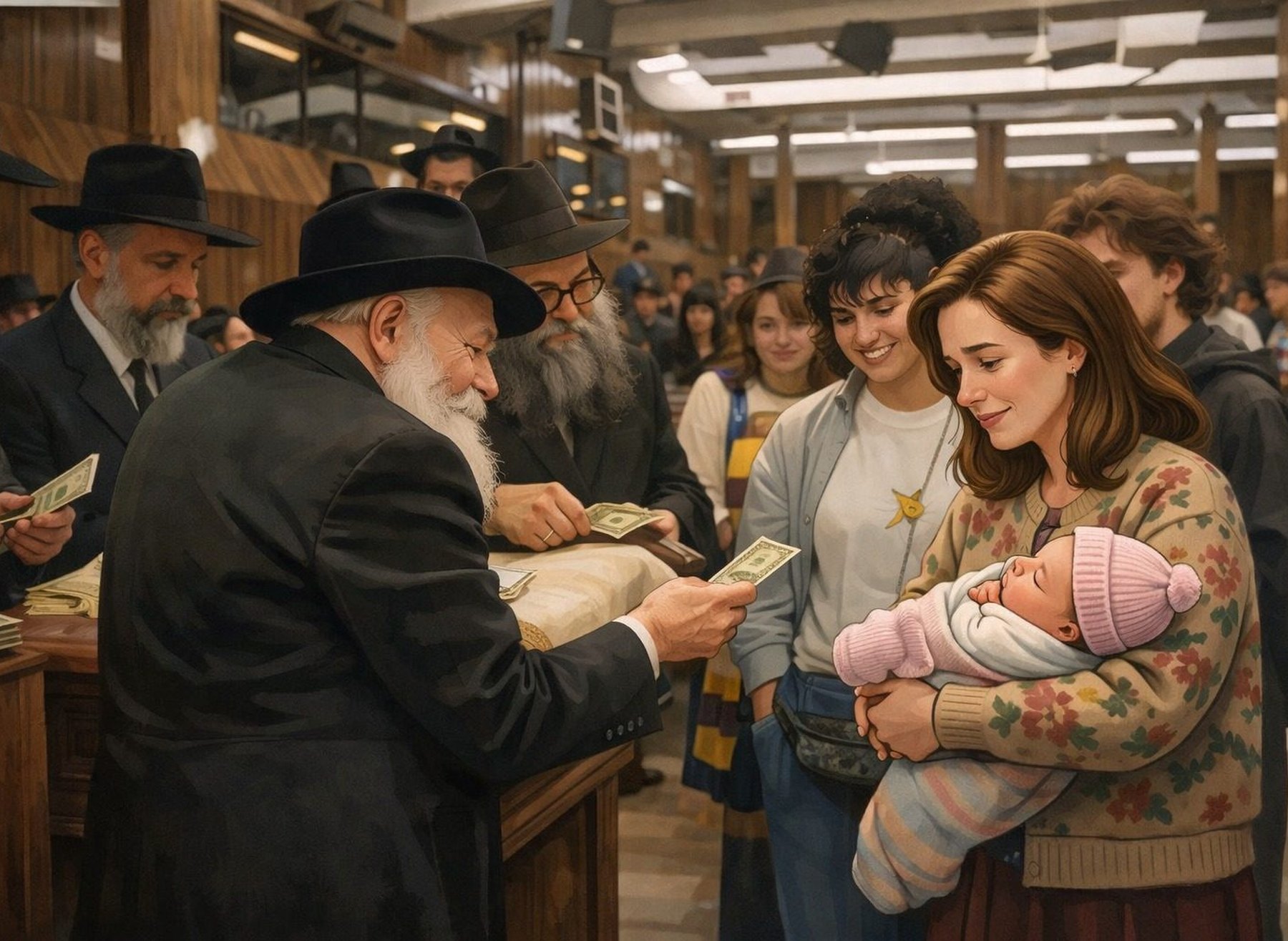
The Rebbe asked me my name, then handed me two dollars – one for me, and one for my daughter. Then he said, in perfect Spanish, “Next time you come, bring your little girl.”
I left the building shaking. Mina was waiting outside for me, bubbling with excitement.
“How was it?” she asked me.
“…Did you tell the Rebbe I speak Spanish?”
Mina shook her head, confused. Of course she didn’t. Had she even known? I now understood why everyone spoke so highly about the Rebbe. I felt like I finally had someone to turn to. I had hope. I burst into tears and collapsed into Mina’s arms.
* * *
The following Sunday, I no longer needed a push from Mina. I’d been waiting all week to go back. I coordinated with the head nurse for Shirley to join me, and when I got there, I quickly met with the secretaries, who led me to the Rebbe.
Shirley and I were welcomed with a wide smile, and immediately the Rebbe began giving my little girl dollars and blessings. I was so distracted, I can’t remember a word of what the Rebbe said, but by the time we’d walked out, Shirley’s coat had eight dollars tucked into it, which meant my little girl had gotten countless blessings from the great tzaddik!
This gave me strength over the next few days. Shirley was being constantly monitored all day long by different doctors and nurses. Finally, after days of tests, the doctors were convinced my daughter needed surgery.
At this point, I was going to 770 almost every day. Sometimes, I’d only catch a glimpse of the Rebbe going to the mikva or the Ohel. Other times, he’d smile or wave at me while on his way out. Every tiny moment gave me strength.
* * *
Meanwhile, the doctors continued to pressure me, insisting surgery was the only way to save Shirley’s life. Every day for weeks, the doctors pushed against my instincts, until, eventually, it was too much.
“Just wait until Sunday,” I begged.
They were uncertain about my way of dealing with things, but the doctors agreed, reserving the operating room for Monday.
That Sunday, I went to 770 to speak to the Rebbe. “They want to give my Shirley surgery,” I told the tzaddik. “Please, I don’t want my baby to go through that.”
The Rebbe nodded and handed me a dollar. “Give this to tzedaka,” he told me. “And Shirley won’t need surgery.”
When I told the doctors, they were furious. I don’t have the words to describe how they looked at me. They were screaming that I’m a horrible parent. The accusations began immediately.
I tried to explain the Rebbe to them, hoping the Jewish doctor might be on my side, but the more I spoke, the angrier they became.
“Is this rabbi of yours a doctor?” they accused me. “A religious fanatic! Why do you think you can make decisions about her health based on some rabbi’s advice?”
They tried to convince my husband, but he was on my side. Not because he believed the Rebbe, but because he was trained in science and medicine and he didn’t believe Shirley had a chance. “Why make the poor girl suffer?” he said. “Let her die in peace and just try to take away as much pain as possible.”
For the entire week, every nurse, doctor, and technician tried to get me to change my mind. I spent most of my days arguing. It was so exhausting, I found myself going to 770 more than ever, relying on the moments of strength the Rebbe provided for me.
* * *
“They’re putting all this pressure on me,” I told the Rebbe. “They even have me meeting with the department head and some psychologist to try and change my mind.”
The Rebbe handed me a dollar and said, “When you stand before the judge, ask them to reexamine.”
I felt taken aback. I hadn’t said anything about a trial or a judge. But before I could react, I was being pushed away to make room for the next person.
* * *
Four days later, I found out that the Rebbe had been right. When I came home, there was an important letter waiting for me. The letter said I had to come to court.
The hospital was claiming something very serious and very hurtful. They were telling the judge I wasn’t taking care of Shirley.. Because of that, they wanted the court to let someone else take care of Shirley for a little while, instead of allowing her to stay with me.
* * *
The doctors had a bunch of papers that proved Shirley’s only chance at survival was surgery, and a letter that claimed I was thinking clearly. The letter said I was suffering from “religious visions,” that I was going crazy, and that I couldn’t really see the truth.
I couldn’t believe what I was seeing. Hadn’t we suffered enough? Immediately, I set out for 770. Once there, I gave the letter to the Rebbe’s secretary and asked that a copy be shown to the Rebbe. Hours later, at 11:00 p.m., I received a call.
“We showed the Rebbe the letter,” the secretary told me. “And the Rebbe said he’s already told you to ask for a reexamination.”
Suddenly, I felt like I could breathe again. My job was to trust. So, I trusted in the Rebbe.
* * *
The court date was just a few days later. At nine in the morning on the day of the trial, I appeared before the judge alone. I didn’t hire a lawyer. I didn’t feel I needed one. I had the Rebbe. While the hospital came with a full staff of lawyers and witnesses, I sat by myself, ready to defend my decision and my daughter.
The prosecution opened with a smear campaign. They painted me as a monster and a religious fanatic. I was negligent and unfit. They asked the court to take my daughter from me.
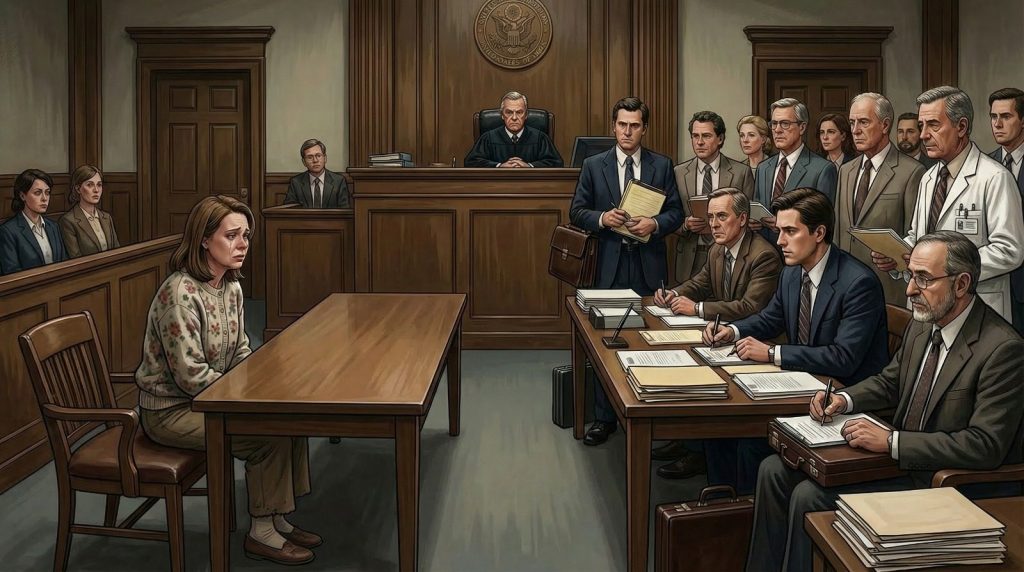
I listened to their words, crying, but when it was my turn to speak, I didn’t rush to defend myself. I closed my eyes and pictured the Rebbe’s kind face. I tried to remember all those moments of courage. And then I stood up, wiped my cheeks, and made one simple request: “I’d like to ask that a third party reexamine my daughter’s case. Someone who’s never met me or my daughter before.”
The judge narrowed his eyes on me. “Why would a different hospital find different results?”
I shook my head. “Your Honor, I don’t have the strength to get into all the details of the past few weeks. But please trust that I love my daughter, and all I want is what’s best for her.”
The judge nodded in understanding, and in that moment, I knew he believed me. The doctors were upset, though.
“Your Honor,” they called. “This is just a tactic to buy time!”
The judge considered this, then called me over to his desk. “If I grant your request,” he said, “and we have other doctors look at her from a whole different hospital, do you promise to respect whatever the other doctors come up with?”
I nodded. “I promise.”
“Any decision?” the judge clarified.
I nodded again, “Yes, your honor, I promise!”
The judge then slammed his hammer down on his desk. “I believe the mother’s request is fair. Another hospital will take a look before anything is decided.”
* * *
The test was set for Sunday at 5:00 p.m. On Sunday afternoon, I picked Shirley up from the hospital and took her to 770, where I caught the Rebbe up on what was happening.
He nodded and thought for a moment. Then he handed Shirley a dollar bill and touched her little palm with his right hand, something that, to this day, I believe was very important. Then the Rebbe smiled and said, “Healing is near.”
Filled with relief, I left 770 and headed straight for the testing center. Then we waited four days to hear the results in court. Naturally, it was a very tense four days. But my trust got me through it.
Each day, I went to 770 to see the Rebbe and get my daily drops of courage and chizuk. Then I arrived at the court, one hour before the allotted time. I was very anxious. All I wanted was for my daughter to recover.
* * *
I saw the hospital crew show up too, and we were each handed the findings from the third-party hospital. I couldn’t wait. Within minutes, I was reading through the papers, skipping to the end where the results were stated clearly: no tumor was found anywhere in Shirley’s body.
My heart sped up, and excitement raced through me. I kissed the pages, barely breathing, I was so relieved. Before the judge, the doctor shared exactly what was written: that no tumor was found, and that, according to him, she wasn’t sick.
“I’ve been a doctor for 35 years,” he told the judge. “And either there was a miracle here, or there was never a tumor to begin with. Either way, this little girl is perfectly healthy!”
The judge nodded. “This court sees these findings as the end of the story. Whether the mother wants additional tests or procedures is now entirely up to her.”
* * *
As part of the court’s decision, Shirley was to be taken for checkups every few weeks to make sure the tumor stayed gone. At one of these routine checkups, I was visiting with the Jewish doctor from the children’s department, and suddenly, I saw a small picture of the Rebbe on his desk.
Of course, I didn’t bring this up, not wanting to embarrass the man, but I can say with full confidence that my little Shirley changed the course of that man’s life. And when Shirley was eight months old, after months of poking and prodding, she was finally released from her monthly checkups with a clean bill of health.
“I guess it’s time to stop driving her crazy,” the doctor said. Of course, Shirley and I continued visiting the Rebbe regularly, and on my little girl’s fourth birthday I took her back to 770 to say thank you.
The Rebbe smiled and handed my little girl two dollars. “For your tuition,” he told her. “At Beis Rivkah.”
And of course, true to the Rebbe’s words, my daughter spent her entire childhood studying at Lubavitcher institutions, where she made friends, learned Torah, and lived a full, happy, and healthy life!
This story is based on the Hebrew sefer “Abba.” Research was done by the author, Rabbi Moshe Orenstein, with further verification from Rabbi Shain of Crown Heights and Mrs. Shaindel Tiechtel, who was the principal of Beis Rivkah
Beis Moshiach #1499 • pp. 55-59
© 2026 Beis Moshiach Magazine. All rights reserved.
This article originally appeared in Beis Moshiach #1499. You are welcome to share it with friends and family by email or in print, provided that you do not change, add to or omit any part of it, you credit the author and Beis Moshiach, and you include a link to archive.bmoshiach.org (written out in full in printed copies).
To republish this article in a newspaper, magazine, book or website, please request permission in advance at [email protected].