The Shtetl in the Corn Belt
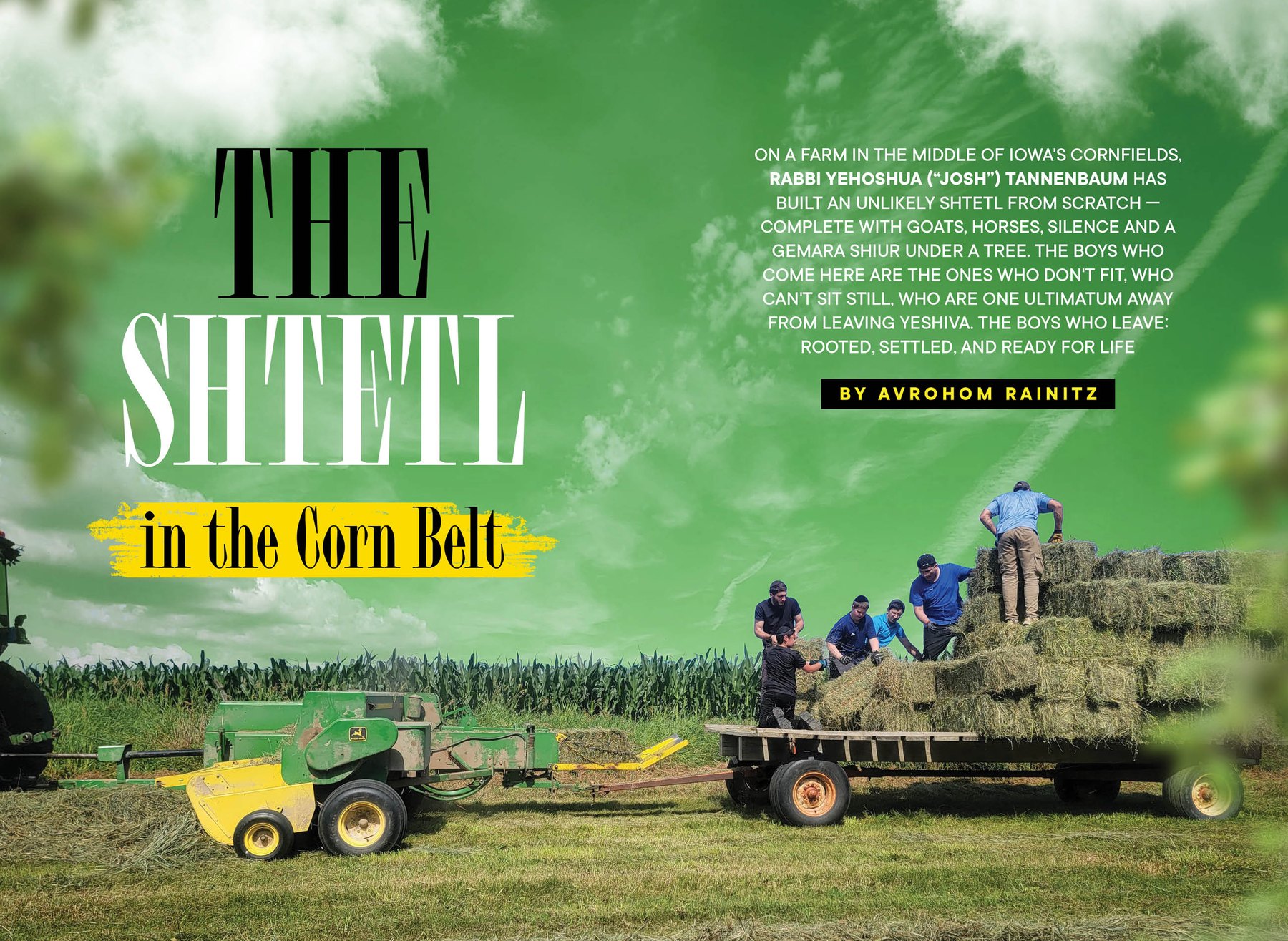
On a farm in the middle of Iowa’s cornfields, Rabbi Yehoshua (“Josh”) Tannenbaum has built an unlikely shtetl from scratch – complete with goats, horses, silence and a Gemara shiur under a tree. The boys who come here are the ones who don’t fit, who can’t sit still, who are one ultimatum away from leaving yeshiva. The boys who leave: rooted, settled, and ready for life.
The deep silence stretching across the expanses of Iowa is a silence that allows you to hear even the heartbeat of nature, so far from the digital noise and urban pressure. Within this silence, under the shade of a broad-canopied tree on the farm, one of the miracles of ‘Camp Shtetl’ took place.
One boy, let’s call him Yanky for the sake of this story, sat there, his back turned to the Gemara shiur being conducted nearby. In his hands, a small whittling knife, and between his fingers, a simple tree branch. He peeled chip after chip, layer after layer, and it seemed that with each peeling of wood, another shell covering his soul was shed.
“Yanky came to us with a very heavy ‘file,’” says Rabbi Josh Tannenbaum. “His father called me in despair, told me that his son was diagnosed with severe ADHD and learning disabilities. At the yeshiva where he studied they gave him an ultimatum: either he takes strong medications to be able to sit ‘normally’ in class, or he goes home. And Yanky? He hated those medications. He said they made him feel like someone who wasn’t himself.”
Already in the preliminary Zoom call that Rabbi Josh conducted with the boy, he saw a restless kid. “He talked to me while jumping on a trampoline, completely lacking repose. I immediately realized that a different approach was needed here.” When summer came, R’ Josh suggested the boy put the pills aside and try to connect with himself through nature. “During the shiurim, he didn’t sit at a table like everyone else, but on the side, and whittled branches to create ‘marshmallow sticks,’ but his ears were open. For the first time in his life, no one yelled at him for not sitting straight”…
The change was dramatic. “His father called me during the summer completely astonished,” R’ Josh recalls. “He told me about a video call he arranged between Yanky and his brother who stayed in the city. The brother tried to provoke him, asked him: ‘What, doesn’t it bother you that they’re picking on you? Come on, fight them!’ And Yanky, who in any other setting would have exploded, answered calmly: ‘Why fight? Over here, if something happens, we just talk about it.’ The father got emotional on the phone. He told me: ‘Yanky is a different child’”…
This is the great victory of the ‘Shtetl.’ This boy, who finished the summer without needing medications, returned to the yeshiva world equipped with new strengths. “Today,” R’ Josh concludes with satisfaction, “he’s learning in a completely regular yeshiva. Not only has he integrated, but he’s become the boy who’s always at the ‘seder Chassidus’ in the evening. He found his peace here among the trees, and managed to take that peace back with him to the walls of the yeshiva.”
Entering the Room at the Right Moment
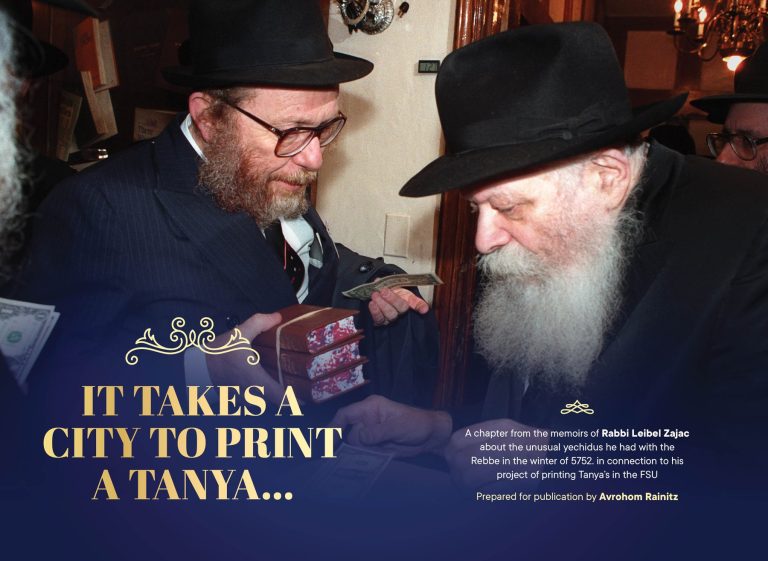
To understand the force that drives R’ Josh Tannenbaum on the Iowa prairies, one must go back in time, to the line for receiving dollars from the Rebbe. That’s where the first spark was planted.
“My connection with the Rebbe is a family story,” he says. “My mother grew up in Crown Heights in the early years of the Rebbe’s leadership. She told us how she would see the Rebbe walking down the street, and sometimes he would stop and give her coins for tzedaka.
“My mother grew up in a modern family, and after she got married, we lived in the Five Towns, an area where modern Orthodox Jews lived. Nevertheless, she always had a warm feeling for Lubavitch and when she heard that the Rebbe was distributing dollars for tzedaka on Sundays, she would go occasionally with her children to receive a dollar for a bracha from the Rebbe.”
One Sunday, when she was already a mother of four, she came to the Rebbe and received four dollars for the children. Immediately after, she continued on her way. Then the Rebbe called her back. “He handed her a fifth dollar and said: ‘May all your children be blessed.’ A week later she discovered she was expecting her fifth child…
Young Josh’s first encounter with Chabad happened thanks to a classmate in the Five Towns, Yossi Weinstein. “In fifth grade, Yossi told me he was going to Gan Yisrael during the summer months. I came home and told my parents: ‘I want to go with him’ and they agreed.” This trip was an entry into another world for him. “We bought a Nusach Ari siddur, new tzitzis, and set out on a journey that was new and amazing for me.”
The return home from camp was no less dramatic. “I came back a different child and my parents were frightened,” he laughs. “During my stay at camp I caught lice, so they gave me a short haircut… when I came back and started proclaiming the ‘pesukim’ or Chabad slogans I learned at camp – my parents thought I had jumped into waters too deep… I already knew then – this is it, I’m ‘tailored’ for Chabad.”
Despite the strong pull, the path wasn’t easy, certainly not straight. During his teenage years, he continued searching for himself, and wandered a lot between different types. Only after high school, when he went to study in Israel, did things come to a head. He arrived in Tzfas where he met Rabbi Yaakov (Yankel) Orimland, someone who became his mentor.
“At a certain stage I got into trouble with the yeshiva administration, and the Rosh Yeshiva told me that if I didn’t sign a commitment to strict rules – I would have to leave. By hashgacha pratis, Rabbi Orimland entered the office and heard this. He turned to the Rosh Yeshiva and said simply: ‘I’ll take responsibility for him.’”
This gesture of absolute trust in a boy who didn’t fit in changed his life.
Later, Rabbi Orimland opened a special program for boys who had gone off the derech, and Josh became a madrich in his yeshiva. He lived in Rabbi Orimland’s home for two years, and began to understand that true chinuch passes through the heart, through trips and through soul conversations. “In those years I merited to strengthen and deepen my connection to Chassidus and to the Rebbe. I knew this was going to be a big part of my life,” he says, adding that there the decision also matured in his heart: one day, he too would establish a place for those boys seeking to learn in a different atmosphere.
Returning to Yeshiva
After formative years in Tzfas, Josh understood he was facing a crossroads. “I knew the time had come to move forward,” he recalls. “I returned to the US and decided that before entering full force into the world of work and employment, I must lay for myself a strong foundation of Chassidus and Torah learning.”
He went to yeshiva in Morristown, New Jersey, where he dedicated a full year to intensive study.
However, as someone for whom “doing” burns in his bones, the respite didn’t last long. “In Morristown I befriended the Meer family, and together with their son Yehuda we decided to open a construction business.” What started as small jobs quickly became building actual houses.
Despite the economic success, his heart pulled him elsewhere. “I always knew I wanted to be involved in kiruv. It was part of me since my youth. When I married my wife Shira, we both knew we didn’t want to stay in the heart of the established Jewish center, and we started looking for a place where we could have more impact.
“Our dream was to find a place where we could combine city community life together with a farm. We wanted to live the rural lifestyle, with animals, land and manual labor, and use it to bring Jews closer.”
The Tannenbaum family’s journey to the heart of America’s “Corn Belt” actually started from the professional aspirations of his wife, Shira. After completing her medical studies, she decided to specialize in the difficult field of anesthesia, and subsequently – a specialization in heart, cardio-thoracic surgery.
Following the specializations in medical centers, the two embarked on a series of wanderings. “In every place we came to, we asked ourselves: how can we help Jews here? We always knew that the goal was to find a permanent place where we could establish our dream – a combination of rural life with shlichus.”
When the time came to look for a permanent position for Shira, they faced an enormous challenge: the modern medical world doesn’t always accommodate the schedule of Shabbos and Jewish holidays. “To find a senior medical position when the first condition is ‘Shabbos observant,’ is almost impossible,” explains R’ Josh. “Everywhere they told us it would be very difficult.”
But then they arrived in Bettendorf on the banks of the Mississippi River, in the state of Iowa. “We checked five or six different places throughout the US, and each time we asked ourselves: Why here? Why Iowa?” The answer came from the management of the local medical center. “The moment they heard about Shabbos observance, they said immediately: ‘We love to diversify our staff. Don’t worry, we’ll manage. You won’t work on Shabbos, unless it’s an emergency case of saving a life’”…
This small miracle was the sign for them. “Everything just worked out. G-d’s hand was completely clear,” he says. The place was quiet, the expanses infinite, and the distance from Chicago – about two and a half hours’ drive – allowed them to stay connected to a large Chabad center, while they built their private “island.”
They settled on a large farm outside the city. Initially they thought the children would learn in the online Chabad schools, but when they encountered technical and bureaucratic difficulties, Shira and Josh decided to take the reins into their own hands. “Some of the children remained learning in the online Chabad schools, and in parallel we established a study program at home. The children learn here on the farm, combining limudei kodesh alongside work in the field. Every time I asked them if they wanted to return to a regular yeshiva, the answer was unequivocal: ‘No way! We finish all the material in half the time, and we have time to go outside, take care of animals and live in nature.’”
Thus the home in Iowa became a living school and a vibrant shlichus. The children grew up between the goat herd and the pages of Gemara.
This was the perfect background for what would become their flagship project – the place where every Jewish boy can feel at home, even if he feels like a stranger in other places.
Discovering Souls Among the Furrows
The shlichus in Iowa, R’ Josh discovered from the beginning, doesn’t only take place within the walls of a shul. It also happens in the building supply yards, in the big-box stores, and especially – in the barn… “I walk around here with a kipa and tzitzis out, and because of the farm work I wear work clothes,” he says with a smile.
This unique appearance, a Chassidic Jew who is also a farmer who understands tractors, is the key that opens even sealed hearts. The most amazing story that R’ Josh shares with us is the encounter with Benson.
“One day we realized we had too many male goats on the farm. According to halacha, this creates questions of firstborn status, and I decided to sell some of them. I turned to my neighbor, a local farmer, and asked him where goats are sold in the area. He told me: ‘You need Benson.’ I picked up the phone, two days later a long trailer arrived.”
Out of the trailer came a man who looked like the embodiment of the American cowboy: wide-brimmed hat, torn shirt, worn work boots and a tough look. “He got out of the truck, looked at me and said in a heavy accent: ‘I can say honestly that you’re the first Orthodox Jew I’ve ever bought livestock from’… I asked him in wonder: ‘What do you have to do with Orthodox Jews?’ He didn’t answer in words, but simply pulled down his shirt collar and revealed a huge Star of David tattoo displayed on his chest. ‘I’m Jewish just like you,’ he declared.”
This moment became the beginning of a journey. “I tried to put tefillin on him, but he immediately declared ‘religion and I don’t connect.’ It took him two years until he agreed to enter the shul to hear the Aseres HaDibros. Today he’s already part of our extended community. He loves to tell me stories about the ‘gefilte fish’ from his childhood, and throws out different words he remembers in Yiddish.”
These encounters repeat themselves again and again. “Once I was standing in line at Menards (a large building supply chain) and ordered paint for a project on the farm. Suddenly someone behind me says: ‘Hey, you’re from the East Coast, right? Your accent gives you away.’ I turned around and saw a man covered in tattoos. It turned out he was a Jew from Brooklyn who landed in Iowa. Today he comes to us every year to get yahrtzeit candles”…
R’ Josh explains that specifically the loneliness and the enormous distances between city and city, between farm and farm, cause these Jews to awaken. “I don’t need to look for them, they just come to me because I look different; because I live my Yiddishkeit proudly even in the middle of nowhere.”
These encounters are the fuel of the Shtetl in Iowa. They prove to him that in every place where a Jew sets foot, there are sparks waiting for their redemption – sometimes through a transistor, sometimes through building a fence, and sometimes through a simple transaction of a few goats.
Don’t Go to Camp; Be the Camp
In the world of modern summer camps, the child is the customer. He comes to be entertained, fed and have a good time. But at R’ Josh’s ‘Camp Shtetl,’ the model is exactly the opposite. “Our slogan is: ‘Don’t go to camp, be the camp,’” he explains. “The truth is they don’t come to a ready-made place. They come to live it, build it and be part of it.”
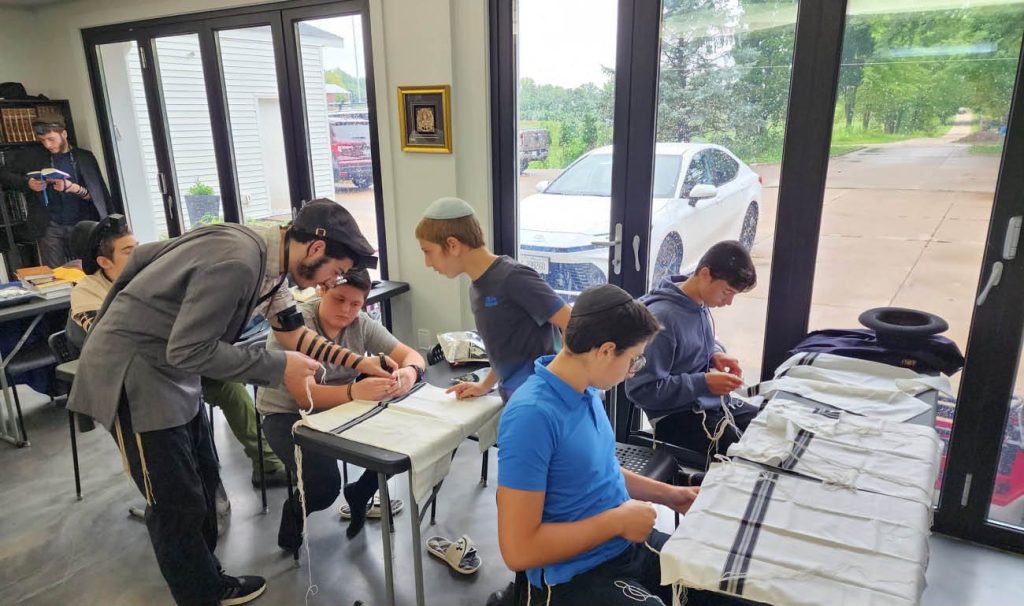
The change begins the moment they land on the farm. All electronic devices – phones, music players, tablets – are collected and deposited for safekeeping. “We don’t have electronics, period. In today’s world, kids are unfamiliar with such silence. This disconnect is necessary so they can start to hear themselves, nature and their friends.”
The daily schedule on the farm is a combination of ‘book and sword’ in an agricultural version. The morning opens with davening and learning, and the learning is always connected to what the hands are about to do. “If they’re learning hilchos Shabbos, they go outside and build an eruv. If they’re learning about the melachos of the Mishkan, we work in construction, experience fire and iron. The boys see the shochet at work, understand how food arrives.”
Responsibility is the name of the game. “Every morning there’s a list of chores and each boy has a job: feed the horses, milk the goats, collect eggs or prepare meals. We don’t have a cleaning staff. If someone comes in with mud to the house, I tell him: ‘Here’s the mop, here’s the broom, this is your home – clean it.’ This is a maturation process. They learn that they’re not guests in the world, but homeowners who are responsible for what happens around them.”
One of the times that R’ Josh won’t forget is building fences for the horses. “We worked together with the campers, drilled in the ground, stretched fences. At the end of the summer we took them to a rodeo. I saw one of the boys standing there, leaning on the fence and looking at the horses with dreamy eyes. He asked my wife, Shira: ‘It’s true that we’ll buy at least two horses, right? So one won’t be lonely?’ His words – ‘we’ll buy,’ ‘we’ – moved me. He didn’t feel like he came to visit someone else’s farm. He felt it was his, that he built this place.”
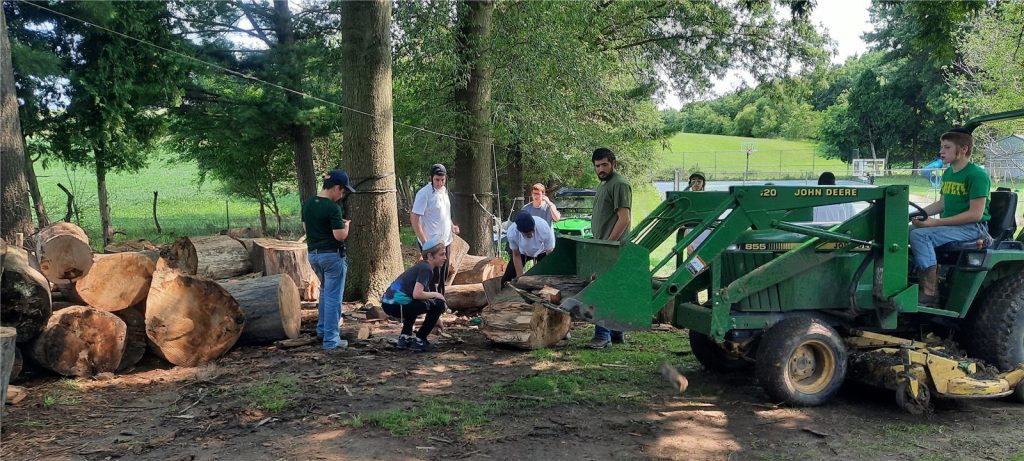
The hard work and dirt are an integral part of the experience. “We work hard, play hard, and usually get dirty,” he laughs. “Boys who come from the city, who are used to mommy doing their laundry and food arriving by take-out, suddenly discover their own strength. When they see my little boys, aged nine and ten, managing the herd, it gives them an enormous push.”
The Plans Changed, But Not the Destination
For years R’ Josh dreamed of taking his large family on a roots trip to Eretz Yisrael. “Covid delayed the plans, but two years ago it finally happened,” he says. “I planned a detailed route, tour guides, lodging in Tzfas; I wanted the children to experience the Land that I love so much.”
But on the morning of Simchas Torah, in a rented apartment in Yerushalayim’s Rechavia neighborhood, the plans shattered. “We woke up to the sound of sirens. At first we didn’t understand what was happening. My sons went out to the street and saw that everything was empty. Slowly the terrible rumors began. On motzoei Yom Tov, when we turned on our phones, we understood the magnitude of the disaster.”
Instead of succumbing to panic or looking for the first flight home, he acted exactly as he teaches his campers on the farm: he identified a need and went to work. “I called a tour guide I knew and asked him: ‘What are we doing?’ He told me that his friends at the front need everything – from undershirts and socks and so on. At that moment I announced to the family: ‘We’re not touring, we’re enlisting’”…
Within a few hours, R’ Josh became a logistical operation. He raised thousands of dollars from his community in Iowa through quick messages. The next morning, the whole family was already traveling with two minibuses, loaded with equipment. “We drove deep into the south, right up to the Gaza border. We saw the black smoke rising from the Strip, passed by tanks and APCs that stood ready on the road.”
One moment was etched in his memory with special intensity. “We arrived at a settlement where soldiers gathered at the shul as a meeting point. The moment I got out of the vehicle, a huge explosion was heard. Boom! The ground shook beneath us. I ducked instinctively, my heart was pounding. One of the soldiers saw me, patted me on the shoulder calmly and said: ‘Brother, don’t worry, that’s “ours’’…’”
For the remainder of their stay in Eretz Yisrael, the Tannenbaum family didn’t visit historical sites, but IDF bases. “We distributed equipment, talked with the fighters, put tefillin on them and strengthened them. When we returned to Iowa – through a circuitous route via Dubai because of flight cancellations – we felt like we were leaving a country at war, and it was hard. We felt like we wanted to stay longer and help.”
Planting, Growth and Chassidishe Patience
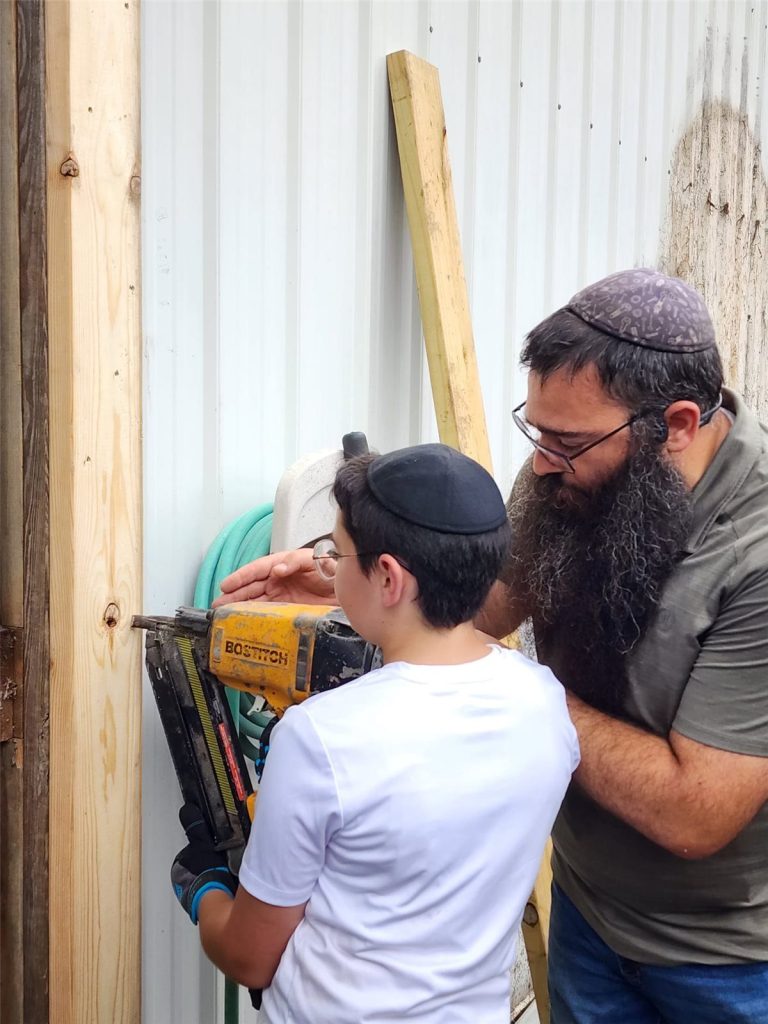
The concept “for man is a tree of the field” takes on a physical and tangible meaning on the Iowa farm. R’ Josh, who combines in his daily routine caring for a cherry and apple orchard alongside educating lively boys, sees the parallel lines stretching before his eyes anew every morning.
“There’s an inseparable connection between the way you care for the land and the way you care for children,” he explains. “Boys are like trees; you must start with the right seed, but you mainly need patience. In the modern world everything happens fast, at the click of a button. In agriculture, you learn that you can’t rush nature. You water, you fertilize, you take care – and wait, and in the middle pray a lot… You can’t force a tree to grow faster, just as you can’t force a boy to go through an internal process before he’s ready for it.”
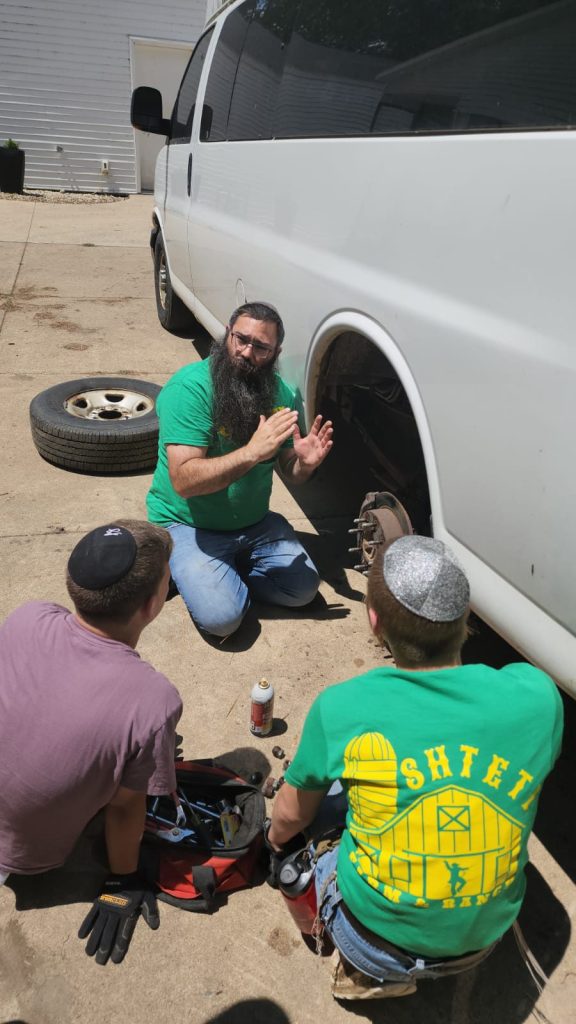
One of the fascinating things about the farm is the connection between halacha and living reality. “When we learn about brachos over food, what defines ‘fruit of the tree’ and ‘fruit of the earth,’ we don’t need imagination. We go out to the orchard. When the camper sees the tree he planted the previous summer beginning to sprout buds, he understands what Divine Providence is. He understands what investment is, giving, and also that his investment bears fruit.”
R’ Josh describes how nature serves as a “calming teacher” for boys who have difficulty in frontal frameworks. “A boy who sits in class and feels suffocated, goes out here, takes a hoe or milks a goat, and suddenly something in him opens. The pressure disappears. In nature there’s no competition of grades. The tree never judges you. This connection to the land gives them an anchor. They return home with a clearer perspective on life, because they experienced the ‘truth’ of creation.”
Even the topic of kashrus becomes an experience. “For a city boy, ‘chalav Yisroel’ is a sign on a carton in the supermarket. Here, when he milks the goat with his own hands in the morning, he understands what it means that the milk is kosher from the moment of production. This turns Yiddishkeit into something that penetrates the blood, not just something known in the head.
“Parents write to me that their children return with inner peace. They feel that part of their neshama remained here, connected to the roots. They learn to appreciate the small things – the water, the bread they baked themselves, the tree that needs daily care. This is avodas Hashem through feet and hands, and this is the best way to raise ‘trees’ that will be able to withstand any wind.”
Life in the “Shtetl” – Family as a Shlichus
It becomes clear that the name “Shtetl” chosen for the place is not just a nostalgic title, but an accurate description of the human dynamics that take place there. On the Iowa farm you won’t find ‘staff’ and ‘customers’ in the usual sense; you’ll find an extended family living their life together.
“Baruch Hashem, we’ve been blessed with a large family, bli ayin hara, fifteen children,” he says contentedly. “And that’s actually the camp. Our home is also the yeshiva, also a school and also a summer camp operating 24 hours a day. When campers come to us, they don’t enter a dormitory, they enter our home.”
One of the fascinating points in the interview is the way the family’s children serve as role models for the visiting boys. “It’s interesting to see a 16-year-old boy who comes from the city, standing amazed in front of my 11-year-old son who teaches him how to behave like a ‘young adult.’ My children don’t know anything else; for them loading food bags and caring for animals is a daily responsibility from as long as they remember themselves. My daughter was nine years old when she was already moving through the field to scatter seeds.”
This connection creates an atmosphere and there’s nothing like it. “Many people asked me: ‘And what about the social aspect? Aren’t your children lonely there on the farm?’ The answer is that our home is always full. Whether it’s a family that comes for a visit that turns into a ‘vacation’ of ten days, or groups of young people, students or camp participants. Not three weeks pass without us having guests for Shabbos, despite us being far from any religious or Chassidic center.”
Even learning becomes part of the family fabric. “During camp time, my older sons who study in large yeshivas come to be the ‘counselors’ and directors of the study programs. An amazing combination is created here: my son, a Chabad bachur, learns together with a boy from ‘Chofetz Chaim’ yeshiva who came to help in the summer. They learn Chassidus together, a page of Gemara, and create an achdus that can’t be found anywhere else.”
This atmosphere also affects the distant Jewish community in the area. “We’re not just a summer camp. We’re ‘JLC’ – acronym for ‘Jewish Life Campus.’ People know they have somewhere to come. On holidays and Shabbos the place becomes a bustling center. Suddenly there’s a minyan, there are Shabbos meals that Shira and I prepare with our own hands, because there’s no kosher catering in the entire area, and there’s a feeling of community being built from zero.”
R’ Josh’s vision is to expand this “Shtetl” even more. “The dream is that additional families will join us, that the place will grow and be really like in the past – a community that lives from the land, guards Torah values, and are joyfully interdependent. The land is large, the heart is open, and we see every day how the Yad Hashem directs more and more neshamos here who want to be part of this family.”
The Farm and Tractors on the Way to Moshiach
The Tannenbaum family’s shlichus on the Iowa prairies manages to bring about change that extends far beyond the boundaries of the small Jewish community. In the interview he excitedly tells how the non-Jewish neighbors, tough Iowa farmers, become part of the support of the ‘Shtetl.’ “They see the Jewish fire, and they come to tell us: ‘We support you, don’t listen to the background noise in the world.’ When a Jew lives with pride and kindness, when he extends a hand to a neighbor stuck with the heating system in the barn in the middle of the night – this is the first step of ‘l’saken olam b’malchus Shakai.’ This is the language of Geula.”
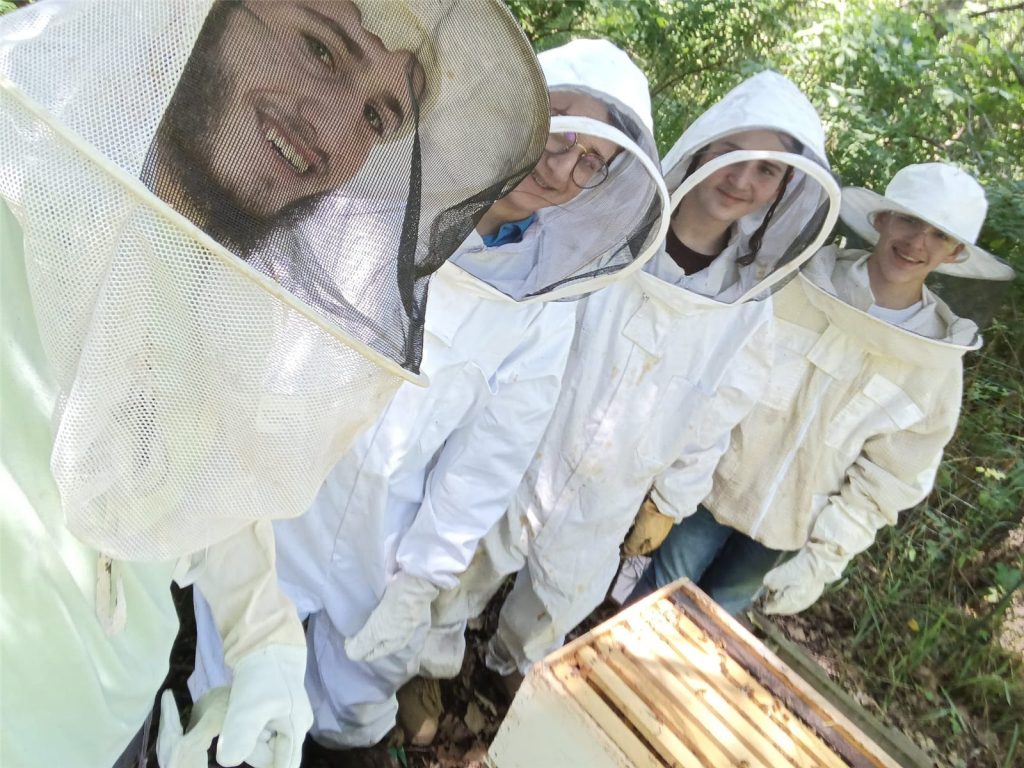
The anticipation for Moshiach on the farm is alive and pulsing, to the point that it’s even contagious to the parents of campers who come from the big cities. R’ Josh recalls a moving line from a mother of one of the bachurim: “She saw my son, a Chabad bachur who learns in Tomchei Tmimim, sitting and learning with a boy from a Litvishe yeshiva who came to help in the summer. They ran the camp out of utter Ahavas Yisrael, and she just stopped and said: ‘Listen, if Moshiach doesn’t come at your farm – I don’t know where else he can come’”…
Toward the end of the interview, I ask him about the moment when everything will change, about the day when the Rebbe will be revealed and we’ll all return to Eretz Yisrael. “Are you ready?” I ask, “Will you go up with your whole farm?”
He smiles. “We’re waiting for it at every moment. I’m 100% ready. With the whole farm, with the horses and tractors – everything will go up to Yerushalayim. Here in Iowa we’re already living now with the feeling of ‘me’ein Olam Haba.’ Everything is calmer, there’s not the crazy race of the city, and you can contemplate the world that the Borei created. We try to be as close as possible to the state of Geula; that the world will be free to engage in only knowing Hashem.”
(Special thanks to Benny Zigelbom, the devoted activity director at Camp Shtetl, for his help in facilitating this interview)
Beis Moshiach #1500 • pp. 42-52
© 2026 Beis Moshiach Magazine. All rights reserved.
This article originally appeared in Beis Moshiach #1500. You are welcome to share it with friends and family by email or in print, provided that you do not change, add to or omit any part of it, you credit the author and Beis Moshiach, and you include a link to archive.bmoshiach.org (written out in full in printed copies).
To republish this article in a newspaper, magazine, book or website, please request permission in advance at [email protected].