My Rebbe, My Words
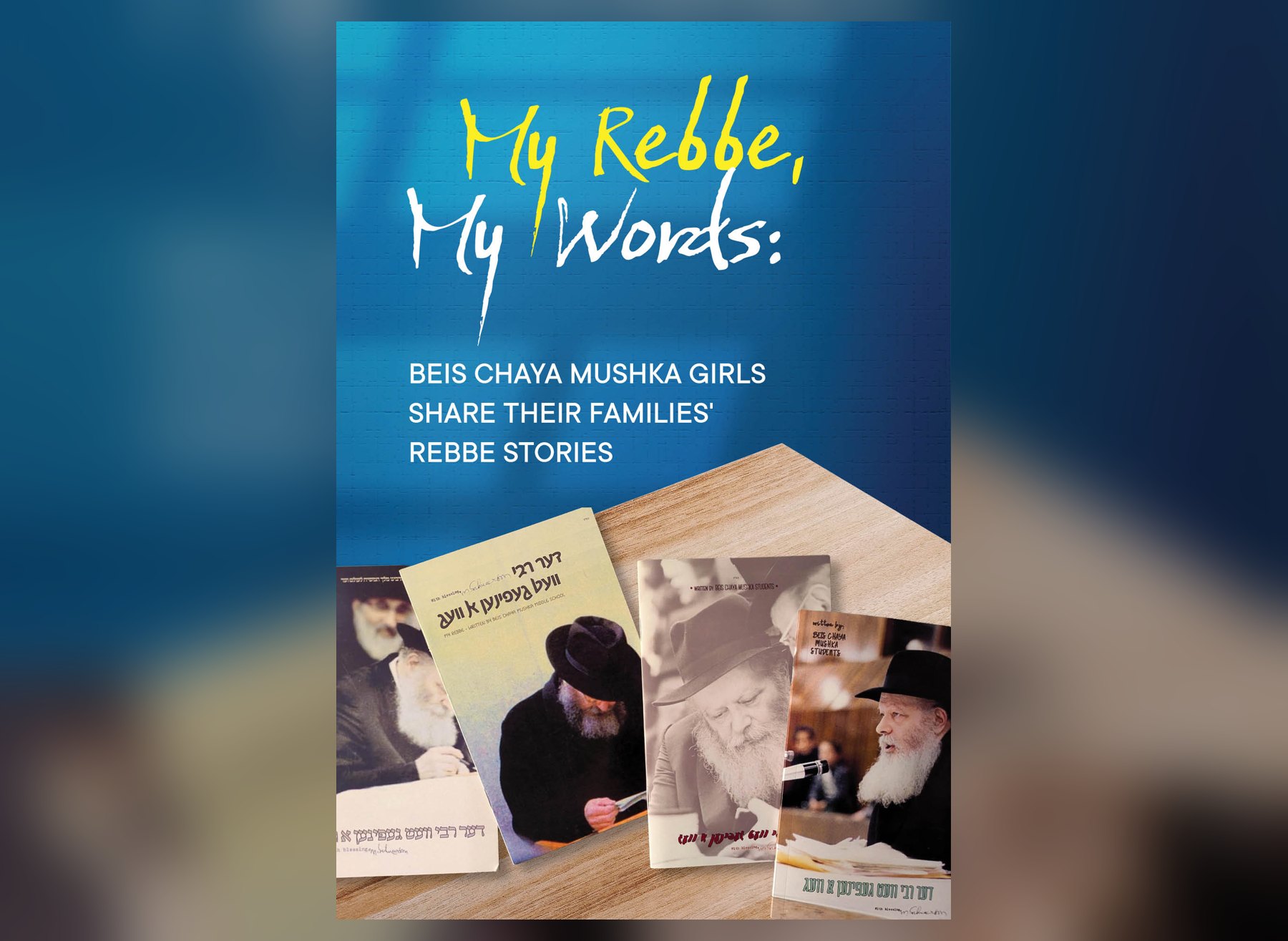
Beis Chaya Mushka Girls Share Their Families’ Rebbe Stories
In a high school English class, girls are working hard on a writing assignment. But this is no ordinary English class project with characters like Tom and Jane. These girls are writing a book of Rebbe stories, and these stories are personal to them and their families.
In a classroom where both the students and teacher were born after Gimmel Tammuz, the Rebbe is very much alive, present, and actively involved in the lives of every student, as is evident in their stories. And looking back, even the fact that this teacher is standing in front of this English class is itself the result of a personal Rebbe story.
When B. Horvitz began working at Beis Chaya Mushka, Crown Heights, she was offered a position teaching English to middle school and high school girls. Well versed in English, her true passions were Torah, Chassidus, and Yiddishkeit, and she had never envisioned dedicating her life to adverbs, predicates, and reading comprehension.
As she considered whether to accept the position, she turned to the Rebbe. She opened a letter dated 24 Adar, 5734. It read: “…Mentioning that you are a teacher of Limudei Chol… Furthermore, even where a teacher teaches secular subjects, he has many opportunities to illustrate what he is teaching with examples and illustrations which have content of Kedusho…” The remainder of the letter included directives regarding the unique shlichus of a secular studies teacher.
That letter gave rise to a Chassidishe English curriculum, including a yearly Rebbe Stories Project that teaches far more than paragraph structure and proper punctuation. Students come away with a deeper awareness and appreciation of the Rebbe’s active involvement in their lives. Their connection with the Rebbe becomes personal and present, and this sense of hiskashrus accompanies them long after the class has ended.
The stories include miracles, momentous interactions, and guidance touching every aspect of life. Now in its fourth consecutive year, the Beis Chaya Mushka Rebbe Stories book has been printed and distributed. The girls take home a beautiful publication to share with their families, and even more importantly, they take home a strengthened awareness that the Rebbe is deeply involved in our lives, awaiting our connection.
The Rebbe’s directives regarding chinuch al taharas ha’kodesh have been fulfilled: every subject, every classroom, every assignment, and every moment can become a pathway to a deeper connection with Hashem and His Moshe.
The following are a handful of stories written by the students of Beis Chaya Mushka, shared in honor of Gimmel Tammuz:
Open a Centre Aéré
Driving down the narrow streets of France, in a big, old-fashioned school bus, my great-grandmother felt that a malach was driving for her.
My great-grandmother was a shlucha of the Rebbe in France. One of her incredible accomplishments was opening a school called Shneor, which is still thriving today! Shneor was founded as a school where Jewish children of all backgrounds are welcomed, ensuring every child, regardless of status, receives a quality Jewish education.
To make it more convenient for parents, Elte Bubbe Basia organized transportation for the students, to and from school. She got a school bus, and she became one of the very first female bus drivers. The buses then were not at all like the modern buses we have today. For example, she would have to stand up in order to turn the steering wheel, because she felt the weight of the entire bus in her own two hands.
Elte Bubbe was a mother, cook, bus driver, and so much more. Every morning, she would wake up very early to go to the market to buy everything she needed to cook the school meals. After that, she would start her daily bus route. When lunch time came around, the aroma of Elte Bubbe’s delicious and nutritious food wafted through the whole school. While everyone was eating, she would go around and check on every student to make sure that they ate and were satisfied. When she came home after dropping everyone off, she was exhausted, yet she still had to take care of her family. This was a lot for one woman!
It happened once that she was in Crown Heights visiting her parents. Her mother told her, “When you go into the Rebbe for Yechidus, tell him how hard you work.” This was not something my great-grandmother felt comfortable doing, but she did it anyway, for Kibud Av V’em.
When she went in for yechidus, the Rebbe listened with great care and then responded, “When you get back home, open a centre aéré (which means summer day camp in French). This will attract many more children to your school!”
And so it was; many non-frum children came to the camp and loved it so much that they stayed for the school year. Eventually, a lot of them became completely frum!
The Rebbe believes in you and gives you the power to do more than you ever thought was possible!
— Liba Laufer, 11th grade
The Answered Question
I once had a question that I was thinking about for a while. I asked someone about it, but she did not understand the question. After some time, I just stopped thinking about it, because I thought maybe my question didn’t make sense.
A few weeks later, I heard something that reminded me of the question. That night, I was lying in bed and couldn’t fall asleep. I was trying not to think about the question, but nothing worked. I finally fell asleep at a really late hour.
The next day in school, I watched a Rebbe video during one of my classes. The Rebbe was talking about my question and answered it. We are so lucky to have a Rebbe who cares about every single Yid!
— Anonymous, 8th grade
The Rebbe’s Command
Once, my great-grandfather, Rabbi Yaakov HaLevi Friedman, was in a car accident. My great-uncle, Rabbi Shalom Horowitz (his son-in-law), rushed to 770 to ask for a bracha from the Rebbe.
The Rebbe was not worried. He gave a bracha and instructed that Mi Shebairach be recited for him the next morning at the earliest Minyan Vasikin. They followed the Rebbe’s instructions exactly.
Baruch Hashem, a week later, my great-grandfather returned home. However, he felt physically and emotionally broken, and he refused to eat anything. Seeing his condition, his son-in-law took him to the Rebbe during Sunday Dollars. When the Rebbe saw him, he asked with a smile: “Have you already sent out the letters for the organization of Chadrei Torah Or?” My great-grandfather didn’t answer. The Rebbe then added: “Moshiach is soon arriving, and you must inform us.”
As the days passed, he still refused to eat. He was brought to the Rebbe once again, and they informed the Rebbe that he was not eating. The Rebbe turned to my great-grandfather and said with a smile, “What does it mean, not to eat? It is a mitzvas asey from the Torah: ‘v’achalta v’savata u’beirachta’!”
Then, the Rebbe turned to my great-uncle, pointed his finger, and said: “And you should inform me when he has fulfilled this ‘Halacha L’Maaseh.’” The Rebbe gave him a dollar and then went to the Ohel.
A few days later, my great-grandfather began to eat again, and they right away informed the Rebbe. Rabbi Groner shared that for the last few days, the Rebbe had been asking, “How is Reb Yaakov doing?”
From then on, he felt way better. Within a short time, he recovered completely.
Miraculously, no trace of the accident remained. Just as the Torah says, “Vayechi Yaakov”—Reb Yaakov went on to live for 14 more years.
— Devorah Leah Hertzel, 9th grade
Surprising Mark
At the beginning of the year, when Chidon began, I was unsure about joining. I was a bit confused and stressed about making this decision, so I decided to write to the Rebbe.
When I opened up the Igros Kodesh, I was shocked! On one side of the page was written about the specialty of fulfilling the mitzvos of the Torah.
After the first Chidon test, I began to get good marks. With siyata d’shmaya and a bracha from the Rebbe, I got an even better grade on the second test.
— Anonymous, 8th grade
Aleph or Hei
During a Torah project, while my father was assisting his customer, Duvi Feldman, with the purchase of a Sefer Torah, an amazing story happened.
Duvy was purchasing a Sefer Torah in memory of his father, Naftali Feldman, who had passed away. As my father guided him through the many details involved in buying a Sefer Torah, Duvy shared a concern that had arisen within his family.
In the Torah, in Parshas Ki Seitzei, the word דכא from פצוע דכא is written differently in various Jewish communities, based on their minhag. Some communities write it with an Aleph, while others write it with a Hei. Chabad follows the tradition of writing it with an Aleph. Being that communities generally follow their own traditions, many will only use a Torah written according to their specific custom.
Duvy explained that his mother lives in Flatbush. She herself is Chabad, but the surrounding community, including friends and individuals who were helping sponsor the Torah, follow the minhag of writing the word דכה with a Hei. When she became aware of this difference, she grew very concerned. If the Torah was written with an Aleph, members of the community might not feel comfortable using it. On the other hand, if it was written with a Hei, she herself would feel uneasy.
She was unsure how to proceed.
At that time, a family friend, Rabbi Yisrael Dardak, who is not Chabad and lives in Eretz Yisrael, happened to be staying in her home.
Mrs. Feldman decided to ask him directly, “According to your minhag, would you use a Torah if the word דכא was written with an Aleph?”
He answered honestly, “No. Our community’s minhag is to write it with a Hei.”
Hearing this only increased her concern, as she now fully understood how strongly people felt about this.
Rabbi Dardak felt deeply for her situation and decided to look into the matter more carefully. Even though he is not Chabad and had never done this before, he chose to open the Igros Kodesh to see if there might be guidance related to this question.
What happened next was incredible.
The letter he opened addressed this exact issue—someone who was writing a Torah was asking how the word דכא should be written. The Rebbe clearly explained that it should be written with an Aleph (bringing sources, including the Alter Rebbe’s Shulchan Aruch, as well as from the Yemenite tradition) and clarified that this is the Chabad minhag. At the end of the letter, the Rebbe even offered blessings for health and other matters.
Rabbi Dardak was completely amazed! He later said that it felt like a message sent directly from Heaven.
When he shared what he had found with Mrs. Feldman, she immediately felt calm and relieved. She now had clarity and confidence in how to move forward. They decided to write the Torah according to the Chabad minhag, with an Aleph, exactly as the Rebbe had instructed.
Later, as Duvy continued the Torah process with my father, he shared this story and said, “That’s how we want the Torah to be written, with an Aleph!”
אשרינו מה טוב חלקנו — How lucky we are to have the Rebbe MH’M guiding us and leading us, and may we be zoche to the Geula right now!
— Devorah Leah Raskin, 8th grade
A Bracha That Healed
When my zeidy was a bachur, he was having issues with his stomach, so he went to the doctor. The doctor told him that they would need to take out a part of his digestive tract.
My zeidy was not sure what to do, so he wrote to the Rebbe, asking for guidance. The Rebbe gave my zeidy a bracha for his stomach, and my zeidy’s stomach was completely healed! The Rebbe also told him to get a second opinion. My zeidy, therefore, went to a different doctor, and the doctor told my zeidy that he doesn’t need surgery; the problem can be fixed with medicine.
My zeidy picked up the medicine, and when he came home, he threw the medicine in the garbage. This was because, thanks to the Rebbe’s bracha, his stomach no longer had any issues.
About a year later, my zeidy forgot about this story, and the next time he went to the Rebbe for yechidus, the Rebbe asked him how his stomach was doing.
May we take the lesson to share with the Rebbe our besuros tovos!
— Anonymous, 10th grade
An Encouraged Hachana
It was late at night when I headed to the bookshelf. Inspired by ‘Achos,’ I had started reading a Rebbe letter before going to bed.
I opened the Igros, and there was a letter of the Rebbe talking about the importance of hachana before a big Chassidishe Yom Tov, and that he hopes we are working on it.
Wow! I had been working on hachana for the past few days, and it took a lot of time and energy. Knowing that the Rebbe cares pushed me to give it my all.
— Anonymous, 12th grade
A Personal Letter
I once wrote a letter to the Rebbe about various things that I was involved with. Afterwards, I realized that I had forgotten to mention something that I wanted to tell the Rebbe about. I thought about writing it to the Rebbe, at a different time, but then decided it wasn’t that important.
I opened the Igros and read a letter in which the Rebbe was writing to a girl. The letter was written in the week of Parshas Beshalach, the exact same week in which I had written the letter. The contents of the letter addressed various issues, the exact same things I had written to the Rebbe about, and it answered everything in the same order I had written the letter!
At the very bottom, the Rebbe wrote: if you ever have anything else to tell me, you can write again. I felt that the Rebbe was writing directly to me.
— Anonymous, 10th grade
Heavy Burden
My great-grandfather, Reb Zalman Levin, was imprisoned for ten years in Russia for keeping Yiddishkeit alive.
After a decade of suffering, deprivation, and hardship, Reb Zalman was finally released from prison. Eventually, he was able to leave Russia together with his family. One of the most meaningful moments following their escape was when they came to visit the Rebbe and entered for a yechidus.
During the yechidus, my great-grandmother, Bubbie Sara, turned to the Rebbe and said in Yiddish, “Er gait arum mit a shvere pekel.” — “He is walking around with a very heavy burden.”
The Rebbe looked at them and responded, “Loz iber der pekel do, mir vet es oich nit shaten. Du tzugait zich altz.” — “Leave your burden here with me. It will not affect me. Here, everything falls apart.”
From this, we learn to confidently place our worries and problems on the Rebbe’s shoulders, and they will disappear.
— Sarale Yecheilov, 8th grade
Beis Moshiach #1510 • pp. 46-50, 43
© 2026 Beis Moshiach Magazine. All rights reserved.
This article originally appeared in Beis Moshiach #1510. You are welcome to share it with friends and family by email or in print, provided that you do not change, add to or omit any part of it, you credit the author and Beis Moshiach, and you include a link to archive.bmoshiach.org (written out in full in printed copies).
To republish this article in a newspaper, magazine, book or website, please request permission in advance at [email protected].