A Bakery Like No Other
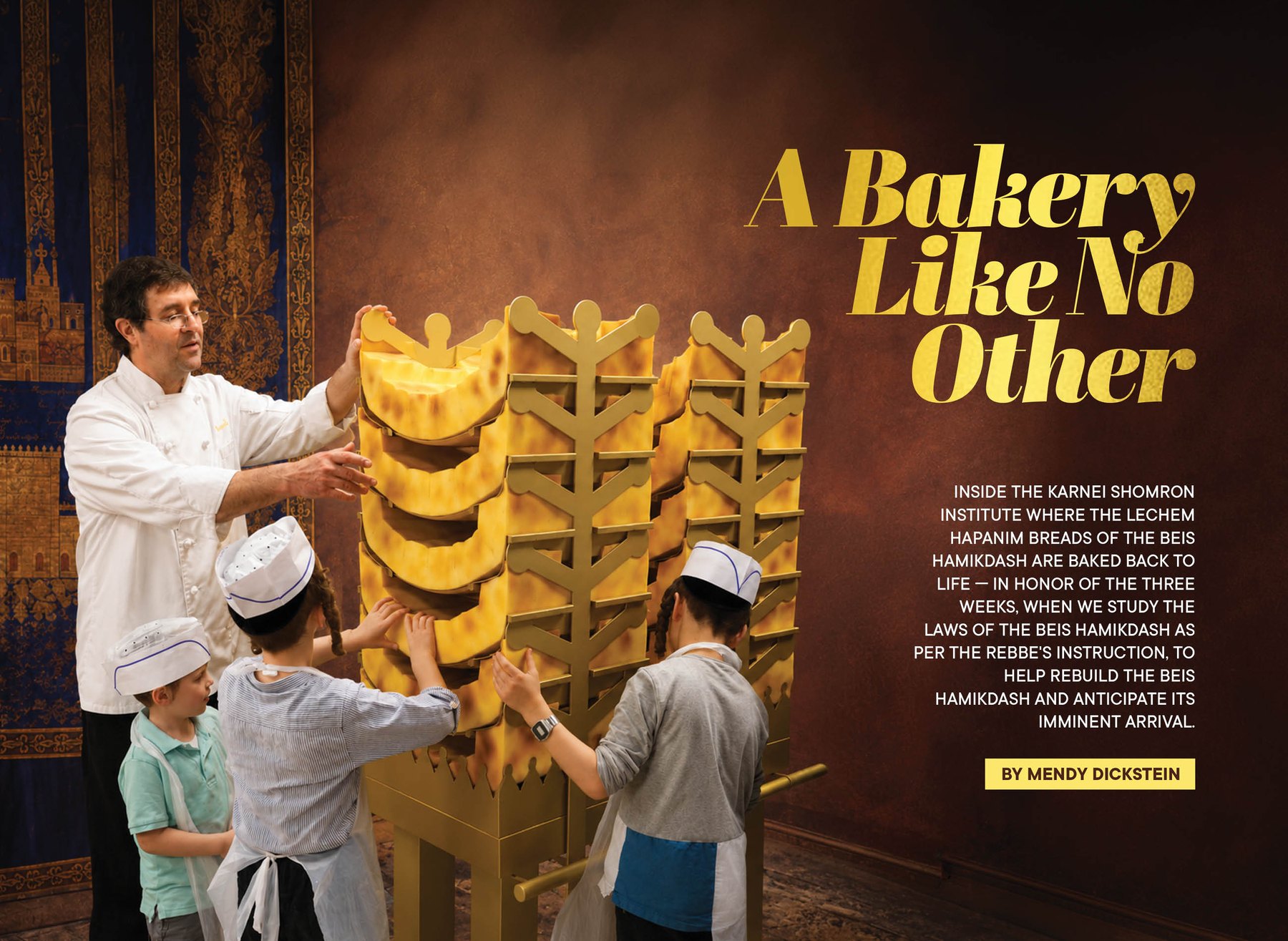
Inside the Karnei Shomron institute where the Lechem HaPanim breads of the Beis HaMikdash are baked back to life – in honor of the Three Weeks, when we study the laws of the Beis HaMikdash as per the Rebbe’s instruction, to help rebuild the Beis HaMikdash and anticipate its imminent arrival.
At the heart of the yishuv Karnei Shomron is a unique institute unlike any other in the world: the Lechem HaPanim Institute. This is the place where they recreate, with the greatest possible accuracy, the baking of the breads that were made in the Beis HaMikdash: the lechem ha’panim that was replaced weekly, the forty loaves that accompanied the korban todah, and the shtei ha’lechem (two loaves) that were offered on Shavuos.
For the days of “Bein HaMeitzarim,” during which we study about the Mikdash and its halachos, I went to see the institute and the workshops held there. There’s nothing like seeing it with your own eyes to understand what is written in the Torah and in the Rambam about how these breads were baked, their shape, and their final appearance. The tour is highly recommended and the enjoyment is guaranteed.
A Fresh Look at Jewish Bread
In a warm space filled with the sweet smell of fresh dough or well-baked bread, beneath the high ceiling of a bakery that has become a “laboratory for researching Mikdash breads,” sits R’ Eliezer Meir Seidel, telling his life’s story. His experienced hands, which began working with dough at a young age in his family’s catering kitchens in South Africa, gently touch a loaf of lechem ha’panim that just came out of the giant oven; a precise recreation of the bread that sat on the golden table in the Beis HaMikdash when it stood in all its glory and splendor.
Behind him towers the oven that is his pride, a six-square-meter monster of stone and fire. This is the second-largest stone oven in all of Israel. “This oven isn’t just a tool,” he explains, placing a loving hand on its warm wall. “The oven is a partner in the journey. When you want to bake bread that weighs eight and a half kilos, you need not just high heat, but also space and the ability to hold a stable temperature over time. The Mikdash breads demand a precision that only an oven like this can provide.”
Seidel continues in a soft voice, full of emotion: “When I started as an ordinary bakery owner, I felt like I was baking bread like everyone else. But one day a door opened for me into a world I didn’t know existed.”
He lights up as he tells of the pivotal moment that brought him into the world of the lechem ha’panim, the moment he discovered that all the breads he thought were Jewish, like braided challah or the bagel, were originally copies of breads from other cultures…
What actually led you to research the baking of the lechem ha’panim?
“By training I’m a physicist, but after 25 years of working in high-tech, I decided to continue an old family tradition and move into the food industry,” he says, wiping the flour from his hands. “When I opened the bakery, I researched different kinds of baked goods and in the process I was exposed to countless other breads I hadn’t known, from all kinds of cultures. The customs of Yemenite, Moroccan, and Russian Jews; a huge spectrum of breads from all the places Jews have lived.”
The experience he gained over the years in his family’s catering kitchens, along with the professional studies he completed before opening the commercial bakery, gave him a broad foundation for understanding the subtleties of baking on a large scale. “When you’re preparing bread for 300 people, you learn to calculate proportions, to understand how heat behaves in large quantities, how the dough rises differently, and more. That experience was critical when we started trying to recreate lechem ha’panim. It wasn’t just theoretical knowledge, but also the intuition for how to handle dough that weighs many kilos.”
As mentioned, the oven itself couldn’t be an ordinary baking oven, but one able to handle the unique challenges. “A home oven wouldn’t have worked—the temperatures are different, the times are longer, and the breads are much heavier. This is an oven that was built specially, with specifications adapted to the needs of the lechem ha’panim.”
His deep research led him to an astonishing discovery that overturned all his previous conceptions about Jewish bread. “I discovered that the braided challah we eat every Shabbos actually began in Germany in the 16th century as a copy of Christian bread, and the Jewish bagel is also copied from breads of other communities.” This insight led him to a deeper question: “If all the breads we thought were Jewish actually came from other cultures, where is the bread that truly belongs to us?
“The one bread that is genuinely Jewish in origin, with no copy of it anywhere in the world—is the lechem ha’panim.”
The Miracle: Having Bread Rise Without Letting It Become Chometz
The turning point came when a neighbor brought R’ Seidel a book by Professor Zohar Amar of Bar-Ilan University, who had researched the ancient strains of the five species of grain. Seidel began reading and was simply captivated by the idea of the lechem ha’panim. “Before that I thought I understood a little about what the lechem ha’panim was, but I came to the conclusion that I knew nothing about it.”
This happened about ten years ago, and around that time he became more religiously observant and began strengthening his Torah study and mitzva observance.
The connection he formed with Professor Amar led to an acquaintance that changed the course of his life. “I told him I was an expert baker, and that I wanted to try to improve the results of baking the lechem ha’panim. He’s a professor in his field, and he deals with botany, but not so much with baking.”
That’s how the bakery became an advanced research laboratory. “We tried all kinds of experiments at our bakery, and it turned into a kind of laboratory for lechem ha’panim experiments. We tried endless combinations of ingredients and proportions between the ingredients, we tested different baking methods, different kinds of pans, all with the goal of achieving the correct shape as described in meseches Menachos.”
What’s the most interesting mystery you solved in your research?
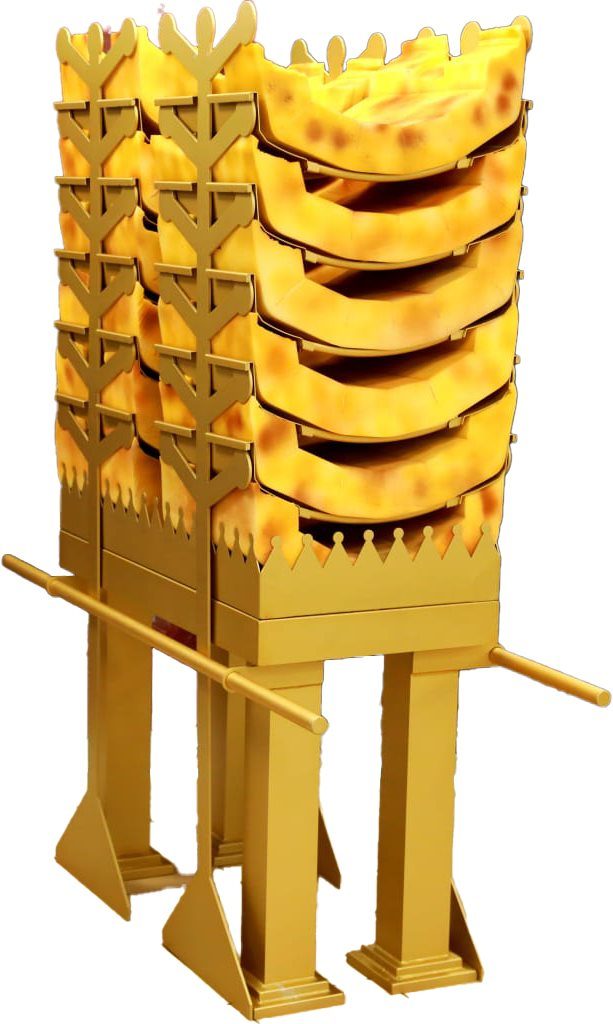
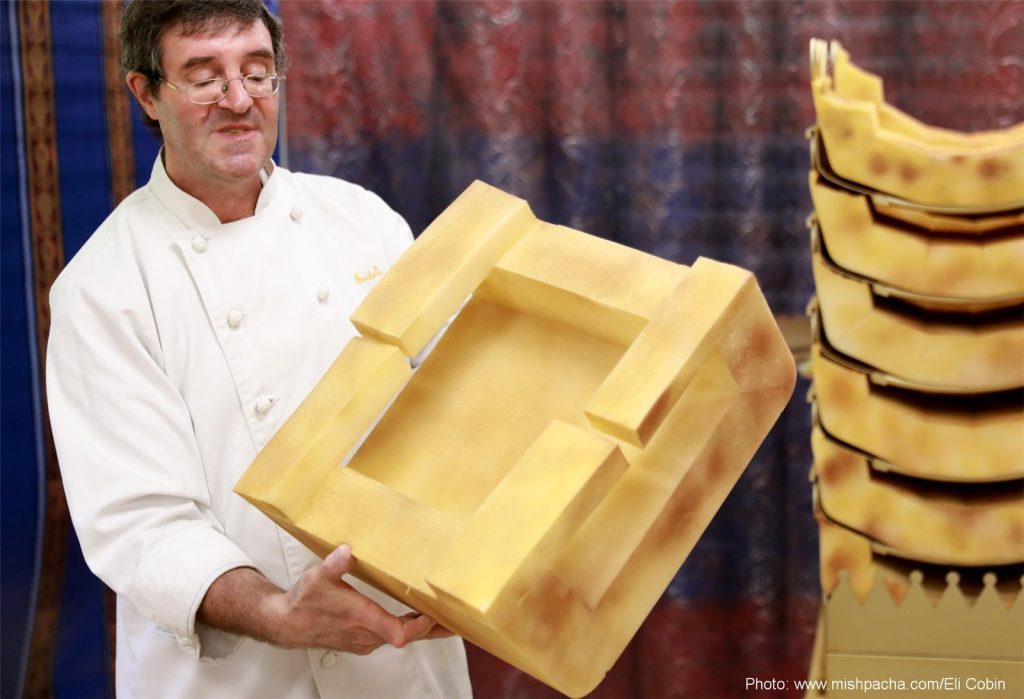
“One of our biggest mysteries revolved around the thickness of the lechem ha’panim,” he explains, pointing to a model standing on the table. “Because with the two-tenths of an ephah of fine flour mentioned in the pasuk, the thickness of the dough before baking comes out to the thickness of a finger. But on the other hand, meseches Pesachim mentions that the thickness is a hand-breadth which is four fingers, twice as much.”
How does the bread rise from the thickness of a finger to the thickness of a hand-breadth, without becoming chometz?
“Great question! In Hilchos Temidin u’Musafin, the Rambam says that the lechem ha’panim is matza without chometz—meaning it’s baked within eighteen minutes. How can dough rise without it fermenting? It’s not a simple technique, almost impossible! The solution required special collaboration. We devoted almost a year and a half of research to this alone. I partnered with Rabbi Shabtai Rappaport, who is known in Yerushalayim as one of the world’s great experts on the topic of chometz.”
The joint research led to a breakthrough. They conducted various experiments and applied interesting ideas to find a halachically valid way to raise the bread to the thickness of a hand-breadth without it being considered chometz. “In the end we arrived at a successful formula where the bread would rise from one finger to four fingers, but would also not be considered chometz.”
The precise technique is described in detail in the book Meir Panim, which Seidel published two years ago, the first book devoted entirely to the Lechem Ha’Panim. The first half deals with the physical side of the lechem ha’panim, the molds and the logistics, and the second half dives into the inner thought and spiritual meaning: why it’s called “Lechem HaPanim” (literally “bread of the face/presence”), what its role was in the heichal, how it connects with the menorah, and how all of this relates to parnassa and wealth.
What’s the secret hidden inside the dough from which the lechem ha’panim is made?
“The only ingredient mentioned in the Torah is fine flour, as it’s written: ‘You shall take fine flour and bake it into twelve loaves; two-tenths of an ephah shall be in each loaf,’” he explains, presenting a special bag of flour. “The pasuk also gives the amount of flour in each loaf. Beyond that, nothing else is mentioned. There’s no need to add that we must mix in water, even though the Torah doesn’t mention it—since you can’t make dough without water. But what other ingredients were added to the dough? Oil? Salt? Nothing is mentioned.”
The first key was obtaining the right flour, and from here began the fascinating botanical research with Professor Amar. “The professor began researching the ancient strains of the five species of grain, the strains over which we say the bracha of ‘HaMotzi,’ and wrote a book about it called Five Species of Grain. In his book he tried to scientifically identify the ancient strains of wheat, barley, rye, oats, and spelt.”
The decisive discovery was that the wheat used in the Mikdash was completely different from the one we know today. Here Seidel drops a culinary “bombshell”: “The strain of wheat we use today to produce flour was developed only 200 years ago, called ‘soft wheat.’ The bread we make today is 99.9% produced from this soft wheat. But 2,000 years ago they used a completely different strain called ‘hard wheat,’ known today as ‘durum wheat.’ Today it’s used mainly in the pasta industry, for making noodles and all kinds of pasta.
“The logistical difficulty was significant. We needed to find a supplier with Badatz kosher certification who imports fine flour from the correct strain of wheat, and of course make sure it doesn’t become chometz on its way to Israel, and that was complicated. I am pleased to be able to say that today there’s a real revolution in this field. In Israel today there’s an entire army of people dealing with the whole subject of experimenting with growing wheat of the correct strain, while trying to produce the fine flour in a pure way, without it coming into contact with liquids.”
The person leading this revolution is Mrs. Tzofia Savir. “She coordinates this entire field and works with large flour mills in Israel. They have several branches around the country and they produce the fine flour on a special line. They dedicate special equipment just for this purpose. This year they produced fine flour for the two loaves [of Shavuos]—new flour made in Israel, of the correct strain of durum wheat grown right here in Eretz Yisrael.”
We haven’t yet talked about the special shape of the bread—a shape unfamiliar to us today…
“Indeed, we elaborate on this in our workshops as well. There’s a dispute among Chazal about what the shape of the bread was, and there are two main approaches: one from Rabi Chanina, that it was an ‘open box’ shape, like a rectangle in an open container, and the second approach from Rabi Yochanan, that it was a ‘dancing ship’ shape, a rounded, half-circle form. Of course, we also elaborate on the theoretical subject during the workshop itself.”
Like They Did in the Mikdash
After completing the theoretical and practical stages of his research, the time came to share this remarkable discovery with more people, and to bring this experience to the wider public.
Seidel concluded that it would be a shame for all this knowledge to remain confined to his research and his small bakery. “After all, it says in Pirkei Avos, that ‘if you have learned much Torah, do not take credit for yourself,’” he smiles. Following this realization, he began teaching people everything he had learned. He started giving classes and lectures on the subject, and also ran an initial trial workshop where people came to bake the lechem ha’panim with their own hands.
The workshops began in 5777 (2017) and focus on three main mincha offerings: the lechem ha’panim, the korban todah bread, and the “two loaves” of Shavuos. “In the workshop we make all three menachos: the ‘two loaves’ offering, the korban todah with all forty loaves, and the lechem ha’panim. We actually make them according to the proper forms, quote the relevant pesukim, study the required halachos, and tell the stories behind the preparation of the lechem ha’panim like, for example, the secret of the House of Garmu’s preparation method.”
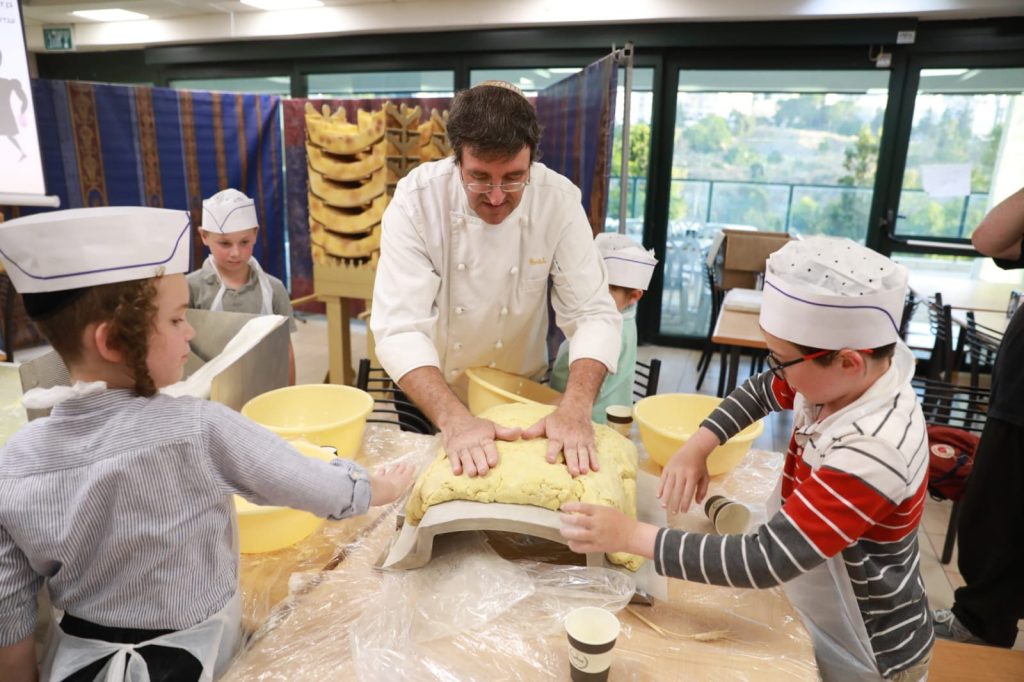
It turns out the experience is far more than just a theoretical class. “People bake this themselves in our bakery, doing the work the way it was done in the Beis HaMikdash. Physically, it’s not just hearing another shiur or class, but actually seeing and experiencing it firsthand. The technical difficulty requires special adaptations on our part, and the giant oven is the central part of the experience.”
The Mikdash’s Oven
And now we return to the oven: “This oven is really the heart of everything we do,” he explains, opening the heavy door and revealing the enormous interior space. “When people see its size, they understand what kind of power must have existed in the Mikdash’s kitchens. A loaf of bread weighs almost eight and a half kilos. This is bread of an enormous size, heavy, and it doesn’t fit into a standard oven.”
R’ Seidel points to the large floor inside the oven. “See how we place two loaves of the lechem ha’panim in here at the same time, with the correct spacing between them, with the heat circulating evenly. Only the Abulafia bakery in Jaffa has a bigger oven and they make tens of thousands of pitas a day with it. We do things more precisely that are more special,” says Seidel, pride creeping into his voice.
The story of the oven itself is fascinating. “We ordered engineering plans for the stone oven from an international expert from Tasmania, near Australia, while we did the actual construction ourselves, brick by brick. We wanted to stay as authentic as possible to the original, since there were no electric ovens in the Mikdash.
“The advantage of a stone oven is its large thermal mass, about 20 tons of stone and concrete, all at a heat of over 350 degrees Celsius. This delivers a powerful blast of heat to the dough being baked, so the baking time is shortened considerably and the bread is also baked more thoroughly.”
How do you solve the oven problem in your mobile workshops?
We have no choice but to be creative. We do the kneading process and putting the dough into the molds, but we make the bread before the workshop and bring the baked product ready with us. We simply simulate the baking work; we put a small piece of bread into a microwave oven, and people start to smell it within a minute or two, to simulate the baking process, and then we pull out the real bread.
How do people respond to this experience?
The reactions are amazing, just amazing! Everyone who experiences this craft finds it life-changing. We’ve done this in front of the broadest possible range of populations among the Jewish people, from the ultra-Orthodox to people far from religion.
A while ago we had a rare visit from a group from the newspaper Haaretz who came to do a story and were simply astonished. They didn’t know something like this existed in the world at all.
We even did a workshop for Christians, l’havdil. Over the years tourists have come from all over the world—from Korea, from Singapore, from Bolivia—fulfilling the pasuk, ‘all the nations shall flow unto him.’ It’s apparently part of their religion too, since they also express great interest in the whole subject of the lechem ha’panim.”
One of the stories most etched in Seidel’s memory happened in Amsterdam. “We were on a trip to raise funds for the Lechem HaPanim Institute. It was motzoei Shabbos, and I gave a presentation accompanied by explanations in English. There was a boy sitting in the front row next to his father, from the chareidi community of Amsterdam. The boy kept looking at me with big eyes, and was really excited by everything I said. At some point I discovered the boy didn’t understand English, except for a few isolated phrases. So I asked the father what the boy thought I was talking about. Instead of answering, the father turned the question to his son: ‘Did you understand what he said?’ Teh boy replied: ‘Sure, you were talking about money!’ And that was indeed the whole point of the presentation, how the lechem ha’panim relates to the subject of parnassa, sustenance, and happiness in the world”…
How do you explain the great interest the public shows in your workshop?
“We are, boruch Hashem, at the end of the long galus and drawing very close to the time of Geula. There’s a tremendous awakening among the Jewish people, a return to roots and a strengthening in Judaism, observance of Torah and mitzvos, as well as inyanei Mikdash. I can testify about myself, that I too am personally part of this; I felt something in my heart pulling me, something unexplained, until I became religiously observant about 15 years ago.”
For Seidel, the work isn’t just academic research, but practical preparation for the building of the Mikdash very soon. “We need to make our effort to learn as much as possible about the Beis HaMikdash. This isn’t a theoretical matter—it’s the foundation of our entire avodas Hashem. We shouldn’t wait until it’s built and only then start learning everything we need to know. We can study the subjects of the Mikdash now and begin to apply this in our daily lives, and thereby bring the Geula closer.”
Do you carry the burden of this project alone?
“Chalila, there’s an entire group of people involved in this. It’s not just me, and not just Professor Amar, but a whole movement of people who understand that we need to be ready for the building of the third Beis HaMikdash.”
R’ Seidel decided he wouldn’t wait for people to come to him for the workshop; instead, he sought to give as many people as possible a taste—literally—in anticipation of tasting the Geula. As a result, he began taking the lechem ha’panim workshop on the road, throughout the country as well as abroad. They go to yeshivas, to ulpanot (religious girls’ schools), to schools, and more.
The workshop offers a three-hour experience called “The Breads of the Mikdash,” and it includes all the necessary equipment.
What message would you like to convey to readers?
“Every time we engage with the avodas of the Mikdash, we bring the Geula closer. The third Beis HaMikdash will be built very soon, and we want to be ready. We want to know how to prepare the lechem ha’panim, how to connect the physical with the spiritual.”
Seidel stands up and gently lifts one of the loaves. “The lechem ha’panim isn’t just a story of the past, it’s also a story of the future, of the time when we will once again merit to see the golden table, the bread placed upon it, and the ongoing miracle every week, when the bread stays warm and fresh throughout the whole week!…
But until the Mikdash is built, we will continue to knead and remember, to bake and to wait.”
As Seidel finishes the conversation, he looks at the golden loaves standing on the table, then leans against the giant oven that still radiates a pleasant warmth. His childhood background in South Africa, the family business that brought him into the world of catering from a young age, the experience he accumulated over the years with large quantities and complex breads—it all led to this moment.
“I feel that my whole path, from the small kitchen in South Africa to this giant oven here in Eretz Yisrael, was nothing but preparation for this mission.” The oven behind him continues to murmur softly, ready for the next baking, the next workshop, the next experience that will connect more people to the Beis HaMikdash.
Beis Moshiach #1513 • pp. 12-19
© 2026 Beis Moshiach Magazine. All rights reserved.
This article originally appeared in Beis Moshiach #1513. You are welcome to share it with friends and family by email or in print, provided that you do not change, add to or omit any part of it, you credit the author and Beis Moshiach, and you include a link to archive.bmoshiach.org (written out in full in printed copies).
To republish this article in a newspaper, magazine, book or website, please request permission in advance at [email protected].