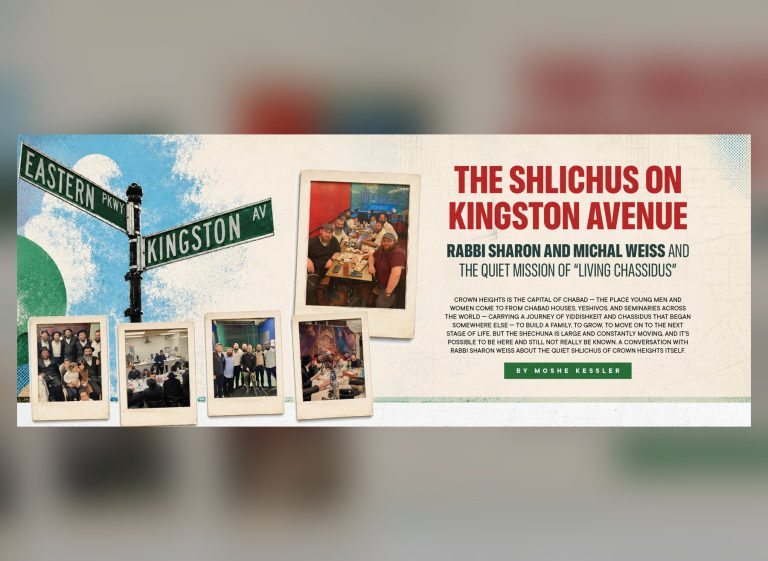
Building a Shlichus Empire in Northeast Ohio – Part II
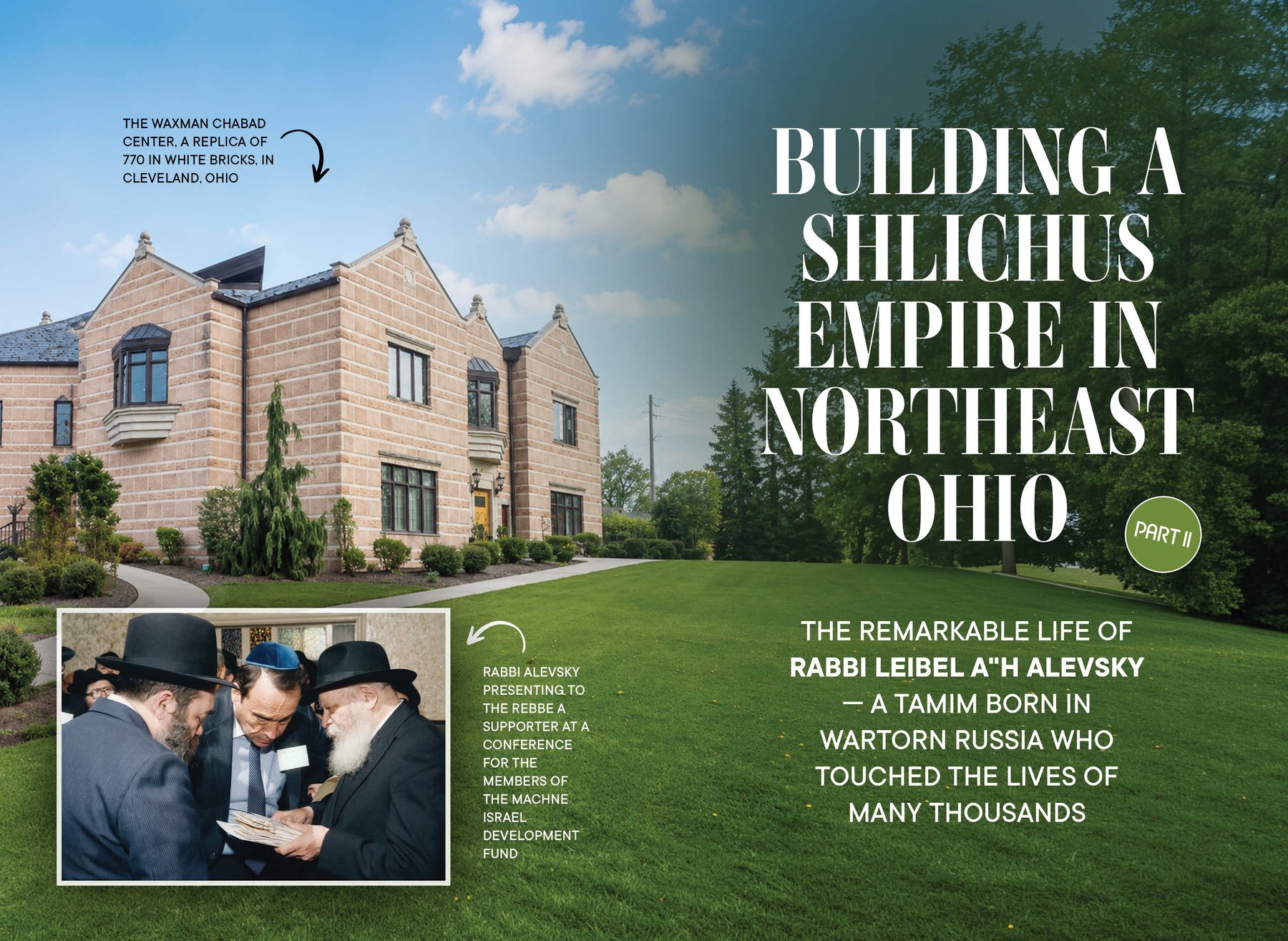
The remarkable life of Rabbi Leibel a”h Alevsky – a tamim born in war-torn Russia who touched the lives of many thousands
As the month of Nissan 5722 approached, a sense of a historic milestone was in the air. Yud-Alef Nissan of that year marked the Rebbe’s sixtieth birthday. In those days, the observance of the Rebbe’s birthday had not yet become the public, central event in Chassidic life that it is today. Nevertheless, at Tzeirei Agudas Chabad, they felt the date could not pass without a special event.
“We held a discussion about the Rebbe’s upcoming sixtieth birthday during the Melave Malka of Shabbos Mevorchim, held at 770 by Rabbi Dovid Raskin,” R’ Leibel recalled. The idea that arose there was unprecedented: to launch a global campaign in which every Chassid would take upon themselves a good resolution or make a donation reflecting the number sixty, whether in Torah study, tzedaka, or any other spiritual matter.
The activists wrote up the details of the Melave Malka and brought the Rebbe a report. Leibel attached a draft letter intended to be sent to all of Anash worldwide, with the details of the campaign. “We would never have dared to do something like this without showing it to the Rebbe first,” he emphasized. To their delight, the Rebbe returned the draft letter without any comments or deletions. For them, this was a green light, and the letters were sent worldwide.
The response on the ground was unprecedented. Letters began pouring in from everywhere, filled with good resolutions and donations. “It was a very special time,” R’ Leibel described. “It was the first time in history that Chassidim from across the globe united to bring the Rebbe nachas collectively, and it gave us all a very special feeling.”
During the campaign, an episode occurred that warmed the hearts of the askanim. Many people overseas, who didn’t distinguish between the secretariat and the Tzach offices, sent their donations directly to the Rebbe’s room. Instead of keeping the envelopes with him, the Rebbe would transfer them to Tzach. The first few times this happened as a matter of course, but then R’ Leibel noticed that the Rebbe had written on the envelopes the words: “L’Keren HaShishim.” The excitement among the activists was enormous: the Rebbe had not only officially approved the project – he had even given it a name of his own!
The peak moments came on the great day itself. On Yud-Alef Nissan, immediately after the Rebbe returned from the Ohel, R’ Leibel went to Rabbi Chodakov and gave to him two bags for the Rebbe: one was filled with reports of good resolutions from around the world, and the second contained cash and checks totaling $22,000 – a staggering sum by the standards of those days. Exactly five minutes passed from when the bags were brought into the Rebbe’s room, when Rabbi Chodakov emerged with a dramatic announcement: “The Rebbe will farbreng.”
Until that day, the Rebbe had not held a farbrengen on Yud-Alef Nissan. That surprise farbrengen may well have been, in fact, the Rebbe’s personal response to that gift from Chassidim who had decided to unite together around the “Keren HaShishim.”
“When You Light Up Your Surroundings”: Going on Shlichus
The closing of the circle of the shy yeshiva bachur who became a dynamic activist came with his marriage. Before Purim 1962, his future mother-in-law entered for a yechidus with the Rebbe and presented a note with a list of shidduch suggestions that Rabbi Dovid Raskin had proposed for her daughter. The Rebbe looked at the list, chose Leibel’s name, but immediately added a surprising and clear instruction: “Don’t tell the children about the idea until after Pesach.”
After Yom Tov, when the proposal did indeed move forward, R’ Leibel continued to conduct himself as a Chassid who takes no step without the Rebbe. After each meeting, he wrote to the secretariat reporting and asking for a bracha to continue. When they reached the decision to become engaged, both entered for a yechidus – but for some reason entered separately. R’ Leibel recalled with a smile how an interesting situation arose: his wife-to-be came out of her audience as a kalla, but he himself, waiting his turn outside, was not yet officially a chassan until he entered the Rebbe’s room. About two weeks before the wedding, they entered together for a joint yechidus for the chassan and kalla. They asked the Rebbe whether they should go on shlichus outside New York. At that time, the Rebbe was not eager to release his devoted Tzach employee and responded with a smile: “You are, after all, succeeding at Tzach – why would you want to leave?”
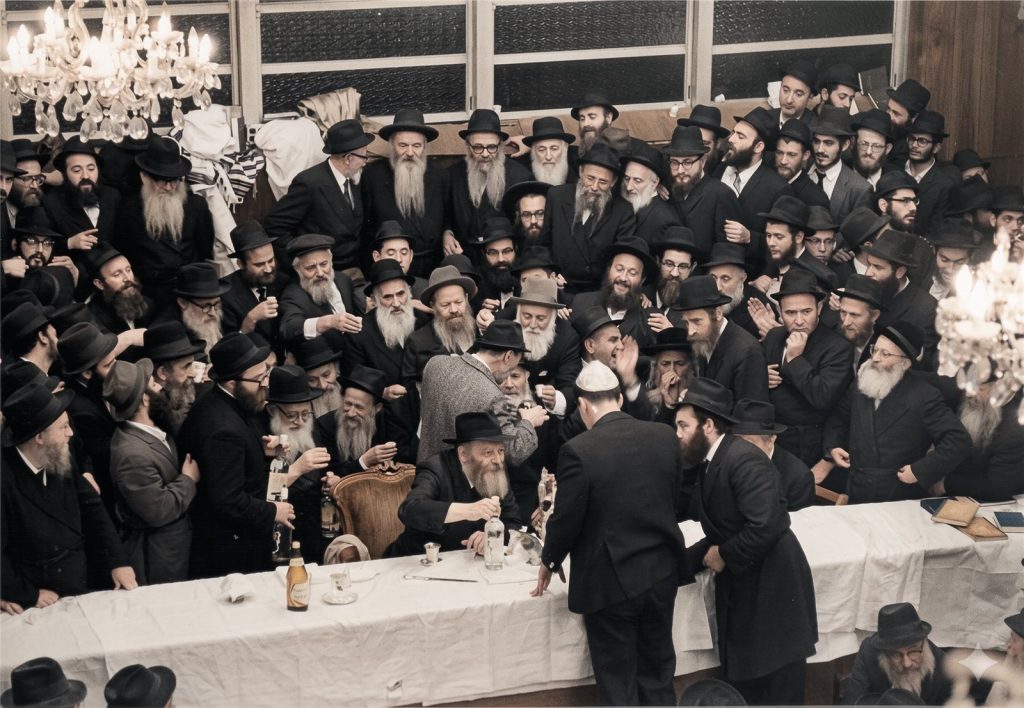
In that same yechidus, the Rebbe engraved in their souls the bracha that became the motto and guiding light of their lives for decades to come. The Rebbe looked at the young couple and said: “Az ir vet machen lichtig arum aych, vet der Oybershter machen lichtig bay aych” (When you light up your surroundings, the Almighty will make it bright for you).
The wedding was set for the 18th of Elul 1962 and took place in Cleveland, Ohio, the bride’s home city. In those years, the Rebbe generally did not make a farbrengen on the 18th of Elul, so many bachurim from 770 allowed themselves to travel to Cleveland to celebrate with their friend. But none of them anticipated what was about to unfold in New York at precisely those same hours.
Simultaneously with the chuppa, the Rebbe unexpectedly came downstairs to hold a farbrengen at 770. This was the farbrengen in which the Rebbe formally announced the “Shnas HaKaN” the 150th anniversary of the passing of the Alter Rebbe, a project that became the central axis of Chabad activity throughout the following year.
The chassan and kalla and many guests in Cleveland missed the farbrengen, but the Rebbe didn’t forget them for a moment. In the middle of the wedding, the phone rang in the hall. On the line was Rabbi Chodakov, who conveyed that the Rebbe had instructed him to call at that very moment, to transmit the central “point” of the farbrengen that had just concluded, and to ask the chassan to repeat the words aloud before the litvishe roshei yeshiva (such as the Telz Yeshiva rabbanim) and the many balabatim present in the hall.
The Relationship with Rebbetzin Chana
The intensive work at Tzeirei Agudas Chabad opened doors to the inner sanctum for R’ Leibel. On his very first day in the position, Rabbi Dovid Raskin took him to be introduced to the Eim HaMalchus, Rebbetzin Chana a’h. This acquaintance led to a unique relationship that continued unbroken until the Rebbetzin’s passing on the 6th of Tishrei 1964. R’ Leibel, who was among the few who owned a car in those days, was privileged to drive the Rebbetzin to her doctor visit every month, which was located near Grand Army Plaza in Brooklyn.
What connected the relationship to an even more personal family dimension was his future wife, Devonia, who began assisting regularly in the Rebbetzin’s home. The time spent in the home exposed them to wondrous giluyim and the Rebbe’s honoring of his mother – of which no words could do justice.
R’ Leibel recalled that every time the Rebbetzin finished her visit to 770 and turned to leave, the Rebbe would stand and follow her with his gaze. He stood silently and watched her walk away. Only when she turned beyond the corner of the street and completely disappeared from his sight – only then would the Rebbe turn around and return to his room with quick steps. “It was a noble sight,” R’ Leibel recalled with deep emotion, “truly like a king escorting the queen.”
Saving Crown Heights
The year 1967. The Crown Heights neighborhood began to change. During that period, a massive exodus of Jewish residents began, as families sought quieter lives in the suburbs, and the streets that were emptying of Jews were becoming increasingly dangerous.
One day, R’ Leibel received a sudden note from the Rebbe that completely changed his agenda: “Does Tzach have anything more important to do than dealing with the neighborhood?”
For R’ Leibel, this was a complete surprise. Until that moment, Tzeirei Agudas Chabad had dealt purely with spiritual matters – spreading Chassidus, organizing classes, printing sichos, and arranging tahaluchos. But a Chassid does not ask questions. The moment the instruction arrived, he threw himself entirely into the new assignment.
And so, R’ Leibel became a diplomat and public figure. He began forming an extensive network of contacts with senior city officials, prominent Jewish organizations, and government figures, enlisting them toward one goal: helping and protecting the Rebbe’s neighborhood.
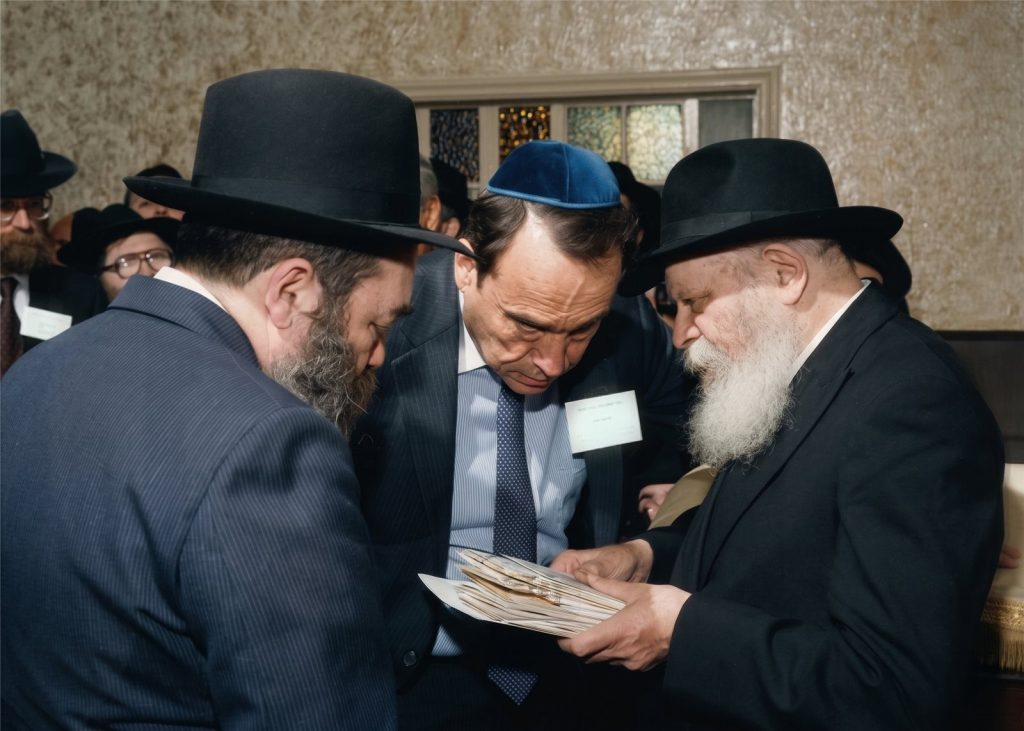
These connections did not remain only in city offices. On several occasions, R’ Leibel arranged for groups of senior officials and prominent Jewish figures to attend the Rebbe’s farbrengens at 770. When they arrived, the Rebbe would give them special attention and even said sichos that were specifically directed at them. (One of the famous photographs from those days, published in the New York Times, clearly illustrates his standing – R’ Leibel is seen personally escorting Mr. Sid Davidoff, senior aide to New York’s then-Mayor, to the Rebbe on motzoei Simchas Torah 5728.)
This activist and diplomatic activity bore fruit on the most practical level. Thanks to those painstakingly cultivated connections, the Tzach organization succeeded in purchasing several buildings in the neighborhood, and obtained numerous grants that helped Jewish individuals buy properties and remain in the neighborhood. This was something that strengthened Crown Heights in the face of the mass migration of those years.
The Ohio Empire — Fifty Years of Shlichus
For many years, R’ Leibel would visit his in-laws, Rabbi Zalman and Mrs. Shula Kazen, pioneering shluchim in Cleveland. The Chassidic energy and drive he brought with him made such a powerful impression on the local community that a special public committee was formed to persuade him to move there permanently. However, the Rebbe, who saw him as a central pillar of the work in New York, rejected the idea time and again. Even when R’ Leibel himself requested it, the Rebbe responded that he was succeeding at Tzach and should remain in Brooklyn.
Only in 1972 was a “compromise” reached – Rabbi Alevsky would move to Cleveland as a shliach of Tzach. Over the years, he and his wife shifted their full weight to Ohio and began building a genuine empire there.
They were unfazed by any challenge. One of his first public battles was the installation of a giant Chanuka menorah in Cleveland’s central Public Square. While public menorahs are taken for granted today, in those years the initiative met with fierce opposition – ironically from the local Jewish establishment. Despite heavy pressure to remove it, R’ Leibel stood firm as a wall and turned the public celebration of the miracle into a living tradition in Cleveland, broadcast throughout the region.
He founded “Camp Chabad,” one of the first summer camps of its kind in the country, and ran the “Challenge the Rabbi” program at student clubs, which brought many young people closer to the world of Chassidus.
His great vision came to fruition with the establishment of the Waxman Chabad Center, a magnificent, expansive complex spanning approximately 15,000 square feet. Under his leadership as director of Chabad institutions in Northeast Ohio, more and more Chabad Houses opened until the network numbered over 20 bustling centers providing services to every Jew, from extensive campus activities to centers dedicated to children with special needs.
On Shemini Atzeres 5738, when the Rebbe suffered a serious cardiac episode and was opposed to being hospitalized, R’ Leibel activated his connections from his base in Cleveland. He reached out to a world-renowned cardiologist and worked to bring him urgently to the Rebbe, so that the best medical care in the world could be provided within the Rebbe’s own room.
The seeds he sowed with such devotion bore fruit even decades later. One such instance occurred recently at Oberlin College in Ohio. A Jewish man named Mark, who had studied there and was drawn closer to Judaism by R’ Leibel in the 1970s, came to visit him at his New York home (where he had been living in his later years) after more than forty years. Mark was looking for a way to “give back” to Chabad for everything he had received in his youth. R’ Leibel, immediately connected him with the local campus shliach, a connection that led to a major donation that enabled the construction of a modern, permanent Chabad center at the college.
R’ Leibel put up a building modeled after 770, but unlike the original’s red brick exterior, he clad the structure in brick in the local architectural style common to the region.
Among his shlichus activities was organizing groups of mekuravim who came on organized trips to receive the Rebbe’s bracha and advice during the Sunday “Dollars” distribution.
Just how deep his influence was, including on the families of mekuravim, can be learned from an incredible story that occurred in 1983. A young boy from Akron, Ohio, named Steven Goldstein – in whose home his devoted mother had established a Shabbos minyan – came to 770 for the distribution of “kos shel bracha.” Seeing the shluchim receiving bottles of mashke from the Rebbe, he turned to the Rebbe with a sincere request: “My mother also deserves a bottle, and a shliach to help her.”
The Rebbe, responding to the innocent request, immediately gave him the bottle. But the true wonder was revealed in a photograph taken at that moment: standing behind the boy was a yeshiva bachur watching what was happening. His name was Mendy Sassonkin. Two years later, that same Mendy married Kaila, R’ Leibel’s daughter, and the one who drove them to their shlichus to formally establish the Chabad House in Akron was none other than R’ Leibel himself! The mother from Akron who received the bottle merited seeing three of her children establish Chabad Houses across the United States.
The bracha that R’ Leibel and his wife received from the Rebbe in the yechidus – “When you light up your surroundings, the Almighty will make it bright for you” – became the very essence of their lives. Their home was open wide twenty-four hours a day, their Shabbos table surrounded by guests, and this atmosphere was absorbed by all ten of their children, who all went out on shlichus and today spread the light from Cleveland and Texas, through Europe and Eretz Yisrael, and on to South America and China.
This past 3 Iyar 5786, R’ Leibel concluded his journey in this world. He left behind a blessed upright generation, a magnificent network of institutions, and the living legacy of a true tamim who combined awe and love for the Rebbe – into action that embraced the entire world.
With credit to Anash.org for some of the material.
The Initiator of the “Satellite” Event on Yud Shvat 5753
One of the milestones in spreading the message of Geula and the Goel in our generation was the global satellite broadcast on Yud Shvat 5753, which transmitted to tens of millions of viewers in the United States and around the world the Rebbe encouraging the singing of “Yechi Adoneinu.” It turns out that the original initiator of this endeavor was the Chassid Rabbi Leibel Alevsky.
During that period, the Rebbe went out nearly every day for tefillos, and after the davening he would encourage the singing of “Yechi Adoneinu Moreinu V’Rabbeinu Melech HaMoshiach L’olam Va’ed.” Those who were at 770 were “living” the message of Geula and the Goel at levels that defied description. However, the shluchim who were occupied at their posts of shlichus were not sufficiently exposed to the intensity of the transformation the Rebbe was bringing about each day. For this reason, R’ Leibel decided to initiate a satellite broadcast that would connect the shluchim from all corners of the world to 770.
The cost was enormous by the standards of those days: $25,000 for the broadcast vehicles and satellite. In addition, various parties who had not yet internalized the change the Rebbe was leading regarding the message of the Geula and the Goel attempted to torpedo the initiative, fearing that the broadcast would heighten the discourse around the malchus of the Rebbe Melech HaMoshiach.
But R’ Leibel was undeterred. Together with his friend Rabbi Shmuel Spritzer, he met with Rabbi Shmuel (Mula) Butman, who threw himself into the matter with full force, along with members of the “World Headquarters to Bring Moshiach,” and took responsibility for financing the global event. In order to bypass the interference from “within,” R’ Leibel hired a broadcasting company from Russia.
The day of the broadcast was the day of the Super Bowl – the most-watched sporting broadcast day in America. The opponents of the broadcast attempted one final move: they leaked to the media that the event was a “Coronation” of the Rebbe Melech HaMoshiach, hoping this would deter the organizers. But the result was the opposite and extraordinary. The word “Coronation” ignited the imagination of the American media. More than 150 television stations dispatched broadcast trucks that filled Eastern Parkway and Kingston Avenue to capacity.
Thousands of Chassidim filled 770 at the appointed hour, alongside tens of thousands of Chassidim throughout the world who watched the live broadcast. Even in the middle of the Super Bowl game – watched by tens of millions across the United States – television networks cut away and announced: “We now go to the Coronation of the Lubavitcher Rebbe in New York.” Thanks to R’ Leibel’s initiative, the entire world witnessed an event of immense kiddush Hashem.
Beis Moshiach #1508 • pp. 16-23
© 2026 Beis Moshiach Magazine. All rights reserved.
This article originally appeared in Beis Moshiach #1508. You are welcome to share it with friends and family by email or in print, provided that you do not change, add to or omit any part of it, you credit the author and Beis Moshiach, and you include a link to archive.bmoshiach.org (written out in full in printed copies).
To republish this article in a newspaper, magazine, book or website, please request permission in advance at [email protected].