How Many Letters Did the Rebbe Write?
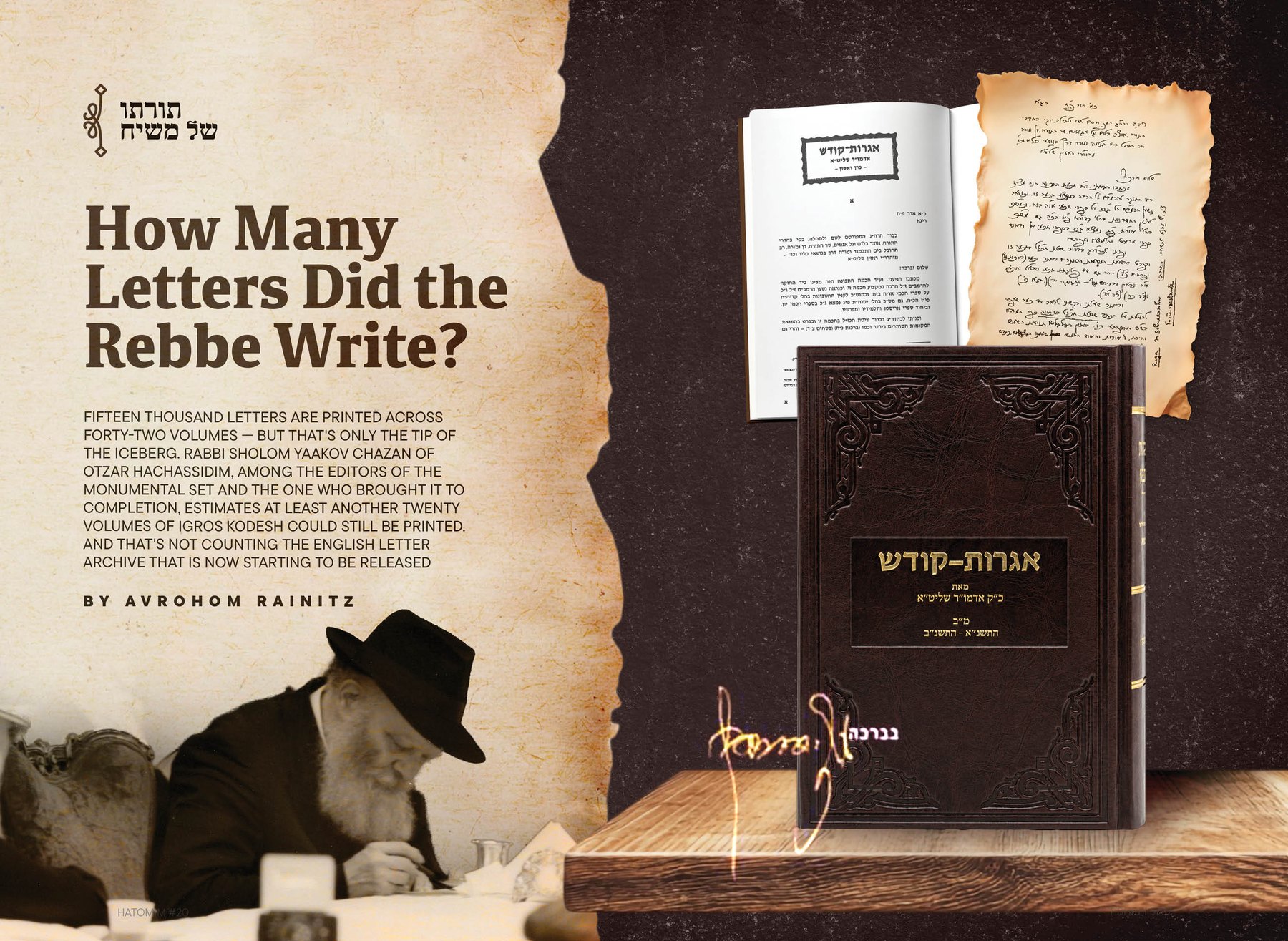
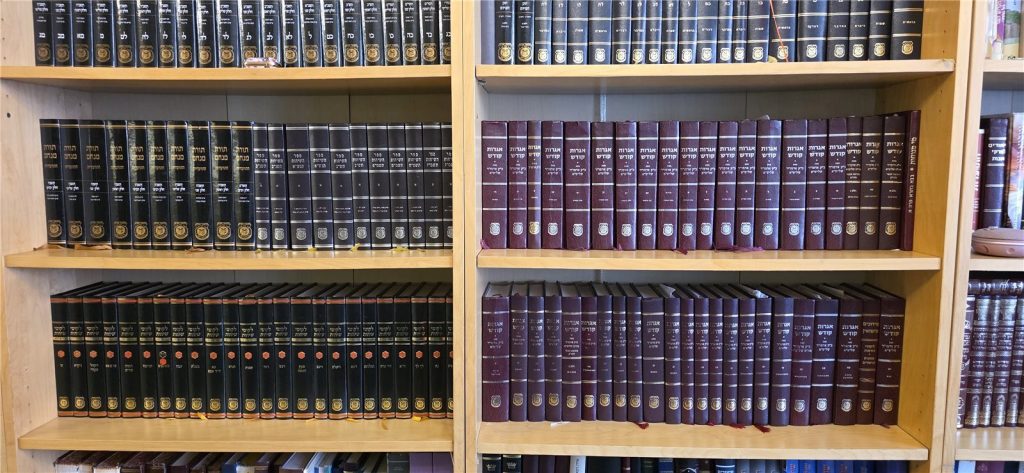
Fifteen thousand letters are printed across forty-two volumes – but that’s only the tip of the iceberg. Rabbi Sholom Yaakov Chazan of Otzar HaChassidim, among the editors of the monumental set and the one who brought it to completion, estimates at least another twenty volumes of Igros Kodesh could still be printed. And that’s not counting the English letter archive that is now starting to be released.
Winter 5749. Within the walls of 770, a quiet, deep excitement was in the air. Ten volumes of the “Igros Kodesh” series of the Rebbe had already been published. Ten volumes of hidden light, thousands of holy letters written to Jewish men and women in every corner of the world and now, on the occasion of the appearance of the tenth volume, a special event was being arranged in 770.
Behind the scenes stood a small group of young, dynamic tmimim from Beis Chayeinu. Leading them were the brothers Rabbi Chaim and Yosef Yitzchok Greenberg, together with Rabbi Avrohom Simpson and the tamim Shneur Zalman Liberow, who took on the task of organizing the celebration down to the smallest detail: Liberow handled fundraising, Yoske Greenberg planned and edited the special commemorative booklet on whose cover, in the background, was printed the Rebbe’s own handwriting. Also brought into the effort was Rabbi Sholom DovBer Levine, chief librarian of the Chabad Library and editor of the series. Rabbi Yosef HaLevi Wineberg was chosen to serve as emcee.
In those years, some had worried that the Rebbe might not be pleased with a celebration centered on the sefarim. But on the Shabbos before the event, when the Rebbe was distributing wine for gatherings and farbrengens around the world, Rabbi Wineberg came up as well, and as the Rebbe poured for him from the bottle, the Rebbe said aloud, louder than usual: “Hatzlacha rabba.”
And so, on Sunday, 21 Adar I 5749, the gedolei ha’Torah and Chassidim from every circle gathered in 770, an event that brought the Rebbe great nachas ruach.
The celebration was extraordinarily successful and 650 volumes of the Rebbe’s Igros Kodesh were sold. The next day a detailed report and a photo album from the event were submitted to the Rebbe. The Rebbe wrote in his holy handwriting: “Received,” and added: “May you relate good news for the future, with an increase; and since this is a time when joy is increased, I will mention it at the tziyun.”
Those behind the event, the two Greenberg brothers, did not yet know that their uncle, their mother’s brother, would be the one who, decades later, would bring the entire series to its completion.
The Final Volume Arrives at 770
Decades have passed since that winter celebration. The series continued to grow, volume after volume, treasure after treasure, until now, when the 42nd and final volume of the series arrives at Beis Chayeinu—containing the Igros Kodesh from the years 5751–5752. Forty years of labor since the first volume was published on 11 Nissan 5747, and now, with G-d’s help, we have the complete series.
If the appearance of the tenth volume merited a magnificent event that brought the Rebbe such great nachas ruach, how much more so now, with the completion of the entire series! How happy we should be!
The one privileged to bring the series to its conclusion is Rabbi Sholom Yaakov Chazan, a member of the editorial staff of “Otzar HaChassidim” at Kehot Publication Society, who also serves as editor-in-chief of the weekly Beis Moshiach.
Over the years, Rabbi Chazan has edited dozens of volumes of the teachings of our Rebbeim published by Kehot, including volumes 22–42 of the Igros Kodesh series—about twenty volumes—which he took upon himself to edit up to this very day.
We spoke with him to hear: how did the series begin, what were the Rebbe’s exacting instructions regarding the editorial work, and what did he witness over decades of this holy labor. And above all, what does the future hold, and what great tidings still await around the corner.
From ‘Hosafos’ to Likkutei Sichos to an Independent Series
“The birth of the general ‘Igros Kodesh’ series, containing the letters of all our Rebbeim,” Rabbi Chazan relates, “came about through initiative from above through an instruction given to Rabbi Sholom Ber Levine, in a note the Rebbe wrote him at the end of Teves 5740, instructing him to collect the letters of the Alter Rebbe and print them. Over the following years, Rabbi Levine received dozens of instructions and holy responses regarding the editing of the letters series of our Rebbeim, until in Teves 5747 the series was completed, including several supplementary volumes.
“After finishing the printing of that series, it did not occur to Rabbi Levine to propose printing the Rebbe’s own letters in an ‘Igros Kodesh’ series as well, since from 5722—when volume 2 of Likutei Sichos was printed—the Rebbe’s substantive letters had been printed in ‘Hosafos’ to the Likkutei Sichos volumes. These letters were obtained by members of the Vaad L’Hafotzas Sichos who possessed collections of holy writings, or from the recipients themselves; and occasionally the Rebbe himself handed over a copy of one of his letters for publication.
“It’s important to stress here how precious this printing was to the Rebbe. Before each volume, when the finished sefer was brought for the Rebbe’s final approval, the Rebbe would also review the letters in the ‘Hosafos,’ and on rare occasions would even add and correct them in his own holy handwriting.
“In the foreword to volume 15, the committee members appealed to the public to send in letters they had received from the Rebbe, ‘to benefit the many.’ The Rebbe added there, in his own handwriting, after those words: ‘And thanks are hereby given to each of them, for the merit of the many depends on them.’ And regarding the phrase ‘we appeal with an urgent request,’ the Rebbe corrected and added: ‘doubled and redoubled.’ Just two words, yet how much they reveal about how dear this matter was to him.
“Still, there was always a shortage. When volumes 12–13 came out as thin volumes, the Rebbe expressed his surprise, and when the vaad members replied that there weren’t enough letters, the Rebbe instructed the secretariat to pass along some of his own letters to them. This happened again and again; in 5743, before volume 22 of Likutei Sichos, the committee wrote about the difficulty of gathering letters, and the Rebbe replied: ‘Let them gather from the secretariat those that are suitable and give them over [for publication].’”
Then came the turning point. “Before volume 25 of Likutei Sichos there was a shortage again. Rabbi Shneur Zalman Chanin, director of the vaad, approached the Rebbe’s secretary responsible for the letters archive, Rabbi Sholom Mendel Simpson, and asked him for substantive letters. Rabbi Simpson brought the request to the Rebbe, and the Rebbe instructed him to check whether the archive held suitable letters, and to show them to him. He selected a bundle of letters from 5718 and brought it in to the Rebbe.
“And here, through an initiative from above, it happened. The Rebbe instructed that the bundle be given not to the committee, but to Rabbi Sholom Ber Levine, the chief librarian, in order to publish the Rebbe’s letters as part of the Igros Kodesh series of our Rebbeim. On Tuesday, 16 Adar 5747, Rabbi Levine received the bundle, with a note in the ksav yad kodesh attached: ‘To Rabbi Sholom Ber Levine—worth clarifying, and as soon as possible: 1) What is worth publishing from the enclosed. 2) To proofread further, and especially to add references. 3) To actually publish it.’

“Rabbi Levine, who until then had had no involvement in publishing the Rebbe’s own letters, did not understand what this had to do with him. He inquired with the vaad members, and asked the Rebbe in what format to publish it, as a special Igros Kodesh series of its own, or as ‘Hosafos’ to Likutei Sichos as before. The Rebbe crossed out the second option, emphasized the first, and added: ‘He should inquire with R’ Sholom Mendel Simpson, who supplied this bundle, and who has many more.’”
When the vaad members heard of the Rebbe’s instruction, they handed over to Rabbi Levine their entire archive of letters. From then on, a race began. “From the Rebbe’s replies, Rabbi Levine understood that the Rebbe wanted the first volume ready by 11 Nissan, his birthday,” says Rabbi Chazan. “The Rebbe wrote to him: ‘Speed up the publication as much as possible,’ and added: ‘and this relates to the Pesach preparations—haste.’ Rabbi Levine put in all his effort, and within just nine days he already had the first proofs in hand. And for 11 Nissan 5747, the first volume was published.”
Rabbi Chazan himself joined the work years later. “I joined in 5752,” he recounts. “I had returned from Brazil, and Rabbi Levine, who had just returned from Russia around that time, asked me to assist him. Starting from volume 21, I did nearly all the letters and added all the supplements—and from volume 22, published in 5753, I took over the editing entirely.” In this role, Rabbi Chazan upgraded the series, adding detailed cross-references and indexes, as the Rebbe had instructed.
The Rebbe’s Concern for Privacy
With the appearance of the first volume, a sensitive question arose that would affect the entire series: how does one publish letters written to individuals without violating the privacy of those who had opened their hearts to the Rebbe?
“Right from the start,” Rabbi Chazan relates, “the Rebbe gave Rabbi Simpson rules for which letters to print. Among other things, he instructed that letters containing anything that could harm other groups or communal workers should not be printed; and that before sending anything to print, it should first be brought to the Rebbe for approval.”
At the heart of the matter was protecting the privacy of the recipients. “When Rabbi Simpson asked whether it ‘would be possible to remove the names,’ the Rebbe crossed out the word ‘possible’ from the question and added in his own hand: ‘and to omit any matter that is not appropriate.’ In other words, not just names, but any private matter that was inappropriate to publicize.”
And here a tension arose that lasted a long time. “Rabbi Levine wanted to edit the letters the way he had edited the previous series, by freely reviewing the archive itself so he could decide what to omit and how to explain each letter. But Rabbi Simpson argued that this was highly sensitive, private material, and that without explicit permission he could not hand over the original letters, certainly not the letters people had sent asking questions of the Rebbe.
“When the matter was brought before the Rebbe, the Rebbe marked Rabbi Levine’s name and wrote: ‘It is worth helping him, provided it is permitted according to Jewish law to fulfill his request.’ Since the halachic ruling follows the ban of Rabbeinu Gershom, which forbids reading someone’s letters without his knowledge, Rabbi Simpson understood from this that, despite wanting to help, he was not permitted give Rabbi Levine the personal letters people had sent to the Rebbe.”
Rabbi Simpson reported back to the Rebbe how he had explained this to Rabbi Levine, and the Rebbe responded briefly: “If so, what is the question?!” And when Rabbi Levine wrote that he could not edit as before without free access, the Rebbe replied: “It is not understood at all how it would be permitted for [Rabbi Simpson] to give (free access) when the writer of the letter (or the like) forbade it!” And to his request to edit “in the manner I edited the previous volumes,” the Rebbe added: “If it will be done differently, if the notes become fewer, can the letters not be published?”
“This was not easy work,” Rabbi Chazan admits. “Rabbi Levine received photocopies from which the non-publishable sections had already been removed, and he wanted the editing to be perfect—for every letter to include an explanation of what question it was answering. He even wrote to the Rebbe that the work was proving difficult for him. The Rebbe replied to him with a bracha: ‘There is no need to wait for my review… for since this is a time for increase, it may be assumed that he will publish something proper.’ And to his request to receive the letters without censorship, the Rebbe replied: ‘I have already answered.’”
And so the editorial process for the remaining volumes was set: Rabbi Simpson would gather material from the archive, photocopy it, remove from the copies anything unsuitable for publication, and pass the bundles to the Rebbe for review and approval; the Rebbe would then pass them on to Rabbi Levine, and when the book was ready, the Rebbe would approve it by dating the foreword.
“When you look at all this,” Rabbi Chazan concludes, “you understand that the omissions were never meant to hide anything. On the contrary, they reflect the Rebbe’s personal concern for the privacy of every Jew who turned to him. The Rebbe protected everyone’s dignity, even while opening his treasures to the public.”
‘The King Squanders His Treasures’ — Didan Notzach and the New Channel
Here we pause and ask: why then? What happened in Adar 5747 that suddenly led the Rebbe to instruct that his own letters be published, something he himself had previously been hesitant about?
“Of course we cannot know daas elyon,’” Rabbi Chazan qualifies what follows, but he offers his impression: “On 10 Teves 5747, during the Didan Notzach celebrations, the Rebbe thanked those who had come ‘to participate in rejoicing over the good tidings of the increase in printing the manuscripts of our Rebbeim and its dissemination, etc.’ On the surface, there had been no special increase in the printing of new sefarim at that time, and this calls for explanation.
“In those days, at the farbrengen of Shabbos Parshas Vayechi, the Rebbe again spoke about the printing of new sefarim, saying that when a new sefer, kuntrus, or maamar is published, everyone must study it and he emphasized that it is not enough that some people study it; rather, each and every person must be able to say, ‘This book, kuntrus, or maamar was printed for my sake!’
“It is possible that already at that time the thought had ‘arisen’ in the Rebbe’s mind [similar to what the Rebbe said of himself when, on Yud-Tes Kislev 5737, he instructed that Hemshech Ayin-Beis be published, saying the idea had already arisen in his mind back on Chof Cheshvan] to publish his own Igros Kodesh series, a series that brought special joy to all Chassidim and in which the personal connection to each and every individual is emphasized.”
And in this lies a special chiddush. “All of the Rebbe’s teachings were printed as a result of the Chassidim’s own initiative. But the Igros Kodesh series came through an initiative from the Rebbe himself. The Rebbe was the one who gave the instruction.”
And as to why specifically then, Rabbi Chazan says: “On Purim 5747, the Rebbe spoke about a lacking in devotion and the hiskashrus between Chassidim and the Nasi HaDor. During that period there were also several incidents reflecting a lack of proper hiskashrus, following which the Rebbe withdrew his nesius from various mosdos.
“Perhaps one could say that specifically against the backdrop of this lack of hiskashrus, the Rebbe granted the Klal Yisrael a new channel to strengthen hiskashrus, i.e. the publication of thousands of his letters, open and accessible to all. If in the past a Chassid would enter for yechidus and receive the Rebbe’s guidance on every detail of his life—now, with this work placed in the hands of every individual, each Jew can open the letters and find the Rebbe’s guidance there.”
This, he says, is the meaning of the expression “the king squanders his treasures”: “In wartime, as victory approaches, the king opens his hidden treasuries and distributes them to the soldiers actually fighting. So too the Rebbe distributes his hidden treasure, his thousands of letters, to all the people of this generation, who take part in the War of the House of Dovid, to bring about the complete victory of the revelation of the Rebbe, Melech HaMoshiach.”
But there is a further depth here. What, in essence, is a “letter”; and how did the Rebbe overcome the hesitation he himself had once felt?
When a ‘Letter’ Becomes a ‘Sefer’
“The chiddush of the letters, compared to the maamarei Chassidus,” says Rabbi Chazan, “is that in them the Rebbe brought the loftiest levels of Chassidus down into the realm of the mundane: livelihood, health, business. As the Rebbe said in the sicha of 15 Shevat 5748, that even in optional matters there are instructions within the Chassidus of the Nasi HaDor; and in particular, as is known, that the revelation of the ‘yechida,’ the essence of the soul, comes specifically through engaging with worldly affairs outside of oneself. It is a rule in Chassidus: the higher something is, the further down it descends.
“The Rebbe explained in the sicha of Erev Rosh Hashana 5744, regarding the printing of the Alter Rebbe’s Igeres HaKodesh, that the nature of a ‘letter’ is that it is intended from the outset to be sent elsewhere, far from where it was written. Thus, the entire purpose of a letter is to act upon the world, i.e. upon the place to which it is sent.
“And here,” he continues, “lies the distinction between a letter and a sefer. As stated in Torah Ohr: ‘A sefer is eternal, never to be nullified; but a letter is written only for the moment, not meant to endure.’ And this was the chiddush carried out by the sons of the Alter Rebbe. They gathered the scattered holy letters and printed them, turning a ‘letter’ into a ‘sefer,’ a fixed work for all generations.”
And on this point, Rabbi Chazan emphasizes, “the Rebbe passed this same judgment upon himself. In volume 33, a response is printed that the Rebbe wrote in 5741 to Rabbi Avrohom Kotlarsky, who had collected the Rebbe’s letters and arranged them into a kind of ‘sefer,’ and asked for a bracha and approval. The Rebbe replied to him: ‘Of course the intention is a good one, but it is understood that in publishing letters written to individuals (most of them), there is great responsibility, especially when many are gathered together into a collection or sefer, etc. and the responsibility falls on me. There needs to be a committee, and not a single individual, to decide what to publish.’
“The Rebbe himself was hesitant,” he stresses. “And yet, six years later, in 5747, it was the Rebbe himself who instructed that his letters be printed as a series. In other words, the Rebbe set aside the very hesitation he had raised, and took the responsibility upon himself.
“And there is a profound remez in this,” he adds. “It is explained in Torah Ohr that a letter corresponds to the sefira of Malchus, ‘a letter is sent from world to world to carry out the will of the Sender.’ And the Rebbe himself is the aspect of Malchus. So this is not merely a collection of letters. It is Malchus itself, sent out into the world to act upon it. The Nasi is the ‘head’ and ‘heart’ of Yisrael, drawing down chayus to each according to his own capacity, while at the same time conveying the very essence of that chayus equally to all. And so every letter is, in a sense, a private audience for every Jew—regarding every aspect of his life.”
15,000 letters, and That’s Just the Tip of the Iceberg
When we asked Rabbi Chazan to sum up the Igros Kodesh series in numbers, he said: “In total, about fifteen thousand letters have been printed so far. But that’s just the tip of the iceberg. The Rebbe wrote many tens of thousands of letters. All the ‘ordinary’ letters: a bracha for a bar mitzva, a wedding, a change of apartment, are not in the series at all. That alone is tens of thousands of letters.
“Take a simple letter: ‘Go to a doctor, check the mezuzas, give tzedaka before lighting candles, talk to friends.’ Blessings for surgery, blessings for healing—tens of thousands like that. Usually there’s nothing novel in them for the public, so they aren’t printed. If there’s a special instruction, the instruction gets printed, but the ‘standard’ letter itself—tens, maybe hundreds of thousands—stays outside the series.
“And all this,” he emphasizes, “is only from the archive of letters in Hebrew and Yiddish. We haven’t even touched the English ones yet, and there too, there are tens of thousands of letters. I already see this from the books starting to come out in English. So what’s printed is only a small percentage of the whole.”
Impressive as these numbers are, they aren’t the main point. The main point is what lies behind them. “When you see all this,” says Rabbi Chazan, “you see for the first time the scope of the Rebbe’s activity, how the Rebbe encompassed the entire world. How people from every corner of the earth wrote to the Rebbe. Nothing like this existed in history. Even among the great leaders of Israel who came before, rabbanim and leaders, there was always some limitation, a geographic or communal boundary. But a scope like this, encompassing the entire world, literally, never existed.
“And don’t forget,” he adds, “this was before there was [modern] communication. There was no internet, no publicity, and yet, from the very first years, you already see the whole world in contact with the Rebbe, asking him questions of life and death. The Rebbe’s name had already become known in the world, and people already trusted him. This was so almost from the beginning of his leadership.”
That’s the visible, numerical scope. But the deeper we went into the data, one puzzlement kept surfacing, one that Rabbi Chazan himself returns to again and again throughout the conversation, almost against his will, as if he cannot let it go: how did the Rebbe manage all this in twenty-four hours a day?
“Consider,” he continues, “that in those days there were also yechidus three times a week, later twice; whole nights, not half an hour. And trips to the Ohel. And Torah study. And tefilla. And thousands of farbrengens. You do the math in hours and it simply doesn’t add up.
“The Rebbe’s holiness and greatness and his wondrous conduct toward all the people of the generation across the whole world—that we can’t grasp anyway. But even the Rebbe had twenty-four hours a day. He didn’t have thirty-five. What the Rebbe accomplished in one day would take other people weeks!”
And it’s not only the quantity that’s astonishing, but the depth behind every single letter. “People think that for an ‘ordinary’ letter the Rebbe just signed off,” says Rabbi Chazan. “That’s not true. The Rebbe read every letter, corrected it, added to it. Let me give you an example I see with my own eyes in the secretariat’s copies: a father informs the Rebbe that a daughter was born to him, and asks for a bracha. The secretary types the letter and prepares it for mailing. Two days later the name arrives. But the letter has already been printed! So they hand the Rebbe a note, and the Rebbe adds in his own handwriting, on the secretariat’s copy, to add to the letter: ‘and she shall be called in Israel, so-and-so, may she live.’ In other words, the Rebbe read that same letter twice. And that’s the most ordinary letter, one you wouldn’t even pay attention to.”
Even the smallest details showed the same care. “Many times the Rebbe mentions a name in the middle of a letter, say ‘his mechutan, Rabbi so-and-so,’ and adds in his own handwriting ‘may he live.’ One word. Or a comma the Rebbe adds where needed. Tiny things, which reveal how measured every letter was.”
From this scope, one can also learn from its flip side: this was a pace that even the secretaries, flesh and blood, could not always keep up with and that fact itself is further testimony to a quantity beyond the natural.
“Something that would naturally take whole weeks—you see it happen in a single day. You see it in real life, in black and white, across thousands of letters; this is an Ish Elokim.”
“From Founding the Institution, to the Fifth Floor”
From the scope and the history, we move to what’s revealed from within the letters themselves and here, says Rabbi Chazan, a surprise awaits anyone who hasn’t studied them.
“People think the Rebbe only gave brachos to the heads of institutions,” he says. “That’s not true. The Rebbe actually managed the institutions himself. You see the scope in the letters, how the Rebbe is involved in every single institution, how he determined how to build an institution and how to run it. The Rebbe gives you here a complete derech for how Chabad was built, literally from the start. These are institutions the Rebbe built, from the foundations up to the fifth floor.
“And note,” he emphasizes, “this isn’t about ‘authority’ or mussar. The Rebbe didn’t just hand out reprimands. The Rebbe guided the directors in the right direction, laid the foundations for how to build an institution and how to run it. Whoever wants success has a map here.”
As an example he points to one letter. “An institution wrote to the Rebbe asking for money. And the Rebbe responds with astonishment: ‘I am surprised. You write that eight hundred thousand remains in the fund. How is there money in the fund? Usually one operates at a deficit! And if you have that much in the fund, why should people donate more to you?’ See how the Rebbe, in a few words, teaches you how an institution should be run.”
But here the question arises: most people aren’t askanim. What relevance does all this have to them?
“First of all, the Torah is eternal,” Rabbi Chazan answers. “If the Rebbe wrote it there’s a lesson in it. You see the Rebbe’s askanus, and essentially you can learn from this the Rebbe’s outlook, what mattered to him, what he emphasized, what he overlooked. You can apply that to your own life, including through communal activity. Second, nowadays, every other Chassid is an askan… In Chabad there are thousands of mosdos; the shluchim alone number about seven thousand, alongside institution directors in communities. And every institution has a parents’ vaad, various boards. Even if you’re not an official director, you’re involved in an institution. Half of Chabad today is involved in communal work, even those who never asked for it. So don’t you want to know what the Rebbe advises, how to conduct yourself? Look in the Igros Kodesh and you’ll know.”
From here he also explains, tentatively, why the Rebbe chose to print the letters in chronological order. “If you were to arrange the series by topic, half the letters wouldn’t get printed at all, because they don’t belong to any defined topic. Rabbi Levine asked about this at the start and requested arranging it by topic like in Likkutei Sichos and the Rebbe explicitly chose chronological order, like the letters of the Rebbeim. And there’s a simple reason for this: this way you see the development. How an institution began in a given year and how it developed; and how the scope of the Rebbe’s own work grew from year to year. When the letter is complete, not cut into five topics, you see the whole picture.”
The Letters That Moved Him
Of everything he’s seen over the years, says Rabbi Chazan, one thing struck him in particular. “The Rebbe,” he says, “is in the category of ‘his head in the heavens and his feet on the ground’ toward each and every person. As it says of Yehoshua, that he could match the spirit of each and every person. In yechidus we weren’t present, we don’t know what happened there. But in the Igros Kodesh you see it openly. Suddenly, on the very same page: one letter on a deep scholarly matter, an entire Talmudic topic and right next to it, a letter to a small child. ‘Matching the spirit of each and every person’—that’s exactly it.”
When we asked Rabbi Chazan which letter moved him in particular, he pointed to a few, and all of them, he says, reveal the same point.
“Take a small child,” he begins, “who writes a question to the Rebbe: why is the Amida called ‘the standing prayer’ when we stand during other parts of the tefilla too? The Rebbe doesn’t send him off to ask this simple question to his teacher, but descends to the child’s level and answers him, that in this part everyone stands and emphasizes in his own handwriting: ‘even adults who find it difficult.’ A relevant answer for a child.
“But what struck me,” he continues, “is what the Rebbe adds afterward, one line: ‘surely you will be a living example for your friends.’ A child in class! The Rebbe doesn’t just answer him. He immediately ‘grabs’ him, and turns him from a mekabel to a mashpia. That he should be a good boy, that through his conduct he’ll influence his friends. Here you see how the Rebbe, as a manhig Yisrael, draws out the pintele Yid from every single person.”
From there he moves to another letter that moved him, the letter to Mr. Burg. “It was printed in Beis Moshiach,” he recounts. “Burg wrote a letter to the Rebbe, and the date was Yud-Beis Tammuz, the Chag HaGeula. And the Rebbe opens: ‘I received your letter… and I am quite surprised that you don’t mention at all that today is the Chag HaGeula.’
“As if the Rebbe is complaining,” he says with emotion. “You write to the Rebbe a letter on Yud-Beis Tammuz and don’t mention at all that it’s the Chag HaGeula? Burg wasn’t an official Chabad Chassid, and yet the Rebbe seems to want him too to live Yud-Beis Tammuz. With the Rebbe there are no chochmos. The Rebbe instills expectations in him: ‘I expect of you to live Yud-Beis Tammuz the way I live it.’”
“This is the thing,” he sums up, “that you see throughout the Igros Kodesh. The Rebbe doesn’t settle for giving an answer. In every letter, and with every person, he searches for how to elevate him, not just that he should receive a response, but that he himself should become a mashpia. The Rebbe draws out the pintele Yid from every Jew.
“Take the year of Ka’n [kuf-nun – 150 years since the passing of the Alter Rebbe],” he says. “In that year, in almost every letter, the Rebbe mentions the year kuf-nun whether in the date or within the letter, and sometimes both. It didn’t matter who the Jew was. The Rebbe, as it were, says everyone should live ‘the Shnas Ha’kuf–nun.’ It’s not only the Rebbe who lives this way; the Rebbe wants the whole world to live this way. It’s not ‘I’m a Chabadnik, I farbrenged on Yud-Tes Kislev and Yud Shevat.’ With the Rebbe, it’s for the whole world, even for people who never heard of these special dates.”
“What the Rebbe ‘Lives’ He Demands of the Whole World”
That same personal attention to every individual, says Rabbi Chazan, extends to the ends of the earth.
A clear expression of this are the general letters. “Starting from the 18th of Elul 5710 [1950],” says Rabbi Chazan, “the Rebbe writes ‘To the sons and daughters of Israel, wherever they are.’ This is the first expression of his becoming leader of the entire generation—not just of Chabad.
“And the Rebbe expected genuine engagement with these letters,” he continues, pointing to a response printed in one of the volumes. “The Rebbe writes to someone who apparently complained that he wasn’t receiving responses from him: ‘Several times a year I wrote to him, and at length, through the letters that open with “To the sons and daughters of Israel, wherever they are”… and never has word reached me from them as to the content of my letters; and when I inquired from the side; the answer was likewise: “not known.”’ In other words, a general letter is a genuine letter meant for every single Jew, and should be treated as such.”
And there are letters that are both general and personal at once. “There’s a wonderful response,” he recounts, “in which the Rebbe reveals his inner intention in sending these letters. It was written to a rabbi who had complained that he received, as a response to his letter, what he called a ‘chozer,’ apparently because it was sent to many others. The Rebbe answers him: ‘The complaint against me… that I sent him a letter that he calls “chozer”… is because I hoped, first, that he has an interest in matters of Torah; second, that he would want to know what I am “engaged with” at that time; and third, that he would study the matter, including the references, in order to convey it, in the proper wording and explanation, to the people of his community, he being the only one in his community, and perhaps in all of Johannesburg, who received this circular letter.’
“In other words, even a ‘circular letter’ is not just a piece of paper; it’s a shlichus.”
The Complete Edition—Every Letter in Its Place
During our conversation, when I ask Rabbi Chazan how it feels to be finishing the series, he surprises me with dramatic news: we’re not finishing—we’re starting!
To my great surprise, he explains: the series is indeed ending but a new undertaking begins immediately. The new, complete edition of Igros Kodesh.
“What’s the good news in the new edition?” I ask, and Rabbi Chazan answers immediately: “First of all—that every letter will be in its proper place. Think of an ordinary person who wants to look up a specific letter, say from the 11th of Nissan of a certain year. He opens volume 1 and doesn’t find it. Goes to volume 21 and maybe it’s there, in the supplements. Then to volume 43. A normal person gives up right at the start; even someone well-versed gets confused.
“In the new edition every letter will be in its correct chronological place and you’ll find it immediately. Beyond that, we’ll add references and notes to the early volumes, which weren’t there in the first edition.”

The heart of the new project is gathering the supplementary material and that’s an enormous undertaking. “We need to collect everything from all sorts of sources,” he says. “Over the years, thousands of new letters were published in various compilation books, in teshuros distributed at simchas, and so on. I alone have several boxes full of supplementary letters. By my count, we’re talking about at least twenty additional volumes of supplements.”
And when people cite a passage from Igros Kodesh, how will they reference it? “Just like with all the sifrei Chassidus we publish in a new, expanded edition,” he answers. “You write ‘new edition,’ with the year of publication noted: ‘5786 edition.’ That’s how it’s done with all the sefarim.”
Rabbi Chazan is aware this is an enormous project. “We’re talking about perhaps seventy volumes,” he says quietly. “It took forty years to produce the previous series and that was with everything already assembled. In the new edition, everything needs to be gathered anew, from every source: copying, searching, checking, verifying, volume after volume. If we manage to put out three volumes a year, that’s twenty years of work ahead of us.”
And amid the sheer scale of the task, there’s also hope voiced. “I hope,” he says, “that within a few months the first volume of the new edition will see the light of day.” The first out of seventy. A first step on a long road, the whole of which is the revelation of the treasures of the Rebbe Melech HaMoshiach, for the entire Beis Yisrael.
HaTomim #20 • pp. 6-19
© 2026 Beis Moshiach Magazine. All rights reserved.
This article originally appeared in Beis Moshiach #1522. You are welcome to share it with friends and family by email or in print, provided that you do not change, add to or omit any part of it, you credit the author and Beis Moshiach, and you include a link to archive.bmoshiach.org (written out in full in printed copies).
To republish this article in a newspaper, magazine, book or website, please request permission in advance at [email protected].