Feeding the Mind First
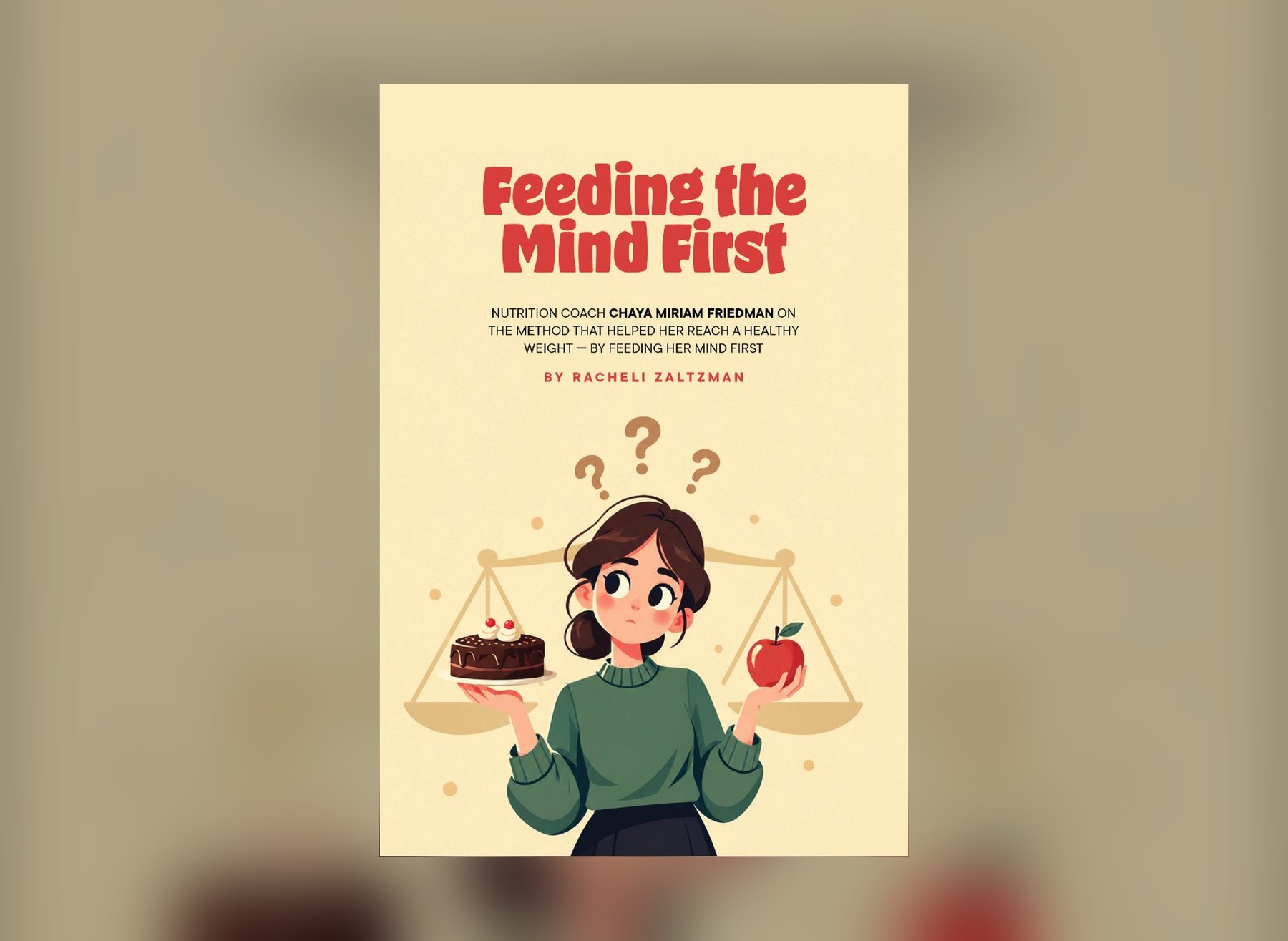
Nutrition coach Chaya Miriam Friedman on the method that helped her reach a healthy weight – by feeding her mind first.
For years I searched for a diet that would suit me, one I could maintain long-term. I was like a yo-yo, up and down, up and down. Until I found Chaya Miriam, who developed a unique method combining proper nutrition with awareness, and I lost sixty pounds.
Chaya Miriam drew me to her from the very first moment. She always thought of me positively and gave me tools to believe in myself and look at my successes. Her key phrase was: “There’s no ‘I fell’! There’s ‘I got up and succeeded’!”
Chaya Miriam changed my outlook. I had the privilege of being personally guided by her through the process. For the first time in my life I managed to maintain a stable weight over time. I recommend that every woman dealing with excess weight go consult with her and receive positive energy that will lead to weight loss and to maintaining it.
So who is Chaya Miriam, what is the method she developed, and how does she help women maintain their weight over time? All this and more in this fascinating interview.
Like a Yo-Yo
Chaya Miriam, developer of the קל להיות קל (Easy to Be Light) method, helps hundreds of women in Israel and around the world in their weight-loss process by working with the subconscious and NLP tools.
Chaya Miriam begins with her personal story:
“I grew up in Yerushalayim and from a young age I experienced difficult struggles due to obesity and also being underweight.
“In my teenage years, when my appearance became significant to me, I understood there was a difference between me and my friends as I have a tendency toward weight gain. A desire arose in me to be thin, and I decided to fight my obesity. Of course, my body suffered first.
“I started with diets I invented myself. I fasted, ate only herbs and vegetables and abstained from all tasty things. I lost more and more weight, and reached the opposite extreme, being underweight. I caused damage to my health.
“Over the years I tried to maintain balance, but I was like a yo-yo, going down and up in weight all the time.
“I read a great deal of material on the subject, went to support groups, researched people in the field, and after an exhausting journey I arrived at an amazing diet that gave me the complete solution to what I was looking for.
“A few years ago I made a discovery that changed my life. I experienced a method that isn’t a diet, but a way of life. I ate, enjoyed, and lost weight in a balanced and correct way! And most importantly, with joy, without the battles found in other diets, where the body truly fights against you and isn’t on your side.
“This method created peace within me because I learned there is no ‘no’ and no ‘forbidden.’ It’s permitted to eat everything, and still lose weight!
“Suddenly I realized that the mind eats before the stomach does. I learned that you can feed the subconscious positive values that automatically affect you and your body for the better. The more I adopted correct eating habits, the more weight I lost! And the more I lost, the more compliments I received, which only strengthened my commitment to the path I had adopted.”
My Method
“I searched for the approach that would suit me and found it. When I tell myself: ‘I am choosing. I’m allowed to eat the Magnum [ice cream bar], but I choose not to,’ it automatically becomes easier for me.
“Out of my love for people and my desire to help, I decided to open weight-loss support groups. I’ve had the privilege of guiding hundreds of women on the path to success. Together we learn how to reprogram the subconscious and how to live with food through love, not war.
“Within each of us there is a ‘thin woman’ and a ‘fat woman.’ In my method, we cultivate good beliefs for ourselves, belief in willpower rather than thinness. We learn to respect ourselves, and we don’t fight against our bodies, because in war you only lose. Instead we believe we’ll succeed in losing weight through the right actions.”
Think Good
“When I tell my subconscious ‘no’ or ‘I’m not allowed,’ it activates immediate resistance and does the opposite.
“Every person actually has two systems that run them: the conscious mind, i.e. all the knowledge we’ve accumulated about ourselves throughout life, and the subconscious, i.e. the chief operating system. The subconscious drives internal processes into practical actions, without us feeling or knowing what’s behind our decisions.
“Conscious and unconscious thinking are similar to a secretary who does everything her boss wants, even in the dream stage, before being asked. What the mind thinks, the body will carry out. If in my head a diet is a long, exhausting, turbulent journey, that’s what the body will experience during the diet.
“When I think that being overweight is ‘in my genes,’ the body will tell itself ‘it’s genetic’ and won’t easily release the excess weight and fat.
“What you think is what you’ll invite; the body is our loyal soldier. It carries out our thoughts precisely.
“Picture a ship led by a captain. The captain steers it from above, the wheel in his hands. So too, the wheel is in your hands. Wherever you decide to sail, that’s where you’ll go.
“When it comes from the mind, there’s no internal war. How much can you stick to a menu, the gym, and dry rules, when in my heart I’m dreaming about chocolate, pizza, or malawach?
“This constant war, and the feeling that I’m giving up and sacrificing more and more from my life, wear me down in the end.
“That’s why it’s important to change your language. In NLP we say, what you say influences what you experience. In our case, what you say—you’ll eat.”
When Thoughts Change Reality
Let’s illustrate the idea:
“Once there was a destitute man who didn’t even have a roof over his head. The poor man couldn’t reconcile himself to his situation, and decided to take action. He took a check and wrote on it the biggest dream he had—a million dollars. That was the sum he imagined he would earn within a decade.
“Slowly he entered the workforce and found a respectable livelihood, and surprisingly, or not so surprisingly, less than ten years from the moment he wrote that check, he earned that sum, and even more.
“Rambam, who was the personal physician of the King of Egypt, found himself in a frightening challenge with a colleague of his, a Muslim physician, following a plot that the other physicians schemed against him. Each of the two physicians was required to poison the other, and to prepare a life-saving remedy for himself, so that everyone could see who was the greater physician.
“The day of the test arrived. By lot, it was determined that the Rambam would be the first to drink poison. Kamon, the Muslim physician, concocted an especially strong poison. The Rambam instructed his students that the moment he swallowed the poison, they should lay him down so the substance wouldn’t spread through his body, and give him the remedy he had prepared. And so it was.
“After several days the Rambam recovered, and it was Kamon’s turn to receive the poison. He drank from it. Minutes, hours, and days passed and nothing happened. Kamon grew very afraid, and was tormented by the question of how the poison he’d received worked. He began abstaining from food, lest contact with the poison activate it. Anxious and terrified, he met with the Rambam, and in that meeting he breathed his last.
“The Rambam was summoned before the king and was asked what strange poison he had prepared that kills after several days. The Rambam replied: ‘The G-d of the Jews gave me a gift to heal people—how could I use this power to kill people? I prepared for him a potion of raw vegetables, and he died only because of the fears he developed from dread of the ‘poison’ that had no effect at all.’”
We see just how significant self-talk and positive thinking are to the process.
Asking the Right Questions
“How do I manage when I really feel like eating junk food or a ‘quick fix’?
“In the moment of truth, I hold an external or internal dialogue with the junk food that’s tempting me. I know how to ask myself the right questions. For example: Is it worth it to me, for one moment of pleasure, for this fat to settle on my waist for a year?
“Maybe I’m tired, hungry, or thirsty, which is why I’m craving something sweet right now?
“What’s my substitute right now? Maybe a small piece of chocolate I keep in the pantry for emergencies? Maybe a health shake? Or maybe I’d rather eat and feel full, and put it off for another time?
“Our brain is like a kind of ‘Google’ simulation. If I search Google for ‘success,’ it will bring me images of luxury buildings, lawyers, successful businesses.
“If I ask my brain what I’m afraid of, it will answer me: war in the north, missiles, terror attacks, thieves, and more. So why not ask it something positive instead?!
“If I ask it: how will I succeed? It will automatically bring me ideas that contribute to my success, like intense sports or salads and healthy casseroles. These questions can advance us greatly, and drive us toward distant places of success. And conversely, if I show my brain how I failed, it will automatically bring up images of failure.
“To sum up: thought creates reality.
“As it says in Mishlei 18:21: ‘Death and life are in the power of the tongue.’
“In the Chassidic tradition: ‘Think good and it will be good.’”
A Chassidic Point — “Think Good”
The words “think good and it will be good” are not just a slogan, but a day-to-day life reality. The Rebbe instilled this idea in us from infancy. When I think well of my husband or my child, and say it to them in words, I can elevate them to other, higher peaks: “I really appreciate your effort… you’re so good at this… and that’s why I think you’ll succeed at an even harder task too.”
By contrast, if I criticize the children or my husband, or yell at them, I’ll never achieve what I want.
The same applies toward myself. If I tell myself: “Ugh, I fell off the wagon because of chocolate, ugh, I fell because of ice cream”… I’ll never manage to pick myself back up.
And why not look instead at all the other hours of the day in which I experienced so many successes? Don’t those successes deserve recognition?! And what about the effort and the striving?
In Chaya Miriam’s groups, they begin by naming five successes from that day.
Such is the “beinoni,” a nebach who inherited a ruler in the form of the yetzer hara, the “kluginker,” who does everything in his power to stop the Jew from being a “beinoni” who does ratzon Hashem. But Hashem and the Rebbe look at the essence of every Jew, at the potential embedded within to stop lashon hara mid-sentence, to stop an argument with one’s husband even when I’m the one who’s right. Hashem delights in the effort of the beinoni, in his persistence in matters of Torah and mitzvos. He also delights in the results, but mainly in the effort and the striving, in the labor born of toil.
The Chassidishe Vibe #1524 • pp. 12-15
© 2026 Beis Moshiach Magazine. All rights reserved.
This article originally appeared in Beis Moshiach #1524. You are welcome to share it with friends and family by email or in print, provided that you do not change, add to or omit any part of it, you credit the author and Beis Moshiach, and you include a link to archive.bmoshiach.org (written out in full in printed copies).
To republish this article in a newspaper, magazine, book or website, please request permission in advance at [email protected].