Don’t Be Afraid Of Material Heights
BEGIN WITH A GRIN
Two madmen having a conversation:
The first: Yesterday I was at the museum and I saw the axe with which Kayin killed Hevel.
His friend replied: And the day before yesterday I was at the museum and I saw the ladder that Yaakov saw in his dream.
Climbing The Heights (Or Not)
Much has already been written about Yaakov’s ladder, which he saw in his dream at the beginning of parshas Vayeitzei. There is a very wide range of Medrashim and commentaries, from the plain meaning of the text to the depths of the secrets of the Torah, discussing in minute detail exactly what Yaakov Avinu saw and how. This week, we will focus on a maamar of the Tzemach Tzedek that relates to an interesting explanation of “Yaakov’s ladder,” and on the Rebbe’s special way of connecting it to our own times (see Likkutei Sichos vol. 5 hosafos p. 382), and to the true and complete Geula.
In the maamar, the Tzemach Tzedek cites several early interpretations from the Medrash (Bereishis Rabba 68:12) of “Yaakov’s ladder.” The first interpretation: “The ladder” is the ramp; ‘set on the earth’ is the altar.” According to this, Yaakov saw the sacrificial service in the Beis HaMikdash, and the angels ascending and descending the ladder are like the Kohanim ascending and descending the ramp on the altar while offering the sacrifices. Yaakov’s seeing the avoda of the Korbanos symbolizes something much more general in our service of G-d today. According to this interpretation, the “ladder” that Yaakov saw refers to the tefillos of the Jewish people. For, as is well known, prayer was instituted by the Men of the Great Assembly to correspond to the sacrifices: “The prayers were instituted to correspond to the daily offerings” (Brachos 26b).
The second interpretation the Tzemach Tzedek cites is that the ladder Yaakov saw was, in fact, Mount Sinai, the mountain upon which the Torah was given. According to this, seeing the ladder refers to our Torah study today. Yaakov saw how, for thousands of years, his descendants and their descendants would sit and learn Torah with toil and effort. These “ladders” that Yaakov saw are called, in the Tzemach Tzedek’s phraseology, “ladders of holiness,” because however we look at it, whether he saw our tefilla or our Torah, he saw the future of Jewish life as illuminated by the light of holiness, in Torah and in tefilla.
Afterwards the Tzemach Tzedek cites a third interpretation: “‘And he dreamed, and behold a ladder;’ this is the dream of Nevuchadnetzar.” According to this, Yaakov saw the image of Nevuchadnetzar, that monstrous statue, that outrageous idolatry which the cruel tyrant Nevuchadnetzar made in his own honor. In this context, the ladder Yaakov saw was certainly not a “ladder of holiness,” but exactly the opposite! An accursed ladder, symbolizing the forces of kelipa and impurity, and not just any kelipa and impurity, but precisely the one that “burned our house, destroyed our palace, and exiled us from our land,” since, as is well known, the king of Bavel, Nevuchadnetzar, destroyed the first Beis HaMikdash. This means that Yaakov saw the destruction and the exile, a “ladder of kelipa,” the dizzying climb of the forces of impurity and their growing power against the Jewish people and the forces of holiness. A vision completely opposite to, and contradicting, the positive sights and visions discussed above.
The Tzemach Tzedek explains at length (and this is not the place to elaborate) why Yaakov saw the image of Nevuchadnetzar and the positive spiritual meaning that results from it, while resolving contradictions between the statements of our Sages about the nature of evil and the use that holiness is supposed to make of that same abominable evil. Without entering into the Kabbalistic analysis the Tzemach Tzedek writes about, let us say that the correct Chassidic outlook is that “the Satan intended it for the sake of Heaven.” Even though in our eyes it appears that the forces of evil and impurity interfere with (and at times, heaven forbid, even overpower) holiness, nevertheless the spiritual root of those forces is certainly positive, and we must reveal the positive in them through our service in holiness.
But as it relates to us, and to the true and complete Geula, the Tzemach Tzedek brings an interesting addition to the story of “Yaakov’s ladder.” He cites the Medrash Tanchuma (at the beginning of our parsha), according to which, G-d asked Yaakov to climb the ladder, after all that he had seen…
Yaakov was very afraid: “At that moment our father Yaakov became frightened.” What exactly was he afraid of? The Medrash explains that Yaakov saw the ministering angels, who represent the guardian angels of the nations of Bavel, Medea, Greece, and Edom, the very angels in charge of the nations that conquered and enslaved the Jewish people. Yaakov saw how each angel in turn “ascends and descends,” meaning that after the time of its rule arrives, the peak of that nation, a dizzying decline follows, failure and loss of control, to the point of the complete collapse of that nation. So it happened to Bavel in its time, so it happened to Medea in its time, so it happened to Greece in its time, and so it will happen (very soon!) to Edom in our time!
Yaakov was afraid, “and he said: Just as these have a descent, so too I will have a descent. The Holy One, blessed be He, said to him: If you ascend, you will have no descent. But he did not believe, and did not ascend.”
Yaakov’s fear caused him not to heed G-d’s request and in the end he did not ascend!
Fear Of Heights
The Tzemach Tzedek explains this interesting addition of the Medrash in a special way that relates very much to our own era. As mentioned above, according to the Tzemach Tzedek’s interpretation, Yaakov saw three types of ladders: two of them represent “ladders of holiness,” Torah and prayer, while the third represents a “ladder of kelipa.” Of the first two types of ladders Yaakov had no fear of ascending at all. He was not afraid to rise in the service of prayer, and he certainly was not afraid of the spiritual elevation of Torah study; after all, at that time Yaakov was engaged exclusively in… pure Torah study! His problem was ascending the third ladder, “the image of Nevuchadnetzar,” “the impure ladder.” Why did G-d want Yaakov to ascend this ladder, and what is the spiritual meaning of this in the service of G-d?
The Tzemach Tzedek explains that “ascending the ladder of kelipa” means “that he should also ascend to the matter of the influence of this world,” that is, an ascent in the material things that G-d gives the Jewish people. Or, in simple words, Yaakov feared that G-d would grant the Jewish people too much money and material wealth. He feared an abundance of silver and gold, precious stones and pearls. He feared that he would have oil wells (instead of Qatar), he feared that most of the world’s exports would come from him (instead of from China), he feared that precious stones would be found on the shores of the Promised Land (instead of in Africa and its surroundings). In short, he feared that he (and we…) would have too much material good.
Why? What is there to fear? What is so bad about an abundance of material plenty?
The Tzemach Tzedek continues: “Perhaps he will not be able to withstand it, and the ascent will be the cause of the…” Yaakov knew that sometimes “the ascent is the cause of the downfall,” and that “an abundance of good they cannot receive,” for it is possible that material plenty would cause a spiritual fall for him, for his family, and for the entire people.
But this was a mistake. G-d told him that “if you ascend, you will have no descent”! Since Yaakov our forefather was, in his essence and inner being, nullified to G-d in all his desires, the material good and plenty would not cause him to descend. On this basis the Tzemach Tzedek explains the wondrous abundance and material plenty of the Messianic era, and the wondrous miracles that will occur then in the physical world (for example: “in the future, a woman will give birth every day”).
For then, in the era of the Geula, when “the earth will be filled with the knowledge of G-d,” and wisdom, knowledge, and truth will increase, the “point of wisdom” in the soul of each person will be revealed, a point of wisdom whose essence is nullification/bittul to Hashem. This nullification will be the lot of all humanity, and there will be no obstacle to material things being bestowed in abundance. As is also brought there, even the stable-keeper of Rabbeinu HaKadosh, aka Rabi Yehuda HaNasi, was richer than King Shapur, a Persian monarch, and this had no negative effect on his service of G-d (if only we all had that!).
The Rebbe quotes this and concludes that from here we learn for our own time that even today, by revealing the point of wisdom in the soul, through nullification to G-d, we are able to ascend “the ladder of wealth.” Although wealth is indeed a difficult test, nevertheless when the Hashem grants a person wealth, He can at the same time also grant him the proper nullification, so that there will be no obstacle in the service of G-d. And so may it be for us!
To Conclude With A Story
And let us end with a story about how the Rebbe wanted to distribute wealth to everyone, but we were not wise enough to accept it…
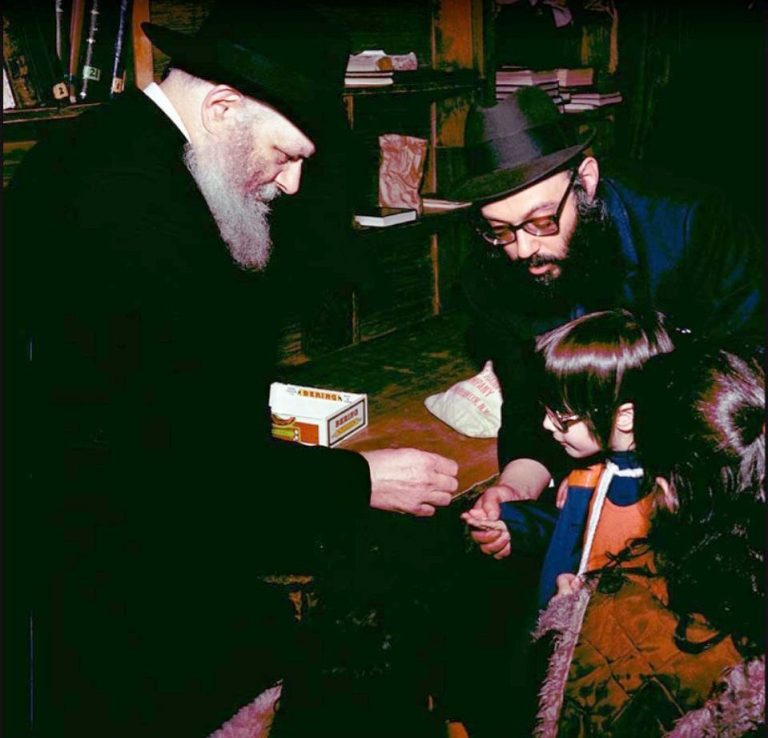
At the Purim farbrengen of 5715 (1955), the Rebbe said the following:
“May the Eibishter give all of Israel wealth, and may there be toil of the soul and toil of the flesh, and may there be a need for several hours of contemplation in order to overcome the test. After all, in America everything is decided by vote, so all those who agree that they should have extravagant wealth and don’t mind the toil, let them raise their right hand with a whole heart.”
Shock in the crowd, total shock.
The Rebbe waited a few moments and looked around. It turned out that most of the people, who were under the influence of the sicha, did not summon the courage to raise their hands and win riches. Only three raised their hands. Then the Rebbe said:
“Afterwards they complain that this is lacking and that is lacking, but when there is an auspicious time, they do ‘Chabad-style nonsense’… What can I do for you? In material matters they go with doubt and double-doubt that perhaps something will come of it, and when there is a gathering of more than a minyan of Jews, in a time of favor, to ‘grab’ and ‘seize’ in a matter connected with the Holy One, blessed be He, Himself, they lose the opportunity so long as they are called ‘masters of intellect.’ What can I do?…”
All three became rich, and the best known among them is Shmuel Isaac Popack a’h, whose great fortune stood at hundreds of millions of dollars.
If only we were wise enough to accept it…
Good Shabbos!
Beis Moshiach #1531 • 10 Kislev 5787 • י׳ כסלו תשפ״ז • pp. 36-38, 35
© 2026 Beis Moshiach Magazine. All rights reserved.
This article originally appeared in Beis Moshiach #1531. You are welcome to share it with friends and family by email or in print, provided that you do not change, add to or omit any part of it, you credit the author and Beis Moshiach, and you include a link to archive.bmoshiach.org (written out in full in printed copies).
To republish this article in a newspaper, magazine, book or website, please request permission in advance at [email protected].