The Night Avresha Became Avremel Again
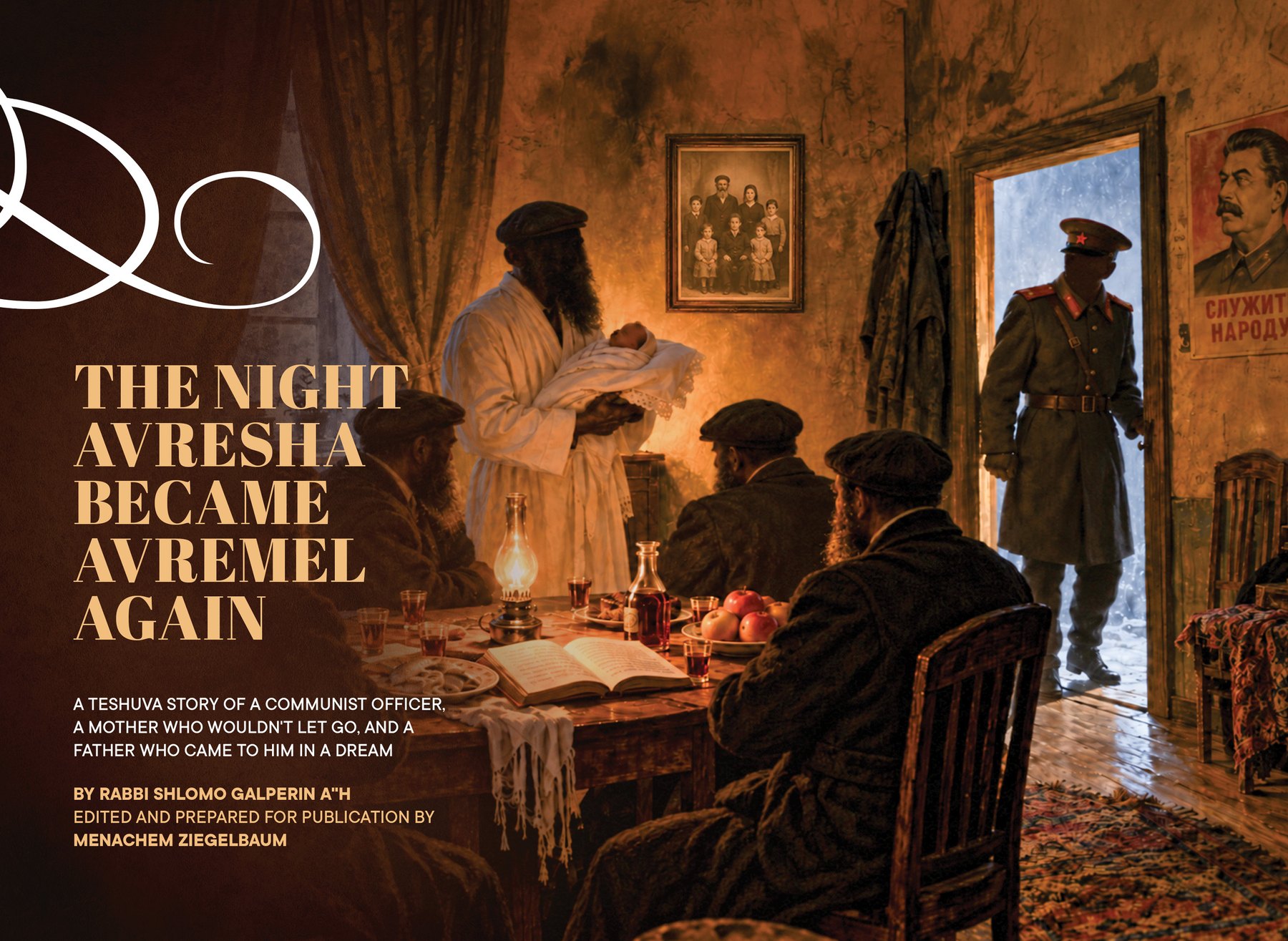
By Rabbi Shlomo Galperin a”h, edited and prepared for publication by Menachem Ziegelbaum
A teshuva story of a communist officer, a mother who wouldn’t let go, and a father who came to him in a dream.
I
In his youth, he studied Mishna and Gemara in a cheder but over time, under the influence of his irreligious surroundings, he drifted away from Yiddishkeit and, rachmana litzlan, began being mechalel Shabbos. Only on Yom Kippur would he enter a shul, and that was enough for him for the entire year.
When he had a son, his mother, Chaya Basha, persuaded him to have the child circumcised. She told him that if, G-d forbid, he refused to circumcise him, she would take her own life. Since Avresha loved his mother, he was forced to agree to the bris mila.
At that point, holy feelings of the G-dly soul awakened within Avresha’s heart. For the neshama always remains whole, just as it descended from the Treasury of Souls; it merely falls asleep over time if a person does not observe Torah and mitzvos. The truth is that the soul cannot separate itself from its Father, blessed be He.
When our Avresha saw his mother’s tears and pleas as she begged him to bring his son into the Jewish fold, he agreed to the bris mila on the condition that it be done secretly and in complete silence. He added another condition: that he, Avresha, would not be home at the time. That way, if word of the bris mila reached the authorities, he could say that whatever his elderly mother had done was without his knowledge, and that he was innocent of it.
Since the Chassid Reb Chanoch-Hendel [Galperin, father of the writer of these lines] was both a shochet and an expert mohel, he was the person Chaya Basha approached to arrange the bris mila. No one else was willing to put himself at risk, since this involved actual mesirus nefesh.
But R’ Chanoch-Hendel was one of those who had absorbed the holy light of Chassidic teachings and the powers of self-sacrifice exemplified by the Chabad Rebbeim. That was why he put all practical considerations aside and went happily, thanking Hashem for granting him the merit of taking part in such a great deed.
Meanwhile, he urged Chaya Basha to hurry and prepare the baby with diapers and hot water, and told her that he would come to perform the bris mila.
On the way, he quietly let several of his Chassidic friends in on the secret so that they could accompany him for the honor of being sandek, to recite the brachos, and even to say l’chaim properly… The Chassidim arrived at the house two at a time, out of concern for prying eyes.
II
Avresha’s home was on a side street, in a medium-sized building inhabited by members of the Communist Party. Most of them were Jews who held government positions such as engineers or drivers for senior government officials, and the like. Although they were officials in the Communist Party, some would slip away for a few minutes on Rosh Hashana to hear the shofar, or would come to the shul for a few minutes for Kol Nidrei.
There were many such Jewish Communists in the building where Avresha lived, along with several non-Jewish families.
When the Chassidim arrived at Avresha’s building, R’ Chanoch-Hendel knocked on the gate. The guard who was stationed there opened the small window in the iron gate and peered through it. When he saw R’ Chanoch-Hendel, whom he knew, he quickly opened the iron gate and said to him, “Gendel! How did you come out in weather this cold, when the water in the buckets has turned to ice and there isn’t a living soul in the street? It’s practically impossible even to breathe because of the terrible cold!”
R’ Chanoch-Hendel replied, “My friend Ivan, please go and tell the Piter-Avresha family that the old man has arrived with his relatives, and they would like to go up to the apartment because it is very cold outside.”
The guard hurried away and returned with the answer that they should come upstairs immediately.
“However,” he said, “Avresha himself isn’t home but Avresha’s mother and his wife are at home, and they are happy to see you.”
As R’ Chanoch-Hendel began climbing the stairs to Avresha’s apartment, Ivan called after them, “I almost forgot to tell you - Avresha has had a baby!”
The Chassidim opened the apartment door and entered the first room, a large room with pictures of prominent government ministers hanging on the walls. Bright electric lights illuminated the room from the chandeliers hanging overhead.
In an instant, Chaya Basha came toward them. With tears of joy, she welcomed them with a heartfelt “Welcome!” and invited them to follow her into the second room.
R’ Chanoch-Hendel placed his old case containing the instruments for the bris mila on the table. Chaya Basha brought out a bottle of vodka that she had recently purchased, along with new shot glasses, a plate of apples and pears, and another plate with fresh salted fish.
R’ Chanoch-Hendel took out a cake he had brought from home. Although Avresha’s kitchen was filled with all kinds of meats and fish, as well as various wines and beverages, the Chassidim could not partake of any of them because of kashrus.
R’ Chanoch-Hendel asked for water and soap so that he could wash his hands. He put on his white kittel, which he used both on Yom Kippur and for bris milas, and also donned a head covering made from the same material, also pure white. He looked like a professor or, more accurately, like an angel dressed in brilliantly shining white.
Then the grandmother brought in the baby.
One of the Chassidim, wrapped in a large tallis, sat down on a chair and took the baby in his arms, a Jewish baby with a G-dly soul. They placed the baby on his lap and he recited the bracha. There is no need to describe the sacred emotion with which the bracha emerged from his lips.
After the mohel had performed everything properly, according to Jewish law, Chaya Basha, overcome with joy, grabbed the baby to take him.
“Wait, Chaya Basha,” R’ Chanoch-Hendel said. “First we must give the baby a name.”
After they gave him the name “Yisroel,” the mohel put a drop of wine into the mouth of the newly circumcised infant, saying, “By your blood, live” (b’damayich chayee). Chaya Basha took him, tears of joy streaming continuously from her eyes, and began dancing with the baby before taking him into the adjoining room to his mother.
The Chassidim sat around the table and blessed one another: “L’chaim! May this little one grow to become great!”
They drank small glasses of strong liquor and tasted the cake, as well as the salted fish and fruit.
“Today we have merited to bind a divine soul to Hashem,” said R’ Chanoch-Hendel. “I am certain that all the exalted souls are looking down upon us at this moment and wishing for themselves a great mitzva such as the one we have just performed here, in Avresha’s home.
“True, he is still far from Torah and mitzvos, yet these are Jews who, despite all the danger involved, circumcised their son. Had the authorities discovered what had happened, at best they would have sent him to live among the polar bears in Siberia.
“And we,” R’ Chanoch-Hendel concluded, “have merited fulfilling the Divine purpose. How fortunate we are. How good is our portion. L’chaim!”
“L’chaim v’livracha!” everyone answered together.
At this point the baby’s mother entered the room. Her eyes were red from crying, and tears streamed down her face as she said with great emotion: “Although I cannot speak Yiddish or Lashon HaKodesh, I am a Jewess, and my parents were great rabbis. But because of the circumstances of the times, I drifted away from religion. The same is true of my husband, Avresha. He is a Jew at heart, even though he holds a senior position and occupies an important post in the Communist Party.
“I thank Hashem that I listened to my mother-in-law Chaya Basha and agreed to give our son a bris. And I thank all of you for this from the bottom of my heart. Surely this child will be a Jew and will remain a Jew.”
When she finished speaking, she returned to her room.
For another short while, the Chassidim held a farbrengen, saying l’chaim. They even began singing a quiet song so as not to arouse the suspicions of the neighbors.
III
It was already late, and the Chassidim were preparing to leave when suddenly the doorbell rang.
Fear swept over the Chassidim. They strained to listen while Chaya Basha went to open the door.
Standing at the door was none other than Avresha himself.
He entered, greeting the Chassidim, and even apologized for having had to travel on Party business. Avresha sat down with the Chassidim and R’ Chanoch-Hendel gave him a small glass of mashke and said, “Nu balabos, say l’chaim in honor of your son’s birth.”
Avresha was just about to drink when he stopped halfway, after R’ Chanoch-Hendel placed a kippa on his head.
“Make the bracha, Avresha.”
Avresha repeated the words of the bracha after the Chassidim and said, “L’chaim u’librius” (“To life and to health”), and those gathered answered, “L’chaim v’livracha, in both physical and spiritual matters.”
R’ Chanoch-Hendel began: “Avresha, do you remember the Chassid Rabbi Avrohom Yaffe? His prayers, and the majestic expression on his face that radiated insight and wisdom?”
“Yes, I remember him very well,” Avresha said. “He was my late father.”
“Say l’chaim in memory of your righteous father, that he may pray for us in Heaven.”
After several glasses of mashke, Avresha’s tongue and heart opened, and he began telling them about his childhood in cheder, about his friends and companions. He also recalled the tefillos of his father, Rabbi Avrohom Yaffe, who even on ordinary weekdays would daven until midday, with tremendous emotional outpouring and intense weeping.
Many people would come to hear his davening, which sounded like those of a man standing before the King, pleading for his very life. Some would shed tears upon hearing the depth of his emotional devotion.
There were also passages of prayer that he would recite with joy and exuberance, for he was also a baal menagen, a gifted singer and musician and a man of great feeling, with a pleasant voice.
Thus, many Jews returned to Yiddishkeit through the influence of Rabbi Avrohom Yaffe z’l who accomplished this through pleasantness and love.
Now R’ Chanoch-Hendel reminded Avresha of his father, his prayers, and the songs he used to sing on Shabbos and Yom Tov. R’ Chanoch-Hendel began singing the deep, pnimiyusdike songs, filled with emotion and holiness, that Rabbi Avrohom Yaffe used to sing. He sang with tremendous emotion while the other participants accompanied him, tears streaming down their closed eyes. They had almost forgotten that they were in a building filled with residents who were members of the Party.
In Avresha’s mind passed the days of his childhood in cheder when he had studied with great Chassidic melamdim who were yirei Hashem. He remembered his friends from those days and the image of his father, Rabbi Avrohom; his tefillos and his speech, and the way he would recite every bracha with dveikus and emphasis.
And he remembered how, because of bad friends, he had abandoned the path of Torah and mitzvos, become a member of the Communist Party, and forgotten everything. And tears streamed from his eyes…
When they finished singing, they took l’chaim once again, and Avresha also drank a l’chaim.
After several glasses of mashke, Avresha became somewhat different…
“Well, Avresha!” R’ Chanoch-Hendel said. “We do not even reach the ankles of your father, the Chassid, who would spare no effort in the world to return a Jewish soul to our Father in Heaven.
“And you, Avrohom, called Avresha, from now on bring nachas ruach to the soul of your righteous father, who in the Upper Worlds suffers because his son is far from Torah and mitzvos.
“Remember, Avrohom, the tears your father shed every day out of profound sorrow. And from today, begin putting on tefillin. Keep kosher and observe the laws of family purity especially when you studied Gemara and Medrash and so forth, and you know the way a Jew is supposed to conduct himself.
“We will come to your aid with all aspects of religion. We will help you replace the kitchen utensils, and we will even try to arrange some kind of work for you that will make a Torah-observant life easier for you.
“And don’t forget that the mikva is at the home of Rabbi Chaim Dov the Lame…”
It was five-thirty in the morning.
Avrohom had forgotten that he had not yet eaten supper and that he had been sitting with the Chassidim for several hours, drinking l’chaim. He had forgotten that he was in his own home. It seemed to him that he was sitting in a shul, farbrenging with the Chassidim as he had in days gone by.
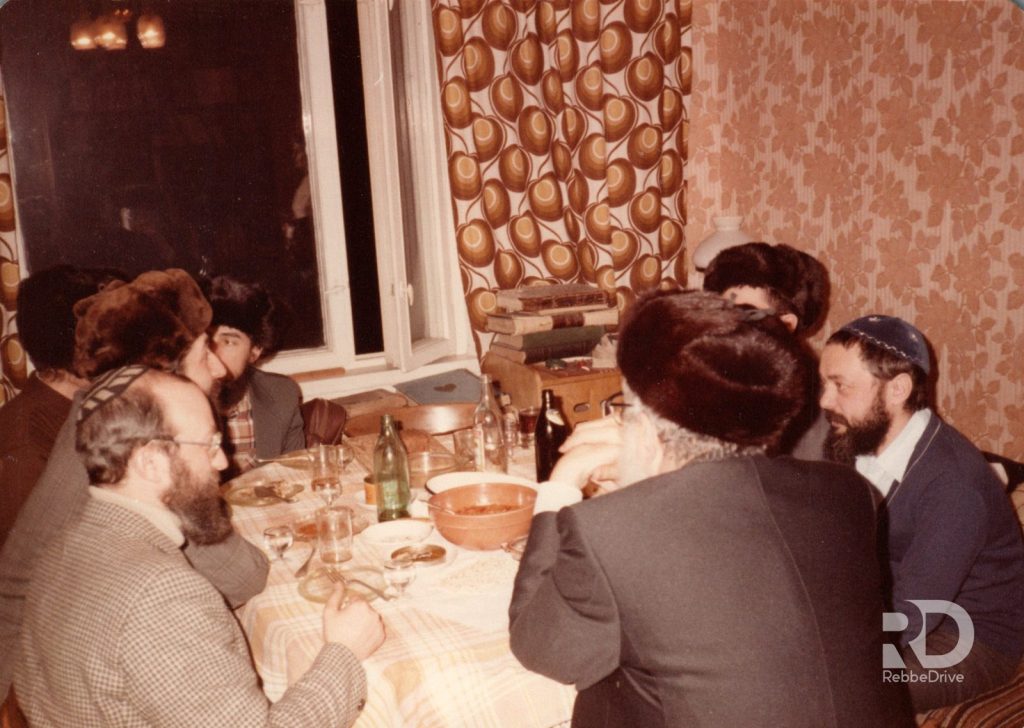
Finally, those gathered rose, saying that it was approaching six in the morning and that it was time to go daven as a new day was about to begin in the bitter winter cold.
IV
After the Chassidim went on their way, Avresha-Avrohom remained sitting in his place and began singing a Chassidic niggun by himself.
He became filled with an inner fervor, and, like a divine fire, something began burning within his heart until he rose from his place and began dancing joyfully: “I was born a Jew, and I will remain a Jew!”
For some time he danced alone in the room, tears streaming from his eyes - tears of joy and gladness - until his wife and mother entered to calm him. They were afraid of the neighbors.
“My dear son Avrohom,” his mother said, “I thank Hashem that He has placed teshuva in your heart and that you have decided to return to the Jewish people and to our Father in Heaven.
“Your wife, too, has decided to throw away all the kitchen utensils and buy new ones, and from now on to observe kashrus, lighting Shabbos candles, and the other dinim that apply to a proper Jewish woman. Now come and see your newly circumcised baby…”
“Ah,” Avrohom said, as though awakening from another world. “I almost forgot. The bris mila was yesterday…”
He immediately entered the adjoining room, where the child was sleeping peacefully in his cradle.
“From now on, it is as though we have been born anew,” Avrohom said emotionally to his wife. “From today we will begin a new life, a life of Torah. I have shed enough of my righteous father’s blood…”
Turning toward the baby’s cradle, he said:
“Yisrolik, our son! Despite the suffering and troubles that the Jewish people have endured throughout thousands of years of history, you will be a symbol of self-sacrifice, and you will observe the Torah proudly, with true self-sacrifice.”
“Enough, Avrohom,” his wife and mother told him. “Now go and rest.”
They were concerned for his health and persuaded him to lie down in bed.
But suddenly he remembered that in the past he had never simply gone to sleep. He would recite the Shema before going to bed. Yet now, apart from “Shema Yisrael” and “Baruch Shem,” he did not know anything by heart.
In his youth he had indeed known a page of Gemara with the commentary of the Maharsha, but over the years he had forgotten it all.
Where could he now find a Siddur with which to recite the bedtime Shema?
But it has already been said, “One who comes to purify himself is assisted from Heaven.” And now, too, Heaven helped him: he found his mother’s Korban Mincha Siddur that she had guarded like a precious treasure.
In this Siddur, Chaya Basha had found consolation, and in difficult moments she had poured out her tears upon its pages.
Now she gave the Siddur to her son so that he could read the bedtime Shema.
Avrohom washed his hands and carefully took the Siddur. He entered his room and began reciting the Shema.
As he remembered how far he had strayed from Hashem’s Torah and recalled the beautiful life he had once lived, filled with Torah, Shabbos, and Yom Tov, he burst into tears, tears falling down his face. The image of his righteous father also stood before his eyes.
Thus he fell asleep in a state of profound dveikus, spiritual attachment to Hashem.
And behold, in his dream his righteous father came to him from the Upper World. He was dressed entirely in white, and his face shone with a great light.
“My son Avrohom! You have brought me back to life!”
He blessed him with the Birkas Kohanim, and immediately disappeared as suddenly as he had come.
Avrohom began calling out to his father, but his mother began calling, “Avrohom! Avrohom!” and he awoke from his sleep. “What happened, Avrohom? What did you dream? Tell me what you saw in your dream!”
“I saw Father in a dream, after so many years during which I had not seen him,” Avrohom said, trembling with emotion.
“It is a good sign,” his mother said.
“He also blessed me,” Avrohom continued telling her.
“If so, that is a great joy and a very good sign,” she replied. “And now, lie quietly, because I think you have a fever.”
Indeed, all the events of the past twenty-four hours had taken their toll on his body. He had a headache and felt extremely weak.
“Today you will stay in bed and rest at home, and I will send for the doctor. He will write you a few days’ leave from your work in the Party. In any case, you will eventually have to leave them and find a new job so that you can live as a Jew.”
V
At ten-thirty, Professor Limanov arrived at his home. He served as the personal physician of the Party members.
“Hello, Comrade Avsonov Kahanov. How are you feeling? The comrades sent me to check on your health. Here is the thermometer; please check your temperature. I heard that you have had a son. Well, may he grow up to be a strong young man, like a cedar, for his people and his parents.
“Ah,” the doctor continued chatting,“it is a very harsh winter this year. It is snowing all the time, and the cold penetrates to the bones. Oh, you have a fever, Mr. Kahanov, and you also look very tired. Let us examine your lungs and heart. Yes, there is a little palpitation in the heart, and your throat is red; but do not worry, it will pass, and in a few days you will be able to return to your regular work.
“In the meantime, I will prescribe a few pills to calm the heart, as well as syrup for the throat and weakness, and pills for the fever - medication that is generally given only to comrades such as our friend Kahanov. I ask you to remain in bed, drink hot beverages, and refrain from any intellectual work that requires effort or concentration. To ensure that you make a complete recovery, I am giving you a week’s leave. If your condition changes, please notify me immediately. Goodbye, and all the best, Comrade Kahanov!”
When the professor entered the adjoining room, Avresha’s mother and wife were waiting for him.
“Professor, what do you think of the patient’s condition?”
As they spoke, they offered him an armchair, poured him a bottle of fine wine and served him excellent cakes, a plate of apples and pears, and a pack of cigarettes that only the Party’s select members could obtain.
The professor poured himself half a glass of wine and ate some of the cake, saying with pleasure, “Wine like this truly revives the soul. Well, Mrs. Kahanov, you should know that your husband’s physical condition does not concern me. What does concern me is his mental state. I see the beginnings of depression. It is no wonder, after such demanding work, which drains all the strength from his body and soul. The meetings that go on for hours and hours at Party headquarters have probably weakened him and his nerves as well.”
The professor poured himself another glass of fine wine and, while eating some of the excellent apples, continued: “But we will send him to a sanatorium for rest and mental recuperation.”
“I have been telling my husband for some time,” said the devoted wife, “that he ought to be examined by the professor, because I could see that he was not himself. He does not talk much, and he has no spirit. Apparently, all the work has weakened his nerves.”
Meanwhile, Chaya Basha presented the professor with an expensive box of chocolates, saying, “For the wife.”
The professor leisurely drank his coffee. Afterwards, he looked at his watch and said, “I still have to visit the head of the organization today, Mr. Grugorenko. As for Mr. Kahanov’s condition, I will try to have Mr. Kahanov’s work changed to something easier, without such strenuous effort. After all, we are friends…”
The professor departed with great dignity, got into the government car that had been patiently waiting for him, and said to the driver, “Now, Comrade Brezhov, drive straight to Lenin Hospital. I have to meet with several of my fellow doctors there.”
When he arrived at Lenin Hospital, he was received by the hospital director, Professor Levitin, the great specialist in heart disease, together with several other surgeons.
“Hello, Professor Limanov. Perhaps you will have lunch with us, and in the meantime we can talk. We have several Party leaders here, and we need to consult about the proper course of treatment.”
“With great pleasure, dear comrades!” said the professor.
They all entered the magnificent dining room where the director and the other medical specialists took their meals. After discussing the menu, Professor Limanov said to his fellow doctors: “Do you know Amsanov Kahanov?”
“Of course. Who does not know him? He serves as the central official responsible for dealing with the Komsomol youth, as well as head of the central bureau, and in addition he is a member of several extremely important committees.”
The professor shook his head.
“Indeed, my dear colleagues, the enormous workload has greatly weakened him. Today I was urgently called to his home, and his condition is not encouraging. First, I ordered complete rest and recommended a month at a special sanatorium for comrades like him, in my opinion somewhere near the Black Sea, where the treatment is excellent and the finest physicians practice. At the same time, his workload must be reduced. We should recommend to the special medical committee that they examine the matter.”
“Well, the head of the medical committee is sitting right in front of you. It is none other than Dr. Simanov,” Professor Leviten, the hospital director, said jokingly. Dr. Simanov nodded his head importantly: “We will try and do whatever is possible in the matter.”
And so the conversation came to an end and the meal also drew to a close. After visiting the hospital wards, the doctors went into consultation in the doctors’ room, and afterwards they returned home to rest.
VI
After considerable efforts at the highest levels, Professor Limanov succeeded in having Avrohom appear before a special medical committee. The committee recommended to the Party leadership that he be transferred to a less important position involving less strenuous work. As a result, he was transferred to another position in which he was responsible for distributing the salaries of the political officers in the region.
Now, having succeeded in freeing himself from his many responsibilities, he was able to devote himself more fully to the chinuch of his son, Yisrolik, and especially to himself.
He obtained a pair of tefillin from Rabbi Chaim Ber Havlin, and brought down from the attic the tallis that had been lying there since his wedding. From one of the shuls, he obtained an old Siddur as well as a Tehillim.
Every day he would stand and daven at length, wrapped in his tallis and wearing his tefillin. His new job made this possible. With time, he returned to studying Gemara and Tanya, and secretly recited Tehillim, particularly on Shabbos. On those days, he would go with his wife, his mother, and his son Yisrolik to visit R’ Chanoch-Hendel, where they would study Likkutei Torah.
Eventually, R’ Chanoch-Hendel confided in him that there was a secret minyan on a certain street. At the back of the courtyard was a large room, reached by descending a staircase. There was a Sefer Torah and benches there, and on Shabbos they davened and read from the Torah.
There, R’ Avrohom had the privilege of davening with a minyan and being called to the Torah after decades of estrangement. After the davening they made Kiddush and drank l’chaim to celebrate the arrival of the new member at the shul.
Day by day, R’ Avrohom continued to grow in his yiras shomayim and his avodas Hashem. Because he knew many senior officials who were his friends and associates, he was occasionally able to perform great favors for Jews who had been thrown into prison on various fabricated charges, especially because they observed the Torah and mitzvos.
Because he was highly gifted and possessed a sharp mind, he advanced in his Torah studies, both in Nigleh and in Chassidus, as well as in avodas ha’tefilla. He also accepted upon himself several practices of teshuva in order to atone for his past.
Beis Moshiach #1523 • ז׳ תשרי תשפ״ז • pp. 20-29, 40
© 2026 Beis Moshiach Magazine. All rights reserved.
This article originally appeared in Beis Moshiach #1523. You are welcome to share it with friends and family by email or in print, provided that you do not change, add to or omit any part of it, you credit the author and Beis Moshiach, and you include a link to archive.bmoshiach.org (written out in full in printed copies).
To republish this article in a newspaper, magazine, book or website, please request permission in advance at [email protected].