In the Zone
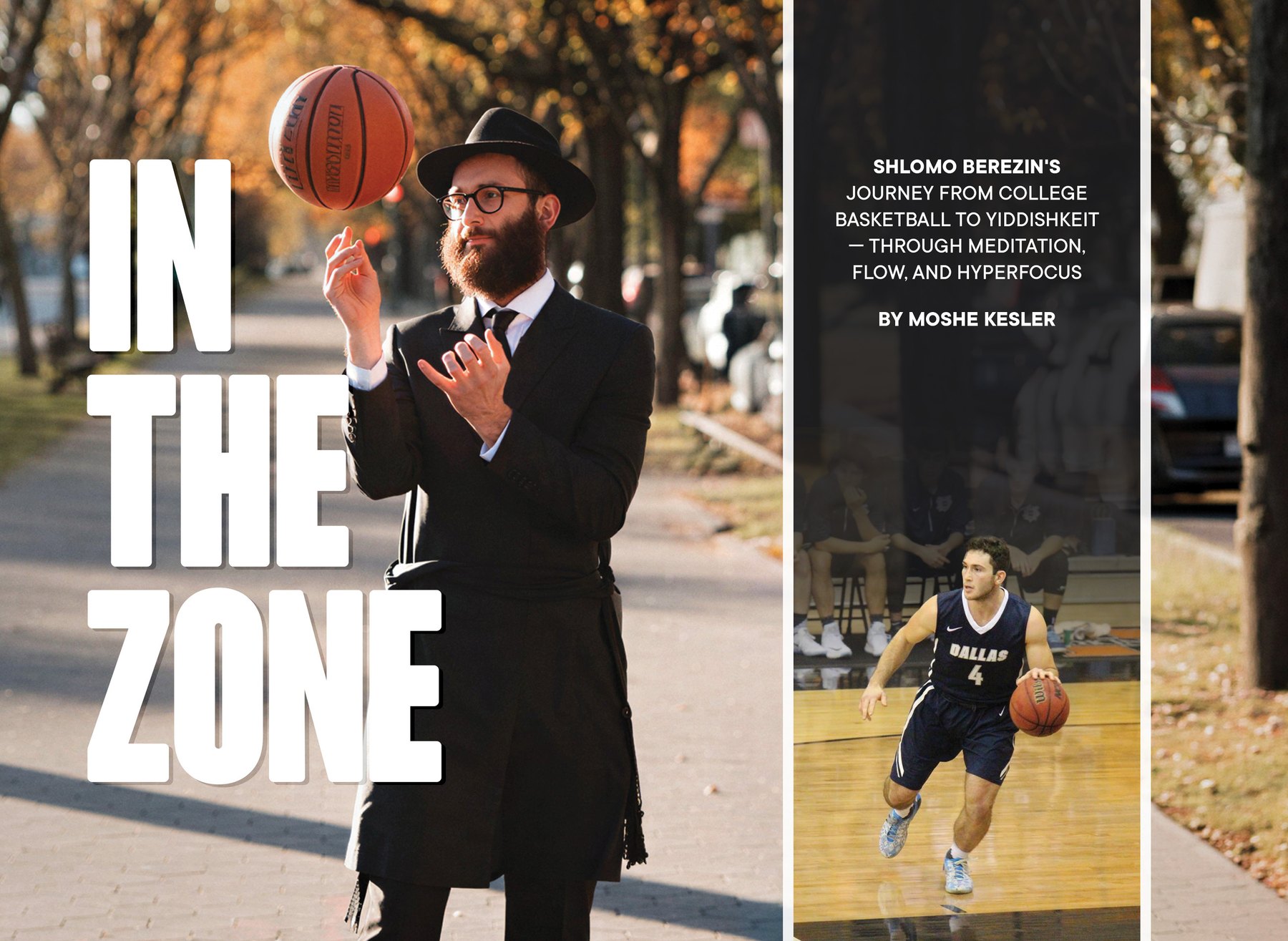
Shlomo Berezin’s journey from college basketball to Yiddishkeit – through meditation, flow, and hyperfocus.
Shlomo’s journey into meditation did not begin in a monastery, a retreat center, or even a search for spirituality. It began on the basketball court. He grew up in Houston, Texas, with a strong Jewish identity, though not a frum upbringing. Basketball became the place where he felt most alive. On the court, he experienced what athletes call “flow”—a state where the mind quiets down, the person stops overthinking, and he is fully inside the moment.
When injuries interrupted his college basketball career, Shlomo began looking more seriously at what coaches had always called “the mental part of the game.” Meditation, mindfulness, and sports psychology became tools to help him train that side of himself.
But what began as a tool for basketball slowly opened into something much larger. The search for focus, health, and inner clarity led him into the world of wellness and personal development—and eventually, in a way he did not expect, back toward Yiddishkeit.
In this conversation, Shlomo discusses basketball, flow, meditation, injury, Shabbos, and the slow realization that for him, true inner alignment cannot remain separate from Torah, mitzvos, and Chassidus.
Can you introduce yourself a little bit—where you grew up, and how basketball became such a big part of your life?
Yeah. I grew up in Houston, Texas, with a strong Jewish identity. As far back as I remember, I was always taught that a Jew is a Jew. I didn’t really even know there were different types—Reform, Conservative, Orthodox. We went to shul on Rosh Hashana and Yom Kippur, we celebrated Pesach and the major holidays, but I wouldn’t say I grew up religious in a serious way.
At the same time, I was very into sports. I played a lot growing up. Basketball, football, baseball—all the regular sports kids played. But basketball was always the one I felt most connected to. I couldn’t have explained why then, but looking back, I think it had to do with the state it put me in.
There was a certain flow I would get into when I played. I was out of my head. I wasn’t thinking so much about myself, or what people were thinking, or whether I was doing the right move. I was just in the game, responding to what was happening—how the person was guarding me, where the opening was, what needed to happen next. It felt like going beyond my ego, beyond myself. Later, I would use more spiritual language for it. I would say that in those moments, it felt like Hashem was playing through me.
Baruch Hashem, I eventually got offered to play college basketball at a university in Dallas. It was a Catholic university, which shows how much basketball meant to me at the time. My mother was very worried that I was going to intermarry. But I always had that strong Jewish identity, and I didn’t see myself as someone who would leave that.
I studied business there, while playing basketball for the school. It was Division III, which means it was still real college basketball, but not like a major Division I program where the whole university is built around the team and the athletes. So on the one hand, we were practicing and playing seriously. On the other hand, I still had regular classes, assignments, and all the pressure of school.
That balance was intense. Sometimes we would have practice from six to eight in the morning, then go to classes, and then come back later in the day for another practice. So it was a lot—trying to keep up with the business classes and also train and play at a serious college level. It definitely took a toll.
So what happened with the injury, and how did that lead you into meditation?
My sophomore year, I broke a bone in my left foot, around the pinky-toe area. It’s called the fifth metatarsal. I ended up needing surgery, and they put a metal rod into the bone. For a while, I was on a scooter and couldn’t practice normally. Up until that point, I was always a very hardworking person physically. If I needed to train, I trained. If I needed to practice, I practiced. But suddenly I couldn’t just stand on the court and shoot, run, or dribble the same way. So in a certain sense, I had to rebound. I had to find another way to keep growing when the regular way was taken away from me.
People would always say, “The mental part of the game is important.” Coaches would tell me, “You have the skills. It’s the mental part that’s not there.” But nobody ever showed me what that meant. It almost felt like I was being thrown under the bus. If the mental part is the issue, then show me how to work on it.
That’s when a close family friend, who was a psychologist, introduced me to mindfulness and meditation. And for me, it became very practical. It was not about becoming spiritual at that point. It was about basketball. It was about performance. It was about learning how to train the mind when I couldn’t train the body in the same way.
For me, “sports meditation” does not mean some separate type of meditation. It means meditation being used for sports performance. Sometimes that could be visualization—picturing yourself playing well, seeing the goal you want to reach. Sometimes it means practicing how to be present, how to slow down your mind, and how to bring your attention back when it runs somewhere else.
In basketball, a lot of things can knock you out of your game. Someone trash-talks you. A referee makes a bad call. A coach says something, or takes you out. Suddenly you’re in your head. You’re upset, pressured, thinking about what everyone else is thinking.
Meditation gave me a way to work with that. I didn’t have to accept every thought that came up. I didn’t have to believe every voice, whether it was coming from someone else or from inside myself. When I came back from the injury, I remember playing well—maybe even better than before—because now I had a way to work on the mental part of the game. I was learning that it’s not only the body that needs training. The mind needs training too.
After that first injury, meditation became a real practice for me. I would do it before basketball games, before practices, sometimes five or ten minutes. And I started noticing that when I was in that flow, it wasn’t only on the basketball court that I was doing better.
I was playing well. I was doing better in classes. I was taking care of my body, eating better, meditating, paying attention to sleep and health. There was a time where everything felt like it was moving in a good way.
But I think that was also part of the issue. I was doing a lot—basketball, school, a relationship, an internship, training, and all the regular pressures of life. I had learned how to use meditation to perform better, but I had not yet learned how to live in a more integrated way.
Then during practice, I got a concussion. At first, I tried to push it away. I didn’t want to make a big deal out of it. That’s also a very athlete thing. You get hurt, you try to keep going. You don’t want to miss another season.
But then the symptoms started showing up, and I noticed that the more stress I had, the worse it became. So I started seeing that this was not only about one injury. It was showing me something about how I was living.
I couldn’t separate everything into different boxes anymore—basketball over here, school over here, health over here, relationships over here, meditation over here. It was all connected. What I ate affected how I felt. How I slept affected how I played. How much stress I was carrying affected my body. My mindset affected my performance. And my physical health affected my emotional and spiritual state too.
That pushed me deeper into health, wellness, meditation, and personal development. A close family friend told me to read Breaking the Habit of Being Yourself by Joe Dispenza, and at that time it was very transformational for me. I devoured it. It spoke about meditation, changing habits, and working with the mind in a way that felt very powerful to me then.
I wasn’t looking at it as religion yet. I was looking at it as: how do I live in that state? How do I live with more clarity, more flow, more alignment? How do I take care of myself physically, mentally, and spiritually in a way that actually works together?
At that point, I still had another year of basketball eligibility because of the injury, and I had signed up for graduate classes. But as I was doing this inner work, I started feeling very strongly that I didn’t want to keep playing basketball at that university anymore.
It was hard to explain. On paper, I had a plan. I had school, basketball, graduate classes. But internally, I felt like I had to listen to what was happening inside. So I left that path. I dropped the classes. I remember thinking, “What did I just do?” But there was also a calmness, like: I’m confident in this decision.
That was a major turning point. I was no longer just trying to get back to basketball. I was starting to ask a bigger question: what am I really drawn to? What kind of life am I actually trying to build?
So how did that start connecting more directly with Yiddishkeit?
Through hashgacha pratis, Yiddishkeit started coming into it more and more.
In December 2019, I went on a ten-day silent meditation retreat. It was very powerful and transformational for me. It was in a remote place, away from regular life, and the whole experience was built around silence, meditation, and being present.
Then the next month, in January 2020, I went on a Crown Heights Encounter trip. I was connected with a shliach in Houston who was running YJP, and he encouraged me to go.
That Shabbos had a very big impact on me. It may have been the first real Shabbos I kept. And what struck me was that the state I was trying to reach on a ten-day silent retreat, Shabbos was able to create inside regular life.
On the retreat, you have to go away somewhere remote. But with Shabbos, you are still in the world. You are around people, in the middle of life, and yet through the halachos—not being on the phone, not working, following the structure of Shabbos—it creates this oasis inside the chaos of the world.
I was still meditating and doing different practices, but I started noticing something. The meditation helped me become more present and helped me work on myself, but I did not feel like I was really moving forward in the way I wanted unless I was also taking on more Jewish practices.
One example I remember is with wearing a kippah. I would meditate in the morning, and my mind would keep going and going. Normally, with meditation, if your mind is very active, you just sit longer and eventually it quiets down. But this time it did not stop.
So I finally paid attention to what my mind was even saying. And it was almost like this inner voice saying, “Put on your kippah. Wear your yarmulke even when you meditate.”
At first I thought, why does that matter? Meditation is internal. It is within me. Why should it matter what I am wearing externally? But the next day I tried it. I put on the kippah while meditating, and I felt this wash of calm come over me. That was very eye-opening for me. I started to realize: this is not just a physical garment. There is something here.
And similar things started happening with kosher, with tzitzis, with other parts of Yiddishkeit. Slowly I came to see that my personal life, and even my professional life, was not really advancing unless I was growing in my Yiddishkeit. So for me, Yiddishkeit did not come as something separate from the inner work. It became part of the inner work. The more I was trying to become aligned, the more I felt drawn toward actual mitzvos, actual practices, actual connection with Hashem.
Not long after that, I started looking seriously at yeshiva. I spent a couple of weeks in Morristown trying it out, but eventually I decided to go to Hadar HaTorah in Crown Heights. Part of what drew me there was that I felt we shared similar values when it came to health. The food and the overall approach fit better with the way I was trying to live, and being in Crown Heights also meant that I had access to stores where I could buy the kinds of foods and products I was looking for. It might sound like a small thing, but at that point health was already a major part of how I approached my life.
I ended up staying at Hadar HaTorah for several years. That became the environment where I continued growing in Yiddishkeit, and I stayed there until I eventually got married.
You often talk about merging holistic wellness with Chassidus, what does that actually mean?
For me, it starts with the idea that a person is not split into separate parts. The body, the mind, and the neshama are all connected. What I eat affects how I feel. How I sleep affects my mind. How much stress I am carrying affects my body. And the way I take care of my body and mind also affects my ability to be present in Yiddishkeit.
But I want to be clear. I did not get into meditation because I was looking for some Eastern spiritual system. I got into it originally for sports, for performance, for breaking habits, for learning how to calm my mind. It was very practical.
The Rebbe On Kosher Meditation
There’s a pressing issue affecting the physical and psychological health of many Jews that deserves attention, even if raising it won’t reach everyone. Meditation itself has deep roots in Jewish tradition—the Torah commentaries describe how Avrohom and the other Patriarchs chose to be shepherds precisely so they could spend time in solitude, fully devoted to serving G-d rather than caught up in worldly affairs. That same principle applies today: stepping back from life’s constant noise and withdrawing into quiet reflection can genuinely support a person’s psychological wellbeing.
But like anything else, this tool can be used for good or twisted into something harmful. Just as the sun and stars—essential for life—were once worshipped as false gods without the world being destroyed on their account, meditation itself isn’t the problem. The problem is that certain movements, including groups marketed under refined-sounding names like “transcendental meditation,” have wrapped meditation practices in actual idolatry—bowing down to an idol or to a guru as though he were a deity, and offering incense before him. Jewish youth, often already searching for peace of mind, have been drawn into these cults, and the practice is spreading in both the U.S. and Israel. Because idolatry is one of the three cardinal sins a Jew must give up their life rather than commit, this represents a serious spiritual danger—one that grows more urgent because it isn’t being loudly confronted.
The proposed solution isn’t to reject meditation, but to reclaim it: build a “kosher” alternative rooted in authentic Torah concepts (such as reflecting on “Shema Yisrael” or on G-d’s greatness), rather than borrowed from other traditions. In setting up such a program, two conditions matter. First, this kind of meditation should only be used by those who actually need it. A psychologically healthy, calm individual has no need for it—and if such a person begins withdrawing inward through meditation regardless, it will only harm his mental health, not help it. The Talmud illustrates this with the laborers of Mechuza, who were accustomed to hard physical work: when they were prevented from doing it, they became ill. In the same way, someone with no need to step back from a productive, demanding lifestyle will only find meditation disadvantageous. Second, whoever guides this meditation must be well-versed in what Jewish law permits and forbids, so the practice doesn’t inadvertently slide toward the very idolatry it’s meant to counter.
Practically, the responsibility falls to psychologists, psychoanalysts, and mental health professionals already equipped to help people in distress—they simply need to expand their expertise into this specific therapeutic area and then publicize it widely, since public awareness is essential for the effort to succeed. The goal shouldn’t be tied to deep esoteric Torah study at the outset; that can come later. The immediate priority is offering something that pulls people away from idolatrous practices by giving them a legitimate, permitted alternative. Given the choice between a permitted and a forbidden path to the same relief, most people will naturally choose the permitted one—and this success itself can then draw in others already caught up in these cults, gradually replacing the counterfeit with the authentic.
Source: Excerpted from Sichos Kodesh 5739, Vol. III, p. 314ff. As published in Healthy in Body, Mind & Spirit — Volume 3, Chapter 9: “Healing Through Meditation and Relaxation Techniques,” compiled by Rabbi Sholom B. Wineberg (Sichos in English).
Later, as I started becoming more involved in Yiddishkeit and Chassidus, I started feeling that some of the elements around those practices did not really fit anymore. Even when meditation is presented as secular, a lot of it still comes from Eastern practices. So I became more sensitive to that. I started asking: what is the actual tool here, and what is the philosophy being packaged with it?
The tool itself can be useful. A person learns to slow down, to become present, to notice what is happening inside, to bring his attention back. But that does not mean I am taking the whole ideology. I am trying to use the practical tool in a way that fits with Torah and Chassidus.
So meditation, for you, is not the avoda itself?
Right. It can help prepare a person for avoda.
If your mind is racing, how are you going to focus on an inyan in Chassidus? If a person is always being pulled by anxiety, pressure, distraction, or whatever is happening in his day, then even when he sits down to learn or daven, he may not really be there.
So a short practice of quieting the mind can help a person become more present. It can help him come back to himself. Then he can focus better on davening, on learning, on the inyan in Chassidus. It is not replacing Torah. It is helping the person become more of a keli to receive and live with Torah.
In Chassidus we talk about the nefesh ha’behamis being strong in the morning, about all the different pulls a person has before davening. So for me, this is part of learning how to quiet those pulls and come back to that still, quiet place inside—what I would call the kol demama daka.
But how do you know that the inner voice you are hearing is really the neshama, and not just your subconscious or your own desire?
That is a very real question. It is something I have asked people myself on my podcast, because the more you grow in these areas, the trickier it can become.
For me, the G-dly soul speaks in a softer way, but also in a clearer way. It is not usually loud and anxious. It comes with more simcha, more lightness, more confidence, more fluidity. When something is coming from a deeper, truer place, it does not feel like pressure or panic. It feels more aligned.
But that does not mean every feeling is automatically right. That is why Yiddishkeit is so important. The inner voice needs direction. It needs Torah. It needs mitzvos. It needs a framework outside of yourself.
So what happens if a mitzva does not feel spiritually aligned to you?
Then it is beyond feeling.
That is the whole point. If everything is only about what feels aligned to me in the moment, then I can make anything spiritual. Torah is not just a reflection of my feelings. Torah gives direction to my feelings.
Meditation can help me listen inward, but Yiddishkeit tells me what the inner life is supposed to be aligned with. A mitzva is not true because I feel it. It is true because Hashem commanded it. The feeling may come later. Sometimes it comes through doing it.
That was part of my own experience. I was meditating and trying to become more present, but I started noticing that I was not really moving forward unless I was also taking on actual mitzvos—kippah, kosher, tzitzis, Shabbos. Those things gave the inner work a real form.
Tell us something practical you learnt in your health journey?
One thing I learned is that you can do the right thing in the wrong way.
A person can exercise in an unhealthy way. He can eat healthy in an unhealthy way. He can meditate in an unhealthy way. He can even learn Torah in a way that becomes rigid, pressured, and not really alive.
There was a time when my morning routine became very long. I would meditate, go to the mikva, learn, daven—all good things. But at a certain point, the very tools that were supposed to help me become more flexible started making me feel trapped. So I had to learn that it is not only about having healthy practices. It is also about having a healthy relationship with the practices.

The goal is not to become a person who just collects habits. The goal is to become more aligned with Hashem, more present, more alive, more able to serve.
So what are you trying to build now?
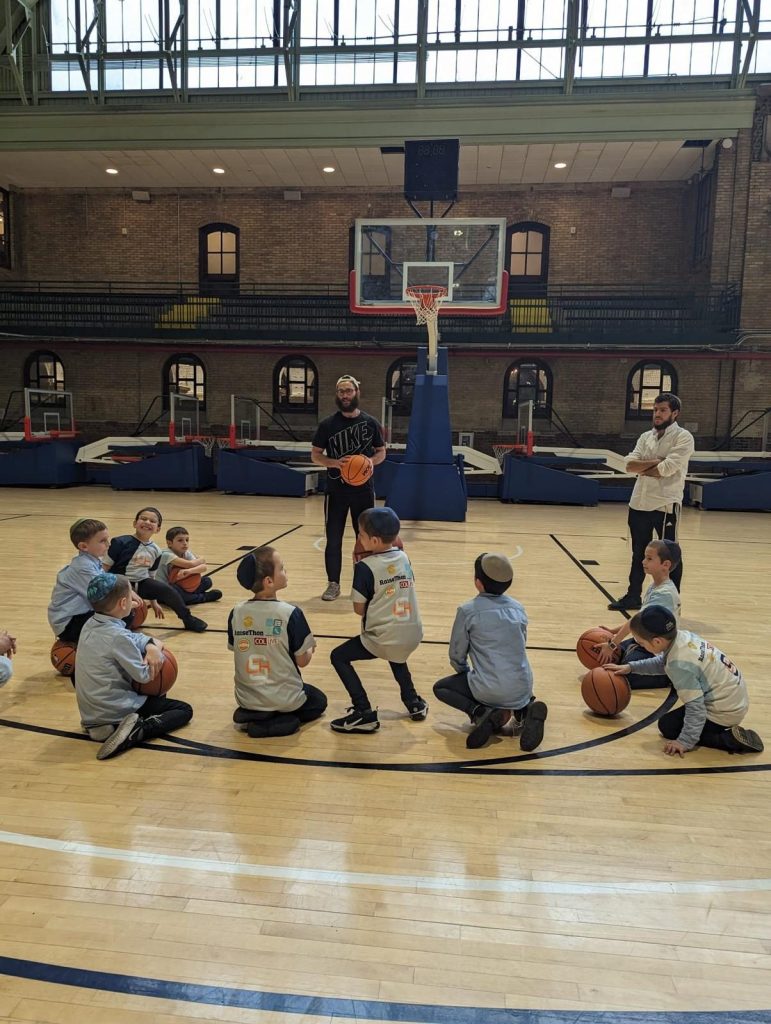
Baruch Hashem, I recently got married, and right now I am finishing my semicha program. I also have my background in coaching and holistic nutrition. The way I see it, I want to be both a rabbi and a coach.
I do not know exactly how it will manifest yet, but my dream is to build a community, maybe a shul, maybe something like a transformational center, where people can come for healing physically, mentally, and spiritually. A place where health and wellness are not separate from Yiddishkeit, and Yiddishkeit is not separate from how a person actually lives in his body, his mind, and his daily life.
For me, that is the shlichus I feel drawn to—to bring these worlds together in a way that is grounded in Torah and Chassidus, but also speaks to the whole person.
Beis Moshiach #1521 • כ״ב אלול תשפ״ו • pp. 12-20
© 2026 Beis Moshiach Magazine. All rights reserved.
This article originally appeared in Beis Moshiach #1521. You are welcome to share it with friends and family by email or in print, provided that you do not change, add to or omit any part of it, you credit the author and Beis Moshiach, and you include a link to archive.bmoshiach.org (written out in full in printed copies).
To republish this article in a newspaper, magazine, book or website, please request permission in advance at [email protected].