L’chaim With George Washington
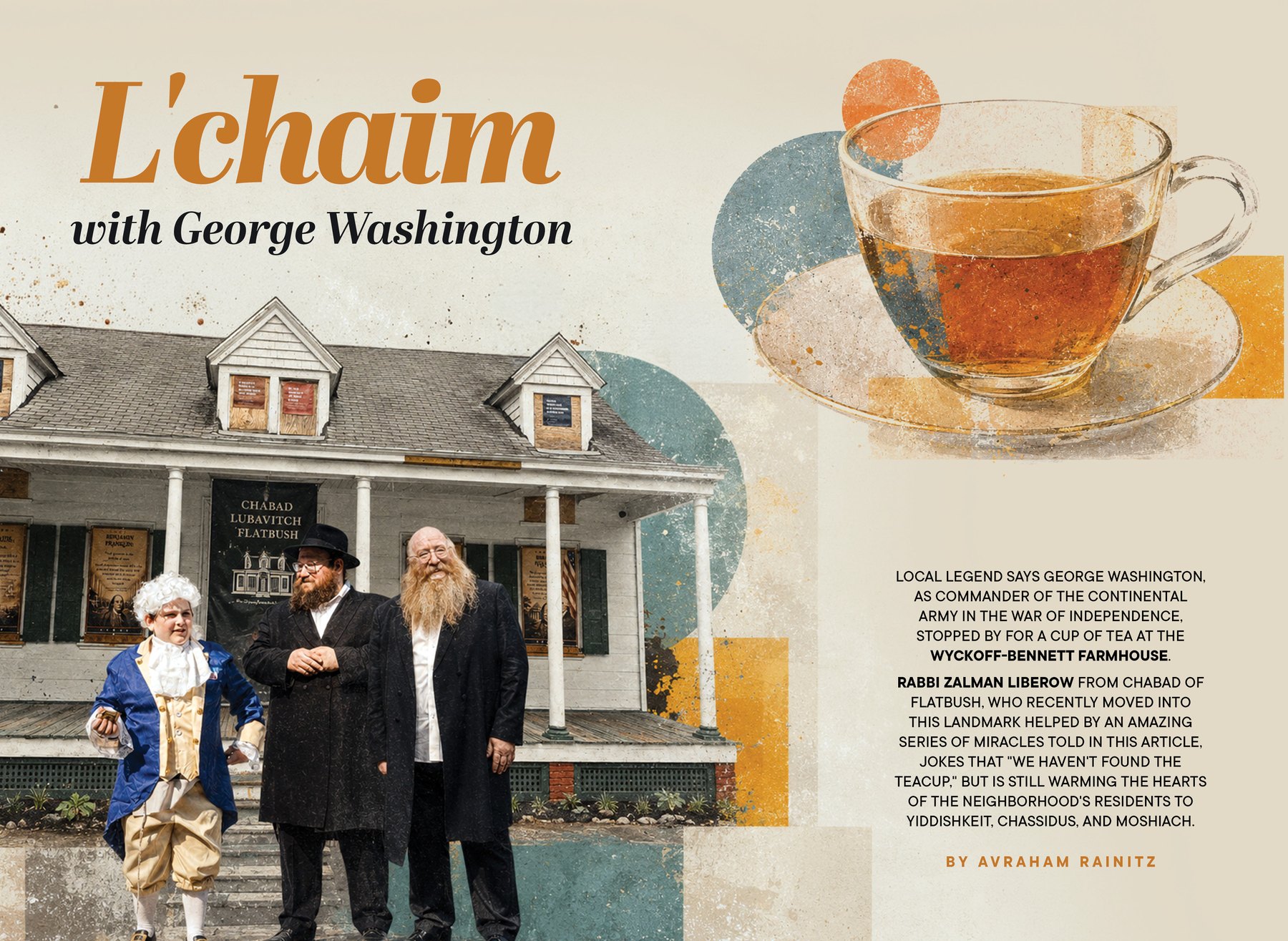
Local legend says George Washington, as commander of the Continental Army in the War of Independence, stopped by for a cup of tea at the Wyckoff-Bennett farmhouse. Rabbi Zalman Liberow from Chabad of Flatbush, who recently moved into this landmark helped by an amazing series of miracles told in this article, jokes that “we haven’t found the teacup,” but is still warming the hearts of the neighborhood’s residents to Yiddishkeit, Chassidus, and Moshiach.
Sunday, 13 Tammuz 5786. On a wide lawn surrounding an old Dutch farmhouse in the Flatbush neighborhood of Brooklyn, hundreds of people gathered, families with strollers, older Jews, young people who had never set foot in a shul. Many of them were exactly the kind of people every shliach looks for a way to reach.
“George Washington,” actually the grandson of the shliach, dressed in the uniform associated with the first president of the United States, a white wig on his head and a tricorn hat, comes out on the steps of the porch. The crowd cheers and cameras come out. Here, in this very house, the first president of the United States, George Washington, once stopped for a cup of tea. “We still haven’t found the teacup,” smiles Rabbi Shneur Zalman Liberow, the current owner of the house, in a conversation with Beis Moshiach.
The high point of the event came when a large screen set up in the yard showed the holy image of the Rebbe MH’M in clips from his sichos about America. The Rebbe spoke of “a malchus shel chessed,” of the “Moment of Silence” that should open every child’s school day, of the coin bearing the inscription “In G-d We Trust.” Hundreds of people, men, women, and children from Flatbush, some of whom came only to see “Washington,” stood and listened to the Rebbe’s message.
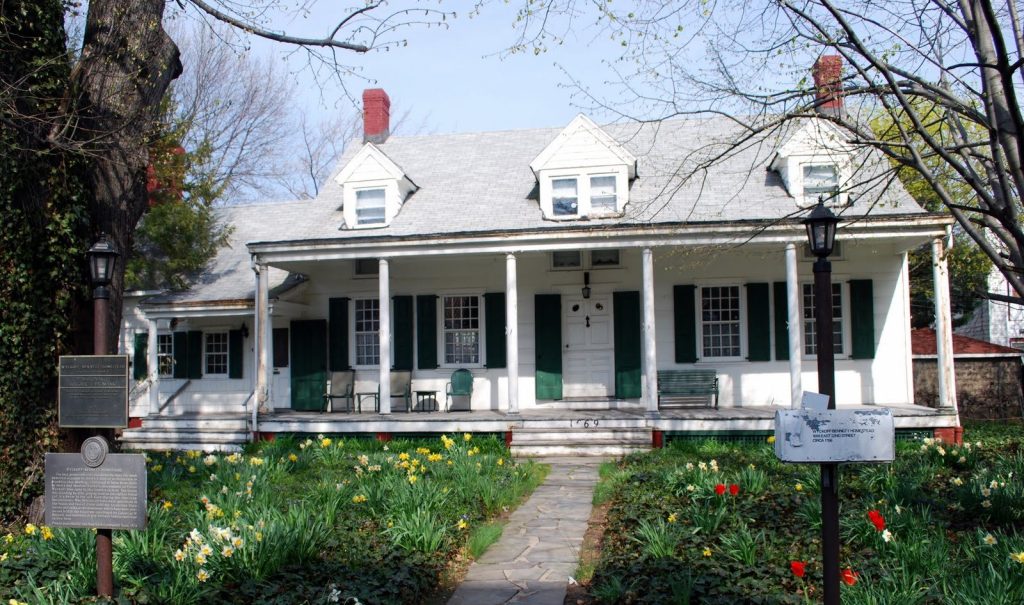
The United States is marking 250 years since its founding and it would be hard to find a more fitting place to mark the occasion than the Wyckoff–Bennett farmhouse: one of only ten structures in all of Brooklyn that survived from the period before the American Revolutionary War, and one of the fifty oldest houses in New York.
The house was built in 5526 (1766), in the very years when the Alter Rebbe was staying with the Maggid of Mezritch… During the Revolutionary War, German soldiers serving in the British army were quartered there, and two of them carved their names and units into the windowpane. That carving survives to this day. It is on this very house that a sign now hangs: “Chabad House of Flatbush,” directed by the shliach Rabbi Shneur Zalman Liberow and his wife, Mrs. Chana Liberow.
How did a neglected ruin become a bustling Jewish center? How did a shliach acquire a property worth five and a half million dollars? And what is the connection between ten Bitcoin, Yud-Tes Kislev, and an old barn brought back to life?
Here is a story of open, step-by-step hashgacha pratis. Incidentally, there are three more Chabad houses across the United States operating out of buildings connected to the American Revolutionary War (see sidebar).
Thirty-Five Years and a Dream That Wouldn’t Let Go
More than thirty-five years ago, Rabbi Liberow and his wife arrived in the Flatbush neighborhood, just a half-hour drive from Crown Heights. The neighborhood has a distinctly Jewish character, full of yeshivas, kollels, and shuls, but within it also live thousands of Jews who don’t find their place in any Torah or religious framework. The Chabad House was established for them.
Over three and a half decades the programming grew, the place became too small to contain it, and the aspiration to expand grew too. For years his eyes were set on a certain area in the neighborhood, but it was never quite within reach…
Meanwhile, Rabbi Liberow tried to rally the community behind the dream of building a large Chabad House. In the year marking 120 years since the Rebbe’s birth, he held a dinner in honor of the occasion, combined with fundraising for the building. Still, the dream wasn’t realized. At the next dinner, a full vision was already presented: a screen showed a rendering of a building modeled after 770, to be built on that same coveted plot. The crowd was impressed, donations were collected but the rendering remained just a rendering. For various reasons the deal fell through and the land slipped away from its purpose. Another door slammed shut, as doors sometimes slam in the faces of shluchim all over the world but they carry on.
Yet this is exactly where the story begins.
That door closed because a place nine times larger was being prepared for the shluchim, just two blocks from the existing Chabad House. “In the nature of my shlichus, things take a long time,” shares R’ Liberow, who still finds it hard to process. “I’m in shock at how fast this whole thing happened”… Only two and a half years passed from the moment he first heard about the property.
“Look at That Corner”
“It started from a completely unexpected direction,” he recounts. “A woman I never would have imagined would give me real-estate advice said to me one day: look at that corner, and that one.” She wasn’t a broker or a real-estate professional.
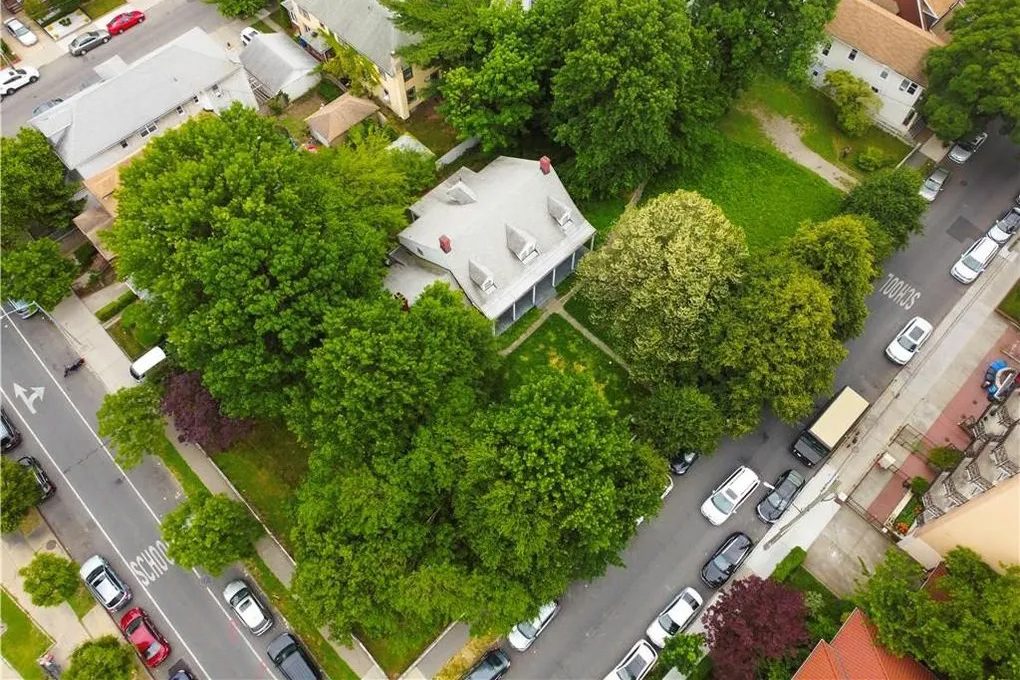
“That corner was right under my nose, just two blocks from the Chabad House. For some reason I had never thought about that spot.” He went with his wife to see it, and they found a “For Sale” sign on a 22,000-square-foot property, divided into four tax lots. “Do you understand what a lot like that means in Brooklyn? When you tell someone in Brooklyn about a plot like that, they think you’re delusional. It’s nine times the size of a regular house lot in Flatbush.” The total price: five and a half million dollars.
The price was steep. “It wasn’t even a dream; I didn’t belong in that price range.” By his calculations, if he sold his house and the existing Chabad House, he could raise $2 million. But where would he find another $3.5 million? At first, his ambitions were scaled back to just two of the lots: to live in the historic house on the larger lot, and to build a Chabad House structure on the smaller one.
And what stood on the larger lot? There stood the Wyckoff–Bennett house, an ancient building more than 260 years old. “Think about it,” says R’ Liberow. “While Chabad Chassidus was taking shape in Mezritch, here, on the other side of the world, Dutch farmers were laying the beams of a house whose true purpose would only become clear 260 years later.”
The building had been designated a landmark, a protected heritage site. It’s forbidden to demolish it, forbidden to build on its lot, and any change to the façade requires approval from the strict city landmarks preservation commission. That’s essentially what deterred many people from even considering buying the place. What developer would pay millions for a lot a quarter of which is occupied by an ancient house that can’t be touched or altered? So the sign stood there for a long time, and no buyers came. The very restriction that scared away the businesspeople was what kept the land available until the buyer came along for whom the old house wasn’t an obstacle, but the whole point.
“We didn’t mind leaving the house as it is,” says R’ Liberow. “We thought we’d sell our house, live in this one, and everything would work out.” Easy to say but between the decision and the keys stood another mysterious co-owner who nearly blew up the deal, and a million dollars short.
What Is the Story of This House?
The Wyckoff–Bennett house was built by Hendrick Wyckoff, son of a Dutch settler who immigrated to New Amsterdam in 1637. An official report by the landmarks commission from 1968 crowned it the finest example of Dutch-Colonial architecture in Brooklyn. Cornelius Bennett purchased it in 1835, and it stayed in his family for four generations—hence the double name. Only two families lived in it for more than two hundred years.
In 1983, a third family entered the picture, a Jewish one: Annette and Stuart Mont, history enthusiasts who saw themselves as caretakers of “a piece of Brooklyn’s ancient history.” Although only the façade was legally protected, the couple also preserved the interior, original furniture from the Wyckoff and Bennett families, and a fireplace surrounded by tiles painted with biblical scenes. The family opened the house to student groups and community events, and in 2013 the house even starred in a documentary film.
Annette passed away in 2013, and her husband Stuart three years later. Their children, Ira and Randy, looked for a buyer who would continue to preserve the house, “but they couldn’t sell it,” says R’ Liberow. In 2021 the property was sold to investment interests who saw mainly its development potential. But preservation laws blocked every plan, and the house, with no one living in it any longer, began to sink: break-ins, homeless squatters, historic items disappearing one after another. At one point, water flowed into it for weeks. Within two to three years, the place was completely ruined. The windows were boarded up with plywood. “My heart broke every time I walked past it,” recalls Lori Citron-Knipel, a longtime neighbor (and District Leader in Assembly District 44 in Brooklyn for thirty years) who remembered the house in its beautiful days.
A property that couldn’t be built on and that was nearly impossible to sell, became a burden on its owners. At exactly this point, the Rebbe’s shliach appeared at the door. But first he had to find the owner and here is where Mrs. Chana Liberow enters the story.
A Meeting Worth $2.5 Million
It started with a meeting with the broker, who presented himself as a partner in ownership. R’ Liberow asked to speak directly with the owner, hoping perhaps to get a discount, but the broker refused to give the name. Through wondrous divine providence, in the middle of the conversation the name slipped out… Avi Dishi. R’ Liberow, who was preoccupied with another matter at the time, didn’t even notice. It was his wife Chana who caught it, remembered it, and wouldn’t let it go. “She insisted on finding the owner,” the shliach says with a smile. Inquiries, searches, and from the name alone she reached a phone number, and from the phone number, a meeting. The date set: Erev Hoshana Raba 5784. R’ Liberow traveled to the meeting in Washington Heights in upper Manhattan.
The property owner turned out to be an Israeli, a veteran real-estate man, forty years in the business. who was barely active in Brooklyn anymore. When R’ Liberow entered his office, he noticed a detail that changed the whole atmosphere: hanging on the wall was a picture of the Rebbe…
“An Israeli with a picture of the Rebbe, it’s not so surprising, but I understood he had some connection to Chabad and to the Rebbe.” And if there’s a connection, one can be bold. Without preamble: “For the sake of the Rebbe, maybe you’d donate the land to us?”
The response was: “I can’t donate the land to you, I have other obligations, but I’m willing to give it to you for only a bit more than what I paid.” The man had bought the property for $2.4 million; the asking price stood at five and a half. In one meeting, the price dropped to three million, a cut of nearly half… “He was very happy it would go to Chabad,” notes R’ Liberow. “For him it was a headache; for us, a good thing. And what’s truly beyond the natural order is the size of the discount. It was simply a great miracle.”
Then came a crisis. The junior partner objected to the price and demanded at least four million. “The guy almost wanted to give me back my deposit and cancel the deal. It’s a miracle in itself that the deal went ahead as planned.” The deal survived, but the seller, wanting to be done with the whole matter, demanded it close within just a few months. At first he even offered an incentive, a $50,000 discount for every month he moved up the closing, but following the partner’s intervention, the incentive was taken off the table. “It didn’t really matter anyway, because I had no way to buy immediately”…
One question remained: where would a shliach in Flatbush get three million dollars in such a relatively short time?
Ten Bitcoin Fell From the Sky
The first step wasn’t a pleasant one. The Liberow family sold their private home, paid for through years of labor, and moved into the apartment above the current Chabad House. “I lived there thirty-five years ago, when I first started my shlichus, and when the family grew, baruch Hashem we had to buy a slightly bigger home, and in 5785, boruch Hashem, we’d already married off more than half our children, so we moved back,” R’ Liberow recounts. The Chabad House building itself couldn’t be sold right away—activity had to continue without interruption—so a bridge loan was taken at a very high interest rate: $18,000 a month just on interest to the bank. “I was ready for that, but not for the long haul. I had something to rely on, the existing Chabad House, which we would sell.”
After all the calculations, nearly a million dollars was still missing. “During the buying process I didn’t really think about it,” admits R’ Liberow. “I said: I’ll get it, and I didn’t know from where. I asked the Rebbe for brachos and I knew the bracha would come”…
Then the phone rang. On the line was R’ Eliot Stavrach a’h, a Jew from Lebanon whose connection with the Chabad House went back to its earliest days, thirty-five years ago. Back at the start, when he heard about the first stage of the purchase, he’d promised $1,000 a month to help with the mortgage. Now he announced: “The thousand dollars I told you I’d give, I’m not going to give you.” “I got a bit scared,” admits R’ Liberow. But then came the rest: “I’m going to give you ten Bitcoin.”
“I had no idea what Bitcoin even was,” he laughs. A quick check showed the digital currency’s price stood then at $51,000. Ten coins, more than half a million dollars in a single gift. “This dear Jew, Hashem sent him. I truly felt the floodgates of heaven had opened”…
What do you do with such a gift: cash it in right away, or hold it as an investment hoping the price rises? R’ Liberow asked three veteran shluchim, and all three answered the same way: according to the Rebbe’s directives, a shliach is not a businessman and doesn’t deal in investments. “I have to cash it in, period,” he thought to himself. On the other hand, there was the honor of the donor, who believed with all his heart in the coins he’d bought years earlier, when their price was just a few dollars each, and felt they should be kept. In the end a compromise was found: “I won’t hold onto it like an investor waiting to see how high it goes; I’ll hold it only until I actually need the money, until the deal closes, and then I’ll cash it in.”
The closing was set for close to Yud-Tes Kislev 5785, the Rosh Hashana for Chassidus. When the ten coins were cashed in, the price of Bitcoin stood at $102,000. Exactly, not a dollar less or more. Double… 51 became 102. Just as the Rebbe always says, “kiflayim l’tushiya,” the half-million became more than a million dollars, precisely the amount that had been missing. The one who held onto the coins not as an investor but as a shliach received the exact difference from Heaven, down to the last cent…
(Incidentally: afterward, Bitcoin’s value dropped, and as of today it’s worth about $64,000… the gain in value happened at exactly the right moment!)
Tanya Between the Beams, and a Barn Brought Back to Life
The deal was signed, and the land became the property of the Chabad House.
What’s the first thing a shliach does in a 260-year-old Dutch house?
“When we acquired the house, the first thing we did was print a bilingual edition of the Tanya,” R’ Liberow recounts. “The Rebbe instructed that the Tanya be printed in every place; every printing extends holiness in that place and prepares it for the Geula. Here there was something extra: while the Wyckoff family lived within these very walls, the Alter Rebbe was putting down on paper the foundations of Chabad Chassidus. To print those words within these walls, it was as if the two stories had been waiting to find each other.”
Meanwhile the loan kept ticking, $18,000 every month, and the way to cover it, selling the old Chabad House, proved not to be simple. A rushed sale would mean giving up hundreds of thousands of dollars.
“I started looking for someone willing to buy it, but not someone who’d squeeze me dry, someone who’d understand there’s both a business deal and a mitzva here. I tried and tried, until in a conversation with someone I’d approached as ‘maybe you know people,’ I heard him say: ‘I’m willing to buy the house from you’”…
The sale was wholehearted: “He bought it at the fullest possible price and on the best possible terms.” The buyer even allowed the Liberow family to keep living in the apartment upstairs until they managed to renovate the landmark house. The deal closed recently and yielded nearly $1.1 million. The large debt was cleared. “We finished it off, miraculously, just a few days ago,” says R’ Liberow with great satisfaction.
But amid this chain of salvations, sad news also arrived. The donor, R’ Eliyahu (Eliot) Stavrach passed away suddenly, exactly one year after his great donation. R’ Liberow sought to memorialize him, and the man who loved delving into Kabbalah and studying the Zohar received a fitting memorial: a Lag B’Omer 5785 event centered on a shiur in the holy Zohar.
Here the second building on the property enters the story, nothing more than an old barn with the year 1899 carved into its beams. “This building was in even worse shape than the house,” R’ Liberow describes. Unlike the house, the barn isn’t protected as a landmark, and precisely for that reason, professionals advised him to demolish it right away, lest one day he be required to preserve it too, and find himself stuck maintaining two buildings he couldn’t touch. He had already inquired about selling off the ancient wooden beams, “and we nearly decided to start the demolition.”
Then came Lag B’Omer. For the Zohar shiur, participants entered the old barn but not before it was given a thorough cleaning. “Suddenly we saw that the place actually had potential.” Ahead of Shavuos, the community’s dairy meal was held there after a thorough cleanup, plastic sheeting over the windows, and three air conditioners donated by Michael Sabo at the last minute Erev Yom Tov.
The place turned out to be a great success, and the decision was made that very evening: the building would not be demolished, but renovated. With an investment of about $200,000, the barn became a country-style shul: wood paneling, lamps, and chandeliers. “We turned the ruined barn into a Chabad House. It came out bigger than the entire space we had in the old Chabad House. Today it hosts tefillos, shiurim, and farbrengens, a Talmud Torah for public-school children, and more activities.”
R’ Liberow sees symbolism in this: a structure meant for animals, standing empty for decades, is now filled with the sound of Torah and tefilla. A place to transform the “boiling” of the holy animal soul, as the Rebbe said in his very first sicha after his first maamar. The rescue of this place came about thanks to one Jew whose love for the Zohar led the community, a year after his passing, to discover what was hidden inside the ruin.
“The neighbors welcomed us warmly,” he adds. “Everyone is happy that someone is finally doing something good with the property.” And neighbor Lori Citron-Knipel, sums it up: “I’m just glad the house won’t be demolished and that it will have a good future as it now appears it will”…
Miracles—Within Nature
When asked to sum up the heavenly chain of events, R’ Liberow references a sicha of the Rebbe: “In the sicha of Gimmel Tammuz 5751, the Rebbe says that Hashem specifically does not perform miracles that are completely beyond nature, because the purpose is [to achieve things] through nature.
“I’ve seen this in the activities I’ve done over the years: the moment I prepare something out of the ordinary, suddenly the floodgates of heaven open and a rain of brachos comes down, but only for a short time, and then the door closes again, leaving us to continue the natural work. That’s what happened here too. A door opened, Bitcoin was ‘poured’ onto me, I managed to buy the land, sell the old Chabad House, truly open miracles. On the other hand, we went into about $200,000 of debt for the renovation. Hashem wants us to keep working.” And with the smile of a veteran shliach he adds: “Whoever reads this story—maybe some tzaddik will come along and donate to us; but boruch Hashem, we’re in a very good place. We’re in our thirty-fifth year of shlichus in Flatbush, and the house we’ve now acquired is another step on this journey.”
The plans of the Liberow shluchim couple are big. The historic house will serve as the shliach family’s residence and for programming, and on the adjacent lots a permanent Chabad House building is planned. But already it’s becoming clear that the site’s history is itself a tool for outreach: “The aspiration of every Chabad House is to reach as many Jews as possible, especially those who aren’t Torah-mitzva observant. In Flatbush that’s not easy, precisely because the neighborhood is full of Jewish institutions. But the history of this place draws exactly those people. We knew that when we considered the purchase and we factored it in.” The celebration of America’s 250th anniversary together with the Chanukas HaBayis proved this. Hundreds of people, many of them who had never been to a Chabad House before, came based on just a week and a half of publicity…
Meanwhile, even before the historic house’s renovation, the house is already broadcasting its message. On the wooden boards covering its windows, banners were hung (with the help of a supportive friend, Eliyahu Shitrit) featuring words from America’s founding fathers on faith and morality, with George Washington’s words from his 1796 Farewell Address at the center—that religion and morality are indispensable supports for a state’s existence.
Anyone who lingers on the date finds another interesting detail: 1796 is the year the Tanya was first printed, in Slavita. Multimedia stations are also planned for the site, where the Rebbe’s sichos about America and its purpose will be shown. Visitors will come for the history and leave with the Rebbe’s message.
And to conclude, one more circle is complete:
Ahead of the event, R’ Liberow got in touch with Ira Mont, son of Annette and Stuart, who lived there for thirty-five years and who himself lived in the house for two years. He was very glad to be invited to the event, and when he arrived, he told him: “I wanted it to remain a historic house, and now it no longer belongs [to us], because everything there was destroyed. But ever since it came to you, we see the hand of G-d here, how everything, deliberately, moved toward the Chabad House.” He never dreamed this house would reach such a happy ending, in fact, a “good continuation,” and from here it continues on to Jerusalem!
At the end of the event, he put on tefillin with R’ Liberow, who sought to deepen his connection to Judaism.
“It’s hard to put into words what wondrous, open hashgacha pratis this is,” Reb Zalman sums up. Very soon, with the hisgalus of Moshiach, everyone will understand that 250 years of America, “a malchus shel chessed,” served as a preparation for the true and complete Geula.
Indeed, precisely in New York, the city of “Nasi Doreinu,” from which the processes of Geula begin, another step is being taken toward Geula, as a historic building of the United States becomes part of the Rebbe’s revolution of shlichus, to prepare the entire world for the complete Geula, immediately, right now!
Three Chabad Houses Born With America
At least four more Chabad Houses across the United States currently operate out of buildings connected to the American Revolutionary War. The pattern is similar: a historic building that fell into neglect, acquired and restored by shluchim, becoming a center of Jewish life.
An Inn on the Road to Lancaster
The “General Wayne Inn” in Merion Station, Pennsylvania, was built in 1704 on the road from Philadelphia to Lancaster. Before the Revolution it housed a King George’s mail branch. Historians believe Washington and other Revolutionary leaders used it.
In 2005, after standing empty for years, it was purchased by Rabbi and Mrs. Shraga and Michal Sherman, shluchim of the Rebbe in the Main Line area, who renovated it, preserving its character, into a shul and community center.
Westport’s Stagecoach Stop
The “Three Bears” building in Westport, Connecticut, served as a stagecoach stop, and for more than a hundred years housed a well-known inn.
The Kantor family, active in the town since 5757, purchased the building around 5772, and the renovation, which preserved its façade, earned the Chabad House a historic preservation award. “You bring the past into the present in order to create the future,” says the shliach, Rabbi Yehuda Leib Kantor.
In the Cradle of American Liberty
In Lexington, Massachusetts, where the first shots of the American Revolutionary War were fired, a Chabad center is housed in the home of Officer Joseph Simonds, who lived there at the time of the Battle of Lexington, in Nissan 5534 (April 1775). The house was purchased in 5745 by Rabbi Alter and Mrs. Sarah Bukiet. Today, together with their son Rabbi Yisroel and his wife Mali, it houses a preschool, a Talmud Torah, and extensive community activity.
Beis Moshiach #1517 • כ״ד מנחם אב תשפ״ו • pp. 12-21
© 2026 Beis Moshiach Magazine. All rights reserved.
This article originally appeared in Beis Moshiach #1517. You are welcome to share it with friends and family by email or in print, provided that you do not change, add to or omit any part of it, you credit the author and Beis Moshiach, and you include a link to archive.bmoshiach.org (written out in full in printed copies).
To republish this article in a newspaper, magazine, book or website, please request permission in advance at [email protected].