The First Chassid In S. Paul
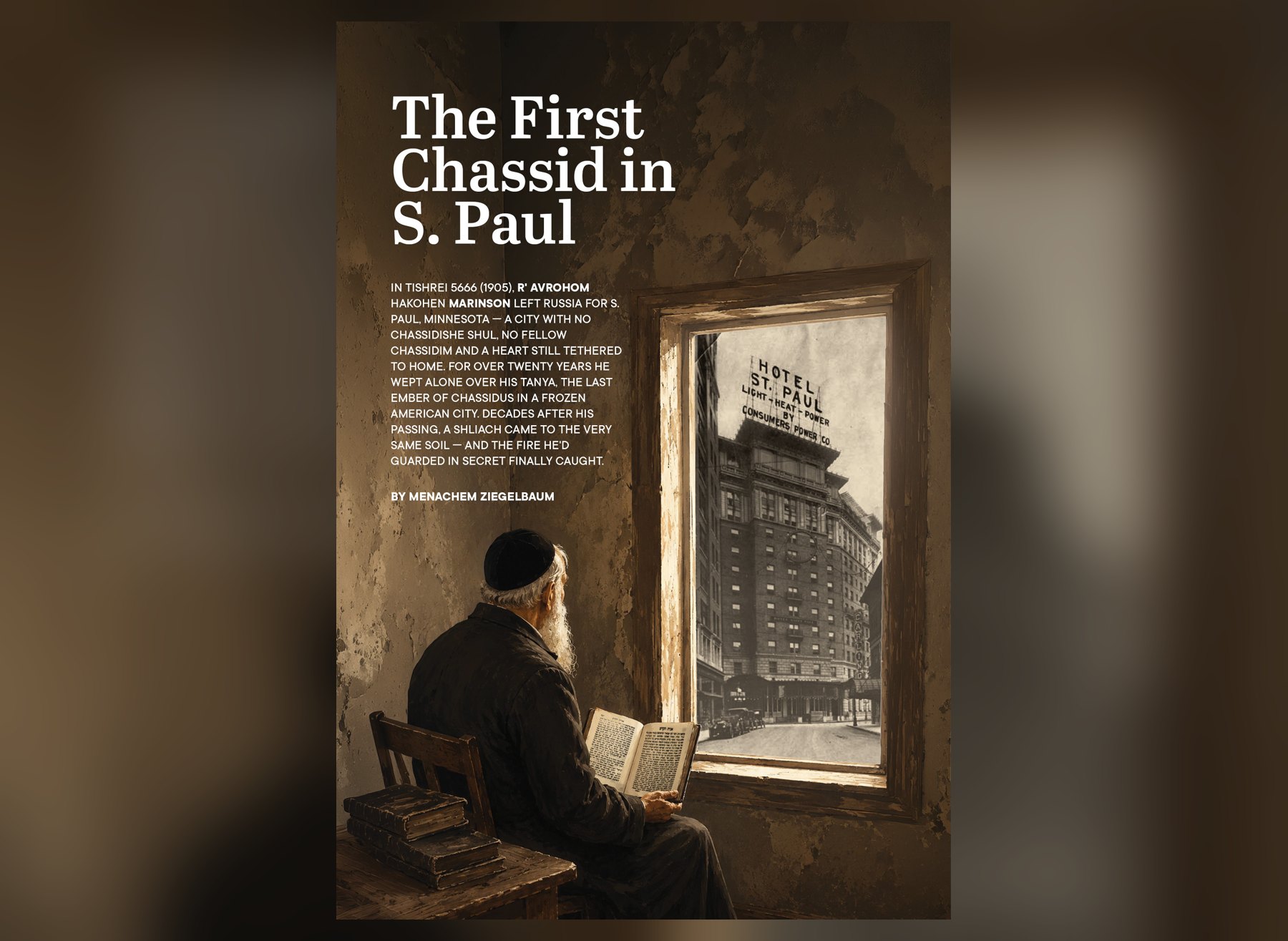
In Tishrei 5666 (1905), R’ Avrohom HaKohen Marinson left Russia for S. Paul, Minnesota – a city with no Chassidishe shul, no fellow Chassidim and a heart still tethered to home. For over twenty years he wept alone over his Tanya, the last ember of Chassidus in a frozen American city. Decades after his passing, a shliach came to the very same soil – and the fire he’d guarded in secret finally caught.
I
S. Paul, the capital of Minnesota.
In a small apartment in one of the city’s Jewish areas, not far from the Mississippi River, sat an elderly Jew, bent over a worn copy of the Tanya. He sat for a long time and studied the “Igeres HaKodesh” at the end of the Tanya, returning again and again specifically to siman 11, “L’haskilcha binah, the perek in which the Alter Rebbe teaches us that “this is not the way that the light of G-d dwells [within a person], to desire a life of physicality, sons, and sustenance”; the perek that teaches a person to accept everything with love.
It was no accident that this Chassid chose this chapter, for his own life was a living, painful chapter of accepting suffering with love. Who was this solitary Chassid, and how did he end up at the ends of the earth?
II
Everyone knew the Chassid R’ Avrohom HaKohen Marinson, thanks to his being a veteran melamed in the town of Kamin, in the Vitebsk district, not far from Lubavitch. He was a G-d-fearing and gentle-souled Jew, one of those quiet Chassidim whose Torah study and tefilla were their vocation. Through the burden of teaching he managed to eke out a meager livelihood. Many children studied with him in the cheder and to them he was an inspirational figure.
His sons, as they grew up, decided that the town of Kamin was too small for them. They wanted space and freedom… Like many young people of that generation, they set out across the ocean until they landed in the distant city of S. Paul, Minnesota, where they found work and a home. Some time after they had settled in, they began urging their father to join them together with their mother. True, they themselves, like many young people who “discovered” America, no longer kept Torah and mitzvos in the fullest sense, but they promised their father faithfully: you’ll be able to be as meticulous here in all your hiddurim as you are used to being…
R’ Avrohom’s soul recoiled from the proposal. He knew well the nature of that dazzling “Golden Land.” In a letter he sent to his brother-in-law, the Chassid R’ Dovid Shifrin, he did not hide his feelings: “My travel to America, a land which devours and destroys the essence of Yiddishkeit is, for me too, a thorn and a painful splinter.”
R’ Avrohom refused his sons’ pleas for a long time, but the pogroms then raging in Russia, his weakened health, and the burden of teaching “which was the deciding factor to destroy my soul and bring me down to the pit,” tipped the scales. The sons urged, old age peered through the cracks, livelihood was scarce, and his heart grew weak…
In the month of Tishrei 5666 (1905), he traveled to Lubavitch to spend the Yomim Noraim in the presence of the Rebbe Rashab and to take the opportunity to ask for his bracha for the significant transition in his life. This turned out to be his last Tishrei in Lubavitch. He remained in the Rebbe Rashab’s presence until after Yom Kippur. In his letter to his brother-in-law he described with excitement what his eyes had seen: the shiurim of the famous mashpia R’ Gronem—“I heard two perakim of Tanya from him in the great and holy house, and he brings forth pearls there”—and the feelings of awe and joy that enveloped the Chassidim on the night after Rosh Hashana, when, after the maamar was said by the Rebbe Rashab, the Chassidim burst into wondrous joy, dancing, “and his holy honor was in the next room”…
After meriting to receive a farewell bracha from the Rebbe, he prepared to leave the country. His old friend R’ Yehuda Leib Aranin, who had just been appointed shochet and bodek in the town of Sheboygan, Wisconsin, in America, even hastened to reassure him in a letter: You need not worry, “free choice exists in America too”…
“May G-d have mercy on me and guide me in paths of righteousness,” R’ Avrohom signed off, not without apprehension. And that winter he sailed across the ocean.
III
America of those days received him exactly as he had feared, and even worse. The “Goldene Medina” knew how to offer its Jews dazzling gold but demanded their souls in return. Shomrei Shabbos were fired from their jobs every Monday after failing to show up for work on Shabbos. The cheders and mikvas were, at best, a mere “zecher l’Mikdash.” A spirit of American coldness hovered over everything.
In faraway S. Paul, where he settled not far from his sons, there wasn’t even a single Chassidishe shul, nor even one minyan praying in the Arizal’s nusach. For long years R’ Avrohom did not merit to daven tefilla b’tzibbur. “I am disgusted with my life,” he wrote years later to his brother-in-law, in words where every letter was steeped in tears and soul-anguish.
At night he would weep in secret. “My eyes have not ceased pouring forth tears mixed with the very blood of my being,” he testified about himself in one of his letters, “my eyelashes have nearly come loose from weeping in secret over my bitter fate and my poor choice.” And he, with the inner honesty of a Chassid, did not spare his own honor: after all, he had traveled to the Rebbe to receive a farewell bracha, and now would he do the opposite of the Rebbe’s holy will?!…
“My sons, may they live, deceived me completely,” he wrote in sharp pain.
Then a firm and courageous decision took root in his heart: to return “aheim,” home, to the small, simple Russian town, but one with Chassidishe chayus. These thoughts gradually turned into a practical plan of action. “All the concerns of my heart and mind are troubled by one matter alone,” he revealed to his brother-in-law, “to carve out an escape from the darkness, and to flee for my life by the skin of my teeth”…
He remembered well that Russia held no jar of honey waiting for him. Here and there he heard about pogroms against the Jews in Russia, and nevertheless, he remained firm in his resolve: “I will not pay heed to the pogroms in the land of Russia; it was not from them that I fled, heaven forbid!”
One thing held him back: the Rebbe! How does one ask the Rebbe such a question? He, the sensitive Chassid, who not long before had sent two rubles to the Rebbe with a “letter requesting mercy,” was hesitant even “to burden him with an answer to such a difficult question”…
Finally, he took action. He asked the Rebbe Rashab whether to return to the land of his fathers or to remain where he was and received his holy consent to return to Russia.
It is hard to describe the extent of his joy. He left the teaching position he had taken up even in America, sold his household belongings, bundled up his beloved sefarim and set out on the road, he and his wife.
IV
Monday, parshas Eikev [the exact year is not mentioned in his letters].
The S. Paul train station was bustling with people; many came to bid him and his wife farewell. His sons were loudly protesting the imminent separation; neighbors and acquaintances “combed my flesh as with combs”—in his own words—for abandoning his sons in his old age. But R’ Avrohom stood strong and firm in his resolve. His eyes and heart were already there, in the holy courtyard of Lubavitch.
The locomotive let out a long whistle, and a moment later the train began to move. R’ Avrohom recited Tefillas HaDerech with a joy of heart he had not known in many years, and sat down quietly. At last he was leaving America and returning to the land of his fathers… Then he looked at his wife and his spirit sank. “And behold, her head was covered, and rivers upon rivers of tears flowed without pause the entire day as we sat in the train car.”
His wife, who was “ill and weak from heart palpitations, G-d have mercy,” could not calm down. Weeping shook her thin body for long hours. All his attempts to soothe her spirit somewhat came to nothing. “Then my hands grew weak,” he wrote later, “for I saw the Satan dancing before us, G-d have mercy.”
The train journey lasted a full day and night, until Tuesday morning when the two arrived in the town of Sheboygan, at the home of their friend Rabbi Yehuda Leib Aranin. His wife lay without strength; he himself was stunned by the depth of her anguish, “and no strength remained in me, and my hands grew weak.”
Nevertheless, he was still determined to return to Russia. He had endured too much spiritual suffering in America: “Come what may, I will not go back, heaven forbid! For where would I return to, after I have been utterly ruined: I left my teaching position, and our household belongings were sold. And besides, how can I go against the Rebbe’s command?!”
But there in the home of his dear friend, he saw what he had not seen before. His friend R’ Yehuda Leib looked at his friend’s weakened wife, and said to him sharply in Yiddish: “Du bist a balabos af dein nefesh moiser zein—ober nit af dem andern” [= “You are entitled to be the master of your own soul and to sacrifice it—but not someone else’s…”].
“An arrow pierced my heart,” R’ Avrohom admits in his letter. In the bitterness of his heart he made one last attempt. He took out the Rebbe Rashab’s letter, the holy consent to return to Russia, and showed it to his friend and host. He imagined his friend would now back down but R’ Yehuda Leib held his ground.
The two spent a week in Sheboygan. Slowly his wife regained her strength. The two had already decided to continue on their way eastward but on motzoei Shabbos, the Shabbos of Parshas Eikev, she grew very weak again, to the point that he feared for her life.
That same week he sat and wrote to his brother-in-law the letter in which his hope was buried, he wrote from his wounded heart: “All my thoughts remain above [unrealized].”
Heaven had intervened.
At the bottom of that letter he added one small line, one capable of piercing every Chassidic heart: “After the coming holy Shabbos, I will send five silver rubles from my earnings and labor to the Rebbe shlita, for my eyes and heart are there always. Believe me, my brother, that he is truly engraved on my heart and in my memory, and I do not forget him, G-d forbid, even for a single moment.”
The road to Lubavitch was blocked. The heart—never.
V
R’ Avrohom returned to S. Paul, to his Chassidic solitude.
In the early years, poor members of Anash still occasionally visited his home while going door to door collecting tzedaka. It was these encounters that brought him a spirit of joy. He would receive from them a taste of Chassidishe warmth, as in his hometown. His friend R’ Yehuda Leib, too, would lodge with him when he came to the city, “and I had a bit of comfort from him.” But the years passed and the visits ceased. “It has now been several years since a single soul from Anash has set foot here,” he wrote in his later years, “may G-d have mercy and shine His countenance on us.”
Solitary and forsaken he lived in a strange, foreign city—he, and his Tanya. There, perek 11 of the Igeres HaKodesh, “specifically through a deepening of understanding,” he studied for over twenty years the great secret of accepting suffering with love, even suffering of the soul.
Despite the many years that passed, R’ Avrohom never lost his faith for even a moment. To his children and grandchildren he would repeat the promise, in the words of the passuk: “Truth shall spring up from the earth” and the situation would not, heaven forbid, remain as it was then!
He did not merit to see this hope fulfilled with his own eyes. In the winter of 5688, he returned his soul to his Maker, far from any Chassidic environment. His will was written in simple, trembling Yiddish:
“The Chassidic sefarim, all of them without exception, should be sent to Dovid’n [his brother-in-law R’ Dovid Shifrin], and he shall hand them over to a Chassidishe shul… In the suitcase lies a bundle, tied up, of Chassidic writings and letters from good friends, from Lubavitch and from Eretz Yisrael. I ask you, my children, do this for my sake, so that they should not, heaven forbid, be dragged through disgrace. Have mercy on me and on yourselves. Within them lie fragments of truth. And the truth will, G-d willing, rise up; it will not, heaven forbid, remain forever as it is today!”
In all of S. Paul at that time there was not even a single Chassidic shul where the books could be left. The crates were therefore sent off to distant New York.
* * *
Twelve years passed since that winter.
On Tuesday, the 9th of Adar II, 5700 (1940), the ship Drottningholm docked in New York harbor, carrying the Rebbe Rayatz, who had been rescued from the burning valley of tears that was Europe.
That very evening, before he had even rested from the hardships of the journey and the terrors of the dangers, the Rebbe Rayatz convened a gathering at his hotel residence and founded the Tomchei Tmimim yeshiva in America. From that point on, the American ice, about which the Chassidim had written so bitterly for decades, began to break.
And the truth that R’ Avrohom had planted in the soil of S. Paul also sprouted forth in glory.
In the course of time, a Jewish boy was born in the state of Minnesota, went to learn Torah and Chassidus at Tomchei Tmimim and later returned to his home state as a shliach of the Rebbe, none other than Rabbi Moshe Feller, to establish there a kingdom of Torah and Chassidus, and shuls following the Arizal’s nusach, which flourish to this very day. In the same city where a lone Chassid could not even find a minyan to daven with, today the voice of Torah and prayer of an entire generation resounds.
“Truth shall spring up from the earth,” the solitary Chassid promised those who would come after him. And from that very earth it truly sprang forth.
(Adapted from “Toldos Chabad in the United States” by Rabbi Sholom DovBer Levine, Chapter 1—based on the letters of R’ Avrohom Marinson to his brother-in-law R’ Dovid Shifrin)
Beis Moshiach #1517 • כ״ד מנחם אב תשפ״ו • pp. 30-34
© 2026 Beis Moshiach Magazine. All rights reserved.
This article originally appeared in Beis Moshiach #1517. You are welcome to share it with friends and family by email or in print, provided that you do not change, add to or omit any part of it, you credit the author and Beis Moshiach, and you include a link to archive.bmoshiach.org (written out in full in printed copies).
To republish this article in a newspaper, magazine, book or website, please request permission in advance at [email protected].