Leviim, Do You Know How to Sing?
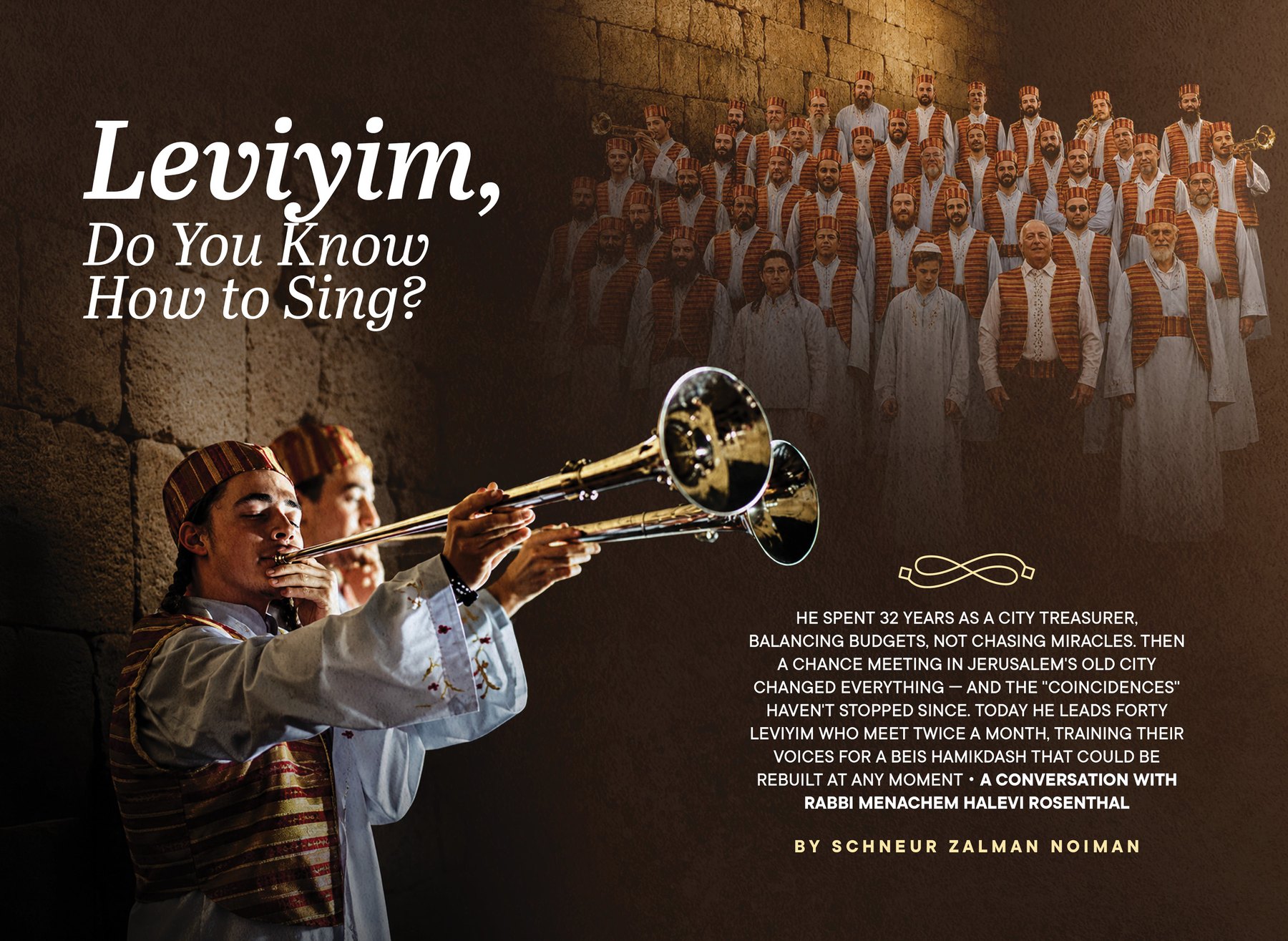
He spent 32 years as a city treasurer, balancing budgets, not chasing miracles. Then a chance meeting in Jerusalem’s Old City changed everything – and the “coincidences” haven’t stopped since. Today he leads forty Leviyim who meet twice a month, training their voices for a Beis HaMikdash that could be rebuilt at any moment. A conversation with Rabbi Menachem HaLevi Rosenthal.
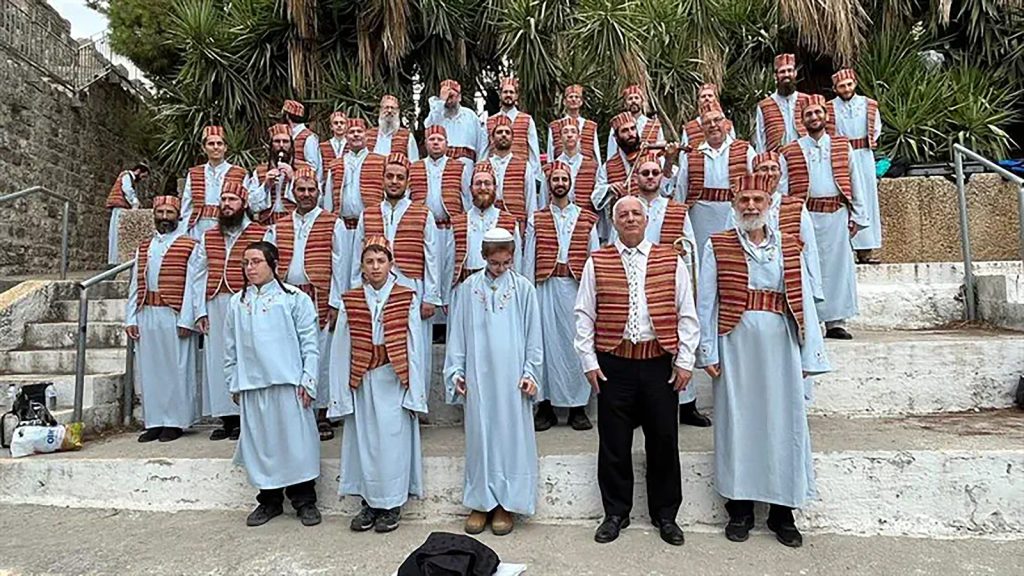
Four and a half hours of exhausting wandering through the textile district of Nachalat Binyamin Street in Tel Aviv. Rabbi Menachem Halevi Rosenthal of Rechovot and his wife go from shop to shop, searching for special fabric to sew the Levite begadim. Rabbi Yisrael Ariel, head of the Temple Institute (Machon HaMikdash), asked Rabbi Rosenthal to sew Levite begadim for all the members of the “Shiras Ha’Leviyim” project he founded, based on halachic and historical research he had conducted at the Institute years earlier.
Just when they thought there was no chance of finding the fabric, something surprising happened. “I was walking to the car and out of the corner of my eye I saw a different shop. Suddenly I see a Jew with a beard and peyos standing at the entrance of his shop, and next to him a roll of fabric that reminded me a lot of the material I was looking for!”
But his wife wasn’t convinced. They debated between themselves—was this the fabric they were looking for or not?
The shop owner, Yosef, joined the conversation and asked what they were looking for. When Rabbi Rosenthal showed him the picture on his phone, Yosef said: “That’s the fabric; it’s a bit different, but it’s what you’re looking for.”
Rabbi Rosenthal replied that to be safe, he would consult with Rabbi Ariel.
That was on Monday. The next day at eight in the morning, Rabbi Rosenthal was sitting with a chavrusa when the phone rang.
“Menachem?” called a voice from the other end of the line.
“Yes. Who’s speaking?”
“Yosef.”
“Which Yosef?”
“From the shop on Nachalat Binyamin. You were at my place yesterday.”
“Listen, I have goosebumps,” said Yosef in an excited voice.
“What happened?”
“Listen, your wife is right. What I told you yesterday wasn’t correct. That’s not the fabric you were looking for. You know what the right fabric is? You won’t believe it. Just now a truck came and unloaded a roll of the exact fabric you were looking for! Believe me, I didn’t order this fabric, it just arrived… Tell me where you live and I’ll send it to you; I’m not selling it to anyone. It’s for the Mikdash!”
Less than four hours later, the roll arrived at Rabbi Rosenthal’s home. “Do you understand? He didn’t order it; it just came to him like that. Hashem sent it to him. Isn’t that obvious siyata d’shmaya?”…
Hashem Sends a Message Straight to the Heart
Rabbi Menachem Rosenthal is not a man of dreams and wonders. Until his retirement, he worked for 32 years at the Rechovot municipality as deputy treasurer. He specialized in serious, practical projects, that was his line of work. But from the day he began the “Shiras HaLeviyim” project, he has felt tremendous siyata d’shmaya accompanying him at every step.
Today he serves as deputy director of the Temple Institute and he believes with all his heart that the project he founded is part of the practical preparations for the complete Geula heralded by the Rebbe Melech HaMoshiach.
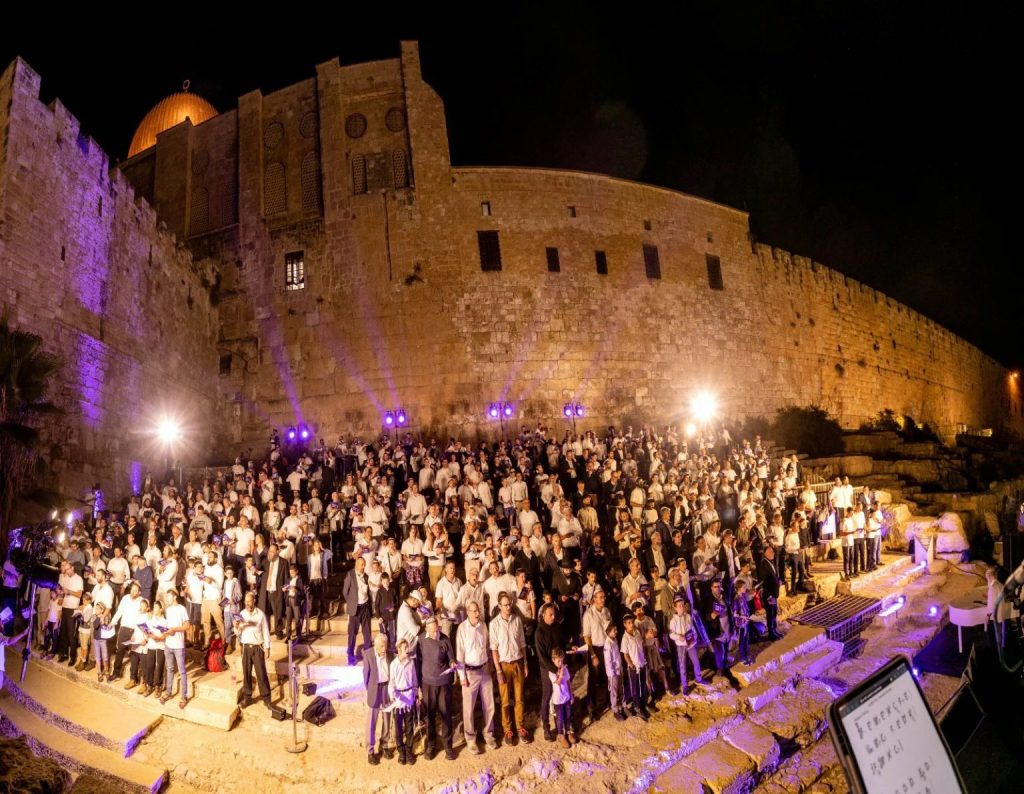
It all began several years ago, when the “Company for the Development of the Jewish Quarter” initiated a special event of Levite singing at the foot of the Chulda Gates. “It was very impressive,” R’ Rosenthal recounts. “There were hundreds of Leviyim standing and singing there. The one who initiated it and conducted the singing was the musician Itzik Weiss.”
During the event, Weiss said something that penetrated straight to the neshama: “I really hope that out of all the hundreds of people standing here singing, a serious core of Leviyim will arise who will truly prepare to sing the finest song on the duchan, to stand and serve in the Beis HaMikdash.”
“His words went straight into my heart. Sometimes someone says something to you and it enters your soul, and you feel that Hashem is sending you the message and that’s what happened to me. I said to myself, ‘This is truly right. We need to do this!’
“The logic is simple: for every mitzva we perform, we need to prepare, especially the singing of the Leviyim since it is known that Moshe Rabbeinu worked for five years to teach the Leviyim to sing! So if the shofar of Moshiach is about to sound at any moment, what will we do? If we don’t prepare, we won’t know how to sing! He’s right, we need to prepare.”
Interestingly, the first Levi to sing was Moshe himself, who was also the first teacher of this song, as stated in the Medrash Rabba: “How much effort did the son of Amram [Moshe] exert until he taught the Leviyim to sing.”
Hashgacha Pratis in the Marketplace
“From the moment this echoed in my mind, things began to unfold through siyata d’shmaya. It’s simply unbelievable,” R’ Rosenthal recounts.
Two days after the event he went up to Yerushalayim as usual to pray at the Kosel. “I’m walking up through the market in the Old City, and right in front of me appears none other than Rabbi Yisrael Ariel, head of the Temple Institute. From a distance he happily called out: ‘Rosenthal! Where are you?’ I didn’t understand what was going on, and he was already embracing me warmly. ‘I need you, I need you!’”
It turned out Rabbi Ariel wanted him to establish a Levite choir at the Temple Institute as if he had read his feelings and the yearning of his heart on this exact subject over the previous two days…
“I lifted my eyes heavenward. Just two days earlier it was Itzik Weiss, and now it’s Rabbi Yisrael. What hashgacha pratis! To establish something like this, it’s a completely new life.”
Why did he approach you of all people?
“He knew me and he also knew I am a Levi; that’s it.”
But R’ Rosenthal feels the Yad Hashem: “You feel as though Hashem sent him. Afterward too, many things progressed quickly without effort, as if you just need to start and it moves forward on its own”…
Leviyim Wanted
With such inspiration from the start, R’ Rosenthal began reaching out to Levites across the country: “I started reaching out to Levites to come join a serious group preparing to work and serve before Hashem in our Beis Ha’ikdash that will be built in the future. The time has come for us to know the task we must perform, so that when Moshiach comes, we will be ready and know how to stand and sing on the duchan.”
This approach emphasizes the importance of initiative from below: “You surely know that in Chassidus it’s explained that arousal from below awakens an arousal from above.
“That’s how a few dozen Leviyim gathered and we’ve been persisting at this for two and a half years now. Slowly we learn and practice singing, learn the kavanos of the song. If Moshe Rabbeinu was our instructor, we would have needed at least another two and a half years to know what to do. So here we haven’t merited having Moshe teach us, but we try to do our best.”
Before continuing a bit of background is in order:
The singing and playing of the Leviyim was part of the korbanos tzibbur that included a wine libation, but not part of individual offerings. At least twice a day, a full choir and orchestra would sing in the Beis HaMikdash during the offering of the two daily “tamid” sacrifices, the morning tamid and the afternoon tamid.
The Levite choir stood in full readiness toward the end of the offering, and the moment the Kohen began pouring the wine libation on the mizbayach, they would burst into song and music.
Since the singing is an inseparable part of the offering and its obligation derives from the Torah, it overrides the prohibition against playing music on Shabbos and Yom Tov, so on those days too the Levites played, and moreover, on those days they played an additional time during the bringing of the korban mussaf, which is also a korban tzibbur that includes a wine libation.
The Gemara derives from various verses that the avoda of song is a Torah obligation. However, the Sages disagreed as to whether the primary obligation from the Torah is vocal singing or playing musical instruments, and the halachic ruling is that the primary form is vocal singing.
Rabbi Rosenthal, you’ve created an inspiring project. But what exactly needs to be learned? Where does one begin?
“Excellent question,” R’ Rosenthal admits. “I struggled a lot with this question. For this I spoke with rabbanim from every stripe, circle, and community. I also tried to speak with those who understand the mystical dimension, in order to know and understand what needs to be sung, what the Leviyim sang, and the details of their avoda.”
Textually, things are clear: “At the end of Maseches Tamid, the songs the Levites would recite in the Beis HaMikdash are described, just as we recite the Shir Shel Yom in davening every day. We also know they sang the Hallel during the bringing of the Korban Pesach. It’s known that during the Water-Drawing Celebration [Simchas Beis HaShoeivah], the Leviyim stood on the fifteen steps from the Ezras Nashim to the Nikanor Gate and sang the fifteen Shir HaMaalos from Tehillim.”
“The big question that arose was: to what tune?…”
And then the insight came: “One day Hashem opened my eyes. In the future there will be a ‘new song.’ The Medrash states: ‘All the songs of the past are referred to in the feminine. Just as a female gives birth, so too the salvations of the past were followed by further subjugation. But the future salvation will not be followed by further subjugation, and therefore it is referred to in the masculine…’
“To me, the message was clear: even if we were to miraculously discover what the tune was in the past—it’s no longer relevant, since we are commanded to sing a new song!”
This is a revolutionary insight: “People ask me so often, ‘What gives you the audacity to sing the song of the Leviyim when you don’t even know what it was?’ And I try to explain that what was is no longer relevant. What was is not what will be. I truly don’t know if what we’re doing is indeed what will be. But we will come to Moshiach and say to him, ‘Listen, this is a new song—do you like it? During galus, when everything around was still dark, we labored to prepare the new song for the Geula and that’s what we know how to do’…
But even if the melodies “Shiras HaLeviyim” is preparing aren’t exactly those that will be sung in the Beis HaMikdash, the preparation itself is essential: “Even if it’s not the song we’ll sing in the Beis HaMikdash, the very fact that we’re learning to sing choral music as excellently as we can—that’s already important in itself. Every song needs to be heard in harmony—at least three voices…
“You need to know how to sing in rhythm, know the right tempo and combination, with the correct adjustment of the voice, raising and lowering it. There’s so much to learn in music, and choral singing in particular. Honestly, at first I didn’t think it would be such a complex challenge”…
One Beis HaMikdash—For Sefardim and Ashkenazim, Chassidim and Litvaks
One of the important goals R’ Rosenthal emphasizes is uniting all streams of the Jewish people around this: “I always say, we will have only one Mikdash… There won’t be a Sefardic Beis HaMikdash, and another Ashkenazi one, a Chassidic one and a Litvish one… We will have one Beis HaMikdash and we all need to be in it. So we took melodies from every part of the Jewish people, and began singing the well-known tunes of Hallel, like ‘Yevarech es Beis Yisroel,’ and of course Chabad niggunim too—like ‘Keili Atah V’odeka’ by the Alter Rebbe, and ‘Yemin Hashem’ by the Tzemach Tzedek.
“We tried to make sure everyone could find themselves in it. We Leviyim come from every stratum, community, and circle. We have Chassidim, Litvaks, Sefardim, Yemenites, Ashkenazim, everyone! The diversity is truly impressive. So we’re all going to do this work together”…
Looking for Yerei Shomayim Composers
After finishing all the familiar Hallel songs, it was time for the next step: “I reached out to yerei shomayim musicians, as well as rabbanim-musicians, and we put out a public call to composers to send us melodies for mizmorei Tehillim that don’t yet have a tune. It’s important to emphasize that this isn’t about a song based on one pasuk or another; in the Beis HaMikdash they would sing the entire mizmor.
“The criteria for accepting tunes are strict and they need to meet halachic rules, as described in the Mishna. For example, you can’t repeat a word. Meseches Tamid states that in the middle of every mizmor there were two pauses for a shofar blast—tekiah, teruah, tekiah—after which they would bow down. So this needs to be incorporated into the music”…

When I tell R’ Rosenthal about the Chabad custom of composing a new niggun each year for the Rebbe’s personal chapter of Tehillim and that in the chapters of Hallel there’s likewise a niggun for each perek, Rabbi Rosenthal perks up with interest: “I didn’t know about that! Where can I hear it? It’s certainly possible we could use niggunim that aren’t set to the whole perek, take what exists as the skeleton of the tune, and develop it for the entire perek—why not?”
40 Leviyim Train Twice a Month
“We meet twice a month, on Fridays,” R’ Rosenthal says. “Leviyim come from all corners of the country for this, to Petach Tikva. We learn vocal development. We also study the kavanos and meaning of the singing. There’s a lot studied there in depth, also from Chabad Chassidic sources. Each time we take a passage and examine it to truly understand its meaning, not just sing it.”
The learning itself isn’t purely technical either: “It’s important that everyone truly understands what they’re doing through the act of singing—where it rises to, what effect it has, where it ascends, what it brings down. This is indeed a great thing. That’s why we examine this, in order to awaken the hearts. That’s what sets us apart. We have a special tefilla that we recite each time before we begin the learning.”
How many Leviyim participate in these gatherings?
“Currently about 40 people participate. Halachically, no watch/shift can be fewer than 12 Leviyim singing vocally—not counting instrumentalists.”
And what about musical instruments?
“Rambam rules that the essence of the song is specifically vocal and therefore only that must be done by Leviyim specifically; however, playing instruments is not the ikar mitzva and is meant only to ‘beautify’ the Levites’ vocal singing, so ideally it should be done by Levites, but distinguished Israelites can also stand on the platform and play.
The Rebbe cites the Rogatchover Gaon that in the future, not only the Leviyim but all of Yisrael will be fit to recite song, including vocal song.
With what instruments? The musical instruments in the Mikdash, like all the other vessels of the Mikdash, were built according to divine wisdom, as King Dovid attests: “All this, [said Dovid.] in writing from the hand of Hashem, He gave me understanding, all the works of this pattern.”
The Mishna and Gemara mention the primary musical instruments used in the Mikdash: the flute, the lyre (kinnor), the harp (nevel), and others. Commentators on the Mishna and Gemara have struggled greatly with identifying them, since musical instruments changed their character and appearance from generation to generation over several thousand years.
For example, the flute we know today differs greatly from the flute of the Alter Rebbe’s time, let alone the flute mentioned in the Mishna.
“There are various instruments one can play,” says R’ Rosenthal: “trombone, violin, trumpets, cello, drums, flute, side flute, and more.”
“As for the violin, it’s known that in the future the violin will have eighteen strings. In the meantime we have a five-string violin… The lyres [kinnoros] in the Mikdash didn’t have a bow—they were plucked”…
The Purpose of the Performances — To Awaken the Hearts
Do you also hold performances for the public? To involve the public of Yisraelim and Kohanim, to make them part of this, and also to awaken in the public a longing for the Beis HaMikdash…
“What do we need public performances for? We want to prepare to stand on the duchan itself,” says R’ Rosenthal, his eyes welling up. “But they say a drunkard’s whole focus is on reaching the tavern, where he celebrates. But before he gets to the tavern, he also needs a drink or two along the way. So it is with us too…
“The mashal is clear: it is written, ‘He has brought me to the house of wine, and his banner over me is love.’ What do we want? We want to stand and serve on the duchan, but until we get there, we need to awaken the hearts, awaken Klal Yisrael, so that they have a longing for the Mikdash. And if some action, some deed, some movement beyond merely moving the lips in prayer is needed, however important that is, we want to do it.
“For two years now, on Sukkos we’ve held a Shiras HaLeviyim event combined with a practice run of the nisuch ha’mayim, including drawing water from the Shiloach spring, sounding trumpets, and so on.
“We also did an amazing event before this past Pesach. On Yud Nissan, ‘on the tenth of this month,’ a special reenactment of the Korban Pesach was held in Yerushalayim. It was initiated by the Chassidic chareidi public and about 700 people participated. We performed at that event, and it was very moving.”
And how did people react?
“You see the light in people’s eyes. First of all, I’m talking about the Leviyim who come. It’s a jarring experience that puts you in a different place. Suddenly you grasp that you’re doing something eternal, spanning generations, that sets you apart as a Levi. You matter as a Levi. You’re truly preparing for something that will happen in the Mikdash. When I look at the Leviyim who come, you see light in their eyes. It’s an immense satisfaction to be engaged in something ‘of the Mikdash.’ We’re doing things that everyone agrees are worthy and ought to be done, and that are dear to the Holy One Blessed Be He.
“Even professional musicians are astonished: sometimes the musical director Itzik Weiss can’t make it, so he sends a substitute. You should see the surprise on their faces. These are people with rich musical knowledge, who have choirs and orchestras all year round but the musical abilities that emerge within the Levite group is something spiritual. They can sense it’s something else”…
Personal Impact: “It Puts You in a Different Place”
Many people learn about the Geula, think about the Geula, and live it but the “Shiras HaLeviyim” project instills the feeling of longing in a powerful way.
“I remember how the first time it was so hard for me to take the begadim and put them on. I didn’t connect to it… but after two minutes you understand you’re in a different place. You’re dressed in different clothes, you have a mission from another world, you’re special for this thing! It’s hard to describe the heavenly feeling.”
What’s your call to your fellow Leviyim?
“I call on every Levi in general, and Chabad Leviyim in particular, to rise up and join, to stand and strengthen this cause. I don’t understand how we don’t have at least 100 Chabad Leviyim involved… There’s nothing more fitting to the Chabad approach than to truly aspire and strive to actually do things in practice. At this stage we want to reach at least 60 Leviyim who will come to the gatherings, learn the subject, stand and sing. That way it will truly be ‘in the multitude of people is the King’s glory.’ This is a great kiddush Hashem and it will surely bring about tremendous unity. Song is something that connects; it brings everyone together. Not to mention the isarusa d’leila that it causes…
“So I call on everyone to come and join this special cause. Levi, prepare for what you were born for! After all, no one asked you if you wanted to be a Levi or not. Just as no one asks a Jew if he wants to be Jewish or not… He was born Jewish, and does what he’s told to do as a Jew. So too a Levi needs to know how to learn, stand, and sing, so that when the Mikdash is built, at any moment, you’ll know how to do what’s incumbent upon you!”
Additional Projects: The Kohanim Need Preparation Too
R’ Rosenthal has more projects he hasn’t yet managed to get to, “but first we need to deal with the matter of the Kohanim,” he explains. “They don’t know what they need to do in the Beis HaMikdash, and they need to know their craft. How do you carry out the ‘holacha’ [carrying the blood], how do you do the sprinkling, which korbanos do you need to sacrifice. Most Kohanim today don’t know their right from their left. The reason for this is that no one deals with it. They need to know, review, and practice! There are many practical matters that only emerge through hands-on practice, issues that don’t come up during theoretical study.”
“We need to look forward, to long for the Geula and taste it: a moment before the Geula, which by all accounts is truly right here; we need to rise up and do whatever is possible.”
R’ Rosenthal quotes the Kuzari: “Rabbi Yehuda Halevi writes that Yerushalayim will be rebuilt ‘when they yearn for her to the utmost degree of yearning.’ Just as a person wants the best education, the best parnassa, and the best health, and makes efforts toward that and doesn’t settle for saying ‘Hashem will send it to me,’ but rather takes action, so too in this inyan, we need to take real action in order to hasten the Geula, through emphasizing ‘yearning to the utmost degree of yearning’ and then Hashem will redeem us swiftly in our days. I have no doubt about this.”
We conclude the interview with hope and anticipation that very soon, we will merit the revelation of the Rebbe MH”M shlita, and all the Leviyim together with the entire world will sing before him: Yechi Adoneinu Moreinu V’Rabeinu, Melech Ha’Moshiach L’Olam Va’ed!
Anyone interested in joining the Shiras HaLeviyim project or receiving more information is invited to contact the Temple Institute in Jerusalem.
The Chassidic researcher and baal menagen, Rabbi Lev Leibman, has extensively researched the subject of Chassidic music, and alongside this, has delved deeply into the subject of the Levites’ music and singing in the Beis HaMikdash.
What tunes did the Leviyim sing? There are Chassidic courts today that take pride in niggunim said to have been sung during the time of the Mikdash. Is there indeed a basis for this?
As we all know from the “Shir Shel Yom” in Shacharis, the Leviyim would sing Tehillim on the platform in the Mikdash. What melody did they use? They used the melody of the cantillation marks (the taamei ha’mikra) of the Sefer Tehillim. These cantillation marks differ from those used for the other books of Tanach. They are especially complex and difficult to perform.
The Alter Rebbe had received through tradition the cantillation melodies of Tehillim as the Leviyim sang them in the Mikdash. He taught them to his sons, his grandsons, and even to his great-grandson, the eldest son of the Tzemach Tzedek, Rabbi Boruch Shalom (the Rabash, the Rebbe’s great-great-grandfather). The Rabash taught them to his younger brother, the Maharash. Although the Maharash had a natural gift for the art of music and had long breath capacity (as is known from his blowing of the shofar—on occasion he would produce 72 sounds in a single teruah), nevertheless, when he once read half a pasuk from Tehillim using these cantillation melodies, his heart began beating rapidly. As far as we know, the last person who received and knew these melodies was the Raza, the elder brother of the Rebbe Rashab.
The Rebbe Rayatz related a tradition concerning the established melodies used by Klal Yisrael in prayer, known as “Skarbove,” which were arranged by the Maharal of Prague. The story was as follows: At a certain point during the Maharal’s lifetime, it was a time of great distress for the Jewish people with harsh decrees imposed by the enemies of Israel. The Maharal asked Above that melodies be revealed to him through which Klal Yisrael could arouse Divine mercy, and he then arranged these niggunim. The Tzemach Tzedek said that the niggunim arranged by the Maharal were among the songs of the Leviyim that had been sung in the Mikdash. Therefore, care was taken that chazzanim should not add anything of their own to these established melodies.
The Alter Rebbe also taught his great-grandson, Rabbi Boruch Shalom, the traditional forms (niggunim) of the prayers. The Rabash regretted throughout his life that he had forgotten one musical phrase from the tefillos that the Alter Rebbe had taught him—a phrase that had been part of the song of the Leviyim in the Beis HaMikdash.
Beis Moshiach #1520 • ט״ו אלול תשפ״ו • pp. 24-34
© 2026 Beis Moshiach Magazine. All rights reserved.
This article originally appeared in Beis Moshiach #1520. You are welcome to share it with friends and family by email or in print, provided that you do not change, add to or omit any part of it, you credit the author and Beis Moshiach, and you include a link to archive.bmoshiach.org (written out in full in printed copies).
To republish this article in a newspaper, magazine, book or website, please request permission in advance at [email protected].