The Child Eliyahu Named
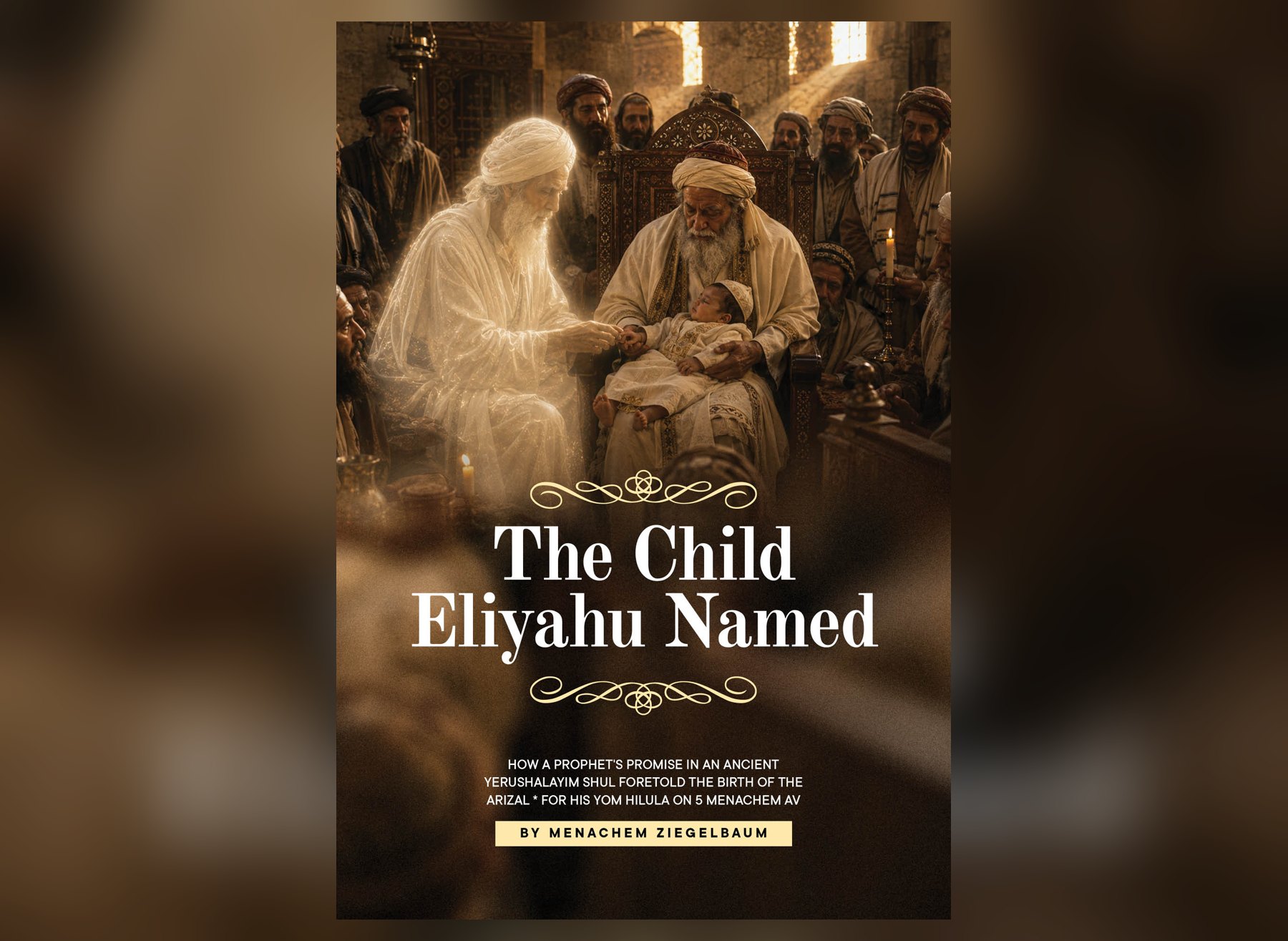
How a prophet’s promise in an ancient Yerushalayim shul foretold the birth of the Arizal – for his yom hilula on 5 Menachem Av.
I
In the ancient shul, on one of the streets of Yerushalayim of yesteryear, Shacharis had just ended. It was quite early, and Yerushalayim was still steeped in the chill of morning. One by one the worshipers left the shul, each going about the day’s business awaiting him.
Only a few remained in the shul, among them R’ Shlomo. He was an upstanding, G-d-fearing man who had shunned evil all his life. The longtime worshipers all knew that R’ Shlomo was never in a hurry to leave the Beis Medrash. He would still sit, crowned in his tefillin and wrapped in his tallis, immersed in his daily learning that would continue for many more hours. Only when he completed his learning would he rise, fold his tefillin into their case, remove his tallis, and go out into the ancient, holiness-steeped alleyways of Yerushalayim to attend to his day.
Many people knew R’ Shlomo who was a familiar figure in Yerushalayim. Several years had passed since he had come up to Eretz Yisrael together with his teacher, Rabbi Kalman Kalonymus of Lithuania. Because of this, the Jewish community of Yerushalayim had given him the nickname “Ashkenazi,” after his origin from Ashkenaz (Germany/Eastern Europe). Few knew that R’ Shlomo was a son of the Ashkenazic rabbinic family “Luria,” whose lineage traced back to Rashi and Dovid HaMelech.
At times, when R’ Shlomo noticed that no one else remained in the shul, he would approach the Aron Kodesh, bury his head in it, and pour out his heart in prayers and supplications that came from the depths of his heart. He prayed about everything: about his righteous and modest wife, about the children they did not have, adding requests for blessing in his livelihood and for finding favor in the eyes of all who saw him.
One morning, as he stood absorbed in his silent prayer among the folds of the velvet curtain, he felt a light touch on his shoulder. Startled, he turned around, and before his eyes appeared a man with a refined countenance, with soft, glowing features—a man whose eyes had witnessed twelve generations, a man known by his hairy appearance.
“Shalom aleichem, Shlomo,” the unknown man began, and R’ Shlomo returned his greeting.
“I am Eliyahu HaNavi,” the man continued without delay. “Know that I have been sent to give you good tidings—behold, your wife is pregnant and is destined to bear you a son. Therefore, I command you to name him ‘Yitzchok’. He will not be an ordinary child, for this child will have a special mission in the world: to save the souls of Israel from the impure kelipos, to repair wandering souls, and through him the wisdom of Kabbala will be fully revealed.
“Not only that,” Eliyahu added, “he will explain the secrets of the Zohar and the Tikkunim, and all the mysteries of wisdom will flow from him. If the generation is worthy, he will even merit to gather the scattered of Israel from all corners of the earth, and his name will go before him throughout the land. Whatever he decrees, both in the upper worlds and in the lower worlds, will come to pass.”
R’ Shlomo nodded his head silently in the presence of this G-dly vision, and could not open his mouth. He swallowed his saliva in fear and nodded his head silently.
“Therefore,” Eliyahu concluded his words, “be careful to guard him from anything bad. On the eighth day, do not circumcise your son until I myself come to be his sandak (the one who holds the baby).”
As soon as he finished speaking, the prophet’s figure suddenly vanished from before his eyes. R’ Shlomo remained standing in his place, stunned and awestruck by the vision. He extended his hand to check whether the vision had truly been real, but no one stood there anymore…
II
That day, R’ Shlomo did not return home. He turned back to face the Aron Kodesh, and a stream of tears burst from his eyes. “Thank You Hashem for the good tidings,” he murmured while weeping with excitement. “Please, Hashem, fulfill the word You have just told me, and let no sin delay the great goodness I have just been told of.”
Only late in the afternoon did he return home, and only then did he taste his first food of that day. He did not even share with his wife the divine vision he had merited to see that morning.
Not many days passed before his wife revealed to him the good news that they were destined to embrace a child, after nine months of pregnancy. There was no limit to his joy, and in his heart he knew with certainty that the divine vision had indeed been real.
Every day of her pregnancy, he poured out prayers that no obstacle, no sin or transgression, should occur because of him, so that it would not spoil the G-dly communication he had received.
The days of pregnancy passed and one day his wife gave birth to a son. A great neshama descended from heaven and entered into the small body of the child. Because of him, the house filled with light. That year was the Hebrew year 5294 (1534).
The following days were days of preparation for the bris mila. He was elated, knowing that he would once again merit to meet face to face with the man who heralds tidings of Geula.
Already on the morning of the eighth day, the happy father led his young son to the shul, to fulfill the mitzva of bris mila. He had invited his friends and loved ones; he called for a renowned mohel to celebrate the bris mila and the festive meal together with him.
As soon as he entered the shul, his eyes scanned the crowd, searching for the promised guest, but Eliyahu was not seen among the crowd. “Perhaps it is still too early,” he thought to himself, and he instructed the mohel to wait before beginning his task.
Meanwhile, a large crowd gathered, and everyone awaited the beginning of the bris, but he had been warned not to begin the bris before Eliyahu arrived. The members of the community, who had already begun to lose their patience, began urging him to begin the ceremony, but he was forced to delay them with various excuses, saying that “not all my relatives have arrived yet.” His wife too stood in the women’s section, puzzled at the reason for the delay.
Another long hour of terrible tension passed, and R’ Shlomo’s knees began to tremble. He approached the Aron Kodesh and as was his custom, buried his head in it and burst into bitter weeping. “Since Eliyahu has not come,” he thought with a broken heart, “surely I have sinned, and my transgressions are what have led me astray. Who knows—perhaps this is not the child I was told about, and because of me, the Navi’s coming has been prevented.”
As he was still overcome with tears, he suddenly felt a gentle touch on his shoulder. Even before he turned around, he knew that Eliyahu HaNavi was standing beside him.
“Do not weep, friend of G-d, servant of G-d,” he said compassionately. “My delay was only to test you, to see whether you would keep my command or not. Now, rise and sit in the chair, hold your son, and I will sit in your lap and hold the boy’s hand, and we will bring him into the eternal covenant.”
Immense joy flooded over R’ Shlomo. He hurried to wrap himself in his tallis and sat down on the sandak’s chair while Eliyahu sat in his lap. He could see him and feel him in his hands, but he was hidden from the eyes of the rest of the crowd; not everyone merits this.
The bris mila was performed swiftly, and the boy was named Yitzchok.
Minutes after he returned his son to his mother’s arms so she could care for him, all those present were astonished to see that the wound of the bris had healed miraculously, as if this were an infant who had been circumcised years earlier…
III
And Yitzchok grew and became a wonder, the wonder of the generations. At age three, he began davening from a siddur. By the time he reached the age of eight, he was already proficient in Gemara and halacha, and he would sit alongside the great ones of Yerushalayim. His ability for sharp analysis and brilliant reasoning became renowned. Even the great Torah scholars struggled to stand before the immense knowledge he had acquired, as well as his depth of understanding.
Sadly, his father did not merit to live long in his son’s company, and when the boy was only eight years old, his father R’ Shlomo passed away from the world, leaving the mother a poor widow.
Only a few months passed before the mother turned to her son: “My dear son, I have tried as much as I can, but I am unable to purchase for you the many sefarim you need. My advice, therefore, is that we go down to Egypt, to your uncle, my brother, who is an honorable, wealthy man. There you will lack nothing, and you will be able to immerse yourself in the labor of Torah study to your heart’s content.”
Young Yitzchok’l agreed to his mother’s proposal, and the two went down to Egypt.
His uncle, Mordechai Francis, received them with great honor, and warmly adopted Yitzchok as if he were his own son. He was very proud of his nephew, so exceptionally wise, and after a few days he hurried to visit the home of the rav of Egypt, Rabbi Betzalel Ashkenazi (author of Shitah Mekubetzes), and asked him to accept the boy as his student. The Rav wondered about the boy who had just arrived from Yerushalayim, and quickly realized that the boy was destined for greatness.
In the following years, he continued to delve into Torah and tefilla, also sitting in the Beis Medrash of the righteous Rabbi David ben Zimra (the Radvaz), his soul soaring and ascending to great heights.
By the time he reached the age of fifteen, the young Yitzchok’s wisdom already surpassed that of all the sages of Egypt. It was then that his uncle gave him his daughter in marriage.
IV
Two more years passed. The young scholar Yitzchok Luria (Ashkenazi—a name he adopted in honor of his teacher and rav in Egypt) sat in the Beis Medrash and learned Torah. His eyes moved quickly over the small lines of text.
Without his noticing, someone sat down on the bench across from him, placed several sefarim he had brought with him on the table, and let out a slight sigh of relief. He hummed quietly to himself an unfamiliar tune, and opened one of the sefarim he had brought, a sefer written in an ancient hand.
Many long minutes passed until the sharp eyes of Rabbi Yitzchok noticed that this was not an ordinary sefer.
“Shalom aleichem,” he extended his hand to him. “Who are you, what is your occupation, and what is this sefer you are reading?”
The guest mumbled in embarrassment: “Sir, what shall I say and what shall I speak. I am of the Marranos (forced converts), of Spanish origin. I am a merchant, and that is my livelihood. As for this book, I do not know how to read even a single letter of it. But I saw that all the members of the community were sitting with their books in hand, and out of embarrassment I too took this book in my hand and opened it.”
Rabbi Yitzchok’s keen eyes had already grasped that this sefer was no ordinary book, and that hidden within it were secrets of Torah and sublime mysteries.
“In that case,” said Rabbi Yitzchok, his soul yearning for the sefer, “sell it to me, and I will pay whatever you ask!”
A slight smile appeared on the lips of the guest who had come from afar. “I am not lacking in money, and I have no need for payment for the book,” the man replied. “But if you do me one favor, I will give it to you as an outright gift. Today a shipment of mine arrived at the port and I am about to pay heavy customs duties on it. If you can, please intercede with your father-in-law and uncle, Mr. Mordechai, that he waive the customs fees for my merchandise.”
Rabbi Yitzchok, whose entire mind was already absorbed in the sefer he held in his hands, hurried to his father-in-law and acted on behalf of the merchant. In exchange, he received the precious manuscript as a gift.
V
Over the next six years, Rabbi Yitzchok Luria secluded himself in a side room of the Beis Medrash, contemplating and immersed in the sefer which was none other than a book of Kabbala, steeped in hidden mysteries. Some say it was the Book of the Zohar. During these years he invested his entire being in studying it, laboring with tremendous effort and great toil. Later he himself recounted that at times, at night, it was revealed to him in dreams that the understanding he had reached regarding a certain passage of the Zohar was indeed the intention of Rabbi Shimon bar Yochai, but that there was also another, deeper secret beyond it. At times, he was told that in order to understand a certain passage, he needed to undergo great acts of self-denial and asceticism.
When he saw that he needed to add holiness upon his holiness, he left the Beis Medrash and the house of his wealthy father-in-law, and with his wife’s consent he secluded himself for two more years in a small house on the banks of the Nile River. During these two years he was swept up in storms of holiness, observing fasts of speech, praying with tears, and beseeching that heaven assist him in reaching elevated spiritual levels. Only on Friday evenings did he return home, and he would speak with his wife only a little, and even that only for great necessity and only in Lashon HaKodesh.
Because of this, he merited to be crowned with crowns of holiness, and even merited to attain Ruach HaKodesh. The pathways of heaven opened before him.
It was then that Eliyahu HaNavi was revealed to him: “I have been sent from the heights of heaven to teach you all the secrets of the Sefer HaZohar, until no mystery remains hidden from you. Take heart, be strong and courageous, and do not cease from your good deeds. You must continue in the practices you have taken upon yourself until you reach the level of an angel of G-d.”
(Adapted from “Eretz HaChaim,” p. 119 — by the Rabbi and Chassid R’ Chaim Leiberzohn zt’l, of Berdichev)
Beis Moshiach #1513 • pp. 30-35
© 2026 Beis Moshiach Magazine. All rights reserved.
This article originally appeared in Beis Moshiach #1513. You are welcome to share it with friends and family by email or in print, provided that you do not change, add to or omit any part of it, you credit the author and Beis Moshiach, and you include a link to archive.bmoshiach.org (written out in full in printed copies).
To republish this article in a newspaper, magazine, book or website, please request permission in advance at [email protected].