She Built a Beis Medrash for the Rebbe’s Daughters
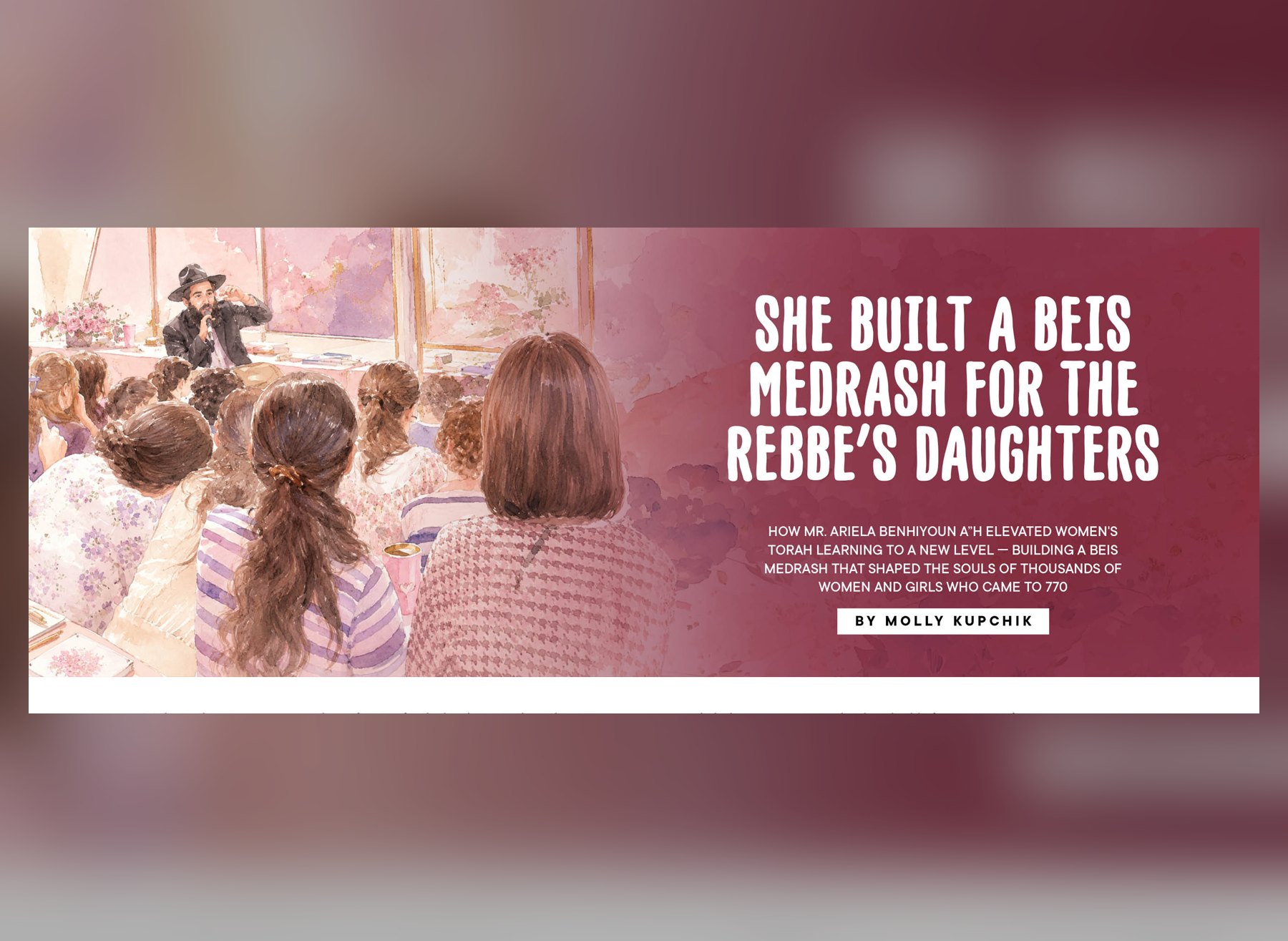
Ms. Ariela Benhiyoun was a special person who left her mark on thousands of women and girls who came to 770 over the past decades.
My acquaintance with Ariela a’h, began in Tishrei 5756 [1995]. Not many girls flew to the Rebbe MH’M in those years. We were a small group numbering a few dozen girls and women of various ages who came to the Rebbe for Tishrei. Ariela took up the challenge and arranged shiurim for us at 770, farbrengens, and even meals which were held in a building in the yard of her sister, Dr. Esther Reich’s home.
Later on, Eshel Hachnosas Orchim, run by Rabbi M.M. HaCohen Hendel and his mother, Rebbetzin Chaya Rochel Hendel, took care of (and still takes care of) the guests’ needs. But that year, she took upon herself the role of caring for the king’s guests through rain and wind.
Even though we arrived after Gimmel Tammuz, the emuna was there, hidden within. The one who lit and kindled it into a blazing fire was Ariela, who arranged for rabbanim who gave us classes, and mashpiim who farbrenged, on weekdays as well as Shabbos and Yom Tov.
Ariela (or “Rabbanit Ariela,” as she deserves to be called) was not satisfied merely with having merited to bind herself to the Tree of Life, but took care to revive many other souls with chayus of kedusha.
It was Ariela who rooted and planted this norm of a Tishrei steeped in learning during every free moment. Ariela paid the rabbanim (for some, even airfare!) so they would come teach the girls, and thus we merited daily classes in “Dvar Malchus,” in-depth Chitas, halachos, maamarim and sichos, hashkafa and emuna. The shiurim were given by the finest rabbis and rebbetzins, mashpiim and mashpios, from Eretz Yisrael, Crown Heights, and from all corners of the globe.
The high point of Tishrei was the “dinner” she held at a magnificent hall on Vav Tishrei in memory of Rebbetzin Chana a’h, and a Simchas Beis HaShoeiva for girls at a hall she rented.
Although one can draw inspiration from the very walls of Beis Chayeinu, when it also has a daily schedule of classes, and they even rent a bus for you to go out on mivtzaim (mivtza kabbolas ha’malchus, or neshek or lulav), Tishrei looks completely different. There’s less need to look for shopping in downtown Brooklyn, and more desire to draw from the Brooklyn above, in the most saturated and satisfying month of the year.
Year after year we grew stronger, in our knowledge of Yahadus, in hiskashrus and emuna. Tens and thousands of women and girls filled the benches of the Beis Medrash and learned during every spare moment.
Besides the classes for girls, Ariela initiated “Bayis HaYehudi” classes for seminary girls and even for married women.
And so, year after year, from Tishrei 5756 until Tishrei 5762 consecutively, I merited to draw water from a well of living waters thanks to her. About fifteen years ago, I merited to be in charge of Tishrei on her behalf, and to witness up close, this time from the organizational side, how much care and attentiveness she put into every detail.
Besides her care for the Rebbe’s guests in the month of Tishrei, her blessed initiative spread across the entire year, as she established daily classes at 770 for the women of Crown Heights.
In addition, every Shabbos, dozens of the neighborhood’s women would flock to hear divrei Torah during the raava d’raavin hour and this continues to this day.
There were other areas that no one else paid attention to, but she did. Every year on the 15th of Shevat, she would arrange for a large, magnificent silver tray filled with select fruits to be placed on the Rebbe’s farbrengen table.
In the nun’s (90s), she was one of the Chabad women in Crown Heights who pushed forward and led the Kabbolas HaMalchus events, as well as the campaign for signing on to Kabbolas HaMalchus, regarding which they received explicit instructions from the Rebbe.
Although Ariela did not merit to marry and bring children into the world, she merited to raise many “children” through the Torah classes she established (“your children—these are the students”), as she toiled and gave from her money and her strength to spread the wellsprings of Torah and Chassidus in educating and shaping the souls of thousands of women and girls who merited to build homes on the firm foundations of Torah and Chassidus, thanks to her.
As young girls, we did not always appreciate her as we should have, and it’s possible she never received the full honor and appreciation she deserved, but she never sought it. On the contrary, every year she sought to expand the scope of the classes and activities for the Rebbe’s guests and the neighborhood’s residents. May this be to her merit.
An Eternal Act
Ms. Ariela Benhiyoun was born in Morocco. She came from a distinguished family, descended from the Chida and Rabbi Yosef Albo. For decades, she merited to live directly across from the Rebbe and Rebbetzin’s house on President Street.
Ariela dedicated her life to Torah, to Chassidus, to chinuch, and to helping others. Through her vision and devotion in founding the Beis Medrash L’Nashim, she inspired countless women and left a lasting mark on her community and on everyone who merited to know her. Her amazing acts of kindness, material and spiritual, touched the lives of countless men and women, and created a Jewish-Chassidic legacy that they carry forward for generations. It is not hard to imagine how much she also has a share in the education of the future generations of those very girls who absorbed so much thanks to the classes they received during the formative years of their souls.
She passed away suddenly at the age of eighty-one. None of my friends who knew her believed she had reached such an age, since she was so fresh in her activity and youthful in spirit.
But it was symbolic that her funeral passed on Friday evening, the 28th of Sivan, in front of 770, the place from which she spread the wellsprings with full force, on such a special day.
I am certain that thousands upon thousands of angels, born from her good deeds, received her.
Rabbanit Ariela! Please continue to act with determination to bring the complete Geula and return to us here, below ten handbreadths, miyad mamosh.
Beis Moshiach #1513 • pp. 48-49, 50
© 2026 Beis Moshiach Magazine. All rights reserved.
This article originally appeared in Beis Moshiach #1513. You are welcome to share it with friends and family by email or in print, provided that you do not change, add to or omit any part of it, you credit the author and Beis Moshiach, and you include a link to archive.bmoshiach.org (written out in full in printed copies).
To republish this article in a newspaper, magazine, book or website, please request permission in advance at [email protected].