How Did Naftali Get to the Beis HaMikdash?
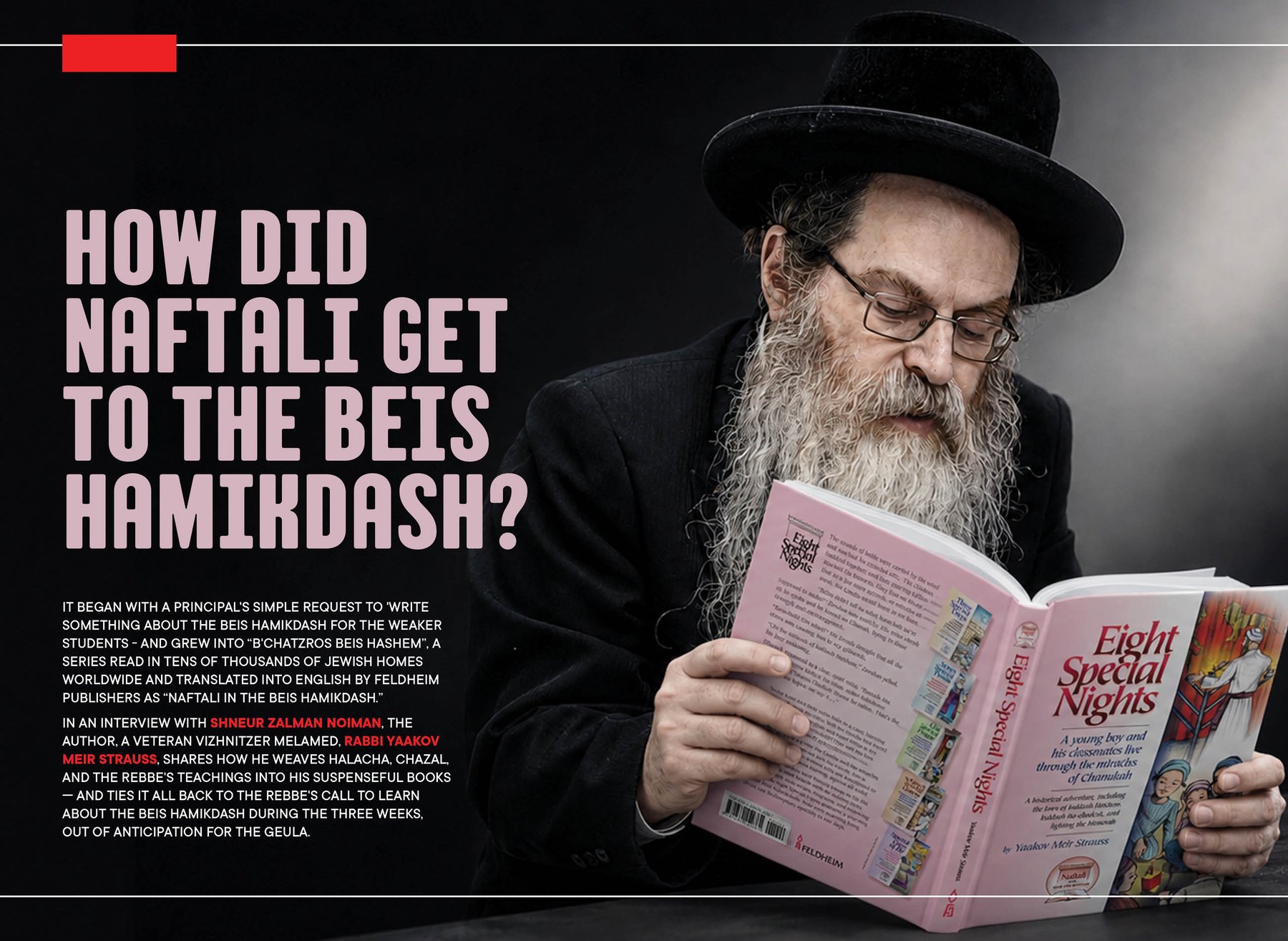
It began with a principal’s simple request to “write something about the Beis HaMikdash for the weaker students” – and grew into “B’Chatzros Beis Hashem”, a series read in tens of thousands of Jewish homes worldwide and translated into English by Feldheim Publishers as “Naftali in the Beis HaMikdash.” In an interview with Shneur Zalman Noiman, the author, a veteran Vizhnitzer melamed, Rabbi Yaakov Meir Strauss, shares how he weaves halacha, Chazal, and the Rebbe’s teachings into his suspenseful books – and ties it all back to the Rebbe’s call to learn about the Beis HaMikdash during the Three Weeks, out of anticipation for the Geula.
Standing Before the King
“His words were swallowed up in the terrible commotion around them. The pressure suddenly increased. The millions of people crowded into the Ezras Nashim stood pressed against one another… The sounds of laughter and the shouts of children carried on shoulders and the crying of infants, made the noise unbearable. ‘I hope I’ll manage to hear the king’s voice within this tremendous commotion,’ Eliyahu thought to himself.”
This vivid description, taken directly from the book “Simcha B’Veis HaMelech,” instantly drops us into the very heart of the Yerushalayim shel maalah, on the eve of the royal Hakhel ceremony. Young Eliyahu, the story’s hero, doesn’t just learn about the mitzva—he’s there. He feels the crowding, the heat, the fear of getting lost in the multitude, and the yearning to hear the king’s word. The reader, young or old, is swept along with him, suddenly discovering that concepts like “Ezras Nashim,” “bima,” and “mora mikdash” (reverence for the Mikdash) are no longer mere dictionary entries, but a living, breathing, almost tangible reality.
Suddenly, silence. “A noble, tall figure was seen ascending the steps of the platform. The Kohen Gadol’s turquoise robe gleamed in the light of the many torches illuminating the place, and his white beard framed his pure face with nobility…” The miracle occurred, and thousands of infants simply fell silent. The absolute stillness, the Shechina resting upon the crowd, seeps out from between the pages of the book straight into the reader’s heart.
This ability, to breathe life and emotion into the laws and minute details of the avoda in the Mikdash, is the secret behind the magic of the monumental literary project of Rabbi Yaakov Meir Strauss, a Vizhnitzer Chassid and veteran teacher from Bnei Brak, whose books have become treasured staples in nearly every Jewish home anticipating the Geula.
In honor of the Three Weeks period, during which the Rebbe MH’M urges learning about the Beis HaMikdash, with an emphasis in our time that this study stems from a longing for the third Mikdash, and from the knowledge that it is happening right now, we sat down for a conversation in Rabbi Strauss’s home. We found a modest man, imbued with emuna peshuta in the coming of Moshiach, who sees his entire life’s work as one great preparation for the building of the third Beis HaMikdash, and who spoke openly about how it all began through hashgacha pratis.
My Student Asked Me Expectantly, “When Will the Beis HaMikdash Be Built?”
Rabbi Strauss, it’s hard to find a home with children that doesn’t have at least one of your Mikdash series books. But looking back, this surprised even you. You didn’t plan on being an author…
Rabbi Strauss: Absolutely. I never imagined this would be my field. The story began about thirty years ago. I was then an eighth grade rebbi in the Vizhnitz Talmud Torah in Bnei Brak. One day during the Three Weeks, I walked into the office of the principal, Rabbi Yitzchok Roth z’l, who was close to Chabad, and saw him sitting with a map of the Beis HaMikdash, trying to prepare something educational for the students, following the custom of these days to learn inyanei ‘Beis HaBechira.’ He looked up and said, “Maybe you’d be willing to write something about the Beis HaMikdash?” I answered, “I can try.”
Over the next two days, after school hours, I sat at home and wrote a short story, about two pages long, about the avoda of korbanos in the Beis HaMikdash. Shortly afterward, at the end of the school year, the stronger students in the class did a general review of their learning, while a small group of weaker students was left with nothing to do. I sat down with them, five or six talmidim, and told them the short story I had written. And then it happened. One of the students, with a child’s tmimus, asked me: “When will the Beis HaMikdash be built?”… Whoa. I understood at that moment that there was something here. It grabbed them, it spoke to them. That question still echoes in my mind today, and it was the spark that pushed me to produce, boruch Hashem, an entire series of books.
That single story gave birth to a booklet, and that soon led to a book?
Not so soon. A year later, it developed into a 12-chapter booklet I called ‘Two Days in the Beis Ha’Mikdash.’ You could say it was the ‘father’ of the whole series. It was very simple. One of my talented students drew some illustrations and a map of the Beis HaMikdash, we printed the booklets on the classroom’s simple printer, and even sold a few copies to other schools. When I saw there was demand, that people were interested in this subject, I decided to put out a full-length book.
That’s how the first book came out: ‘HaZechiya HaGedola’ about the Korban Pesach and aliya l’regel. Working on it alone took no less than six years! Every detail, every law, every description required study and verification. I brought the material to Torah scholars who offered important comments. When I finished, I faced the printing dilemma. A well-known rule in publishing is that if an author prints a thousand books and sells them all, that’s considered a great success. I, in my great foolishness, or maybe with siyata d’shmaya, printed 3,000 copies to start… I was very afraid I’d be stuck with boxes of unsold books, and then, shortly after the book hit the market ahead of Pesach, the distributor called to tell me that 2,500 books had already sold! There was no natural explanation for it. Simply because it’s about the Beis HaMikdash. That’s what the public loves. And everyone, Chabad for sure but also Litvaks, Chassidim, Sefardim, really every sector, everyone wants the Beis HaMikdash.
That success whetted your appetite, and the later books came out at a faster pace?
Since then, it’s been like a spring that flows and can’t stop. About every year and a half, another book came out. The next book was ‘Mul Kisei HaKavod,’ about a regular day in the Beis HaMikdash. I had planned to include Shavuos in it too, but the material accumulated and became a whole book of its own. I included topics like the para aduma and the purification of the metzora. That book is woven through with many halachos, and includes about 800 references.
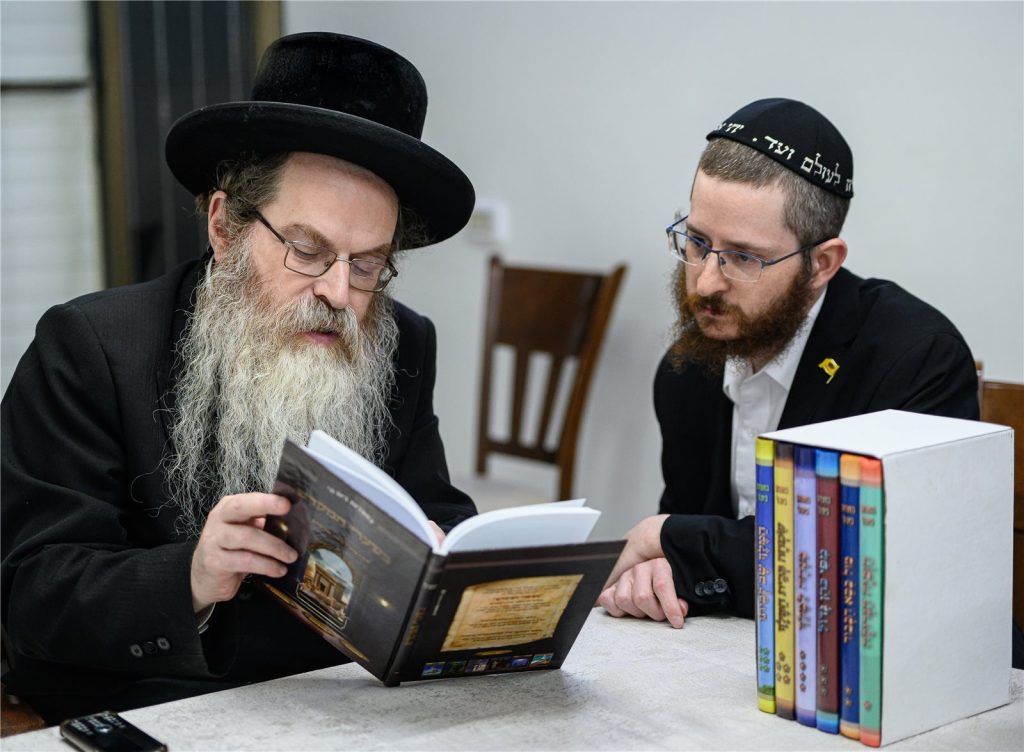
After it came ‘M’Pi Kohen Gadol,’ which details the Yom Kippur avoda. Here I allowed myself to include a more serious plot, about spies who came from Rome to track the Kohen Gadol, to check whether the rumor was true that he was praying for the kingdom’s downfall. I placed the plot about 70 years before the Churban, when the Romans already had a foothold in the land.
‘Mincha L’Melech’ is about Shabbos Kodesh in the Beis HaMikdash, Chag HaShavuos, and menachos in general. ‘Simcha B’Veis HaMelech’ opens with a description of the Hakhel ceremony, and continues with the Water-Drawing celebration and the events of Sukkos. And the last book in the series, ‘HaMelech Shav L’Beiso,’ tells of Chanuka. That’s already a different era, and Eliyahu (Naftali in the English series), the series’ ten-year-old hero, steps aside for other children. The story of Chanuka is woven together with medrashim of Chazal, and the book’s title symbolizes Hashem returning to His home, to the Beis HaMikdash, on Chanuka. The books have also been translated into English, Yiddish, and Spanish.”
Ages 8 to 88 — and Beyond…
You describe a tremendous undertaking, both in quantity and depth of detail. What does the work process look like? Do you sit and relearn all the sugyos for each book?
It’s an interesting process. The later books were mostly written during bein ha’zmanim. I would sit for two weeks and just write continuously. When I wrote about Yom Kippur, for example, I wrote most of it from memory, from what I had once learned in meseches Yoma. Here and there I’d open a sefer, but mainly I wrote according to what flowed in my head—the story, the plot. Only afterward, of course, did I go over everything and check thoroughly against the sources to make sure there were no mistakes, and add the source references.
“The main sources are the Mishna, Gemara, and Rambam, mostly from Seder Kodshim. At first I didn’t even have a computer; I couldn’t search for sources at the click of a button. Everything was done with sefarim (he points to a copy of Rambam’s Sefer Avoda on his desk). You see this, the ‘Avoda’ volume of the Rambam (which opens with the Hilchos Beis HaBechira), it’s the most useful one… The binding is already torn. Sometimes the source is even older, like the liturgical poem ‘Atah Konanta,’ recited in the Yom Kippur Musaf, which is the sole source for certain halachos found in the Rambam. I also had to work hard on the illustrations, to make sure everything was accurate according to halacha, so there wouldn’t be mistakes.
Beyond halachic accuracy, of course, the books have another layer, of emotion. Someone once told me he was glad ‘a Chassid wrote this’… So the books also carry feeling, not just dry factual description. I think that’s part of what makes them work. To convey concepts, you can’t stay only on the technical level. Why did Chazal use stories so much? Because a story makes the message sink much deeper into the mind and heart. For example, we understand the message of ‘whatever Hashem does, He does for good’ best through the story of Rabbi Akiva and the bandits. It’s the same here. When a child reads about Eliyahu afraid of getting lost during aliya l’regel, or searching for a good spot to see the king, he relates. The Beis HaMikdash becomes a place he wants to be, and he almost feels he’s really there.”
By the way, even though my original target audience was children, many adults read the books too. I think even more than children… because adults also love reading halachos and content in an accessible way. Once I advertised that the books are for ages 8–88. A friend called and said, “Why do you write up to 88? My father is 90, and he really enjoys reading.”
There’s another book I wrote called ‘B’Shaarei HaMikdash,’ intended for adults, offering a concise summary of concepts and explanations about the Beis HaMikdash and the korbanos. Following this deep involvement and knowledge in inyanei HaMikdash, I also began giving lectures along with slides around the country, for every audience and age. I’ve had the chance to lecture at several Chabad houses as well (which can be arranged by phone: 0527615549).
The power of the Beis HaMikdash to make everything personal and touching is something our Sages emphasize. Are there examples of this?
Certainly. There’s the famous story of Yosef Meshita. When the enemies entered the Beis HaMikdash, they announced that whoever went in could take one vessel for himself. Yosef Meshita went in and brought out the pure golden Menorah. The enemies told him: “That vessel is too precious, it doesn’t suit someone of your standing. Go back in and take something else.” He refused: “I won’t go in again.” They threatened him: “If you don’t go in, we’ll kill you.” And he held firm: “Kill me, and I still won’t go into the Heichal again.” They tortured him and cut off his hands and feet, and he cried out, “Woe is me, that I angered my Creator!” A heavenly voice went out and declared: “Rabi Yosef Meshita is destined for the World to Come!”
What happened here? Within a few moments he went from being a criminal to a complete tzaddik, holy and pure! That’s the power and influence of the Beis HaMikdash’s holiness. One encounter with kedusha can transform a person completely.”
Are there also more hidden details, not always well known, about what happened in the Beis HaMikdash?
There’s one detail that doesn’t appear in the books. It’s well known that when the Kohen Gadol entered the Holy of Holies, they would tie a golden cord to his leg, so that if something happened to him, they could pull him out. In the First Beis HaMikdash, when the kohanim were completely righteous, this wasn’t necessary. But I saw in a kabbalistic text that in the First Beis HaMikdash there was also a cord, extending from the Kohen Gadol’s robe out to the courtyard which served a completely different purpose.
If the Kohen Gadol saw from inside that the Divine Name was shining upon the Aron, he would know the spiritual state was good. And if, heaven forbid, not, he would give the cord a light tug, and that was the signal to his fellow kohanim standing outside to begin crying out and rousing the people of Israel to teshuva, to return to Hashem with all their heart. It was a spiritual communication tool.
A Life Imbued with Emuna in Moshiach
Behind a literary project like this, entirely revolving around Geula and the Mikdash, there’s usually something deeper. Was this subject present in your life in a special way even earlier?
I think it’s thanks to my father a’h. The subject of Moshiach was so important to him, he simply lived it, and so I believe he merited that his son would write books about the Beis HaMikdash, something that hastens the Geula. My father was filled with true, simple faith in the coming of Moshiach. These weren’t slogans for him. When my brother was abroad, he would tell him, “Come back quickly, Moshiach is coming.” He lived it literally.
There’s a story that captures how it began for him. He was born in Frankfurt, and at age three moved with his family to England, even before the Holocaust. At that time there were no proper Orthodox schools there. He studied at a gentile school, and in the evenings received private lessons in Judaism.One day, my grandfather walked into the room and saw my father, then about six or seven, crying bitterly. “Why are you crying?” he asked. My father explained that his teacher had said Moshiach would come, and then everyone would go up to Yerushalayim. He was afraid Moshiach would come while he was at school, and when he came home, he wouldn’t find anyone there because everyone would have already left for Yerushalayim… My grandfather, with great sensitivity, comforted him and promised: “I won’t leave without you…” He grew up with that expectation from childhood, and that’s what he passed on to us.
By the way, my father told me that before the Six-Day War, there was tremendous tension in London. There were two groups of young people, ‘Tzeirei Agudas Yisrael’ and ‘Tzeirei Chabad.’ The Aguda youth, out of sincere concern, went around neighborhoods registering families willing to take in refugees from Eretz Yisrael, because they were sure things would turn out terribly. The Chabadnikim, on the other hand, announced to everyone that the Rebbe had said everything would be completely fine, that there would be a great victory, and that people should go out on mivtza tefillin to add zechuyos. By the end of the war, we saw who was right.
Have you gotten responses from readers showing that they too live with pure faith in the coming of Moshiach, thanks to the book?
Certainly! Here’s an example that shows how people live Geula today, here and now. Once a giyores called me to pose two questions about the Beis HaMikdash. First question: “Women don’t go barefoot. So how did they enter the Beis HaMikdash where it was forbidden to enter wearing shoes?” (I checked and there are various explanations for this.) But her second question stunned me. She said: “A convert must bring a korban olah. In the Geula shleima, I want to bring a goat as an offering. There are two types of goats, one the public generally prefers, and another whose taste I personally like more. Which goat will I need to bring?” Look at the kind of questions this is! She’s already planning her korban! It shows that this subject is alive in people’s hearts.
When one is deeply immersed in a particular Torah topic, interesting chiddushim often emerge. Can you share one?
I’ll tell you about a chiddush that occurred to me, and when I shared it in a lecture before Chabad Chassidim, one of them showed me that the idea is actually written in the Rebbe’s Likkutei Sichos. For me, that was a moving surprise.
Here’s what happened: I always wondered about the phenomenon of the Kohanim Gedolim in the second Beis HaMikdash period, who would buy the priesthood with money, and it’s known that the vast majority of them didn’t live long; they died within the year. I asked myself, where was their sense? Imagine there was a virus in the White House, so that whoever becomes president dies within a year. Who would be foolish enough to take the job? After all, you’d see it happen year after year!
So in that lecture I offered the insight that occurred to me: that there was such a gilui Elokus there, and the longing to enter the Holy of Holies was so intense, that they were willing to give up their lives for that one singular moment. It was worth everything to them. And then, one of those present stood up and told me: “Yes, the Rebbe says this” (in Likkutei Sichos, vol. 18, p. 190).
This principle, of the burning longing for closeness to Hashem, resolves many other difficulties too. How could King Uziah, who was righteous, offer ketores and be punished with tzoraas? Didn’t he know the halacha? Rather, he simply couldn’t restrain himself! How could two hundred and fifty men who offered ketores follow Korach, when Moshe explicitly told them that only one would survive? The answer is that same overwhelming longing that overcame reason (ibid., Likkutei Sichos).
As is known, the Rebbe says that studying inyanei Geula and Moshiach is the direct and easy way to bringing the Geula, and also what brings one ‘to live with Moshiach.’ It seems your books play a part in that.
I’m very glad to hear that. The primary goal of the books is, of course, knowledge. I’ve received many responses about that. For instance, a father called and said: “My eight-year-old daughter knows the whole book by heart. You can test her.” I myself don’t remember everything I wrote… But beyond the knowledge there’s the feeling. Simply living with it. When a child or an adult reads about the Beis HaMikdash in such a vivid way, it stops being something abstract and distant. He identifies with the children in the story, he enters the Heichal together with them… and naturally that stirs the anticipation and longing for the building of the Beis HaMikdash. One Rebbe told me that before Yom Kippur, he goes through the book ‘M’Pi Kohen Gadol’ and it puts him in the right frame of mind. It connects the heart.
The Books That Bring Geula, One Moment Sooner!
When the Rebbe is revealed, what will he say to you?…
There’s a song that tells how, at Moshiach’s coming, he will tell everyone who brought him closer – (Rabbi Strauss smiles).
I merited, boruch Hashem, to take part in that! I think if I came before the Rebbe at a dollars distribution, the Rebbe would surely have been very pleased, and I’d probably have earned an extra dollar…
The truth is, even as a child I had a connection with Chabad in London, where I learned my alef-beis. I grew up there until age eight, when we moved to Eretz Yisrael. Today I see Chabad’s activities and how devoted they are to publicizing the subject of Moshiach, and the Rebbe’s words that Moshiach is coming immediately—it’s a wonderful thing.”
What are your plans for the future? Perhaps another book in the series? About the Geula and the third Beis HaMikdash?
Moshiach is coming immediately. That’s it. Those are the plans. We won’t have time to put out another book, he’s already coming!
We keep talking about ‘b’itah’ [in its proper time] and ‘achishenah’ [I will hasten it]. There could be a difference of a minute, right? And does anyone imagine that the Jewish people, after everything they’ve endured in exile, wouldn’t want to receive Moshiach one minute sooner?! One minute! Of course it will be ‘achishenah’! We can’t wait even one more unnecessary minute.
That’s why we no longer need more books and more models. As I wrote at the end of the Chanuka book: there are many models but that’s not what interests us. We need the real thing! May we merit it immediately, mamosh.
That certainty, that Moshiach is coming right now, grows stronger the more one engages with inyanei Geula and Moshiach. Someone who doesn’t study it. doesn’t ‘live’ with it, and unfortunately there are people who, if you ask them, “Do you want Moshiach now?” will say: “Look, in a week my son is getting married… I don’t know if people will make it to the hall or not… better he come a week later.” Another will say: “Let him come after Yom Tov, I can’t right now, I’m in the middle of shopping for Yom Tov. Now I should run to Yerushalayim to look for sheep for a korban? I don’t have time.”
By contrast, for someone who studies the subjects of Geula and the Beis HaMikdash—it heightens the sense of anticipation, and he truly begins to wait, wholeheartedly, unconditionally. With Hashem’s help, through genuine learning and anticipation, we will immediately see the true and complete Geula.”
Beis Moshiach #1514 • pp. 16-23, 33
© 2026 Beis Moshiach Magazine. All rights reserved.
This article originally appeared in Beis Moshiach #1514. You are welcome to share it with friends and family by email or in print, provided that you do not change, add to or omit any part of it, you credit the author and Beis Moshiach, and you include a link to archive.bmoshiach.org (written out in full in printed copies).
To republish this article in a newspaper, magazine, book or website, please request permission in advance at [email protected].