Ron Nachman Got the Security Briefing. Bibi Got Something Bigger
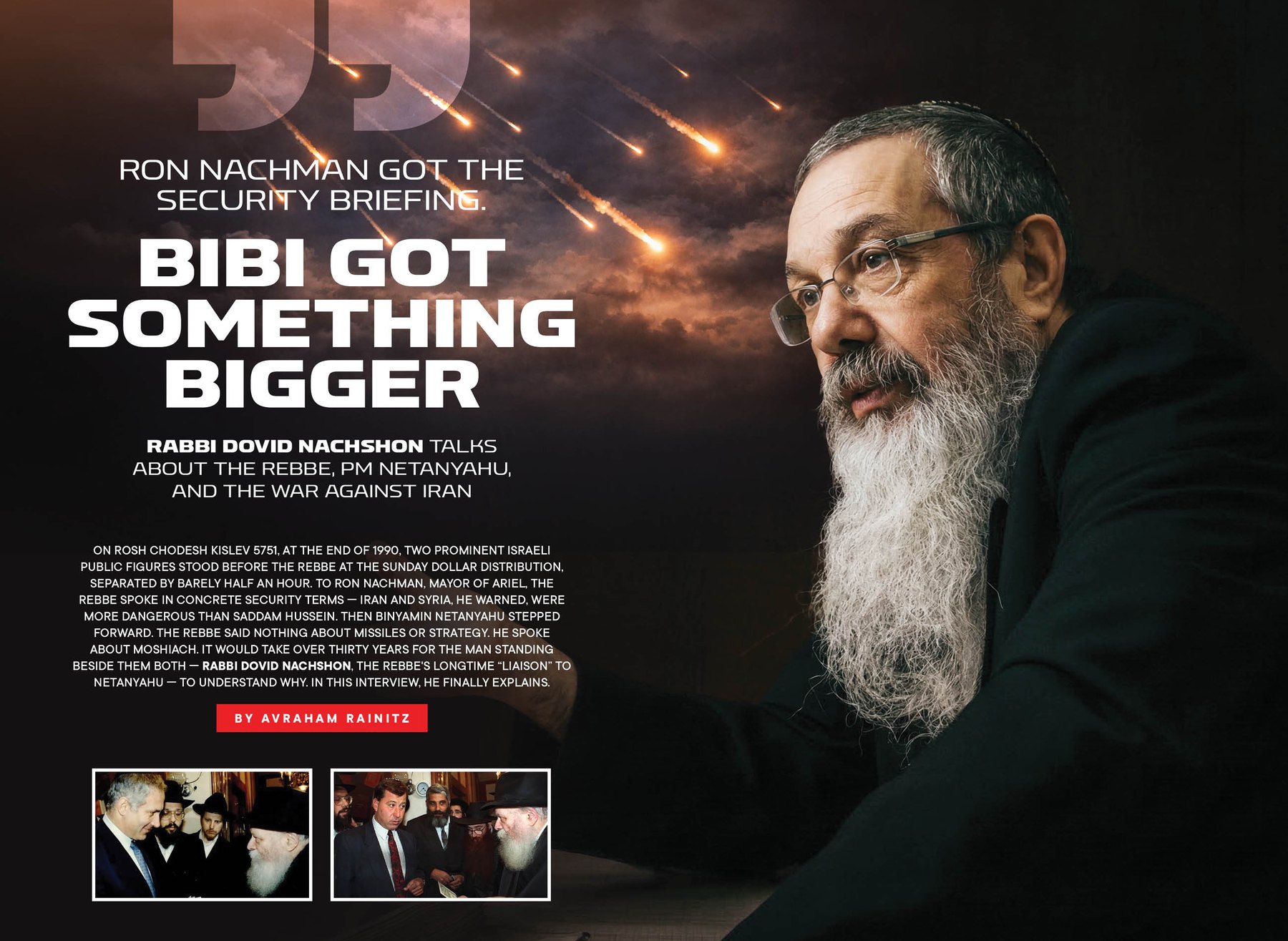
Rabbi Dovid Nachshon Talks About the Rebbe, PM Netanyahu, and the War Against Iran
On Rosh Chodesh Kislev 5751, at the end of 1990, two prominent Israeli public figures stood before the Rebbe at the Sunday Dollar Distribution, separated by barely half an hour. To Ron Nachman, mayor of Ariel, the Rebbe spoke in concrete security terms – Iran and Syria, he warned, were more dangerous than Saddam Hussein. Then Binyamin Netanyahu stepped forward. The Rebbe said nothing about missiles or strategy. He spoke about Moshiach. It would take over thirty years for the man standing beside them both – Rabbi Dovid Nachshon, the Rebbe’s longtime “liaison” to Netanyahu – to understand why. In this interview, he finally explains.
The sirens on the morning of Shabbos Parshas Zachor, eight weeks ago, plunged the Jewish people into a “state of war.” Everyone understands that this time it is a “war of Hashem against Amalek,” but each person experiences it from a different angle. The soldiers mobilized to various combat units on the air and ground fronts while the civilians who remained in the rear – which has itself become a front in recent wars – and even Jews abroad entered a state of emergency alert. Each person has their own vantage point.
And then there is the Chabad Chassidic perspective. Chassidim always view reality through a different lens. Especially since the Rebbe MH’M, announced that “the time of your redemption has arrived,” and everything happening in the world is part of the Geula process. When others focus on missiles, the Chassidim focus on miracles, and while everyone else is frightened by the sound of sirens and explosions, the Chassidim are stirred by the sound of the great shofar that is about to be blown.
In a deep conversation we held before Pesach with Rabbi Dovid Nachshon, director of Chabad Mitzva Tanks and Tzivos Hashem in Eretz Yisrael, he looks back at Israel’s previous military campaigns and shares with us the messages that the Chassidim received from the Rebbe, emphasizing that these were not merely messages of reassurance, but above all one clear message: everything happening in the seventh generation is part of a single process leading to the hisgalus and the true and complete Geula!
Rabbi Nachshon, we are in the midst of a war against Iran and its proxies. The mainstream media, as usual, constantly sows panic. The Home Front Command warnings and the repeated sirens also raise the anxiety level. As a Chassid who has operated on the front lines in many of Israel’s wars alongside soldiers in the field, what comes to mind when you hear that a war has broken out?
Naturally, the reassuring messages we heard so many times from the Rebbe immediately come to mind. But before we sail off into memories of the past, it’s important to disconnect this from the notion of mere “reassurance,” and to connect it to the larger picture the Rebbe draws for us:
From the time the Rebbe ascended to the leadership, he began fulfilling the shlichus of the seventh generation – to bring the Geula to the world. Since then, the major events taking place in the world are part of the Geula process that the Rebbe leads.
This is especially true since the winter of 5752 (1991–92), after the Rebbe declared that we were in “di hechste tzeit” (the highest time), and as Moshiach he had already begun to act among the nations. On Shabbos Parshas Mishpatim the Rebbe focused on nuclear disarmament as part of the destiny of “they shall beat their swords into plowshares,” but it is clear that the wars occurring in the world – and in particular those directly connected to Eretz Yisarel – are part of the “wars of Hashem” of Melech HaMoshiach.
There is a plan here, to bring the Geula into the world, and whoever sees the work plan is just not frightened by the side effects along the way.
When did you first experience the difference between the general panic and the Rebbe’s confident, Geula-oriented message?
The first war I experienced was the Sinai Campaign, but I was then a child in second or third grade. The significant war I experienced as a young man was the Six-Day War. You cannot imagine the fear that existed here. The country was full of Holocaust survivors who had experienced the terrible Holocaust only twenty plus year earlier, and when they saw the Arab states uniting to destroy us, they prepared for the worst. About seventy thousand graves were prepared in the Negev, r’l!
The American military sent ships to evacuate two thousand American citizens from here. People were urged to flee. Rabbanim and gedolei Yisrael, communal leaders, said it was permitted or obligatory to leave, and some even left themselves. And only the Rebbe stood like an iron wall – one man against the entire world – and said: Panic? Absolutely not!
Telegrams of encouragement from the Rebbe arrived at the Kfar Chabad yeshiva – telegram after telegram, and we hung them on the wall. The Rebbe wrote: “Behold, the Guardian of Israel neither slumbers nor sleeps”; “A land which the L-rd your Hashem looks after, from the beginning of the year to the end of the year.” The Rebbe stood against a murky wave of fear and broadcast absolute certainty that there would be miracles and wonders. One of the talmidim, Rabbi Zev Katz – who later became a gabbai at 770 – was supposed to get married in Israel, and they were considering postponing or changing plans because of the war. The Rebbe instructed: Do not change anything; hold the wedding on time!
This is a Navi. The Rebbe did not speak as flesh and blood guessing or hoping for the best. The Rebbe spoke as someone who knows where the train is heading – whose every move is part of the process of conquering the world toward the hisgalus of Moshiach. Our problem, as coarse material beings, is that we look through the narrow prism of the present and find it hard to see the great picture the Navi draws for us.
The Cry from 770 and the Weeping That Tore the Heavens
Were there also days when everyone was complacent and the Rebbe stood at the gate and warned us? People were in a state of euphoria – a feeling that it was the quietest and best of times. How did the Rebbe respond to that illusory calm?
I was in 770 in the summer of 5730 (1970), after Israel and Egypt signed the ceasefire agreement that ended the War of Attrition that had been going on since the Six-Day War. The Rebbe opposed the agreement with full force and said: “I see that not a single Phantom jet will be able to pass.” He saw exactly how they were going to exploit the agreement to rearm.
I will never forget one of those Shabbos afternoons. I was standing right in front of the Rebbe at a farbrengen. The Rebbe spoke with enormous pain – truly shaking – and quoted the verse: “Why, when I came, was there no one? When I called, was there no one to answer?… Has my hand become too short to redeem?” The Rebbe described in that sicha how at that very moment, in the middle of Shabbos, the Egyptians were moving missiles to the canal, inside disguised trucks. And then, suddenly, the Rebbe stopped in the middle of the sicha – and simply wept. He wept with terrible pain over the danger to the Jewish people.
At the time, no one saw war on the horizon. Everyone had fallen in love with the illusory calm that lasted three years, until the Yom Kippur War broke out and surprised everyone. Everyone – except the Rebbe. This is precisely what shows who is a prophet. In Israel no one saw anything. But the Rebbe saw that something terrible was coming, and he began to act to annul the decree.
Suddenly, in the summer of 5733 (1973), before the war, the Rebbe asked that gatherings of children be organized. He quoted the verse “From the mouths of infants and sucklings You have established strength, to put an end to enemy and avenger,” and asked that children – infants – be brought to the Kosel to daven and say pesukim.
My firstborn son, Yosef Yitzchok a’h, had just been born. He was only a month and a half old! There was intense heat, very heavy and oppressive. But I took him on the buses to the Kosel. People around me looked at me and said: “Are you crazy? You took a tiny infant in this heat? What are you shlepping him for?” I replied: “The Rebbe said ‘from the mouths of infants and sucklings’ – sucklings! This is the child.” I took him to the Kosel so he could fulfill the Rebbe’s instruction. The Rebbe saw entirely different things from what we saw.
Were you at 770 that year during Tishrei? Did you sense something in the air?
Absolutely. On the sixth of Tishrei, a few days before the war broke out, the Rebbe said he had no time for long private audiences, and so audiences should be limited to mentioning names for a bracha, while all other questions and clarifications should be written down, and over time the Rebbe would try to respond. But the very next day – the seventh of Tishrei – suddenly the Rebbe had time to stand for long hours distributing coins for tzedaka to thousands of children! Children were brought from the whole area, thousands came. On one hand the Rebbe says he doesn’t have a free second, and on the other he stands for hours distributing coins to children in order to arouse their merit and that of the entire Jewish people.
On Erev Yom Kippur, right before the war broke out, the Rebbe added a note to a general letter and asked to ensure it was published in Eretz Yisrael before the fast began. In it was written that in all of Israel’s wars – Israel is victorious. The Rebbe wanted the promise of victory to descend into this physical world before the firing began.
You spoke about the need to see the full picture and to understand that all the great events are part of Moshiach’s wars. Where can we see this idea in the Yom Kippur War?

On this particular topic, one doesn’t need to work very hard to find the connection, because the Rebbe himself spoke about it extensively. Toward the end of the war in 5734, the IDF repelled the Syrians and approached Damascus, but suddenly stopped about 40 kilometers from the city. The Rebbe, with his prophetic vision, cried out from the depths of his heart that Damascus must be conquered! The Rebbe said: Conquer it, even if only for 24 hours.
In the defense establishment and government they offered various tactical excuses. The Rebbe dismissed them one by one. He said: “They tell me the army cannot conquer Damascus because there are rocks there… That excuse you couldn’t even sell to small children!” Then they said the superpowers – the United States and Russia – would object. The Rebbe said everyone knew that was nonsense too.
But beyond the security critique, the Rebbe revealed the inner dimension of the move – its connection to the revelation of Moshiach. After the Rebbe dismissed the political and military excuses, he said: “Now I will give a ‘batlanishe taam’ – the inner and spiritual reason.”
The Rebbe quoted the verse from the Navi Zecharya: “Chadrach and Damascus are his resting place,” and explained according to Chazal that “Chadrach” is the name of Moshiach – who is “chad” (sharp/firm) toward the nations of the world and “rach” (soft/gentle) toward Israel – and “Damascus is his resting place” means that Yerushalayim is destined to extend until Damascus.
And therefore, the Rebbe cried out, Damascus must be conquered now! Even if only for 24 hours. The Rebbe expressed it in Yiddish: if they conquer it now, “m’vet machen gringar far Moshiach’n” – it will make the work easier for Moshiach! We are meant to conquer Damascus in order to ease the way for Moshiach to apply the holiness of Yerushalayim in the future to come.
The Rebbe concluded with a resounding statement: “And if they do not conquer Damascus – they will have to do it!”
And behold: now, decades later, we see how the IDF is forced to return and do all the work in Syria and Lebanon! They stopped then, and now they are forced to go back in.
It is important to emphasize: people are not at all aware of the magnitude of the miracles that happened to us on the Syrian front in recent years that are flowing into the current war. Syria had a dreadful chemical weapons arsenal – far worse than an atomic bomb – sufficient to destroy, Hashem forbid, millions of Jews in a single strike. (This fits with the Rebbe’s statements to Ron Nachman, cited below, that Syria and Iran are far more dangerous than Iraq.) And in the end? They burned and consumed the weapons against each other in their civil war, and in recent years the stockpiles were completely dismantled and destroyed without a single IDF soldier being scratched! Everything was ready to strike us, Hashem forbid, and through miraculous miracles it was neutralized.
What the Rebbe demanded be done then as preparation for Moshiach is happening today before our eyes. Hashem is now clearing the field and removing the threats in preparation for the fulfillment of the destiny of “Chadrach – Damascus is his resting place” – the complete and full revelation of Moshiach!
The Return of the “King of Persia”
If we can make a leap in time to 5751 (1990–91) – the year of “I will show you wonders.” The world was gripped by anxiety over the Gulf War. The Rebbe quoted the Medrash in Yalkut Shimoni: “The year in which Melech HaMoshiach is revealed… the King of Persia provokes the Arab king… and Yisrael becomes agitated and alarmed… and the Holy One says to them: Do not fear – the time of your Geula has arrived,” continuing to conclude: “At the hour when Melech HaMoshiach comes, he stands on the roof of the Mikdash and proclaims to Yisrael: Humble ones – the time of your Geula has arrived.” And here we stand today facing Iran, which is the original Persia. Was what we saw then merely the prelude to what is happening now?
In the summer of 5750, the Rebbe began interpreting the Yalkut Shimoni and applying it to current events. When speaking of the “King of Persia,” the Rebbe explained that Persia includes modern-day Iraq as well (in the Rebbe’s words: “which simply refers to the territory that includes Iraq”). In other words: the Rebbe revealed to us that the Medrash is being fulfilled in Iraq, and the redemptive process has already begun.
If the Rebbe said that the Medrash’s words were already fulfilled in 5751 – why must we experience it again?
First it is essential to emphasize: the Rebbe did not merely quote the Medrash as encouraging and strengthening words, but explicitly determined that all parts of the Medrash were fulfilled in practice in 5751. The Rebbe expressed this in Parshas Naso 5751, when he said that “the words of the Yalkut Shimoni had already been fulfilled” (emphasis in the original), and that “since then (and especially in the month of Nissan, the month of Geula) we already stand at ‘the hour when Melech HaMoshiach comes’ – ‘Hinei zeh ba’… and proclaims to Yisrael: Humble ones – the time of your Geula has arrived!”
Therefore it is clear that the Medrash as written was fulfilled in 5751, and the Rebbe has already come and announced the Besuras HaGeula to Yisrael, and since then we stand and await the complete hisgalus.
What we are seeing now – it is possible that we are going through the same process in a more “revealed” fashion. Now it is being shown to us much more forcefully before our eyes! If back then we saw miracles, now we are being shown even stronger wonders!
Take for example what the Rebbe quoted then: “He who struck Egypt through their firstborn” – that the nations of the world themselves strike Saddam Hussein. We see this happening now with wondrous precision. If someone had told you a week or two ago that Qatar would attack Iran – you would have said: “You’re crazy. What’s gotten into you?” After all, despite Qatar being Sunni and Iran being Shia, they always protected one another. And suddenly? They are fighting each other!
Hashem is now bringing us all the impossible things, all the amazing miracles, and saying to us: “Well? Do you believe now?” It took thirty years to prepare the hearts and the ground. In 5751 people had difficulty absorbing it – it was hard for them to accept the power of “the year in which Melech HaMoshiach is revealed.”
And now? Now the time has come and we are experiencing the precise and powerful continuation of that same prophecy. We are simply moving ever closer to the climactic moment!
The Rebbe once said regarding the Rebbe Rayatz that there are things one only understands after twenty, thirty, or even forty or more years. So too we see with the Rebbe: today, from the distance of years, we begin to understand things and hints that the Rebbe gave us then, which we did not always grasp at the time.
All the events taking place in the world today – the plan of Geula, the Yalkut Shimoni about kingdoms provoking one another – each thing has its precise time. By nature, our perspective is limited; we want to see everything “here and now.” But we must remember that there is a Divine plan that the Rebbe is leading. This is the work of Moshiach among the nations of the world. What previously appeared to be delays turns out now to be part of a historical continuum leading to its conclusion – the destruction of Amalek.
[Parenthetical note: Rambam rules that the obliteration of Amalek is a prerequisite for Geula, but since Sancheiriv “mixed up the nations,” we do not know today who Amalek is. How then can we fulfill the mitzva? I thought about this – that Divine Providence causes Amalek to reveal itself. Iran (the Persia of our times, the place of Haman), whose leaders’ names hint at “Haman,” displays a pure Amalekite essence: brazenness and impudence, and an irrational, self-destructive hatred toward Israel and G-d. Thus, Hashem enables us to identify them and blot them out, thereby completing the conditions for the complete Geula.]
Between Netanyahu and Ron Nachman
Rabbi Nachshon continues: Understanding the Rebbe’s words, sometimes requires the perspective of many long years. I experienced this firsthand concerning an event in which I was personally involved, but whose full meaning I only understood recently, more than three decades later.
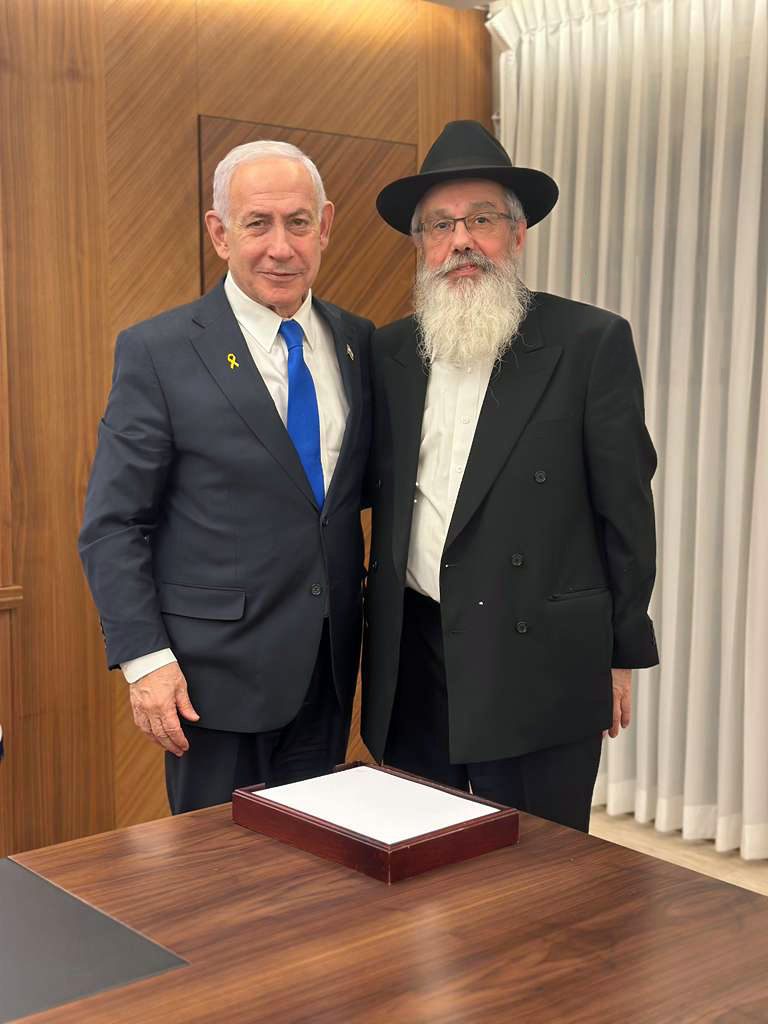
It happened at a Sunday dollar-distribution, on Rosh Chodesh Kislev 5751. On that day, within a gap of roughly half an hour, I had the merit to present two personal friends, prominent Israeli public figures, to the Rebbe: the then-Mayor of Ariel, Ron Nachman a’h; and Binyamin (Bibi) Netanyahu, who at the time served as Deputy Foreign Minister.
I stood close to both of them and clearly heard the exchanges. The difference between the messages the Rebbe conveyed to each of them was striking, and left me with a deep sense of confusion.
To Ron Nachman, the Rebbe spoke clear political and security matters. The Rebbe told him that Iran and Syria were more dangerous than Saddam Hussein (who was then at the center of the Gulf War), and that they hated America even more than they hated Eretz Yisrael.
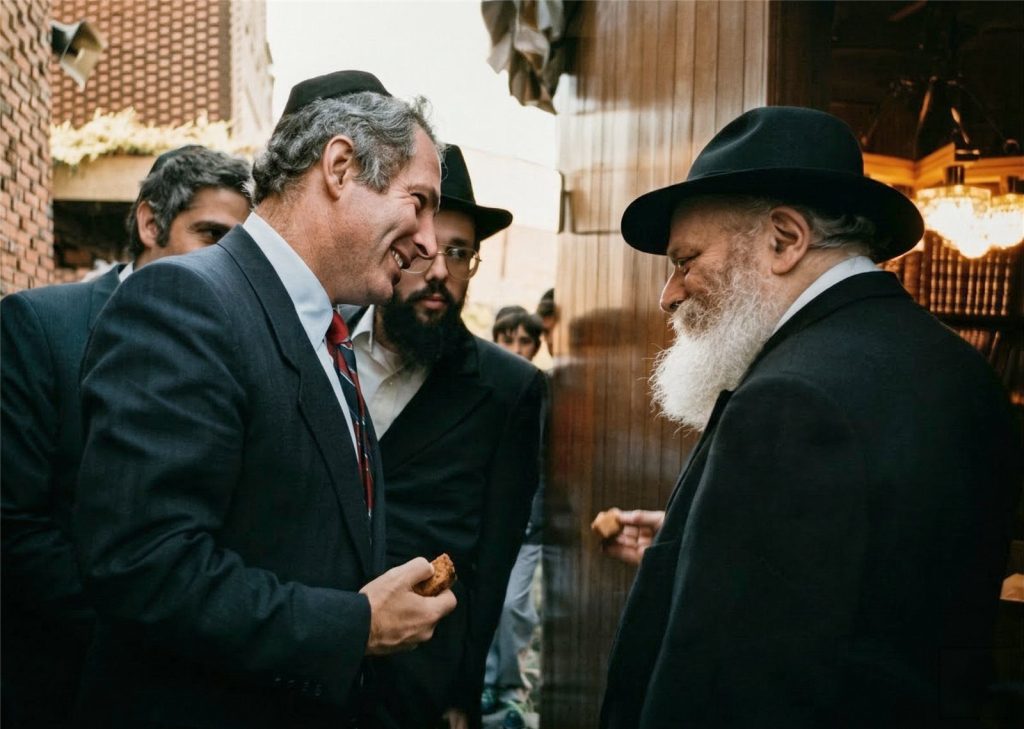
Half an hour later, Binyamin Netanyahu stood before the Rebbe. The Rebbe turned to him and said: “Since we last met, several matters have been added – what there was then, and also now that Moshiach still has not come – you should do something to hasten his coming.”
Netanyahu responded: “We’re working on it, we’re working on it…” and the Rebbe pressed further: “Apparently it’s not enough, since today already has several hours and he still has not come – but there are still a few more hours, so one must make the effort even today.”
At the time, I asked myself: if the Iranian threat is so urgent and critical, why doesn’t the Rebbe speak about this with Netanyahu as well? After all, he is an unparalleled communicator – the most fitting person to amplify the message! And yet, with Netanyahu specifically, the Rebbe chose to speak about Moshiach, a topic not particularly associated with him.
With the Rebbe, every word is precise. The question remained open: why Moshiach?
Last week, it suddenly clicked for me. It happened after I heard Netanyahu’s speech at the press conference, in which he said in the context of the current war: “This is our opportunity, this is the opportunity that Hashem has given us to return to our land… and in the end, we all say, we will reach rest and inheritance, we will reach the days of Moshiach…”
Suddenly everything became completely clear to me. The Rebbe did not change the subject when speaking with Bibi. The Rebbe simply was looking at a far longer range of time.
As we mentioned earlier, the wars of Moshiach are closely connected to the war against the “King of Persia” – that is Iran, the greatest enemy of Hashem and of the Jewish people. The Rebbe knew that the one who would need to carry out this war against Amalek would be Netanyahu.
The Rebbe was essentially telling him: “Listen, you have work to do. You will need to destroy Amalek and take an active part in the war of Geula.” When the Rebbe spoke with him about Moshiach, he was in effect charging him with the supreme mission that encompasses the war against Iran and the entire axis of evil. Netanyahu answered the Rebbe “we’re working on it,” and the Rebbe replied that “apparently it is not enough, since today several hours already passed and he still has not come.”
Today, as we see him deep in the campaign, leading the war against that Persian “Amalek,” we understand that this is precisely the action of “bringing the Moshiach” that the Rebbe spoke about. It took me decades to understand the connection, but now the picture comes together into one wondrous and precise tapestry. Even then, the Rebbe hinted that Netanyahu was chosen by him to take an active part in the mission of the Rebbe MH’M among the nations, and to carry out the erasure of Amalek.
Rare Closeness: From the Rebbe to Binyamin Netanyahu
Over the years, you have been an intermediary for transmitting the Rebbe’s messages to Prime Minister Binyamin Netanyahu. The connection began when he was still Israel’s ambassador to the UN. As someone who has known him so closely for so many years, how do you perceive this relationship today?
Indeed, from Netanyahu’s very first meeting with the Rebbe on Simchas Torah 5745 – through my friend Rabbi Shmarya Harel, who was the Operations Officer of Chabad’s Mitzva Tanks, and had previously served under Netanyahu in the Sayeret Matkal – I had the merit to bring him and accompany him at all his meetings with the Rebbe, and also to serve as the Rebbe’s liaison to him.
Here is how events unfolded:
On Hoshana Rabba 5745, we traveled to his office at the Israeli UN Mission and invited him to come to the Hakafos of Simchas Torah with the Rebbe, as I knew that ambassadors had attended in previous years. He arrived between the farbrengen and the Hakafos, and Rabbi Shmarya waited for him outside as we had arranged, and brought him to the Rebbe’s platform where I was waiting. When the Rebbe arrived, I introduced him. The Rebbe received him with a broad smile and signaled to Rabbi Groner to give us l’chaim. Cups were brought and we said l’chaim, and then the Rebbe began a very long conversation with him – lasting more than forty minutes!
After Simchas Torah, Netanyahu called me to his office and brought me two sets of the books he had written – one set for the Rebbe with a special personal inscription in each book, and a second set for me.
During those years, I met with him many times at his office where I put on tefillin with him, and we also met several times at the UN. He also participated in lectures for friends of the Mitzva Tanks in America, where he would speak with admiration about the important contribution of Chabad’s Mitzva Tanks to the morale of IDF soldiers.
At the beginning of 5748, Netanyahu was set to complete his role at the UN and return to Israel. I brought him to the Rebbe on Hoshana Rabba, and to his great surprise, the Rebbe was not pleased with his plans to return. When Netanyahu told the Rebbe, “I am preparing to return to Israel soon, to fight for things there and try to make an impact” – the Rebbe said: “But there is still much to influence from here” (from the UN).
Netanyahu tried to say that “one can also fight from Eretz Yisrael. It’s important to ensure there are good replacements” (for the UN position). But the Rebbe continued: “There is no one to rely on.”
When Netanyahu said “there are a few good candidates,” the Rebbe said: “That is doubtful, and doubt cannot override certainty. You know that at the UN there is the issue of the ‘Seven Noahide Laws.’”
Netanyahu responded affirmatively, and the Rebbe continued: “This is a Jew’s mitzva – to influence the nations, and that is a role that must be fulfilled.”
Netanyahu tried to shift direction and said: “I have not forgotten our first meeting. I acted according to what you told me – to stand proud and strong. It was engraved in me and I acted accordingly.” But the Rebbe continued to press Netanyahu to remain at the UN: “You certainly know that Binyamin was the only son among the twelve tribes who was born in Eretz Yisrael. He later influenced the nations with firmness and pride.”
When Netanyahu hinted that he felt he had exhausted his role in America: “I have been serving here for five years already,” the Rebbe concluded by saying: “You can continue to serve from here until Moshiach Tzidkeinu.”
Netanyahu remained in New York for a few more months, until the month of Adar, then informed me of his plans to return to Israel and run on the Likud list, and asked for our help. When I told him we could not help him against the Rebbe’s wish that he remain at the UN – he said his original plan had been to leave immediately after Tishrei, and in light of the Rebbe’s words he had extended his stay as long as possible, but now Foreign Ministry procedures did not allow him to remain in New York any longer.
I wrote to the Rebbe about this, asking whether to press Netanyahu and persuade him to fight the decision and remain at the UN per the Rebbe’s words, or to help him get elected. The Rebbe’s response was not to press him further on this matter, and to assist him.
Toward Pesach 5748, in the midst of the First Intifada, Netanyahu traveled to Israel as part of his preparations to run on the Likud list. He called a press conference and sharply criticized the military and political establishment for not suppressing the Arab uprising. His first public statement was that stone-throwers should be shot to be killed, and this was widely covered in the press.
When the Rebbe received the newspaper, the following response came on the 25th of Nissan: “For Ambassador Binyamin Netanyahu – I was pleased upon reading in the press the criticism of his first declaration upon returning to the Holy Land, and how his declaration ‘penetrated’ (judging by the reactions). I will mention [him] at the gravesite.”
Beis Moshiach #1502 • pp. 12-21, 31
© 2026 Beis Moshiach Magazine. All rights reserved.
This article originally appeared in Beis Moshiach #1502. You are welcome to share it with friends and family by email or in print, provided that you do not change, add to or omit any part of it, you credit the author and Beis Moshiach, and you include a link to archive.bmoshiach.org (written out in full in printed copies).
To republish this article in a newspaper, magazine, book or website, please request permission in advance at [email protected].