When Bibi Left the UN…
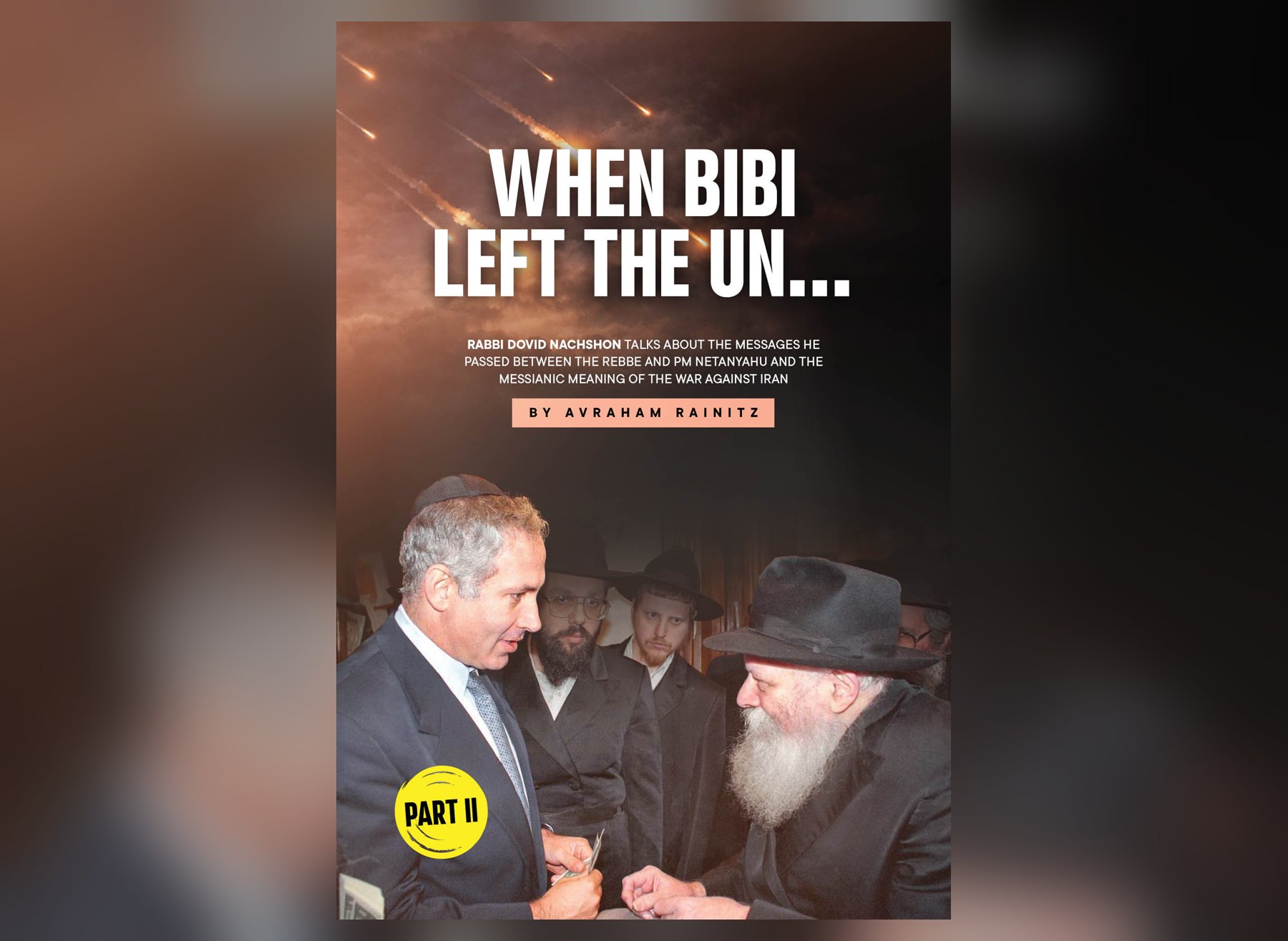
Rabbi Dovid Nachshon talks about the messages he passed between the Rebbe and PM Netanyahu and the Messianic meaning of the war against Iran
A Channel for the Rebbe’s Messages
I heard that shortly after Rabbi Groner relayed this response to the Tanks’ offices in New York to be passed on to Netanyahu – Rabbi Groner called the office manager, Rabbi Akiva Marshall, and said the Rebbe had requested that “specifically David Nachshon deliver the message to Netanyahu.” Why specifically you?
Rabbi Nachshon: We do not know “daas elyon,” but on the human level at least, I see that the inner bond that formed between us and our style of communication allows me to transmit the Rebbe’s messages as they are, without “prettifying” or “cutting corners.”
In relationships between Chassidic activists and politicians, the activists often try to “tailor” things for the politicians who don’t understand what a Rebbe is. Our relationship is of a different kind – more of a close personal bond.
Let me tell you a small story that illustrates this: Once we met in Kyiv. I went to his room for a meeting that was supposed to take five minutes, and in the end we sat for a full hour! When I came out, his entire staff was waiting for him with suitcases in hand, under pressure to leave. They asked him in amazement: “What is this? You hold up your friend like that?” Netanyahu answered them immediately: “He is not my friend, he is my brother.” That is how he defined our relationship.
Following the Rebbe’s instruction that I deliver the response to Netanyahu, and in continuation of the Rebbe’s response to help him in his new role in Israel – I decided to fly to New York to meet with him and bring him to the Rebbe to receive a bracha for the road.
On Beis Iyar 5748, I arrived with Netanyahu at the dollar distribution at the Rebbe’s home on President Street, and the Rebbe began by saying: “I had great nachas from your speech, the first one, and yehi ratzon that you continue in this vein… This is the best approach, so that there will be no need for matters of war and the like.”
Netanyahu responded to the Rebbe: “I thank you for the opportunities you have given me to come and benefit from you, to receive the great spiritual support you give me – not only to me, but to all Am Yisrael.”
The Rebbe said to him: “I am still at the beginning of my work. You too are at the beginning of your last role… You will need to contend with one hundred and nineteen people. Certainly you will not be intimidated by this, since Hashem is on this side. Blessing and success in Hashem’s mission. Blessing and success.”
Before he left New York for Israel, Netanyahu wrote the Rebbe a thank-you letter for the great moral encouragement he had given him throughout the years of his service at the UN: “Our meetings have always served me as a great source of spiritual inspiration, and your unequivocal support for our right to Eretz Yisrael stood before me many times, especially in the most difficult hours.” In the same letter, Netanyahu noted: “I was also glad for the opportunity given to me to assist my good friends, David Nachshon, Shmarya Harel, and Akiva Marshall, in their tireless activities on behalf of Chabad’s ‘Operation Tanks,’ which reach IDF soldiers standing on the front line.”
Following the Rebbe’s aforementioned response to help Netanyahu in Israel – I enlisted my friend and partner in countless missions, R’ Avi Taub a’h. He and his father were members of the Likud Central Committee, before his father’s drawing close to Chabad, and they were able to exert significant influence in Netanyahu’s favor – obviously not in the name of Chabad. And indeed, in the first elections where the Likud’s list of candidates was determined, Binyamin Netanyahu was selected in first place.
In those days, the Likud’s election method was such that after choosing the candidates, additional elections were held to assign the elected candidates to viable spots on the Likud list. This was called the “quintets.” Netanyahu put forward his candidacy for fifth place in the first quintet. When I reported this to the Rebbe, Rabbi Groner called me and said the Rebbe had asked: “Why not number one?”
Netanyahu did not want to harm Moshe Arens, who had put himself forward for second or third place in the first quintet. And in the end, he was indeed elected to fifth place in the first quintet.
How do you use this “familial” closeness to convey to Netanyahu the Rebbe’s Chassidishe and political messages?
Rabbi Nachshon: “When I speak with him, we speak with total openness. I always remind him of who placed me there. On one occasion I said to him: ‘Bibi, beyond the fact that we are brothers, you know – the Rebbe apparently placed me as a ‘channel’ to transmit his message to you.’
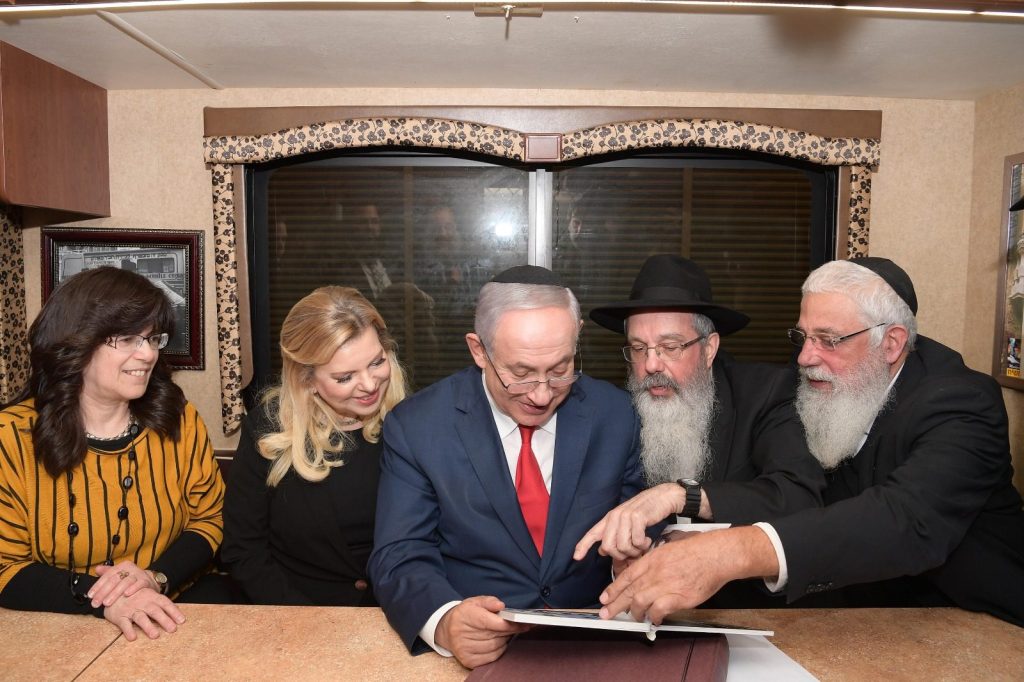
About three years ago, after four exhausting election campaigns in which he nearly managed to return to power but something always went wrong at the last moment – I sat with him and said: ‘Look at what is happening here. You are always close to forming a government and not succeeding. How do you explain this? If you believe there is a spiritual force at work here – you understand that there is Someone managing these events!’
I told him that in light of the Rebbe’s words that he would fight whoever spoke with the Arabs about surrendering parts of Eretz Yisrael – I believe the root of his problems lay in the Bar-Ilan speech, in which he spoke about two states for two peoples.
Netanyahu immediately responded: “You know I didn’t mean it that way…”
I told him that although I believe and know he did not intend to implement those words, and said them only as lip service – the Rebbe had made clear on several occasions that the very act of speaking about it causes the Arabs to raise their heads, and poses a direct danger to the Jewish people. I reminded him of the Rebbe’s words to Mr. Moshe Katsav, that if Shamir continued talking with the Arabs the Rebbe himself would fight against him. At the time, Netanyahu’s father, my friend Professor Benzion Netanyahu a’h, had asked me to meet with his son and read him the Rebbe’s sharp words…
I also told him that during the Oslo Accords period, I met in the Knesset with MK Rabbi Avraham Shapira a’h, who told me he had the previous evening met with the Gerrer Rebbe, the Pnei Menachem, regarding the vote on the Oslo Accords. The Gerrer Rebbe told him that in 5738, when the Rebbe cried out against Begin’s talk of autonomy – he had asked the Rebbe: “But Begin does not intend to implement it; he will never give the Arabs autonomy – why does the Rebbe speak so forcefully against him?” The Rebbe answered: “Begin indeed will not implement it, but what if in 15–16 years another prime minister arises and implements everything Begin spoke about?” Shapira related that the Gerrer Rebbe repeated these words with amazement at the Rebbe’s clear prophetic vision!
In summary, I told Netanyahu that I have no doubt that if he renounces the speech, he will be elected Prime Minister as the Rebbe blessed him – “may he lengthen his days upon his kingdom.”
Netanyahu understood this and told me he would find a way to clarify his position. And indeed, since then on several occasions he returned to say that the idea of two states and the like is not on the table and no longer exists, and was never his intention to begin with. Not much time passed, and in the next elections he received the Prime Ministership, with a stable government that is functioning to this day, and will apparently be the first government in many years to complete its term – with the hope that even before then we will merit the revelation of the Rebbe MH’M!
The Message Netanyahu Took from the Rebbe to His Meeting with Trump
How does Netanyahu regard the Rebbe’s words today? Does he understand that this is a “Navi HaDor” whose voice must be heeded?
Rabbi Nachshon: Absolutely. He holds the Rebbe as a wondrous figure, above and beyond any spiritual figure he knows. In our conversations over the years, we have discussed the central issue – that “the Rebbe is a prophet.” Once, in one of our conversations, I said to him: “The Rebbe is not just another important rabbi you come to, receive a blessing from, and leave. They are all important and good rabbanim, but here you are talking about something entirely different! The Rebbe is a Navi!”
And the words sink in. In our conversations, he speaks about the Rebbe in terms of a supreme prophet, like one of the prophets of the early generations.
In a press interview about his connections with the Rebbe, when asked to describe the Rebbe’s character, he chose these words: “I see the Rebbe as a contemporary prophet.”
Also recently, when Argentine President Javier Milei presented Netanyahu with a special painting of his meeting with the Rebbe, you can see in a video from that occasion that President Milei said he incorporates the Rebbe’s words in his speeches, and Netanyahu responded with emotion: “He truly is a prophet.”
When I hear Netanyahu express himself this way even before world leaders – it is clear to me that in his eyes, the words he heard from the Rebbe are not the words of ordinary flesh and blood, but of a true prophet whose every word is fulfilled.
If I may ask: did you meet with him recently, close to the outbreak of the war, and what did you discuss?
Rabbi Nachshon: Yes, this past winter, before one of his crucial flights to a meeting with Trump – it is now known that at that meeting the war with Iran was finalized – I met with him and asked to show him a video with the Rebbe’s message to Elyakim Rubinstein.
Rubinstein had traveled with Shamir to meet with President Bush, and the Rebbe said to him: “You are his advisor, so advise him – if one wishes to achieve something in the United States, one must show firmness of position and that one does not intend to make concessions. Not to anger them, but because otherwise it simply cannot work! One cannot demand of Eretz Yisrael to do something that is the opposite of its vitality and existence.”
When Rubinstein argued that this was indeed what Shamir was expected to do, the Rebbe clarified that until now they had not acted that way, but had “held to the line that one must concede – not on something minor but on fundamental matters, in exchange for which they would receive something.” The Rebbe said this was “the opposite of the nature of the United States. The United States was founded and sustained by standing firm that what is vital to them cannot be conceded. There is no choice, even when England stood against them and France stood against them – as the whole world was then against the United States – and because they held to this line, they succeeded and continue to succeed to this day.”
Netanyahu sat, watched the video with great attention (even though he had very little free time), and nodded throughout, saying: “He’s right, he’s right.” He knows that the Rebbe’s formula – to light a candle in the “House of Lies” and not to fold under international pressure – is the only winning formula that works. He also asked at the end of our meeting that I send him the video.
I am certain he used these words of the Rebbe in his meeting with Trump, who indeed entered the war with Iran with full force, and speaks openly about the fact that Iran threatens the United States no less than it threatens Israel – and therefore its military power must be completely dismantled.
From your personal acquaintance with him, do you think he is truly navigating today according to the Rebbe’s compass?
Rabbi Nachshon: In my opinion, he is acting very well today. He has stopped being swayed by the background noise around him; he is focused and doing the right thing.
It seems to me that beyond the great military victories, he sees the miracles and wonders of Hashem – “Who alone does great wonders” – and understands that this is not “my strength and the power of my hand,” but the hand of the Creator directing the campaign. And indeed, in recent years he has been careful to mention “b’ezras Hashem” and the like in all his speeches.
If I were sitting with him now in a one-on-one meeting, I would say only one thing: keep going! Keep emphasizing Hashem proudly in every speech, and as you are accustomed to saying, that the one who strengthens you is the prophet of the generation, the Rebbe of Lubavitch. When you convey “and they believed in Hashem and in Moshe His servant” – no international pressure can move you.
Internalizing: We Stand on the Verge of the Hisgalus of the Rebbe, Melech Moshiach!
From all these lofty ideas – what is the practical instruction for every Chassid in the face of all the threats outside?
Rabbi Nachshon: First of all, let us make a good resolution to add to the learning of inyanei Geula and Moshiach, because this is the direct way to bringing the hisgalus.
Let us go out on the Rebbe’s holy mivtzaim, imbued with the main point – preparing the world to welcome Moshiach Tzidkeinu, including of course the activity of bringing about the kabbolas ha’malchus by the people.
In addition, it is very important to raise the level of joy, and to strengthen emuna and bitachon that “the Guardian of Israel neither slumbers nor sleeps.” The Rebbe demands of us to be happy. Joy breaks through boundaries; joy sweetens harsh judgments. When the world trembles, a Chassid must radiate absolute confidence.
Do yourselves a favor: close the radio and turn off the news. Open the Dvar Malchus instead. When the mind is immersed in the words of the Navi, fear simply evaporates.
I suggest that everyone study the Rebbe’s letter from the 25th of Adar 5751 (the birthday of Rebbetzin Chaya Mushka a’h) and the Rebbe’s sicha in yechidus to guests from 26 Nissan 5751. The Rebbe’s words in that letter and sicha encourage and illustrate the miracles and wonders, and the connection to the Geula Shleima.
And how does one prepare on a personal level for the hisgalus?
Rabbi Nachshon: When we see the miracles and wonders, and are moved by the “erasure of Amalek” – Iran – we must not stop there. We must think about “the day after,” which is the day of the revelation of the Rebbe. And this is precisely the point! We must internalize that today, perhaps tomorrow morning, we are going to pass before the Rebbe. The Rebbe will look at us face to face and ask: “Nu, what did you do today to bring Moshiach? How did you prepare?”
Whoever lives with such awareness cannot remain on “autopilot.” He cannot be satisfied with the fact that “there was an amazing miracle against Iran.” The miracle is only the backdrop that Hashem is setting. The main thing is that the Rebbe is already here, and we must be keilim to receive him.
We must remember the closing words of the Yalkut Shimoni. The Holy One, Blessed be He, stands and cries out to us: “My children, do not fear… Everything I have done, I have done only for your sake… The time of your redemption has arrived!” Moshiach has already suffered the tribulations on our behalf, the Rebbe has done all the work, and reality cries out Geula.
The time has come to open our eyes, and may we merit to see the Rebbe reveal himself to us b’poel mamosh – completing the erasure of Amalek, bringing down the third Mikdash from Heaven, and gathering all the scattered of Israel to the Holy Land – immediately and without delay, Amen!
Beis Moshiach #1503 • pp. 12-17
© 2026 Beis Moshiach Magazine. All rights reserved.
This article originally appeared in Beis Moshiach #1503. You are welcome to share it with friends and family by email or in print, provided that you do not change, add to or omit any part of it, you credit the author and Beis Moshiach, and you include a link to archive.bmoshiach.org (written out in full in printed copies).
To republish this article in a newspaper, magazine, book or website, please request permission in advance at [email protected].