The Flags, the Forecast, and the Lifetime Translator
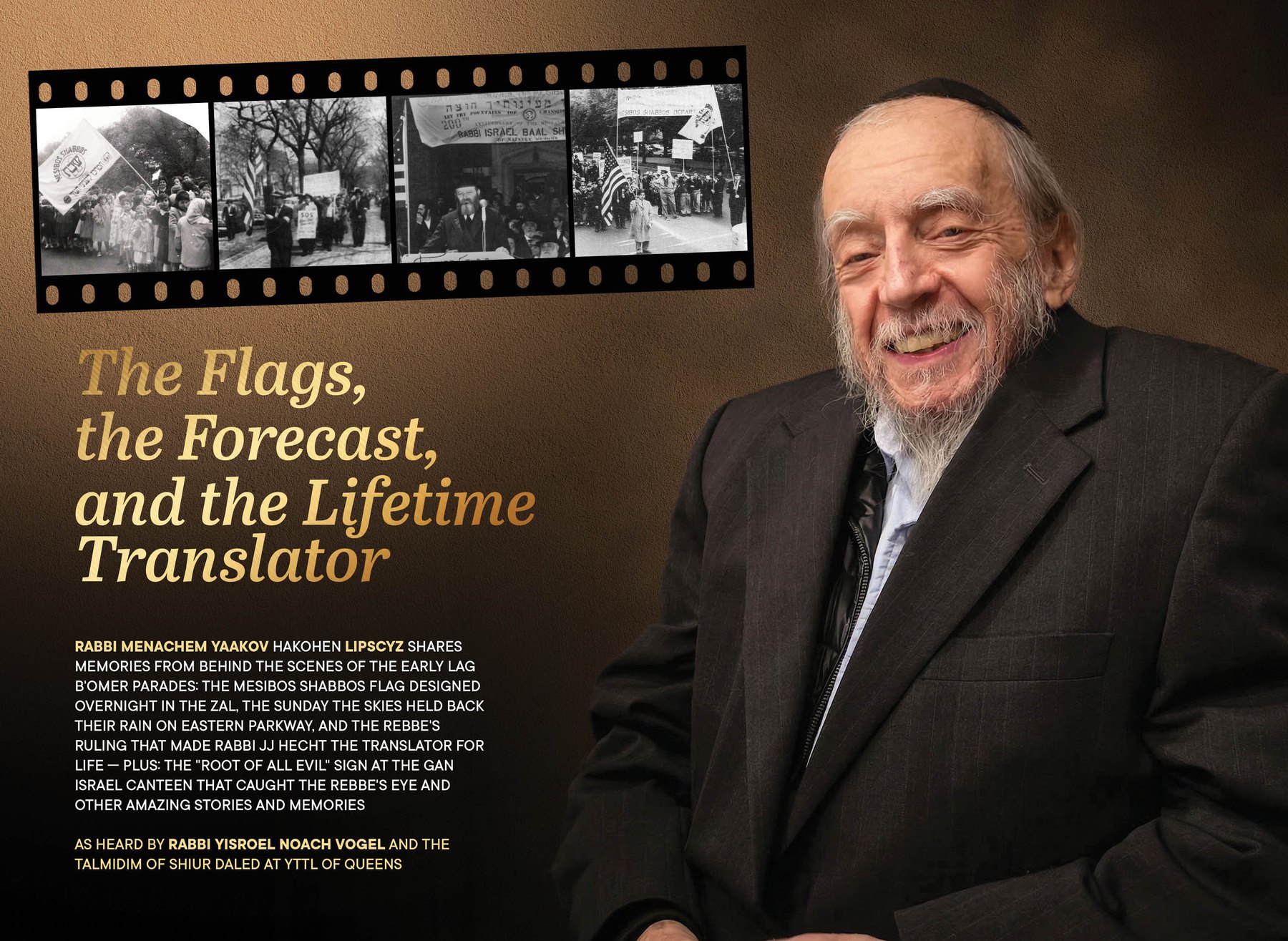
Rabbi Menachem Yaakov HaKohen Lipscyz shares memories from behind the scenes of the early Lag B’Omer parades: the Mesibos Shabbos flag designed overnight in the Zal, the Sunday the skies held back their rain on Eastern Parkway, and the Rebbe’s ruling that made Rabbi JJ Hecht the translator for life – plus: the “Root of All Evil” sign at the Gan Israel canteen that caught the Rebbe’s eye and other amazing stories and memories
The early childhood years of Rabbi Menachem Yaakov HaKohen Lipszyc were spent in distant South Carolina, where his family had emigrated following the directive of the Rebbe Rayatz. However, a Chassidic family like the Lipszyc family could not remain disconnected from the spiritual center for long. The longing for a Torah education tipped the scale.
When Menachem Yaakov reached bar mitzva age, on 4 Kislev 5710, the young bar mitzva boy merited a yechidus with the Rebbe Rayatz, even receiving his bracha. This was his first yechidus, and certainly one of the last opportunities, as just two months later, on the 10th of Shevat 5710, the Rebbe Rayatz passed away.
After his bar mitzva, young Menachem Yaakov began to learn in Lubavitch institutions. He learned in Tomchei Tmimim, which at that time was located on Bedford Avenue in Brooklyn – two years in the upper classes of the yeshiva ketana (mesivta), and afterward in the yeshiva gedola.
In those years, students from the Bedford yeshiva almost never went in for yechidus with the Rebbe. “From the yeshiva on Bedford Avenue, people simply didn’t go to yechidus, at least not in those days,” he recalls.
Around the year 5717, when he was 18–19 years old, R’ Menachem Yaakov crossed the threshold of “Beis Chayeinu” and became a full-fledged tamim in the big zal of 770. From that moment, the door opened before him – into the Rebbe’s private room for yechidus.
The Pidyon That Was Read “From the End to the Beginning”
Like all the bachurim who learned int 770 in those years, R’ Menachem Yaakov had a fixed schedule for yechidus: every year, before his birthday, he would enter for a private audience – first as a bachur, and over the years, together with his wife and children.
For him, the moments of yechidus were accompanied by immense awe, sometimes to the point of trembling. “As I remember it,” he describes with a smile, “it took me more time to walk from the door to the Rebbe’s desk, hand over the pidyon, and then walk back – than the time the Rebbe actually spent blessing me…”
He noticed a remarkable detail in the Rebbe’s manner of handling the pidyon nefesh. The Rebbe would hold the note, roll it between two fingers, and after reading it from beginning to end, would roll it back and respond from the end to the beginning. “The Rebbe would begin answering from the last question written at the bottom, and then move upward.”
Unlike many Chassidim who would lay out before the Rebbe weighty questions, business dilemmas, or detailed shidduchim suggestions, his notes were short, general, and remarkably concise. He never asked specific questions. His standard wording was simple: “On such-and-such a date is my birthday, and I request a bracha from the Rebbe,” followed by his signature. Thus, the brachos he received were usually general birthday blessings. “Presumably, you will conduct yourself according to the customs associated with a birthday,” the Rebbe would instruct him and bless him.
Over the years, R’ Menachem Yaakov entered yechidus several times with members of his family. He would hear from friends and acquaintances moving stories about how the Rebbe gave special attention to small children – asking them questions in their studies suited to their level, giving them dollar coins, and greeting them warmly.
“Personally – and I don’t know for certain why – since I didn’t ask questions (both because I didn’t dare to ask, and also because I didn’t want to receive assignments I wasn’t sure I could fulfill), perhaps that is why this never happened with my children,” he says honestly. “I entered yechidus with my children many times over the years. The Rebbe never asked them questions or gave them gifts. He would read my note, give me the birthday blessing, and that was it – we left in awe.”
But in one particular year, an unusual and unforgettable event occurred, leaving a deep impression on him.
“As always, I entered with my family and handed in my regular note,” he recounts. “The Rebbe read it and gave his blessing. We went out the door. I didn’t even notice, but my wife, with her keen intuition, turned to me immediately in the hallway and said with concern: ‘Did you notice? The Rebbe didn’t give a bracha to our children!’”
In previous years, although the Rebbe did not speak with them, a general blessing would still be given. That year – silence.
The concern proved prophetic. R’ Menachem Yaakov concludes the story with a chilling line: “That was the year my daughter, Toby, was burned on her hands…” The Rebbe’s eyes saw the impending decree, and the heavy silence in the room was a sign of what was to come.
His Regular Spot Behind the Rebbe
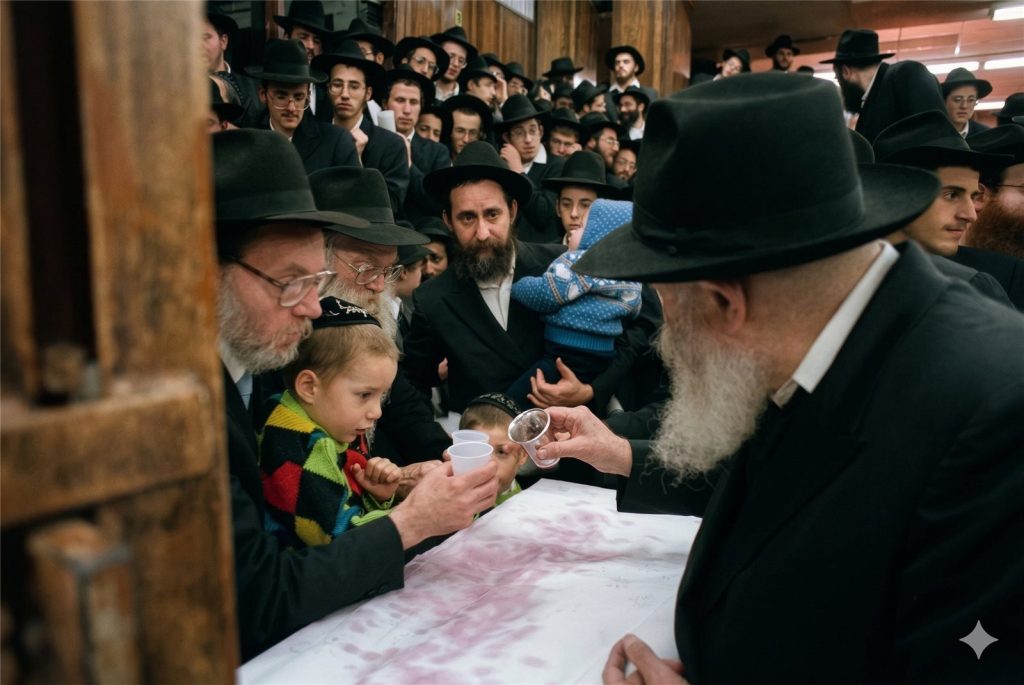
Anyone who merited to participate in the great farbrengens in 770 knows that securing a place around the Rebbe’s platform was no simple matter – especially during the distribution of “kos shel bracha” at the conclusion of Yomim Tovim, when thousands of Chassidim passed by in a steady flow to receive a drop of wine from the Rebbe’s cup.
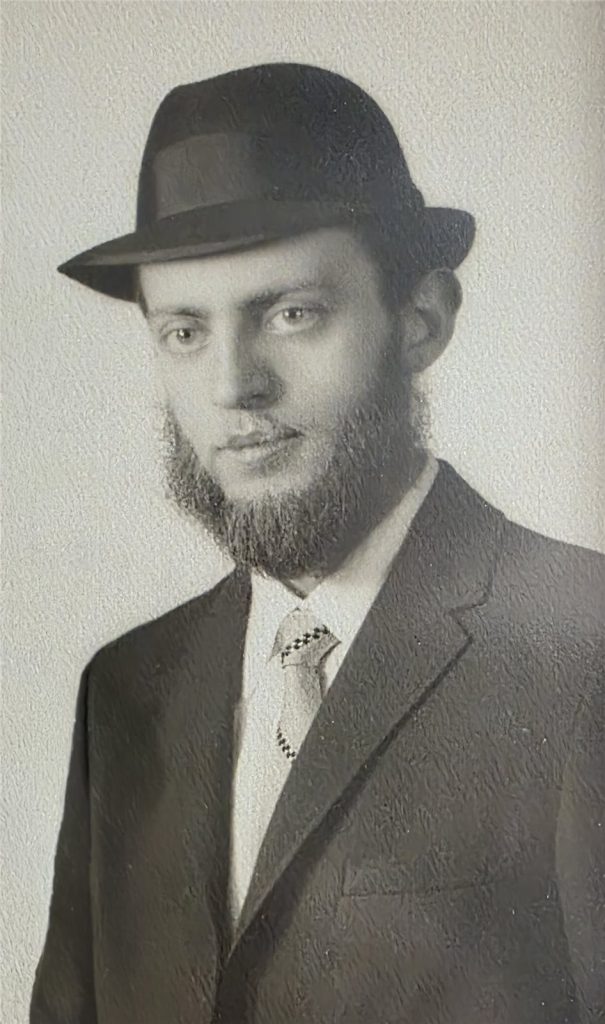
And yet, R’ Menachem Yaakov Lipszyc had a uniquely fixed place – he stood directly behind the Rebbe. How did a young man reach such a strategic position? The story begins with the respect he showed to the elder Chassidim:
Behind the Rebbe’s chair were places reserved for the elders and distinguished members of the community. One of those places was reserved especially for the rosh yeshiva of the central Tomchei Tmimim, the gaon and Chassid Rabbi Mordechai Mentlick a’h. His role during the distribution of “kos shel bracha” was to pour wine into the Rebbe’s cup throughout the long hours.
Standing for long periods and waiting before the Rebbe entered the Beis Medrash became difficult for him. In the crowded shul, an empty place – even if reserved – was a great temptation for anyone hoping to see and hear. Here is where R’ Menachem Yaakov entered the picture.
“I used the excuse of guarding his place as an opportunity,” he recalls with a smile of positive Chassidishe chutzpa. “I would come early, wait at Rabbi Mentlick’s reserved place, and guard it carefully until he arrived. The moment the Rebbe came in, I would vacate the place for him – but remain standing right there, behind the Rebbe.”
This location had a tremendous advantage beyond simply being physically close. “From there, I could hear every word,” he explains. “From any other place, it wasn’t always possible. At a farbrengen, if you didn’t hear the entire flow continuously, you lost the thread – you simply couldn’t go back and understand what was being discussed now.”
Easing the Burden on the Rebbe
R’ Menachem Yaakov didn’t just secure a good spot – he used his proximity to notice small details. During those long hours of distributing “kos shel bracha,” many fathers approached the Rebbe holding their young children. The sight was moving, but logistically complicated.
“More than once you would see a father approaching with two small children in his arms,” he describes. “He’s holding both children, and they are trying to hold their little cups. The father is struggling, one child holds the cup upside down… Then the Rebbe’s secretary, Rabbi Leibel Groner, would have to bend from the other side of the father to turn the child’s cup to the correct angle so the Rebbe could pour the wine safely.”
“I saw that it was becoming difficult for everyone, and especially that it made things harder for the Rebbe,” he says.
Instead of waiting for the confusion to unfold, he would take preemptive measures. Watching the fathers approaching in line, he would go up to them before they reached the Rebbe and whisper with his typical Ahavas Yisrael: “Listen, let me help you – would you prefer that I hold the child, or the cups?”
The Rebbe Saw the Sign – and Responded
The year 5716 was etched in golden letters in the history of Chabad chinuch in the United States. That year, at the initiative of the Merkos L’Inyonei Chinuch and with the Rebbe’s close and detailed encouragement, the summer camp “Gan Israel” was founded. Its goal was to provide a pure Chassidishe chinuch even during vacation, and to bring in children from non-observant homes into an atmosphere filled with holiness.
The organizers of the camp – then young students Rabbi Moshe Lazar and Rabbi Yossi Weinbaum, together with Rabbi Kehos Weiss – rented land in Ellenville (near Ferndale) for the first year. R’ Menachem Yaakov’s younger brothers were there even before the official opening and received direct instructions from the Rebbe. He himself later joined the camp staff when it moved to Swan Lake. He was in charge of two popular attractions: the arts and crafts room, and the camp canteen.
The canteen was set up in a structure that was originally a garage, with a split door. He would open only the top half, creating a service counter, with himself inside and the goods behind him. To attract the children and contribute toward the fun atmosphere, he made two large, creative signs which he hung up on either side of the door.
The first addressed a practical issue: in those days, drinks came in glass bottles that had to be returned. He set up milk crates (with square holes) and wrote a sign that challenged the boys: “Test your IQ: Put the round bottles into the square holes!”
The gimmick worked and the children returned the bottles where they belonged.
The second sign was more philosophical which used a common saying: “Money is the root of all evil – leave your evil here.”
The point, of course, was to encourage the campers to buy snacks, with a smile.
Throughout the years of the camp, it received three historic and rare visits from the Rebbe (in the years 5716, 5717, and 5720). For the Rebbe, who did not typically travel outside the boundaries of New York City, these visits illustrated more than anything his famous statement that “the camp is part of 770” and that it is like “an anvil on which Chassidim are forged.”
In the year 5717, during one of those uplifting visits to Swan Lake, the Rebbe toured the grounds of the camp. The Rebbe’s entourage approached the canteen. Accompanying him were the camp’s directors and founders: R’ Kehos Weiss, R’ Yossi Weinbaum, and R’ Moshe Lazar. The Rebbe walked at a relaxed pace, arrived in front of the half-window of the kiosk, and peered inside at the shelves stocked with candies and drinks. But the eyes of the leader of the generation were not searching for physical sweets. The Rebbe scanned the shelves and directed a pointed question in Yiddish: “Vu zeinen di sefarim?” (“Where are the books?”) Even in a kiosk selling 5-cent chocolate bars to young boys, the Rebbe wanted to see Jewish books.
After remarking on the absence of books, the Rebbe continued his tour. He noticed a sign that read “Money is the root of all evil” – and stopped to read it. R’ Menachem Yaakov, who was standing inside, saw the Rebbe pause before the sign, turn around, and exchange a few words with the camp directors accompanying him.
Shortly afterward, R’ Menachem Yaakov approached R’ Moshe Lazar. “I saw the Rebbe stop to read the sign,” he said curiously. “What did he say about it?” R’ Moshe told him that the Rebbe’s reaction was: “The source of all evil?!” – and added: “Check the source of that.”
In those days, far from any urban environment and long before the age of the internet, he had no way to look up sources. The saying had seemed to him like a piece of folk wisdom and nothing more. But when the summer ended and he returned to New York, his curiosity would not leave him alone. He hurried to the public library, pulled out a thick book of quotes and proverbs, and searched for the origin of the expression “root of all evil.”
What he discovered there left him stunned: the saying (whose precise original form is “the love of money is the root of all evil”) originates from none other than the New Testament, attributed to – “oso ha’ish – rachmana litzlan.
Only then did the young R’ Menachem Yaakov understand the Rebbe’s remark. A sentence that seemed to everyone like an innocent and lighthearted quip had immediately grated on the Rebbe, for he knew the spiritual impurity concealed behind the words.
Behind the Scenes of the ‘Mesibos Shabbos’ Organization
To understand the depth of the young R’ Lipszyc’s connection to the heart of Chabad activity in those years, we must go behind the scenes of one of the most important educational projects of the era: the Mesibos Shabbos organization.
This organization was founded in the year 5702, at the initiative of the Rebbe Rayatz, with the aim of gathering Jewish children – especially those who had not received a Torah education – on Shabbos afternoons. Volunteers would tell them stories of tzaddikim, teach them basic concepts of Judaism, and distribute candies.
R’ Menachem Yaakov was deeply involved in this activity. He personally ran a branch of Mesibos Shabbos for boys in a large shul on Strauss Street in the nearby Brownsville neighborhood. But beyond the fieldwork, he also worked in the “back office” of the organization – a tiny, cramped office in the basement of the bachurim’s dormitory at 676 Eastern Parkway.
By virtue of his role in the office, he was exposed to an astounding fact that illustrated the Rebbe’s close involvement: the Rebbe read every letter and every report sent to “Mesibos Shabbos”!
“All the mail addressed to 770,” he recalls the original organizational procedures at the secretariat, “would arrive at the office of the Merkos L’Inyonei Chinuch, which was located in one of the front corners of the 770 building. There, the mail was divided into three main piles: one pile for the yeshiva bachurim who used the 770 address for personal letters; a second pile for Yeshiva Tomchei Tmimim, which the Rebbe would pass along to the yeshiva administration (to Rashag); and the third pile – everything else – went straight to the Rebbe’s desk. Within that ‘everything else’ was all the mail for ‘Mesibos Shabbos.’”
“The Rebbe did not just read these letters,” attests R’ Menachem Yaakov. “Many times he would make comments on them.”
The Rebbe’s close connection to the organization’s volunteers also expressed itself in touching personal ways.
In the parallel branch where he operated in Brownsville, there was a special Mesibas Shabbos for girls, run devotedly by the wife of a local doctor named Dr. Block (not the Block family known from Crown Heights). She saw R’ Menachem Yaakov every Shabbos, and they became close family friends. Mrs. Block herself was very connected to the Rebbe and wrote him letters frequently.
“One day,” he recounts, “I was sitting in the zal absorbed in learning. Suddenly, the secretary Rabbi Binyamin Klein approached me and called me outside. This was a very rare thing – ordinarily, a bachur would not be taken out in the middle of seder.
“I went out to the corridor. R’ Binyamin gave me a dime, the price of a public telephone call in those days – and told me: ‘Go call Mrs. Block and find out on behalf of the Rebbe how her granddaughter is doing.’ R’ Binyamin explicitly instructed me to go outside 770 and dial from a public phone, not to use the building’s phone.”
He went out immediately, dropped the coin in the slot, and dialed. When Mrs. Block answered, he said: “The Rebbe sent me to ask how your granddaughter is doing.”
Mrs. Block was surprised: “Everything is perfectly fine! Why are you asking?”
“Because the Rebbe wants to know,” the young Chassid explained. Then she remembered: “Oh! A while back she wasn’t feeling well, and I wrote to the Rebbe at the time to ask for a bracha…”
“Exactly,” R’ Menachem Yaakov confirmed. “And the Rebbe wanted to know what happened afterward.”
The moved Mrs. Block reported that the child had recovered completely., and he returned to 770 and relayed the reassuring report through the secretary to the Rebbe’s desk. The Rebbe’s fatherly concern for each and every one of the Mesibos Shabbos volunteers left an indelible mark on him.
But the Rebbe’s guidance was not always simple to understand, and his eyes saw far ahead – as R’ Menachem Yaakov discovered in a particularly complex episode that stirred up the little Mesibos Shabbos office.
A Rain of Miracles — Lag B’Omer 5717
The Mesibos Shabbos operation grew and expanded, but the year 5717 was marked by a truly historic breakthrough.
Until that year, Lag B’Omer gatherings had been held in the courtyard of 770 in a more modest format, and the first parade had been held in 5716. In 5717, Lag B’Omer fell on a Sunday. For the Mesibos Shabbos activists, led by R’ Berel Shemtov, this was an unprecedented golden opportunity. On Sunday, there is no school in the public schools. This meant that thousands of non-observant Jewish children could be brought right into the streets of the city – before the holy face of the Rebbe himself!
The idea was bold and demanded enormous logistical preparation. The activists wasted no time. Immediately after the Tishrei holidays, they submitted a letter to the Rebbe with the grandiose proposal to organize a massive parade for public school children on the Sunday of Lag B’Omer.
The months passed and the answer was slow to come. Cheshvan, Kislev, Teves, Shevat… Only after Purim did the long-awaited response arrive from the Rebbe. The response, which was affirmative in essence, made clear why the Rebbe had delayed granting his approval. The Rebbe was deeply concerned about the Torah study of the tmimim, who were the organization’s primary manpower. In his reply, the Rebbe wrote and emphasized – with every word underlined: “Please, please – do not disrupt the yeshiva schedule.”
“In the end, we did disrupt the yeshiva schedule a bit,” R’ Menachem Yaakov admits with a smile. “But we did so with limits, because the excitement was enormous. Understand – we were supposed to take responsibility for thousands of public school children we had no idea about, take them out of their neighborhoods by bus, all without any prior experience at this scale!”
As the great day approached, the task seemed increasingly impossible. The meteorological forecast brought bad news: a massive rainstorm was set to drench New York precisely that Sunday. Parents began calling the Mesibos Shabbos offices in a panic.
“The chances of rain on Thursday stood at 96%,” recalls R’ Menachem Yaakov, recounting the tension. “On Friday the forecast climbed to 98%, and by motzoei Shabbos the forecasters announced with absolute certainty: 99% chance of rain on Sunday! Parents asked ‘What’s going to happen?’ and we, with the self-confidence of yeshiva boys, told everyone: ‘Don’t worry, we have a contingency plan for every scenario.’ Even though it was clear we had absolutely no plan in case of a flood.”
R’ Berel Shemtov, who bore the primary responsibility, approached the secretary Rabbi Chodakov on motzoei Shabbos and asked anxiously: “What do we do? The forecast is terrible!” Rabbi Chodakov, with his usual calm, replied: “Let’s wait. I’m not going to go in to the Rebbe right now with this question.”
Sunday morning dawned. Contrary to all the forecasters’ predictions – the sun shone in its full glory on Eastern Parkway. It was a warm and clear day. Thousands of children marched in procession, displaying Jewish pride, as the Rebbe stood and encouraged them. The entire parade passed with dazzling success.
When did the rain begin? “Only after we received the phone call from the last counselor, reporting that the last child had been collected and returned home safely – at that very moment the heavens opened and torrential rain began to fall,” describes R’ Menachem Yaakov recounting the open miracle. “It later emerged that there was an even more astounding detail: during the morning hours, the only place in the entire area where no rain had fallen was Crown Heights!”
(Incidentally, he recalls that in another year, when rain did drizzle on parade participants, Rabbi Yaakov Yehuda (JJ) Hecht turned to the Rebbe and said apologetically: “The rain wasn’t on my schedule…” The Rebbe replied with a smile: “Not on mine either…”)
The Controversy Behind the Translation at the Parade
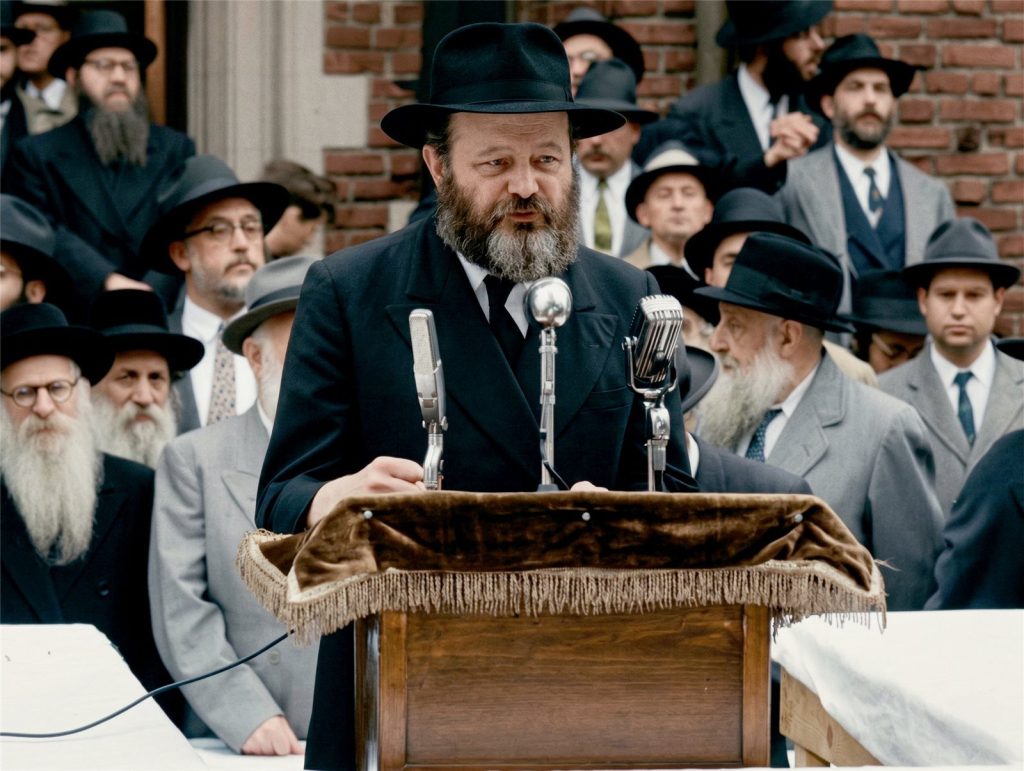
The greatest surprise of the 5716 parade was not the weather, but the Rebbe himself. “We invited the Rebbe to speak, but no one really expected that he would agree to address public school children,” R’ Menachem Yaakov admits candidly. “The Rebbe spoke in Yiddish, and usually delivered sichos of 45 minutes or more. How would American public school children listen to a rabbi speaking in a language they didn’t understand?”
For this reason, the organizers had arranged in advance for Rabbi Shlomo Zalman Hecht of Chicago (brother of Rabbi Yaakov Yehuda – who was a gifted orator – to serve as the “guest speaker.” But to everyone’s surprise, the Rebbe announced that he would indeed come out to speak. In those years, where the large shul was later built, there stood the sukka, and beside it steps that led to a small balcony outside the Rebbe’s room. The Rebbe came out onto that balcony to speak to the children.
Now an awkward situation was created for Rabbi Shlomo Hecht, who had been specially invited from Chicago. The solution was ingenious: the Rebbe would speak and Rabbi Shlomo Hecht would stand beside him and translate what was said into contemporary, engaging English for the children. And so it was.
The success of the translation that year made its mark on the years to come, and created an interesting story of its own. Ahead of the following year’s parade (5717), Rabbi JJ Hecht approached the organizers and announced: “This year, I will translate for the Rebbe!”
R’ Berel Shemtov, who managed affairs with a firm hand, replied: “Thank you, but we don’t need you – we’ve already arranged someone else (his brother Shlomo).” Rabbi J.J. Hecht didn’t flinch: “I’m not asking you, I’m telling you! I am the vice president of Mesibos Shabbos, and I am taking on this role.”
R’ Berel, who had poured his blood and sweat into the organization, was hurt. He hurried to Rabbi Chodakov and complained: “I do all the ‘dirty work,’ and he suddenly shows up claiming he’s ‘vice president’?!” Rabbi Chodakov went in to the Rebbe with the complaint, and when he emerged, he conveyed the Rebbe’s astonishing reply, which put an end to the dispute: “Der Rebbe hot gezugt, az der Rebbe der shver hut im gemacht, un keiner hot im nisht oysgemacht!” – (“The Rebbe said that the Rebbe his father-in-law [the Rebbe Rayatz] appointed him to the position, and no one has canceled that appointment!”)
From that moment on, Rabbi J.J. Hecht became the legendary translator and emcee of the Tzivos Hashem rallies and Lag B’Omer parades until his last day, continuing to ignite Jewish children with his thunderous voice – by the power of that eternal appointment.
Designing the Flag
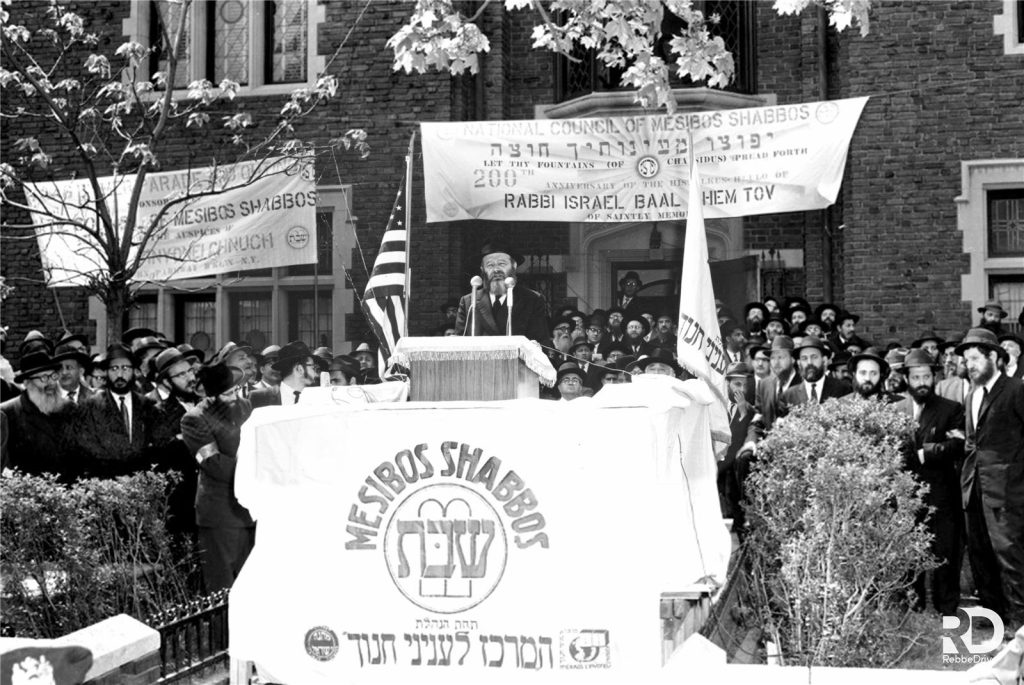
For the Lag B’Omer parade of 5717, the procession headed onto Eastern Parkway. Going publicly onto the street required compliance with the strict laws of the time, which stipulated that any public gathering on a street must open with the raising of the American flag (as well as the playing of the national anthem – a requirement that was circumvented by a military band playing march music). The one who held the American flag at the head of the parade was the Chassid R’ Shmuel Isaac Popack a’h.
The march through the city streets stirred considerable attention. Many parents who watched the parade called the Mesibos Shabbos offices to complain: “Why was only the American flag flying? Why was there no Israeli flag?” The activists, operating under last-minute pressure, used this as an explanation to parents – they simply hadn’t thought of it and had only responded to the legal requirements.
But R’ Berel Shemtov, with his practical instinct, understood that this excuse would not hold the following year. He went to Rabbi Chodakov and proposed: “Perhaps we should prepare our own flag? An official Mesibos Shabbos flag. This way, alongside the American flag, an authentic Chassidic Jewish flag would fly.” Rabbi Chodakov approved the idea and promised to bring the proposal to the Rebbe for his approval, but added: “Prepare some kind of sketch so I can show the Rebbe.”
R’ Berel wasted no time. He tracked down R’ Menachem Yaakov, who was sitting absorbed in his learning in the zal of 770. “Lipszyc,” R’ Berel declared, “I want you to design a flag for Mesibos Shabbos!”
“You’ve turned me into a flag designer?” he exclaimed in wonder, but R’ Berel was insistent: “By tomorrow morning I need a sketch.”
R’ Menachem Yaakov stayed up the entire night. He took a sheet of white paper, divided it diagonally, and placed the Mesibos Shabbos emblem in the center in contrasting colors so it would stand out. He left the upper half white and colored the lower half green. In the morning, when he presented the sketch to R’ Berel, Rabbi Chodakov asked: “Why exactly these colors?”
“My answer was simple,” he recalls. “I told R’ Berel: If I’d used red and white – it would look Communist. If I’d used blue and white – it would look Zionist. Green and white was simply the first neutral color that came to mind!”
R’ Menachem Yaakov decided to toss the ball back to the ‘bigshots’: “I told R’ Berel: Listen, every day of the week is connected to a sefira and every sefira has a color associated with it according to Kabbala. Bring me the exact colors of the seven sefiros, and I’ll design a flag with six segments in the colors of the weekdays, with Shabbos in the center – encompassing everything from within and without!”
The idea was received with great enthusiasm among the lamdanim. Before long, the finest minds in the yeshiva rallied – R’ Yoel Kahn, R’ Zelig Katzman, R’ Sholom Marozov, and R’ Leibel Groner – and opened sefarim to identify the precise color of each sefira.
Once the colors were found, R’ Menachem Yaakov designed a pie-shaped flag, with the color blue of the sefira of Tiferes, representing Shabbos, appearing both in the center and as an encircling band around the outside.
He presented this Kabbalistic masterpiece to Rabbi Chodakov, who took it in to the Rebbe. The Rebbe’s response was not long in coming – and it was direct and clear: “Every flag – one color, or at the very least the color of the country.”
“All my overnight work with the Kabbalistic colors was undone in an instant,” R’ Menachem Yaakov smiles.
The final design work was transferred to the official Chabad artist, R’ Hendel Lieberman. The Rebbe added an instruction that the flag should also feature the emblems of Machne Israel and Merkos L’Inyonei Chinuch. Interestingly, no one at 770 could recall what the Machne Israel emblem looked like. Only after frantic searching was the emblem found printed faintly on the receipt booklet of the secretary, R’ Eliyahu Quint. And so the parade’s official flag came into being.
The Value of a Single Penny
One of the central roles at the Mesibos Shabbos office was managing the budget, which was extremely modest. In those years, the amount approved for expenditure per child was only 10 cents.
In an effort to save on postage, special postcards were printed for the counselors working in different neighborhoods, with a simple low-cost stamp already printed on them, leaving space to report attendance figures over six consecutive weeks.
On one occasion, ahead of the conclusion of Chumash Bereishis, the office wanted to submit to the Rebbe an organized report on all Mesibos Shabbos participants before the Shabbos of Parshas Vayechi. R’ Menachem Yaakov asked R’ Yosef Goldstein, who printed the activity guides, to add a note to the next leaflet: “Please return postcards immediately, even if six weeks have not yet been completed.”
The counselors complied, and the postcards began flowing to 770. One postcard arrived from a counselor working in the nearby East New York neighborhood. For some reason, that counselor had not used the prepared postcard, but instead sent her own postcard – and affixed an airmail stamp to it.
The postcards were brought in to the Rebbe. The Rebbe read through the children’s reports from across New York.
When the stack of postcards came back out, the activists were astonished to see the postcard from East New York: on the front of the postcard, near the sender’s address, the Rebbe had circled the airmail stamp in a ring, drawn an arrow from it toward the counselor’s address in East New York, and beside the arrow had written question marks with a double underline beneath them!
The Rebbe’s eyes had immediately noticed the absurdity: from East New York to Crown Heights there is no need whatsoever for airmail.
“Planes don’t fly between East New York and Eastern Parkway,” explains R’ Menachem Yaakov. The difference in cost between a regular stamp and an airmail stamp was a grand total of one penny. But for the Rebbe, the “sacred funds” of Jewish children’s chinuch demanded precision and care even over a single cent of waste. “Be careful with the money you receive” – that was the sharp and clear message.
To illustrate just how significant that one penny was that had been wasted on airmail, R’ Menachem Yaakov notes the value of money in those days: “With five cents you could buy a juicy apple, or a chocolate bar much larger than those sold today.”
To show how dismissively people treated small coins, and how much could be gained by collecting them, R’ Menachem Yaakov provides the following anecdote from that era:
“In those years, a story was published in the Daily News about a man who worked at a garbage collection and recycling site in Florida. In those days, people would throw penny coins into the trash, because they didn’t want to walk around with copper in their pocket. This man began collecting and recycling those pennies from the garbage. By the end of the process, he had raked in a fortune of a quarter of a million dollars – just from the pennies people had thrown away! For comparison, the average weekly salary of a shochet was about $20.”
“Among us in Chabad, by contrast, we learned from the Rebbe that every donated penny is precious and sacred, and must be accounted for down to the very last one!”
Beis Moshiach #1503 • pp. 18-29
© 2026 Beis Moshiach Magazine. All rights reserved.
This article originally appeared in Beis Moshiach #1503. You are welcome to share it with friends and family by email or in print, provided that you do not change, add to or omit any part of it, you credit the author and Beis Moshiach, and you include a link to archive.bmoshiach.org (written out in full in printed copies).
To republish this article in a newspaper, magazine, book or website, please request permission in advance at [email protected].