The Power Of The Rebbe’s Mashke
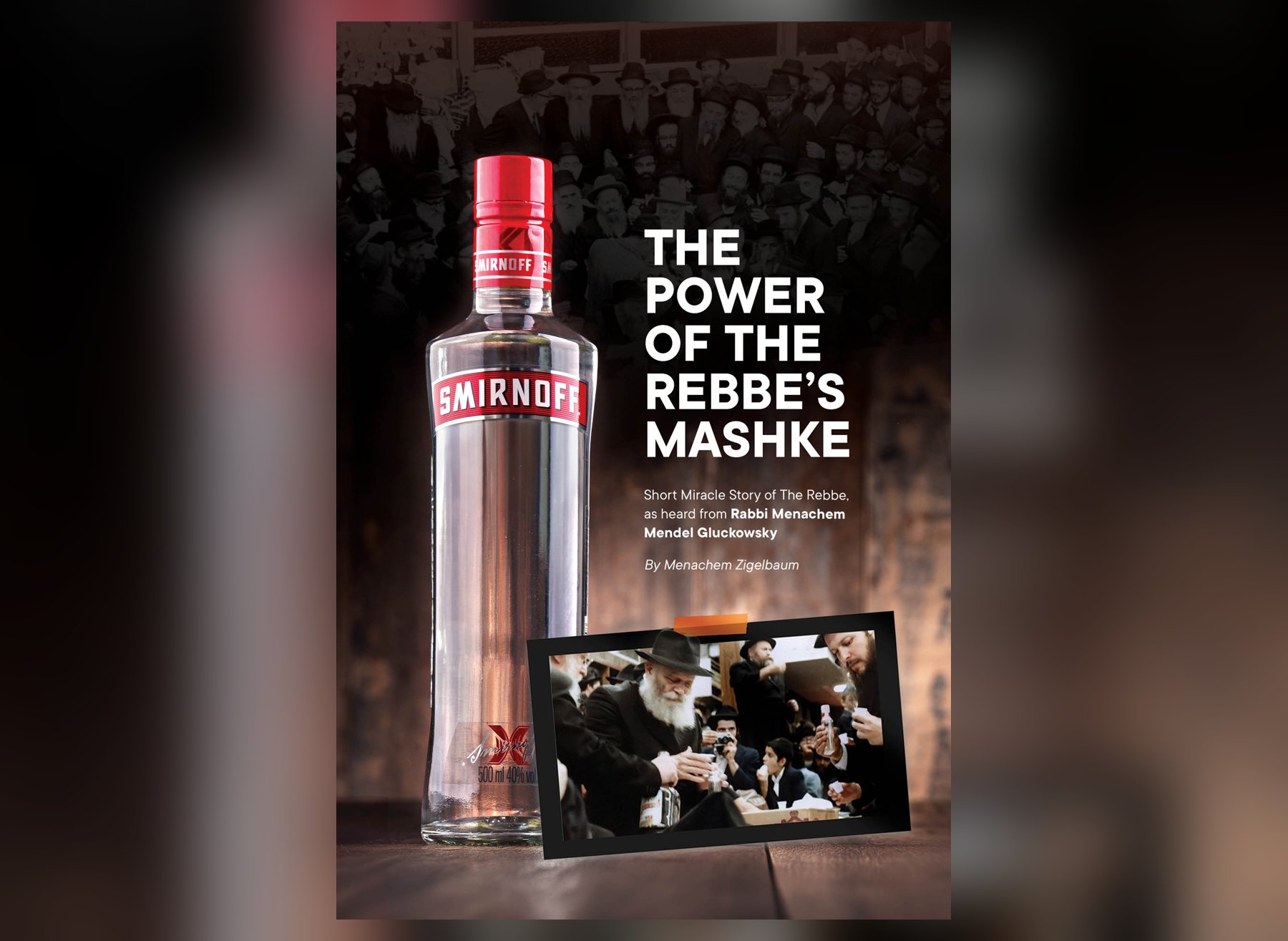
Short Miracle Story of The Rebbe, as heard from Rabbi Menachem Mendel Gluckowsky
Anash of Rechovot recently gathered for a Chassidishe farbrengen. Rabbi Menachem Mendel Gluckowsky, rav of the community, told the following story. As is typical of Chassidim, there is a story before the story…
I
The Chassid, Rabbi Pinchas (Pinye) Altheus was one of the outstanding askanim in the early years of the Rebbe’s nesius. His natural charm opened many doors to him and he was able to get through to a lot of people of influence to the benefit of Chabad institutions.
Since he was from the well-known Altheus family from Nikolayev, the Rebbe’s birthplace, he enjoyed a special closeness and personal regard on the part of the Rebbe. As for him, he sometimes dared to speak up to the Rebbe in a way that other Chassidim would never have done.
At one of his private audiences, the Rebbe sadly asked him, “How come they’re not building in Kfar Chabad? I ask that they build, I encourage and urge them, but the askanim are not doing their work properly. Look at Kiryat Sanz in Netanya where the Sanzer Rebbe asks them to build, and they build! Why isn’t it that way with us?”
R’ Pinye smiled and said in feigned surprise, “The Rebbe doesn’t know why?”
“No!”
Said R’ Pinye, “When the Sanzer Rebbe asks his Chassidim to build, he also sends money to his Chassidim for the building, but when the Rebbe wants construction to be done, he sends a bottle of mashke…”
This sharp answer from R’ Pinye made the Rebbe smile broadly.
II
“I learned,” said R’ Gluckowsky, “that the Rebbe’s mashke is worth a lot more than the money given in other places. Listen to this story.”
It was 5744, one of the first years of shlichus in Rechovot, and the Chabad community faced many difficulties. There were Chabad preschools in Rechovot and the start of a Talmud Torah (elementary school) but financial problems kept on coming up and made it hard to pay the salaries of the morahs and rebbis. Every month there was a deficit of $4000 that accumulated to very large amount of money.
Another problem was with the Chabad House run by the shliach, Rabbi Mordechai Kastel. Although the Chabad House was active, it wasn’t centrally located. Residents of Rechovot occasionally met the few Lubavitchers who lived in Rechovot and asked, “Are you from Kfar Chabad?” The answer was, “No, we’re from here, just like you. There’s a Chabad House here,” and they showed them the off the beaten path Chabad House.
It was clear that people were happy with the presence of Chabad in the city, the problem was that renting a place on Rechov Herzl, Rechovot’s main shopping street, entailed lots of money which they didn’t have. R’ Gluckowsky traveled to Kfar Chabad to discuss the situation with R’ Zushe Wilyamowsky, the “Partisan,” who was known for his unique personality.
“What do you mean?” said R’ Zushe. “You need to write to the Rebbe.”
“I don’t want to write this. I don’t want to aggravate the Rebbe. Why should I tell him things like this?”
But R’ Zushe insisted. “I was told by my teachers, a soldier on the front lines must report to the commander about what’s happening on the front. If you don’t report, that is a form of dereliction of duty. What the Rebbe will do with the information, you’ll leave for him to decide. Perhaps he will send planes, maybe artillery. You can’t know what he will do, but the commander must know what’s really going on.”
R’ Gluckowsky sat down to write to the Rebbe about the two problems, the constant shortfall of the mosdos and the problematic location of the Chabad House and their wanting to move to a central location.
III
Shabbos Mevorchim Nissan 5744, the Rebbe farbrenged as usual. Among the Chassidim present was R’ Zushe who had come to the United States for his son’s wedding. R’ Kastel of Rechovot was also there that Shabbos.
The Rebbe farbrenged for hours. Toward the end of the farbrengen, the Rebbe took two bottles of mashke out from under the table and announced that he wanted to give out mashke for Eretz Yisrael. The Rebbe didn’t say names but it was obvious that those from Eretz Yisrael were asked to come forward to receive a bottle.
The first to go over was R’ Zushe. The Rebbe poured a little from the bottle into a cup.
“L’chaim,” said the loyal Chassid.
“L’chaim v’livracha,” responded the Rebbe.
The second bottle remained on the table with nobody going forward to claim it.
Was there someone else from Eretz Yisrael? But nobody moved forward.
“Is there anybody else here from Eretz Yisrael,” the Rebbe asked R’ Zushe.
R’ Kastel was there but he didn’t have the courage to get up and approach the Rebbe. Awe paralyzed him. He prayed that there would be someone else from Eretz Yisrael aside from him who would go over to the Rebbe, but his silent prayer went unanswered.
“Is there someone from Eretz Yisrael?” asked the Rebbe again.
Strong arms pushed R’ Kastel to get up. Someone had noticed him and realized he must get up. With faltering knees he climbed over the benches till he stood before the Rebbe. R’ Groner waved his hands at him as though to say, “Why are you coming over when you didn’t submit a bottle before Shabbos?” but the Rebbe knew who the guest from Eretz Yisrael was and R’ Groner retreated.
The Rebbe beamed at him and said, “I already gave to the Holy Land. Are you from Rechovot?” The Rebbe then quoted the pasuk from Chumash Bereishis about Rechovot, “‘For now, G-d has expanded for us and we will flourish in the land’ – may it be with harchava (expansiveness).”
“L’chaim.”
“L’chaim v’livracha,” responded the Rebbe.
IV
When R’ Kastel returned to Eretz Yisrael, he met his friend, R’ Gluckowsky and told him what happened.
“It’s remarkable. I didn’t submit a bottle before Shabbos, as is customary, and still, the Rebbe insisted, again and again, is there someone here from Eretz Yisrael? And when I went over, the Rebbe blessed me with expansiveness and quoted a pasuk.”
R’ Gluckowsky smiled broadly and said, “I’ll tell you the secret behind the scenes.”
And R’ Gluckowsky told him that he had written to the Rebbe and asked for a bracha both for the budget and to relocate the Chabad House on the main street. “If the Rebbe gave mashke, it needs to be given out as this contains the bracha.”
The two of them began giving out the mashke to Anash of Rechovot as well as to the children in the schools (after diluting it with water) and the teachers were given too.
It was a few days before Pesach and mashke from the Rebbe isn’t sold to a goy. The two of them went to Rechov Herzl and stood on the corner, poured for each other and drank a l’chaim.
“Maybe now you’ll finally find a central location,” said R’ Gluckowsksy.
In the natural order of things, this was unrealistic. Every available commercial space on the main street was immediately grabbed up at exorbitant prices, but if you have “mashke – bracha” from the Rebbe, then everything is possible.
On Chol HaMoed Pesach, R’ Kastel decided to go out again and look for a place for the Chabad House. He noticed an available place for rent on a narrow alleyway leading from the main street with only space for a large sign on the main street, which is why the rent was so cheap.
“Is it permissible for me to close on this on Chol HaMoed,” he asked R’ Gluckowsky who said, “Definitely. Grab it. It’s a davar ha’avud.”
Decades later, this store is the Uforatzta center.
“Now, let’s see a yeshuah for the Talmud Torah,” said the two shluchim expectantly.
V
Less than a month later, the famous mashpia, R’ Nissan Nemenov passed away on 9 Iyar 5744. He educated thousands of talmidim in Brunoy, France to avoda and hiskashrus to the Rebbe.
His body was flown to Eretz Yisrael where it was first brought to Kfar Chabad so a large crowd would attend his funeral. R’ Gluckowsky was one of his talmidim and he went to Kfar Chabad and stood waiting patiently opposite the Beis Menachem shul for the aron to come from the airport. As he stood there, he met R’ Leibush Polner, a diamond dealer who lived in Kfar Chabad.
“What’s new in Rechovot?” asked R’ Leibush.
R’ Gluckowsky sighed. “The situation isn’t easy. We haven’t paid salaries in a few months. Every month we have a deficit and soon we will have to close the mosdos and the Talmud Torah.”
“How much money are you missing every month?” asked R’ Leibush.
“Four to five thousand dollars.”
R’ Leibush said, “Come to me every month, on the tenth of the month, to the diamond district in Ramat Gan, and I’ll cover the shortfall – either me or my fellow diamond dealers.”
For the next four years, the menahel of the mosdos went every month to R’ Leibush’s office and R’ Leibush gave him the money he needed. This went on until the deficits were covered and the mosdos stabilized on a secure footing.
R’ Gluckowsky concluded his story.
The Rebbe prepared a bottle of mashke to give to someone in Rechovot and a bracha along with it as a result of which all the problems disappeared within a short time, and the yeshuah continues till today.
“When we went on shlichus to Eretz Yisrael, the Rebbe wrote that he would try, bli neder, to help each of the shluchim and indeed, we often saw the Rebbe’s help with communal matters as well as personal matters. From this I learned how the Rebbe’s mashke has the power to bring about yeshuos and to establish mosdos.”
Beis Moshiach #1411 • pp. 24-27
© 2026 Beis Moshiach Magazine. All rights reserved.
This article originally appeared in Beis Moshiach #1411. You are welcome to share it with friends and family by email or in print, provided that you do not change, add to or omit any part of it, you credit the author and Beis Moshiach, and you include a link to archive.bmoshiach.org (written out in full in printed copies).
To republish this article in a newspaper, magazine, book or website, please request permission in advance at [email protected].