A Day In The Life Of A Ukrainian Army Chaplain
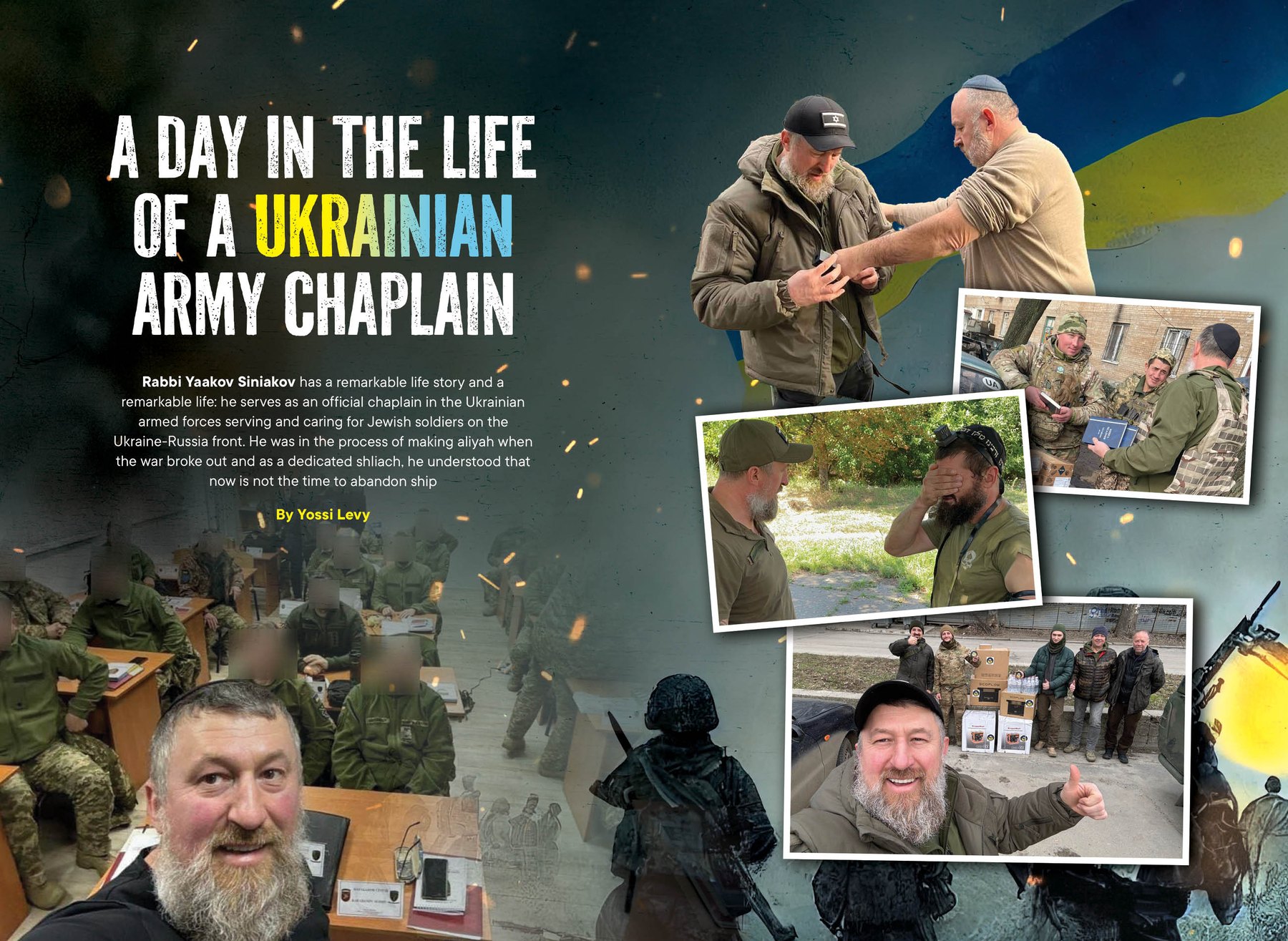
Rabbi Yaakov Siniakov has a remarkable life story and a remarkable life: he serves as an official chaplain in the Ukrainian armed forces serving and caring for Jewish soldiers on the Ukraine-Russia front. He was in the process of making aliyah when the war broke out and as a dedicated shliach, he understood that now is not the time to abandon ship
When I arrived at the Menorah Center in Dnipro, Ukraine, which is the largest Chabad House and Jewish center in the world, and I saw Rabbi Yaakov Siniakov davening b’dveikus, I couldn’t believe that a Chassidic Jew, who joined in naturally with the hundreds of worshipers, had just returned from the front lines two hours before Shabbos.
Rabbi Sinaikov was appointed by Rabbi Meir Stambler, director of the Federation of Jewish Communities in Ukraine (FJCU) to be the shliach for hundreds, maybe thousands, of Jewish soldiers who were drafted or who joined the Ukrainian army and are posted on a tough and long front which stretches 2000 kilometers (1243 miles), facing the Russian army.
Our Rebbeim took great care of the material and spiritual needs of soldiers on the front. The Rebbe Rashab took care of soldiers serving in the Russian army in the Russo-Japanese War and the Rebbe Rayatz took care of Jewish soldiers in the American army during World War II. The Rebbe’s activities are known with Jewish soldiers in the IDF and the American army during the Korean War and Vietnam War.
Back to R’ Sinaikov. After the davening, before we met to talk about his life and work, I asked him for a fresh story from the front lines. He said:
“I was in the area of hostilities in the Charkov district where the most difficult battles are being waged today. Suddenly, the vehicle started acting up. I couldn’t get it to move. A strange thought came to my mind. How do I get a tow-truck for a car that gets stuck on a battlefield? I panicked. It was dangerous and I had to get out of there.
“I suddenly heard a mighty explosion. It was close! At the last minute, I managed to get the car to move and I pressed down hard on the gas pedal. I managed to escape at the last second!”
It’s probably true to say that R’ Sinaikov is doing Chabad activities in the one of the most dangerous places in the world. As the war in Ukraine continues, his job becomes even more significant. Many Jewish soldiers serve in the Ukrainian army, some of them aware of their Jewishness, some less so, and they all need encouragement, emuna and tefilla from a Jewish rabbi. R’ Sinaikov visits battle sites, takes care of soldiers’ Jewish needs and provides them with moral support. R’ Sinaikov’s experiences can fill several books and they include tears, pain, anger, helplessness and sticking to the mission.
Before hearing R’ Sinaikov’s exciting stories, let’s get to know him.
Mysterious Jewish Roots
R’ Sinaikov lives in Dnipro today, the city where the Rebbe grew up and where his father served as Rav of the city. The Rebbe called the city, “the Jewish capital of Ukraine,” and it is blessed with everything connected to Judaism. R’ Sinaikov was not born in Dnipro and was not even born Jewish, at least not officially. He is a psychologist by training and serving as a military chaplain was not in his plans when he began finding his place in the world.
“I was born fifty-two years ago in Voznesensk in the Mykolaiev district (Nikolaiev, where the Rebbe was born) which is on the banks of the southern Bug River. When I was forty, I moved with my family to Dnipro for my work. A little more than eight years ago, I asked a Jewish friend what they do there in the synagogue. The friend said, ‘Instead of my telling you, why don’t you see for yourself? Come with me and see.’ It was the central shul of the city, Shoshanas HaZahav, which is led by the Rebbe’s shliach, Rabbi Shmuel Kaminetsky.
“We went together on Shabbos. I couldn’t even explain what it did for me. I looked at all the Jews praying and felt that this is where I want to be. The climax was when they raised the Sefer Torah and everybody loudly said, ‘This is the Torah which Moshe placed…’ I was very moved and somehow felt that this is something close to me.
“I started to join him at the shul every week. I always knew that my family had Jewish roots but I had no proof. I began searching but didn’t find any document or proof. I decided I wanted to convert. The rabbi that I spoke to tried to dissuade me. ‘You can continue coming every Shabbos. Why convert?’ But I insisted. It was important to me to go all the way. I studied and stuck to my goal, uncompromisingly, until I converted.”
Something in R’ Sinaikov’s face is so Jewish that it’s hard to believe that he wasn’t Jewish all his life. It seems there is something to the fact that he has Jewish roots.
What did your friends think about your mid-life conversion?
“They were very surprised. I suddenly couldn’t eat at their houses. I shut the phone on Friday afternoon until Saturday night. They were in shock. I explained to them and eradicated many mistaken ideas about Jews, many myths.”
How did this affect your wife?
“My wife was with me all the way. I appreciate this so much. The secret to the Jewish people is the women. It’s all thanks to her. My wife went through the process with me. She converted around the time I did. We have two daughters, ages 18 and 26, and they did not convert along with us. They believe in G-d and even sit and say Psalms, but we felt it wasn’t right to pressure them and that the decision has to come from them.
“Interestingly, in my wife’s family, the Jewish roots are more clear although there too, we were unable to find incontrovertible proof that would be acceptable in a Beis Din. That’s what nearly eighty years of communism did to the Jewish people. The name of her maternal grandmother is Schubert and she spoke fluent Yiddish. She named her son, my wife’s uncle, Avrohom. Her history is interesting. She moved from Kazakhstan to Turkmenistan, and from there to Chabrobsk where my mother-in-law was born. They moved to Ukraine many years later.
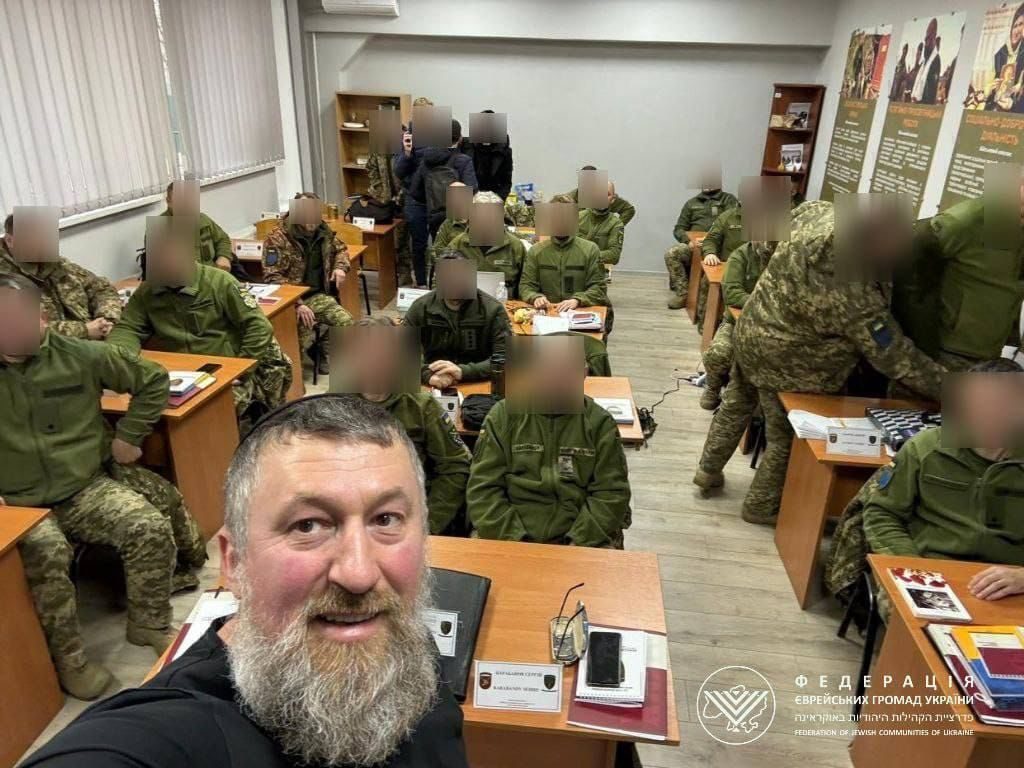
“After we converted, my wife and I married k’das Moshe v’Yisrael. It was an extraordinary, moving event. Slowly along with my Torah learning, I began giving shiurim. When the FJCU suggested that I give shiurim and work with Ukrainian soldiers, I liked the idea. I began this job before anyone dreamed that a war would break out between Russia and Ukraine.”
‘my Commander Is Making My Life Bitter.’
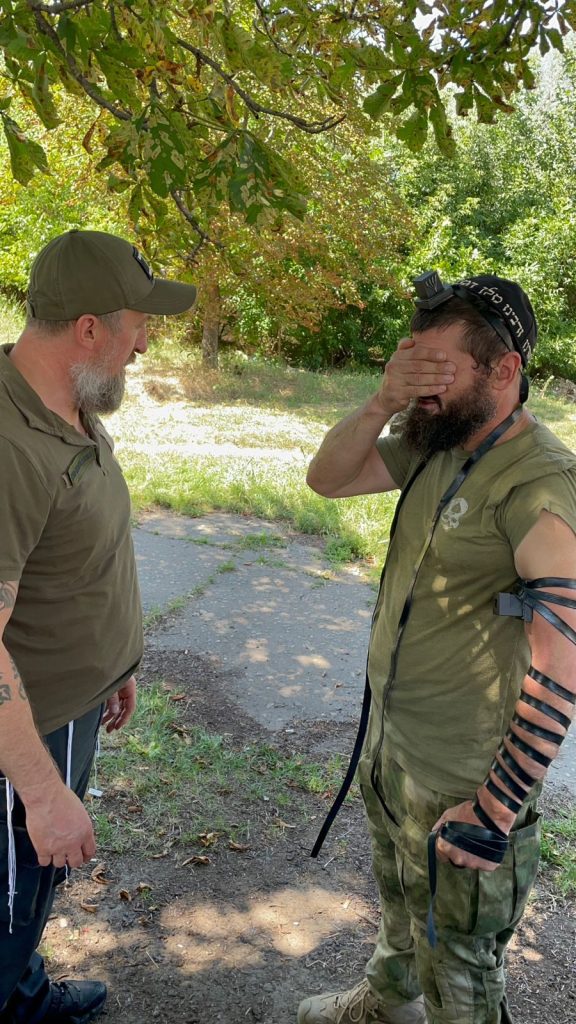
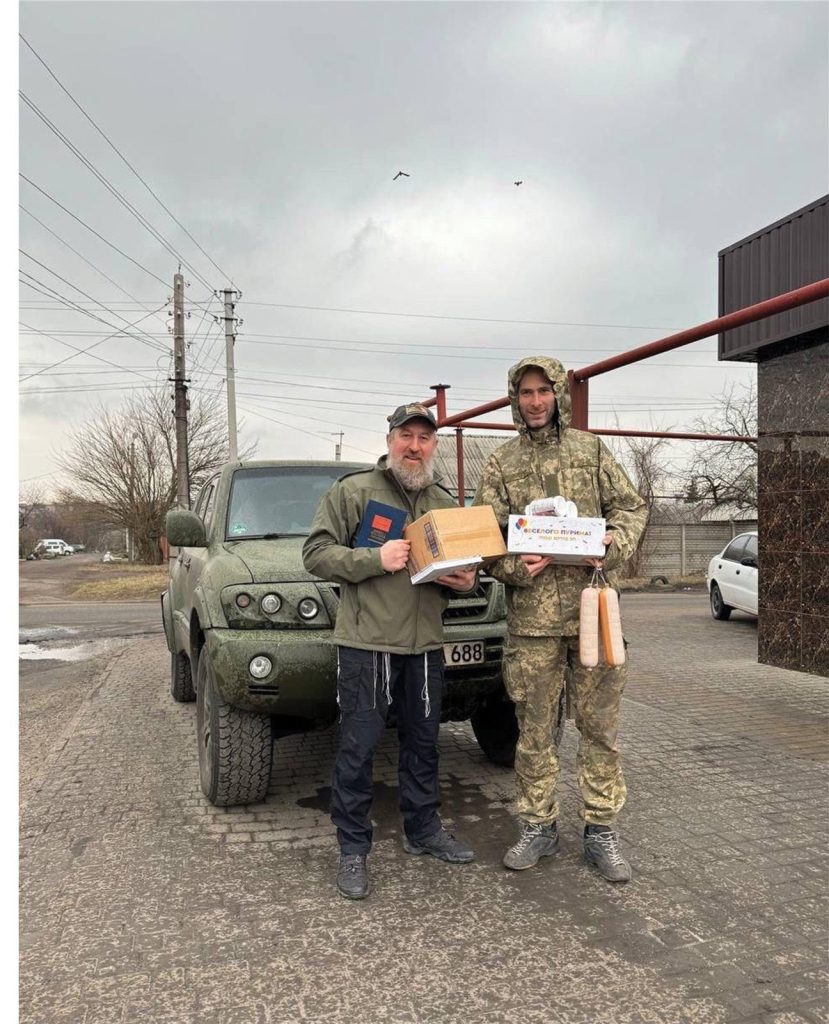
“I would go among the army bases, tell the soldiers about G-d, give them holiday kits before holidays, and of course speak to them and put tefillin on with them. Then the war began which we didn’t think would happen.”
Is your job in the army official?
“Yes. I have official military papers that allow me on the front lines, places where civilians are not allowed to go. I got two medals of bravery from the army. At the same time, my job is voluntary and is not paid for by the Ukrainian government.”
Aren’t you afraid to go to war zones?
“Of course, I’m afraid. I’m a normal person, but before anything else, I fear G-d and know that He watches over me. The story about the Rebbe Rayatz and the revolver which didn’t frighten someone who has one G-d, is my guiding light. I’ve often been to Chasov Yar, a city about six kilometers east from Bakhmut. The bombing there is very close, a kilometer away from us, and it’s scary but I believe in a Creator of the world. We’ve had to run away because the Russian army approached and wanted to bomb us. We escaped in a terrible fright and were saved.
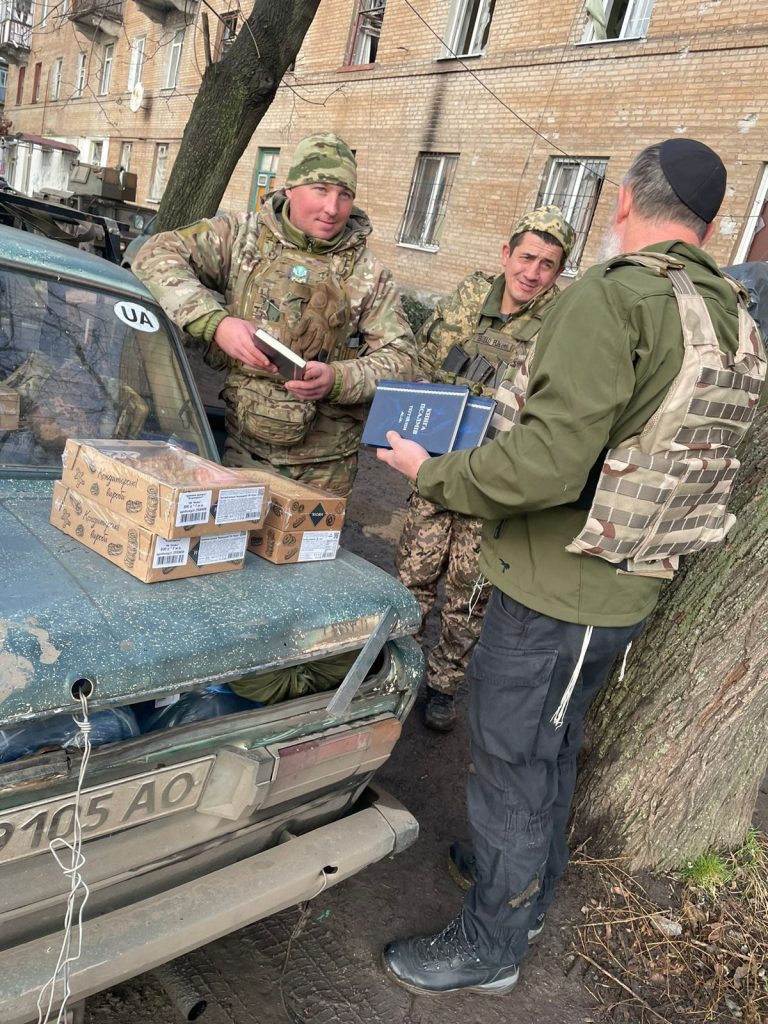
“Many times, I’ve gotten signs from heaven that my work is necessary. I saw how I arrived at just the right time to strengthen a soldier’s faith, being able to speak to him and give him the right words. I invite the soldiers to pray with me, to put on tefillin, and they love it. Many of them know zero about Judaism and I show up and talk to them as peers and they realize that being a Jew is not so frightening.
“Of course, I also give them a picture of the Rebbe and sometimes, booklets about Chassidus that the Federation publishes in Ukrainian. When I give out packages before holidays, for Rosh Hashana and Pesach, they are so happy that someone thought of them. They are usually exhausted and the packages raise their morale.
“I know that this is my responsibility and the spiritual job that I got from G-d. Before the war broke out, I was involved in obtaining a visa to Israel. It entailed endless bureaucracy. I had to bring endless documents. I finally got my visa but then the war began and I realized that for now, my job is to stay here.
“I love life. G-d gave me a treasure and I do everything I can to preserve it. Even when I go to the front lines, I keep away from the line of fire and don’t enter places of danger while carrying out my mission in the best possible way.
“I remember how I once got to Chasov Yar, a place with no civilians, just soldiers. We spoke with soldiers, I read Tehillim with them, and then one got up and said that he knows the synagogue in his city but doesn’t know whether he is a Jew. Another one got up and said he knows about a Jew among the soldiers who didn’t join us since he doesn’t know anything about his Judaism.
“It was close to Purim. I gave out hamantashen and asked that Jewish soldier his name. He said, Perlman. He saw that I’m Jewish but didn’t think it had anything to do with him. We spoke for a while and I was so happy that I had been able to touch his neshama, his Jewish spark. One can never know when the spark will burst into flame.”
What questions come up for you, in your work?
“Many soldiers ask me about emuna and bitachon. Why did G-d create a situation of wars? Many of them have relatives in Russia; why should they be fighting one another? I explain that we have no control over what will happen, but when anything happens to us we need to know that we are in G-d’s hands. This is our test.
“Many of them ask me about Judaism. Even gentile soldiers come and ask about Judaism. They see a Jew with a beard, kippa and tzitzis and despite all the anti-Semitic stereotypes they grew up with, I even look normal! I raise the morale of all the soldiers I meet and consider this an enormous shlichus.
“Interestingly, they feel they can pour out their hearts to a Jewish rabbi. This is where my vast experience in psychology comes in handy, as I listen to them and what’s on their minds. A soldier told me he doesn’t get along with his commander.
“‘My commander is crazy tough and he embitters my life.’
“‘What do you plan on doing about it?’
“‘I’ll show him who’s the strong one here.’
“‘Do you have family waiting for you?’
“I wanted to get him to respond properly and not act in the moment which would make life bitter for him afterward.
“‘I don’t have a wife but I have an only daughter and she is waiting for me at home.’
“‘What do you think she will think if you challenge your commander and you find yourself in military prison for some unknown amount of time?’
“He thought a bit and his approach changed.
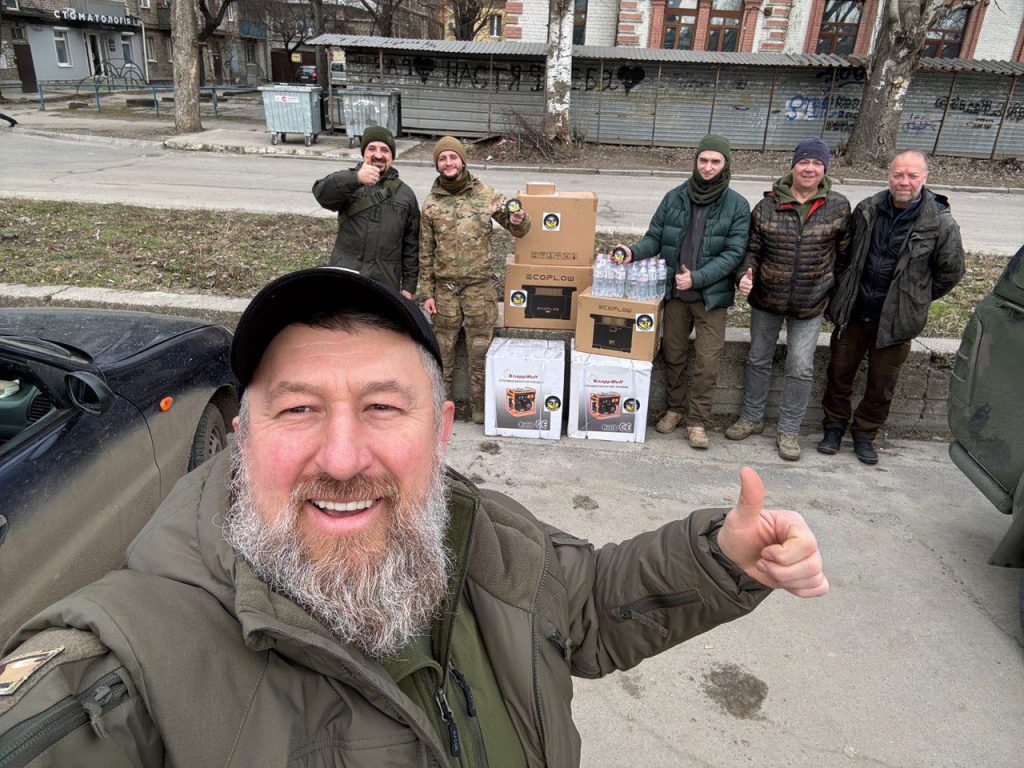
“Another time, a soldier told me about a bigger problem. He was conscripted and his wife, sick of the situation, had fled with the children to Europe and wanted a divorce. I sat with him and listened and counseled him to speak to the military authorities about the situation.
“Their lives aren’t easy. It’s two years already that they’ve barely seen home. Once every few months they get furlough to visit home for a few hours and then, it’s back to the front.”
The Routine of War
Back to Dnipro, where R’ Sinaikov lives.
What is the war like for you there?
“First of all, the bombing. Half a year ago, there was a huge explosion here and a nine-story building fell. This occurred four kilometers from my house. I went there, as a psychologist, and spoke with families, mothers who lost children, and was present during the rescue operations.
“At the moment, the war is felt primarily because in the streets you see many soldiers and armored vehicles of all types. There are also constant explosions. A while ago, I made tea for my wife when suddenly, as I dipped the tea bag in the water, there was a massive explosion. I paused, began breathing again, and then asked my wife, ‘How much sugar did you say you want?’
“Life here is very mixed. The stores, cafes and restaurants are open, but a month ago, a bomb fell on a large shopping center. Miraculously, it happened at seven in the morning and only a few people were hurt. We have gotten used to living routine lives during war. You in Eretz Yisrael can understand this since you live this way too.”
R’ Sinaikov’s civilian life is very busy. He conducts a full day and occasionally goes out to the soldiers.
“I give a shiur for over 150 people. We have three shiurim a week and when I go to the front, I teach from there! Besides that, I have private clients as a psychologist and also teach psychology in a Jewish school here in Dnipro. Just today, I gave a three-hour seminar about dealing with trauma and stress in civilian life and in the army.”
What unusual stories do you have that can happen only on the front lines?
“I was once sitting with soldiers and they prepared rations. They collected boards for a bonfire and roasted meat and cooked rice. The smell was fantastic. In that cold it was so hard to withstand the scent of cooked food. They just couldn’t understand why I couldn’t sit and eat with them and why I insisted on my canned food.
“I told them. ‘Picture the general telling you to eat a certain thing. Would you eat it or not?’ They immediately said they would eat whatever the general told them to eat. ‘I’m just like you. I eat only what the great General, the Creator, says to eat!’ They accepted that.”
Before we parted, R’ Sinaikov wanted to thank the Federation.
“This organization that was started by the Rebbe’s shluchim twenty-five years ago, is the lifeblood of the Jews of Ukraine. It works not only with shluchim everywhere but also with 168 Jewish communities around the country, in small towns, most of which don’t have a permanent shliach, and with tens of thousands of Jews. Promise me you’ll write an article about them,” he asked me. It’s hard to refuse such a request so, G-d willing, we’ll try to work on an article that will survey the work of the Federation on behalf of the Jews of Ukraine.
Beis Moshiach #1417 • pp. 10-17
© 2026 Beis Moshiach Magazine. All rights reserved.
This article originally appeared in Beis Moshiach #1417. You are welcome to share it with friends and family by email or in print, provided that you do not change, add to or omit any part of it, you credit the author and Beis Moshiach, and you include a link to archive.bmoshiach.org (written out in full in printed copies).
To republish this article in a newspaper, magazine, book or website, please request permission in advance at [email protected].